

Monthly Archives: February 2019
Can the State of California Afford to Provide Universal Health Care Coverage?
Can the State of California Afford to Provide Universal Health Care Coverage?
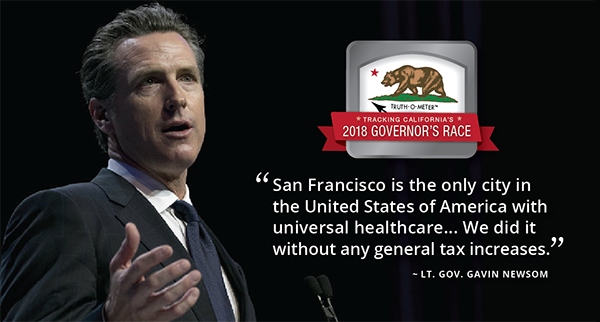
Perhaps no issue looms larger on both the state and national political stage than the question of universal health care coverage.
U.S. Presidential hopeful Kamala Harris (D) sent a shockwave through the national health care debate on Monday Jan. 28th by nonchalantly stating that she would eliminate private insurers as a necessary part of implementing “Medicare-for-all,” according to a CNN report.
Due to a firestorm of attention, most of it negative, the next day the Harris campaign walked back the previous day’s remarks in large part by stating that the candidate would also be open to more moderate health reform plans, which would preserve the private industry, according to the CNN report.
Newly elected California Governor Gavin Newsom (D) campaigned on the issue of single-payer health care and on his very first day in office unveiled a comprehensive package of reform proposals aimed at expanding state health care coverage subsidies and lowering its costs, which includes extending Medi-Cal to undocumented immigrants, according to a report by the LA Times.
In an interview, Gov. Newsom told the LA Times “These are not just symbolic gestures…We’re hoping to ignite a new conversation. It’s a moral imperative, not just economic,” states the LA Time report.
But as many experts, including Gov. Newsom, have pointed out, big systemic reform to the system, such as a move to a single-payer health system, would require the unlikely support of the Trump Administration.
Newsom has done a good job of tempering expectations for single-payer health care and his proposed coverage expansions and prescription cost controls demonstrate to the his supporters and the public that he is serious about expanding coverage as well containing costs.
But the 800-pound guerilla in the universal health care conversation is where will all the money come from to provide guaranteed government financed coverage to every Californian and everyone who likely to come to California once universal health care is guaranteed by the state?
“Where do you get the extra money? This is the whole question…I don’t even get it…how do you do that?,” said former California Governor Jerry Brown (D) following a universal healthcare discussion in Washington, D.C. in a 2017 interview with the LA Times.
At the time, Gov. Brown pointed out that the overall cost of medical care in California is equal to 18% of the state’s gross domestic product, which would be about $450 billion.
“You take a problem and say I’m going to solve it by something that’s an even bigger problem, which makes no sense,” then Governor Brown said at the time, according to the LA Times report.
Gov. Newsom developed some questionable rhetoric during the 2018 campaign, where he said that the State of California cannot afford not to move to a single-payer system because health care has become such a big expense in the state.
It appears that one of the major points of disagreement between former Gov. Brown and now Governor Gavin Newsom is the question of whether the State of California can afford to move to a universal health care system, specifically a single-payer system?
More recently, other high-profile liberal Democrats have come out against single-payer health care with former Mayor of New York City and billionaire Michael Bloomberg stating that Medicare-for-all “would bankrupt us for a very long time,” according to a CNN report.
“I think we could never afford that,” Bloomberg said, addressing pin factory employees in New Hampshire. “We are talking about trillions of dollars.”
“I think you could have Medicare-for-all people who are uncovered, but that’s a smaller group,” Bloomberg said.
“But to replace the entire private system where companies provide health care for their employees would bankrupt us for a very long time,” said Bloomberg according to the CNN report, which noted that Bloomberg made the comments in response to Sen. Kamala Harris calling for an end to the private health care market.
So what does all this mean for the current universal health care debate in California?
It means that California Democrats might want to heed the advice of two of the county’s most prominent liberal Democrats—former Gov. Jerry Brown and Michael Bloomberg—and proceed with great caution regarding the feasibility of California going it alone on universal health care.
There is no question that the state could choose to enact a single-payer or Obamacare-type universal health care system, but the million dollar question, or trillion dollar question rather in this case, is would such a system work and be fiscally sustainable over the long-term?
As a long-time analyst of fiscal issues in California, I believe that former Gov. Jerry Brown and Michael Bloomberg are correct to point out the major challenges and risks of moving to a universal health care system—both at the state level and the federal level.
Medicaid is the ACA’s workhorse

The Affordable Care Act’s insurance exchanges have been the law’s headline feature over the past eight years, but the law’s Medicaid expansion has covered just as many people, and its rolls are more likely to grow under the Trump administration.
Driving the news: Roughly 8.8% of Americans were uninsured last year, according to new Census figures released yesterday — essentially unchanged from 2016. That means the Trump administration has not kept the ACA’s coverage gains going, nor has it successfully rolled them back — at least, not yet.
How health care is like an airline

A rapidly consolidating industry. One that generally delivers on very difficult work, but with such a horrible customer-service reputation that people hate dealing with it. Known for wringing every last dollar out of its customers. You and the person next to you may be paying wildly different prices.
Health care, or an airline?
It’s a common comparison, and not without merit.
- Harvard doctor and researcher Ashish Jha invoked the metaphor last year, in response to a non-profit hospital telling investors that it was trying to boost admissions: “Every extra passenger they can squeeze in is profit,” Jha said.
- Here’s Brent Miller, a nephrologist at Indiana University, explaining to Modern Healthcare why most dialysis patients are treated in facilities instead of at home: “An empty chair is kind of like an empty seat on an airplane. If we were just looking at this not as people and not as health care but just as a business like an airline, our goal would be to fill all those slots.”
- And, for the trifecta, here’s Elizabeth Rosenthal, writing in Kaiser Health News: “Just as airlines have been shown to exaggerate flight times so they can boast about on-time arrivals, hospitals set prices crazy high so they can tout their generous discount.”
The bottom line: In all seriousness, this analogy does get at an underlying problem with health care: As much as providers love to talk about new payment models, volume is still king — it’s simply too lucrative to give up.
Ads for short-term plans may be confusing

People Googling for ACA coverage often found results that were actually trying to sell them skimpier short-term health plans, according to a report from Robert Wood Johnson Foundation and the Urban Institute.
Why it matters: Consumer confusion is one of the things regulators worried about most when the Trump administration expanded access to “short-term” coverage.
- For some people, especially those who do only need coverage for a short time, one of these more bare-bones options might be a better choice than the comprehensive policies sold under the ACA.
- But if you don’t realize you’re signing up for a plan with incredibly limited coverage and the right to drop you once you get sick, you could be in for a catastrophic surprise.
- That’s why HHS mandated a disclosure statement about the plans’ limited benefits.
Details: Researchers Googled terms including “cheap health insurance” and “Obamacare plans” and looked at the first 4 results — which are usually ads.
- Sites that included short-term plans “dominated the results,” though some of those sites also sell ACA-compliant plans. Sites varied in how much information they provided about the differences between the two types of plans.
 HENRY KOTULA