Even the most seasoned patients are no match for the Medical Insurance Industrial Complex

https://www.kevinmd.com/blog/2019/05/even-the-most-seasoned-patients-are-no-match-for-the-medical-insurance-industrial-complex.html

Image result for Medical Insurance Industrial Complex

“Does my insurance cover this?”

I cannot calculate how often a patient poses this inquiry to me assuming wrongly that I have expertise in the insurance and reimbursement aspects of medicine. If I — a gastroenterologist — do not even know how much a colonoscopy costs, it is unlikely that I can speak with authority to a patient’s general insurance coverage issues.

Of course, patients assume that we physicians have an expansive expertise of the medical universe, both in the business and the practice of medicine. Often, friends and acquaintances will informally present a medical issue for my consideration that is wildly beyond my limited specialty knowledge, and yet they expect an informed opinion. “Hey, aren’t you a doctor?” Yes, I am, but if you think a gastroenterologist — a colonoscopy crusader — can advise you on your upcoming hip surgery, psoriasis treatment retinal detachment, or cardiac rehab, think again.

And, I likely know more about psoriasis treatment than I do about the enigma of insurance coverage. I have to check with our billing expert to understand my own medical coverage, and I’m in the business. And, at the risk of appearing as a simpleton to my erudite readers, I cannot aver that I fully grasp the meaning of the EOB (explanation of benefits) forms that I receive for my own care that purport to explain exactly where my insurance company responsibilities end and mine begin.

Imagine for a moment that you are an actual physician as you counsel a patient who is sent to you for a screening colonoscopy. (To assist you in this role play, a screening colonoscopy means there are no symptoms or any other abnormalities that would justify the procedure. A screening study is done on patients who are entirely well as a preventive medicine exercise. In contrast, if a patient has a symptom, such as pain or bleeding, then the colonoscopy is considered diagnostic and not screening.) You advise your 50-year-old patient that his screening colonoscopy will be fully covered by insurance. The patient is happy.

However, during the screening colonoscopy, a polyp is discovered and removed. Indeed, removing polyps is the mission of the procedure. However, polyp removal automatically changes the procedure from screening to diagnostic. And, guess what? Now, the procedure may not be free and the patient may be subject to copays or diving into his deductible. When the patient receives his EOB, and properly decodes it, he is no longer happy. Then, our office is likely to receive a phone call.

This is but one example of the Medical Insurance Industrial Complex. Even our most seasoned patients are no match against this machine. It’s not a fair fight. They make the rules, change them at will and serve as the referees. And, if the insurance company ruling doesn’t fall your way, relax, you can certainly appeal. This process is about as pleasurable as undergoing a rigid sigmoidoscopy. The appeals process is not for the faint of heart. You must have the patience of Job, the fortitude of a Navy SEAL, accept rejection gracefully, welcome irrationality, regard a dropped phone connection as an amusing event and have several consecutive hours available typically at times most inconvenient for you. On reflection, perhaps the sigmoidoscopy is the more pleasant option.


What your hospital knows about you

https://www.axios.com/hospitals-doctors-privacy-records-hacks-data-5cb5d8c1-27de-4cc1-94d8-634015efc04a.html

Illustration of a neon sign in the shape of a health plus with an information "i" in the center.

Every trip to a doctor’s office or hospital adds more information to a deep, comprehensive record of who you are — physically, emotionally and even financially, Axios’ Bob Herman reports.

Why it matters: Health care data breaches are more common than ever, putting our most sensitive personal information at risk of exposure and misuse.

How it works: Although electronic health records have pitfalls, they can help patients and the health care system overall.

Yes, but: “No one truly understands there’s no such thing as deleting information from a health care file,” said Pam Dixon, executive director of the World Privacy Forum. “You cannot push the rewind button.”

The medical details: Health records contain all the obvious stuff, such as height, weight and age; every appointment, vital sign, allergy, test, surgery, procedure and scan; and any prescription drugs you take, or have taken in the past.

  • But everything divulged to doctors also gets recorded. That could include describing your drinking habits, admitting responsibility in a car accident, sharing marital problems or even sending a Christmas card.

The financial details: Insurance and contact information are always on file.

  • Hospitals’ billing departments also have more personal financial information — like debit and credit card numbers — because insurance plans keep requiring patients to pay more out of pocket.

But that’s not all: Uninsured or low-income patients can apply for hospitals’ financial-assistance programs, but they have to prove they qualify.

  • That usually means handing over tax returns, pay stubs, bank statements or other relevant financial information.

The bottom line: All of this information can be exposed in data breaches, but also in medical malpractice lawsuits, workers’ compensation lawsuits or custody disputes.

Go deeper: Learn what other companies know about you


The Retailization of Healthcare

https://www.modernhealthcare.com/care-delivery/report-retail-clinics-have-what-patients-healthcare-execs-want?utm_source=newsletter&utm_medium=email&utm_campaign=newsletter_axiosvitals&stream=top

Health clinics are coming soon to a retail storefront near you, Modern Healthcare reports, citing reports from several consulting firms.

By the numbers: The number of health care tenants in retail spaces has risen 47% over the past 3 years, and could double by 2022.

  • “It’s the Walmart or Kmart that went out of business,” Greg Hagood, senior managing director with SOLIC Capital, told Modern Healthcare. “You pull right up. The parking is easy. The patient is likely to come more often.”

Everybody involved seems to like this idea. And it’s not just pharmacies and walk-in clinics. Complex specialties like oncology are also looking to storefronts.

  • Empty retail space is an attractive option for clinical practices that have gotten frustrated with the high overhead costs on hospital campuses. And a storefront is a good branding opportunity.
  • Landlords like medical tenants, too — they generally have good credit and sign longer leases than traditional retailers would.

The big question: Will this trend help lower health care spending, by shifting care out of expensive hospital settings? Or will it increase them by driving more utilization, the way retail space was designed to do?


Federal Reserve Report on the Economic Well Being of U.S. Holdholds in 2018

Click to access 2018-report-economic-well-being-us-households-201905.pdf

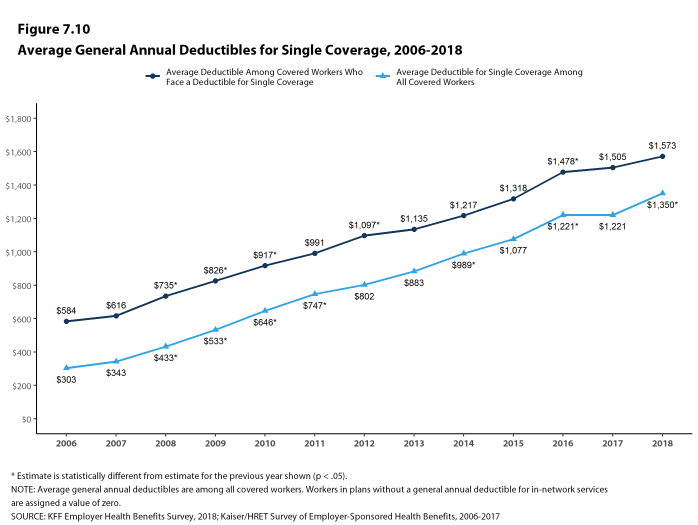
2018 Employer Health Benefits Survey – Section 7: Employee Cost Sharing

Figure 7.10: Average General Annual Deductibles for Single Coverage, 2006-2018

Shot: Almost 40% of Americans would struggle to handle a surprise expense of $400, according to a new Federal Reserve report.

Chaser: The average deductible today among all workers is more than $1,300, according to the Kaiser Family Foundation.


The 16 health systems to which Walmart sends employees for care

https://www.beckershospitalreview.com/strategy/the-16-health-systems-where-walmart-sends-employees-for-care.html?origin=cfoe&utm_source=cfoe

Image result for walmart

Through its Centers of Excellence program, Walmart partners with health systems that have demonstrated appropriate, high-quality care and outcomes for defined episodes of care.

The program bundles payments for the costs of certain procedures, meaning the $514 billion retailer bypasses insurers and works directly with health systems.

To determine where to refer associates for defined episodes of care, Walmart starts by examining health systems — not hospitals or individual physicians. Lisa Woods, senior director of U.S. health care at Walmart, and her team gather massive amounts of publicly available data on health systems. They then distribute requests for information and conduct detailed on-site visits, which involve determining precisely which physicians affiliated with the health system do and don’t participate in the COE.

Below is a listing of the 16 health systems and campuses to which Walmart will refer patients for defined episodes of care as of May 20.

Joint replacement

  1. Emory Healthcare (Atlanta)
  2. Johns Hopkins Medicine (Baltimore)
  3. Kaiser Permanente (Irvine, Calif.)
  4. Mayo Clinic (Jacksonville, Fla.)
  5. Mayo Clinic (Rochester, Minn.)
  6. Mercy (Springfield, Mo.)
  7. Northeast Baptist Hospital (San Antonio)
  8. Ochsner (New Orleans)
  9. Scripps Mercy (San Diego)
  10. University Hospital (Cleveland)
  11. Virginia Mason (Seattle)

Spine

  1. Emory Healthcare (Atlanta)
  2. Geisinger (Danville, Pa.)
  3. Mayo Clinic (Jacksonville, Fla.)
  4. Mayo Clinic (Phoenix)
  5. Mayo Clinic (Rochester, Minn.)
  6. Memorial Hermann (Houston)
  7. Mercy (Springfield, Mo.)
  8. Virginia Mason (Seattle)

Bariatric

  1. Geisinger (Danville, Pa.)
  2. Northeast Baptist Hospital (San Antonio)
  3. Northwest Medical Center (Springdale, Ark.)
  4. Scripps Mercy (San Diego)
  5. University Hospital (Cleveland)

Cancer and transplants

  1. Mayo Clinic (Jacksonville, Fla.)
  2. Mayo Clinic (Phoenix)
  3. Mayo Clinic (Rochester, Minn.)

Cardiac

  1. Cleveland Clinic
  2. Geisinger (Danville, Pa.)
  3. Virginia Mason (Seattle)


The Health 202: Large employers don’t want Medicare-for-all

https://www.washingtonpost.com/news/powerpost/paloma/the-health-202/2019/05/20/the-health-202-large-employers-don-t-want-medicare-for-all/5ce1aa38a7a0a435cff8c0d4/?utm_term=.47900c042418

Medicare-for-all advocates argue enacting their plan would lift a heavy burden off employers to provide their workers with health-care coverage, which is the way 180 million Americans get their insurance.

But large employers are just fine with being the suppliers of insurance and don’t want to give up that role, according to an association that represents them.

Overwhelmingly they would like to continue doing it,” Jim Klein, president of the American Benefits Council, told me. “They think they’re doing a good job.”

The American Benefits Council — which represents the country’s largest employers including Walmart, ExxonMobil and Apple — hasn’t joined the large industry coalition of insurers, pharmaceutical makers and hospitals who are vigorously fighting every iteration of Medicare-for-all proposals coming from Capitol Hill (we’ve written about that partnership here).

But its leaders are plenty skeptical of the prospect of a single-payer system, stressing it would upend the way most people in the United States get their coverage and potentially subject employers to big new taxes so the government could pay for the whole thing.

“I think they’re very concerned about sort of a blank check which the government would be filling in the blank, in terms of cost,” Klein said of his members.

The future of employer-sponsored coverage is one of the stickiest questions raised by the Medicare-for-all debate. The shortcomings — and merits — of the system got a lot of airtime during last month’s Medicare-for-all hearing at the House Rules Committee and probably will be part of the debate at a similar hearing House Budget Chairman John Yarmuth (D-Ky.) has scheduled for Wednesday.

Just look at how some of the Democrats running for president have recently danced around the issue.

Sens. Cory Booker (D-N.J.) and Kamala Harris (D-Calif.) are co-sponsors of the latest Medicare-for-all bill from Sen. Bernie Sanders (I-Vt.), which would upend the country’s health insurance system, replacing virtually all private plans with a generous set of benefits provided by the federal government. But both candidates have tried to take a softer stance on what would happen to workplace coverage.

—“I stand by supporting Medicare-for-all, but I’m also that pragmatist that, when I’m chief executive of the country … I’m going to find the immediate things that we can do,” Booker told CNN’s Jake Tapper this month.

“Because I’m telling you right now, we’re not going to pull health insurance from 150 million Americans who have private insurance who like their insurance — my union friends, brothers and sisters, who have negotiated for their health insurance,” Booker added.

—Sen. Kamala Harris (D-Calif.) told Tapper last week “that’s not what I meant” when he asked her to clarify previous comments in which she said she supports eliminating the private insurance industry.

“I support Medicare-for-all but I really do need to clear up what happened on that stage,” Harris said. “It was in the context of saying let’s get rid of all the bureaucracy.”

— Yarmuth poured cold water on the idea of Medicare-for-all being law anytime soon, despite the hearing he’s holding on the issue this week.

“A lot of people, I think, co-sponsored Pramila’s bill for the same reason they co-sponsored H.R. 676; it was the metaphor for Medicare-for-all,” Yarmuth told my colleague Dave Weigel last week. Yarmuth was referring to the House bill proposed by Rep. Pramila Jayapal (D-Wash.).

“Now, people have seen some of the details and said, ‘Okay, we need to look at this.’ There doesn’t seem to be much of a sense of urgency because it’s not going anywhere,” Yarmuth added.

Rep. Donna Shalala (D-Fla.), former Health and Human Services secretary under President Bill Clinton, is also a Medicare-for-all skeptic:

Perhaps these Democrats recall President Barack Obama’s infamous “if you like it, you can keep it,” pledge, where Obama learned the hard way what happens when people lose insurance they wanted to keep. Obama repeatedly promised people they could retain coverage they liked under his 2010 Affordable Care Act. When around 4 million people got notices their plans were being canceled — because they weren’t ACA-compliant — the administration came under heavy fire. The website PolitiFact dubbed Obama’s promise its “Lie of the Year” in 2013.

Yet employer-sponsored plans are still far from perfect. In fact, many health policy wonks have said many of the problems with health insurance in the United States stem from people getting it through the workplace instead of shopping for it on their own.

Costs are a big problem for both employers and their workers. For years, employers have grappled with rapid health-care cost inflation, resulting in higher monthly premiums and annual deductibles. Last year, health benefits for the average employee at a large company cost more than $13,000, according to a Mercer survey of employer-sponsored plans.

In response, employers have trended toward high-deductible plans or asked their workers to contribute more to their monthly premiums. Some have also invested in workplace wellness programs, in hopes of creating a healthier, lower-cost workforce.

“It puts a huge burden on employers,” House Rules Committee Chairman James McGovern (D-Mass.) said at his committee’s Medicare-for-all hearing.

Then there’s the issue of portability — the problem created when people change jobs and are forced to also change their health plan. This can be especially costly for those with chronic health conditions, who can’t afford any gaps in coverage and may find themselves having to satisfy an annual deductible for the second time in one year.

Yet to those enmeshed in the system, such as large employers, overhauling the whole thing is a daunting prospect. While health-care costs continue to rise, employers are more fearful of having to help fund the expensive single-payer system proposed in the Sanders and Jayapal bills.

Sanders argues his Medicare-for-all plan would be net cheaper for employers. He has proposed charging them either 75 percent of what they’re paying for each of their employees enrolling in Medicare-for-all or a 7.5 percent payroll tax, whichever is higher.

This would result in a net savings for employers, Sanders argues. Large employers don’t appear convinced.

Klein said the council isn’t necessarily opposed to expanding Medicare to more people — and stresses that its members are deeply interested in reining in cost growth.

But he said employers don’t want a health insurance overhaul, arguing they spend more than $4 on health benefits for every dollar the government loses by exempting the benefits from taxes.

“Our employers are not calling for Uncle Sam,” he said.


GOP Needs a Health Care Plan, Not an Immigration Plan

https://www.realclearpolitics.com/articles/2019/05/20/gop_needs_a_health_care_plan_not_an_immigration_plan_140372.html?utm_source=morning-scan&utm_medium=email&utm_campaign=mailchimp-newsletter&utm_source=RC+Health+Morning+Scan&utm_campaign=85626cbe0d-MAILCHIMP_RSS_EMAIL_CAMPAIGN&utm_medium=email&utm_term=0_b4baf6b587-85626cbe0d-84752421

Image result for health policy

On Thursday, President Trump unveiled his proposal for shifting the United States to a merit-based program for admitting future immigrants. The plan, which offers meaningful change and deserves serious consideration, is a non-starter politically, given that it does nothing to address the question of the Dreamers, or the millions of other immigrants already in the country illegally. Democrats, as expected, quickly condemned the president’s plan.

Trump isn’t wrong to highlight immigration. A broad-based restructuring of our immigration system is a laudable goal, and we do have a crisis on our southern border – as some Democrats now begrudgingly admit.

So immigration, legal and illegal, is an important issue, particularly to the president’s political base. The problem is that it’s not the most important issue for a most Americans, including many Republicans. It’s not even close. On the issue that is considered the most important – health care –Trump and the Republican Party have no plan at all.

Last week our polling firm, RealClear Opinion Research, released a new survey showing that health care is far and away the most important issue to Americans. At 36%, it was 10 percentage points above the number two issue – the economy – and more than 21 points ahead immigration, which ranked as the number three issue at 15%. (Education and the environment were tied at 11%, and foreign policy ranked last at just 3%.)

Attitudes about our current health care system were even more striking. Although 72% of registered voters rated their own health care as “excellent” or “good,” just 4% said the system was working for all Americans well enough that it needs no significant changes, while 28% think the current system is broken and needs to be replaced.  The vast majority (68%) is somewhere in the middle, viewing the current system either positively or negatively but agreeing that it is in need of improvements.

RealClear Opinion Research pollster John Della Volpe described the findings this way: “Significant proportions of Democrats, Republicans, and Independents agree that the current system needs substantial reform. The debate will be where to start, and how dramatic the correction.”

Democrats are already having that debate. Every single one of the 23 candidates running for the party’s nomination has embraced some form of reform, from expanding Obamacare or advocating “Medicare for All” to calling for a government-run single-payer system.

Meanwhile Trump and the GOP are standing on the sidelines. Nearly two months ago, Trump’s Justice Department came out in support of a Texas district court ruling striking down all of Obamacare. At the same time, the president took to Twitter (where else?) to declare that “the Republican Party will become ‘The Party of Healthcare!'”

Trump claimed that “the Republicans are developing a really great healthcare plan with far lower premiums (cost) & deductibles than Obamacare,” further promising that a “vote will be taken right after the Election when Republicans hold the Senate & win…”

After Republicans complained Trump had caught them off guard, on April 3 the president tweeted, “I was never planning a vote prior to the 2020 Election on the wonderful HealthCare package that some very talented people are now developing for me & the Republican Party. It will be on full display during the Election as a much better & less expensive alternative to ObamaCare…”

Since then, crickets. The thumping the GOP took in the House in 2018 should have been a wake-up call given the prominent role health care played in sending Republicans down to defeat. According to exit polls, 41% of voters in 2018 said health care was the most important issue facing the country, with immigration and the economy running a distant second and third place at 23% and 22%, respectively. More than two-thirds of voters said the health care system needed “major changes.”

Notice how closely those numbers mirror our new findings from RealClear Opinion Research. Six months after Republicans lost the House, voters’ opinions about the importance of health care and the need for reform haven’t budged. If  the president and his party don’t come up with a viable plan to address voters’ concerns, they may find it’s “déjà vu all over again” in 2020.


Healthcare Industry Consolidation Raises New Workforce Challenges

https://www.amnhealthcare.com/healthcare-industry-consolidation-raises-new-workforce-challenges/?utm_source=email&utm_medium=pardot&utm_campaign=story-3

Image result for hospital consolidation

When health systems consolidate, one of the major challenges they face is integrating, managing, and optimizing their much larger workforce. The newly integrated workforce must deliver on the value promised by the consolidated enterprise, which is why healthcare industry consolidations need the most advanced workforce solutions available.

The mission of every sector in the consolidation — whether it’s in enhancing the patient experience, improving care quality, realizing economies of scale, expediting the shift from volume- to value-based care, implementing new population health strategies, improving revenue cycle management, or launching new technology — is dependent on the effectiveness of its workforce.

Most healthcare organizations already face workforce problems in the form of shortages of nurses, physicians, technicians and technologists, coders, leaders, and others. Consolidation doesn’t relieve shortage problems, because most organizations’ workforces are already stretched very thin. The paramount challenge may be that the new organization must integrate workforces that have entrenched and often widely different quality standards, procedures, training, values, and cultures. Consistency across the newly consolidated organization must be attained through standardization and adoption of best practices.

Consolidation is producing sophisticated regional enterprises of vertical services and facilities stretching across multiple states, including some emerging as Fortune 500 companies. Solutions to workforce challenges need to become more sophisticated to match this growing organizational complexity. A continuum of effective workforce innovations, many of which have been in use in other industries, are now available in the healthcare industry, though they have been largely untapped until recently.

The talent imperative in healthcare can be effectively addressed through these innovations. Comprehensive managed services programs that optimize the contingent workforce are becoming mainstream. Radical new credentialing innovations can be leveraged to improve time-to-revenue and productivity for physicians and other clinicians. Predictive labor analytics can accurately forecast patient volume months in advance and then match scheduling and staffing practices to the forecasts. Workforce solutions also are available to help find the best talent for leadership roles, which are critically important to guide an industry undergoing fundamental change to revenue based on value instead of volume. The vital realm of health information management is another area where workforce solutions can raise performance in quality, efficiency, and revenue generation.

However, when it comes to workforce solutions, many healthcare organizations remain in a reactive mode, with managers scrambling to fill holes in staffing needs on a daily basis. And many still rely on inadequate paper-based and other outdated systems to manage workforce challenges. Such practices do not fulfill the needs of the sophisticated healthcare organizations emerging from the wave of consolidations. Modern healthcare workforce solutions are needed, but many healthcare organizations don’t have the resources, capacity, or bandwidth to develop and operate these solutions on their own. Or, they are unaware that advanced, technology-enabled workforce solutions are available.

The bright spot is that new entities emerging from consolidations can often leverage combined resources to invest in advanced workforce solutions that will ensure that their enterprise-wide workforce is optimized and performing at its highest level.

Expert workforce partners who are entirely focused on solving healthcare workforce problems hold the key. Such partners are found outside the walls of hospitals and healthcare systems, and the best ones can quickly integrate with patient-care organizations to customize solutions. Since the healthcare workforce is the greatest differentiator in the success of a healthcare enterprise, the services of an expert workforce solutions partner are critical during and after consolidation.


Half Million Unfilled Healthcare Jobs

https://www.amnhealthcare.com/latest-healthcare-news/healthcare-hiring-report/?utm_source=email&utm_medium=pardot&utm_campaign=hcwfd

GAP between healthcare job openings and hires

Healthcare Workforce Data

Healthcare Jobs Show Strong Start to 2019, Led by Ambulatory Care

Healthcare employment continued on its path of strong growth in April, increasing by 27,000 jobs, which included 17,000 jobs in ambulatory care, 8,000 jobs in hospitals, and 7,000 jobs in nursing care facilities, according to the US Bureau of Labor Statistics.

Over the past 12 months, healthcare employment has grown by 404,000 jobs, solidifying the healthcare industry as the nation’s largest employer. Healthcare job growth has started off strongly in 2019, led by particularly robust growth in ambulatory care.

The imbalance between supply and demand of healthcare workers has significantly since the end of the recession, according to Bureau of Labor Statistics data. For the last several years, the ratio of job openings to job hires has been approximately 2:1, representing approximately a half-million unfilled healthcare jobs.

Nations largest industry-healthcareemployment continues upward

Healthcare jobs show strong monthly growth in 2019

Robust start for ambultory care jobs growth in 2019