Big Insurance Q1 2026 Earnings Round Up

In Q1 2026, 7 Big Insurers did what their shareholders demanded: hike premiums, slash benefits and dump the sick.

The most recent numbers the nation’s largest for-profit health insurers have shared with investors tell a story the industry is eager to tell Wall Street: the worst is over. After two brutal years of earnings misses, executive firings, and stock price collapses driven by unexpectedly high medical spending, the seven biggest publicly traded health insurers have now completed their first-quarter earnings reports for 2026 and their shareholders are cheering.

Every one of them beat analysts’ expectations in various ways, and most raised their full-year 2026 guidance. But before you read the company-by-company results, it is worth examining the mechanisms behind that recovery because the story the earnings releases tell is not quite the same as the story they leave out.

To get back into Wall Street’s good graces, insurers have:

  • raised premiums
  • cut benefits
  • narrowed their provider networks
  • exited markets that weren’t meeting investors’ profit expectations, and
  • shed members they deemed too costly to cover.

Across the seven companies, total medical membership fell by roughly four million people between the first quarter of 2025 and the first quarter of 2026, and from what executives signaled to investors, many more people likely will be dumped by the end of the year. The patients who already have lost coverage through market exits or who found their benefits reduced this year do not appear as line items in an earnings release. They appear in the year-over-year membership declines and skimpier benefits that analysts note with approval.

WATCH NOW

HEALTH CARE un-covered

Inside Big Insurance’s $1.7 Trillion Year | EP 2

Copy link

Inside Big Insurance’s $1.7 Trillion Year | EP 2

In second episode of the HEALTH CARE un-covered Show, we walk you through the full year 2025 earnings reports of seven of the largest for-profit health insurance corporations in the country.

The key metric driving the recovery is the medical loss ratio — the percentage of premium revenue that insurers actually spend on medical care. When that number falls, profits rise and investors get richer. Across the sector, medical loss ratios came down in the first quarter, or at least came in lower than Wall Street feared. Insurers credited tighter cost management, a milder flu season, and “repricing” — the practice of raising premiums and cutting benefits, particularly in Medicare Advantage plans, to close the gap between what they collect and what they pay out. (Financial analysts’ term for this is benefit buydown, which is unique among American industries.) Higher revenue coupled with devalued benefits produces better medical loss ratios from investors’ perspective.

The stock market has responded — but the picture is more complicated than a simple sector rebound. Most of these stocks are up year to date, measured from deeply depressed December 31 baselines. But look back a full year and a different story emerges: four of the seven companies are still worth less today than they were a year ago. Molina is down 43% over that period. Cigna and Elevance are each down about 6%. The “recovery” is real in the sense that stocks have bounced off their bottoms.

For much of the sector, it is not yet a return to full health, but the companies clearly are making good on their assurances to investors that they will do whatever it takes to improve their profit margins, regardless of the consequences to patients.

Here is what each of the seven reported — and what each report left out.

UnitedHealth Group

UNH Close (May 11): $384.44 YTD: +17.4% 1-year: +4.4% Dec 31: $327.56 | May 12, 2025: $368.36

UnitedHealth Group, the nation’s largest health insurer, reported first-quarter 2026 revenues of $111.7 billion, with adjusted earnings of $7.23 per share and a medical loss ratio of 83.9% — well below the 85.5% analysts had expected. The company raised its full-year adjusted earnings guidance to more than $18.25 per share.

UnitedHealth attributed the year-over-year declinedecline in its medical loss ratio to strong medical cost management and favorable reserve development, while acknowledging “consistently elevated utilization and unit cost trends.” In plain terms: patients are still using more care than the company would prefer, but UnitedHealth is getting better at managing around it.

The stock’s 17% year-to-date gain requires context. UnitedHealth ended 2025 at $327.56 — the result of a punishing year that included the Change Healthcare cyberattack, the killing of its insurance CEO, and mounting federal scrutiny of its Medicare Advantage risk-scoring practices. Then this past January, a disappointing fourth-quarter 2025 earnings report sent shares plunging nearly 20% in a single session, pushing the stock to its recent lows before the partial recovery began to take hold. The May 11 close of $384.44 leaves the stock about 4% above where it was a year ago — a modest gain that reflects recovery from a deep hole rather than a return to anything resembling its former heights.

CVS Health / Aetna

CVS Close (May 11): $92.23 YTD: +18.2% 1-year: +47.5% Dec 31: $78.03 | May 12, 2025: $62.52

CVS Health reported first-quarter net income of more than $2.9 billion as costs slowed for subscribers of its Aetna health plans. The company’s medical loss ratio fell to 84.6%, compared to 87.3% in the same period a year ago.

CVS attributed the decline primarily to better underlying performance in its government business and the absence of a premium deficiency reserve recorded in the prior year — a liability an insurer must set aside when anticipated claims are expected to exceed the premiums it has collected. Its absence is itself a sign of improved financial positioning.

Total revenue grew more than 6% to $100.4 billion. CVS raised its diluted earnings per share guidance and confirmed it is exiting the individual Affordable Care Act marketplace after this year. Total medical enrollment fell by roughly 600,000 members compared to year-end 2024, and more than one million year-over-year. This marked CVS’s fifth consecutive quarterly earnings beat.

CVS tells the clearest turnaround story in the group. Its stock is up 18% year to date and up nearly 48% from where it traded a year ago, when the company was in the depths of its earnings crisis and had just replaced its CEO. The trajectory is unambiguous — and so is the strategy behind it.

“Margins over membership”

That recovery was not an accident. It was a stated strategy. CVS CEO David Joyner has said repeatedly over the past year that the company is prioritizing “margins over membership” in its Medicare Advantage business. That means exactly what it says: CVS would rather have fewer, more profitable enrollees than a larger membership it cannot price to break even. On the commercial side, Joyner made the same calculus equally plain. “We do see elevated trends. We took a disciplined pricing approach to that in 2025, which has pressured membership, but we’re going to stay disciplined in our pricing approach,” he told investors last August.

“Pressured membership” is the corporate euphemism. What it describes is people being priced out of their plans, and what it means is that Aetna is once again purging customers it considers a drag on profit margins. (It has done that frequently over the past 25 years.)

The membership losses CVS reported this quarter — roughly 600,000 members gone, more than a million year-over-year — are the direct result of that strategy. Wall Street loved it.

Cigna

CI Close (May 11): $289.00 YTD: +5.6% 1-year: −6.5% Dec 31: $273.72 | May 12, 2025: $309.20

Cigna beat analysts on both earnings and revenue in the first quarter, posting $1.65 billion in profit. Its medical loss ratio came in at 79.8%, a favorable shift from the 82.2% posted a year earlier.

Cigna’s unusually low medical loss ratio reflects both aggressive cost management and a significant structural change. The MLR decline is partly attributable to the removal of its Medicare Advantage business, following Cigna’s sale of that book of business to Health Care Service Corporation. Medicare Advantage has been the primary driver of elevated medical costs across the industry. Cigna’s complete exit from MA made the numbers look cleaner.

Cigna also announced it will exit the individual ACA exchange market beginning in 2027. The company raised its full-year 2026 adjusted earnings guidance to at least $30.35 per share.

Evernorth, Cigna’s pharmacy benefit management and health services arm, generated $58.4 billion in revenue for the quarter, far more than the company’s health plan division. Like its peers, Cigna is increasingly a pharmacy and services company that also sells health insurance — not the other way around. (CVS now takes in more revenue from its PBM, Caremark, than from Aetna’s health plans and the company’s 9,000 retail stores.) Cigna’s stock has recovered to a 5.6% year-to-date gain but remains down about 6.5% from a year ago. A strong quarter has not answered the underlying question investors are asking: now that Cigna has exited Medicare Advantage and is exiting the ACA market, where does future growth come from?

Elevance

ELV Close (May 11): $381.84 YTD: +9.6% 1-year: −6.4% Dec 31: $348.40 | May 12, 2025: $407.98

Elevance Health (previously known as Anthem) reported $1.8 billion in first-quarter profit, down about 19% from the same period a year earlier, though the results exceeded Wall Street expectations. The company, which operates Blue Cross plans in 14 states, posted a medical loss ratio of 86.8% — slightly higher than a year ago, reflecting elevated costs in its Medicaid business, but better than analysts had feared.

Adjusted earnings per share came in at $12.58, above analysts’ consensus expectations. Elevance also raised its full-year 2026 adjusted earnings guidance.

One significant complication: Elevance’s results included a $935 million accrual tied to Medicare Advantage risk-adjustment data the company had previously submitted to federal regulators, where the ultimate liability remains uncertain. Risk-adjustment data — the system by which Medicare Advantage plans submit diagnosis codes to justify higher payments — has come under increasing regulatory scrutiny as a driver of what federal analysts estimate are tens of billions of dollars in annual overpayments to private insurers.

CEO Gail Boudreaux told investors that the company saw “moderately stronger retention” in its ACA segment and attributed better-than-expected results partly to a shift by remaining enrollees toward bronze-tier coverage — lower-premium, higher-deductible plans that tend to see lower utilization in the early months of the year. The stock is up nearly 10% year to date but remains about 6% below where it traded a year ago, with the risk-adjustment liability an unresolved overhang.

Humana

HUM Close (May 11): $274.24 YTD: +7.6% 1-year: +10.2% Dec 31: $254.84 | May 12, 2025: $248.93

Humana’s first-quarter results were the most complicated of the group — a beat on paper, but with enough asterisks to keep analysts cautious.

The company’s insurance segment MLR came in at 89.4%, edging out its own target of just under 90%, with medical and pharmacy cost trends running somewhat lower than anticipated. Revenue for the quarter reached $39.6 billion, up sharply from $32.1 billion a year earlier, driven largely by a 25% surge in Medicare Advantage enrollment.

But Humana did not raise its full-year guidance, unlike most of its peers. The company said it expects its second-quarter medical loss ratio to come in slightly above 91%, a deterioration from the first quarter — a signal that the cost pressures driving last year’s sector-wide crisis have not fully abated – and the expectation that Humana picked up many of the more costly MA enrollees that its competitors dropped.

Humana confirmed it expects to earn at least $9 per share for the full year and projects a full-year medical loss ratio of 92.75%, far higher than its rivals. Humana executives said the company’s primary objective is returning to a sustainable individual Medicare Advantage margin of at least 3% by 2028. Getting there will require continued benefit cuts, premium increases, and geographic retreats — all of which bear directly on the Medicare beneficiaries enrolled in Humana’s plans. What that means is that Humana likely will purge many of its new MA enrollees in the same way it did in 2025 after it disappointed Wall Street the year before.

Humana’s stock recovered sharply after the Q1 report, closing Monday at $274.24 — up nearly 8% year to date and up about 10% from a year ago. But investors’ enthusiasm should be tempered by one number: Humana’s aggressive Medicare Advantage membership growth this quarter mirrors exactly what CVS did in 2024, just before badly missing its cost targets as expenses came in far higher than expected. If that pattern repeats, the recovery will be short-lived.

Centene

CNC Close (May 11): $56.35 YTD: +36.9% 1-year: −10.4% Dec 31: $41.15 | May 12, 2025: $62.87

Centene kicked off the year with better-than-expected revenue and adjusted earnings, signaling a recovery from a rough 2025. Its stock rose more than 13% the day after its earnings call — and at nearly 37% year to date, it is the strongest year-to-date performer in the sector so far in 2026.

The company posted total revenues of $49.9 billion, with its consolidated medical loss ratio falling slightly to 87.3%. Adjusted diluted earnings per share came in at $3.37, and Centene raised its full-year adjusted EPS guidance to above $3.40.

Centene is primarily a Medicaid and ACA marketplace insurer, and its recovery story is rooted in those markets. The company’s Medicaid medical loss ratio fell half a percentage point — driven by rate increases from states and continued cost management.

The ACA marketplace, however, remains a source of volatility. Centene’s ACA enrollment fell sharply as the expiration of enhanced premium tax credits pushed many lower-income consumers out of the market — a policy shift that, for Centene, paradoxically helped near-term financial results by reducing exposure to a segment that had been generating losses.

As with the rest of the sector, context matters. Centene ended 2025 at $41.15, deeply depressed from its year-ago price of $62.87. The stock has bounced hard off that bottom but remains down more than 10% from where it stood a year ago. The recovery is real but the hole it is recovering from is also real.

Molina

MOH Close (May 11): $185.17 YTD: +6.7% 1-year: −43.5% Dec 31: $173.54 | May 12, 2025: $327.69

Molina is the outlier in the sector’s recovery narrative — the one company whose headline numbers looked genuinely bad, even as management insisted the underlying story was better than it appeared.

Molina reported a 95% year-over-year drop in net income for the first quarter, falling to just $14 million from $298 million in the same period last year. The collapse was driven primarily by a one-time charge: a $93 million impairment of intangible assets tied to the company’s planned 2027 exit from the Medicare Advantage–Part D market.

Total revenue was $10.8 billion, with premium revenue down about 4% year over year. The consolidated medical loss ratio rose to 91.1%, up from 89.2% in the first quarter of 2025.

The company’s executives reaffirmed full-year guidance for about $42 billion in premium revenue and at least $5 in adjusted earnings per share, and CEO Joe Zubretsky called the quarter “solid under the circumstances.” Molina has described 2026 as a “trough year” for its Medicaid margins, with the expectation that new contracts and the exit from unprofitable Medicare lines will improve results in 2027.

The stock market has rendered a harsher verdict. Molina’s shares are down 43% from where they traded a year ago — by far the worst one-year performance in the sector. The 7% year-to-date gain is recovery from a floor, not a foundation. Investors who held the stock through 2025 have lost nearly half their money.

The Second Quarter Will Be the Real Test

From Wall Street’s perspective, the industry has stabilized. Whether the companies’ management teams have learned anything different is a question the second quarter will begin to answer.

Analysts have flagged Q2 as especially critical — particularly for Humana, whose aggressive Medicare Advantage membership growth while holding benefits stable mirrors a pattern CVS followed in 2024, before badly missing its medical loss ratio targets. If that pattern repeats, the stock gains of recent months will not hold.

More broadly, the mechanisms driving this quarter’s “recovery” — premium hikes, benefit cuts, member shedding, and structural exits from unprofitable markets — are not cost reductions. They are cost shifts. The medical spending did not go away. It was simply transferred: onto patients through higher out-of-pocket costs, onto states through Medicaid pressure, and onto the federal government through the ongoing overpayment dynamics in Medicare Advantage that regulators have not yet fully addressed.

Wall Street calls this a recovery but it is worth being precise about what has actually been recovered and what has simply been moved off the balance sheet and onto someone else’s.
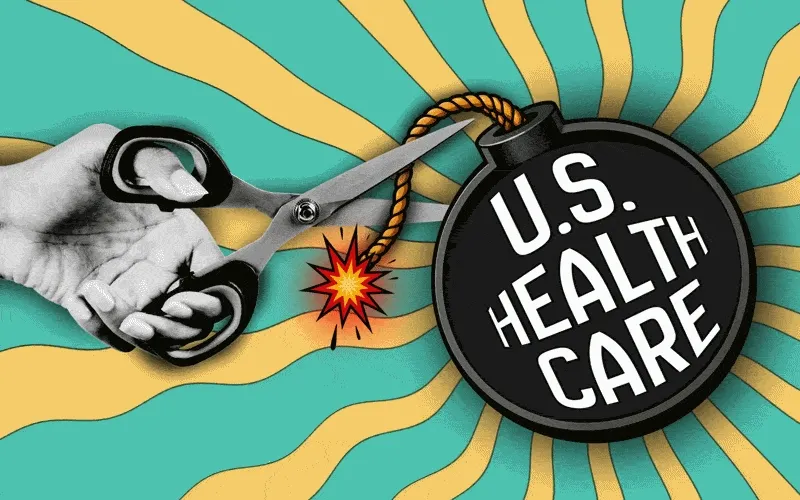

Five Ways to Start Fixing America’s Health Care System

Identifying what’s broken in American health care is easy. The harder part is disarming the ticking time bomb before soaring costs, consolidation and coverage gaps explode into something worse.

I saw an interview with a bomb disposal technician. He made the comment; “Identifying a bomb is easy, disarming it is the hard part.” It made me think about the debate around our current health care problems. It’s easy to point to all the things that are wrong or to throw stones at big insurance companies or Big Pharma.

Even though the finger pointing may be warranted, the harder part is coming up with a solution to this ticking time bomb. If we don’t figure out how to disarm this bomb it’s going to take us all with it when it goes off. I am as guilty as anyone of focusing on the problems we have, so, here is my attempt at some real solutions. I don’t pretend that these five things will solve all our problems, but I think they are a good start. So here we go.

  1. Pass the Break Up Big Medicine Act. We need to pass this bill right away. Much of our problems with cost and insurance intervention in health care comes from the fact that they have been allowed to create mammoth vertically integrated companies that not only finance health care but also control much of how health care is delivered. These massive health care companies have done nothing to control costs. Their focus is on maximizing profits. Case in point. A recent study showed that UnitedHealth Group pays its own doctors an average of 17% more than independent doctors in the same specialty and market. This is just one example of how this vertical integration is increasing costs to increase profit for UnitedHealth. I could write a whole book on why this much vertical integration creates problems but the long and short of it is, insurance industry vertical integration is like having a for-profit fire department that is also an arsonist. If you are going to be an insurance company then you need to focus on that business and not be allowed to own doctors, PBMs, etc.
  2. Pass a law that makes the actions performed by insurance company medical directors fall under the legal definition of “practicing medicine”. This would mean that when an insurance company medical director decides that a patient can’t have a study or a specific drug or when they deny a claim as not medically necessary, they are practicing medicine. They would then have all the responsibilities and accountabilities that the treating physician has. They would have to have a valid license in that state. They would have to be practicing in their specialty. They would have to document their decision making in an electronic medical record that belongs to the patient, and they could be sued for malpractice. You know all the same things that the actual treating physician must do. No more hiding behind the shield of “I’m not saying you can’t have it, just that we won’t pay for it.” If this were done it would eliminate most of the delays and care denials that plague our current system.
  3. Deal with the highly concentrated health insurance marketplace with existing monopoly rules and enforcement. In almost every other industry the Federal Trade Commission protects consumers and makes sure that competition is present by looking at highly concentrated industries. They use a long-standing mathematical measure called the Herfindahl-Hirschman Index (HHI). Under this index any industry with a score higher than 2,500 is considered highly concentrated and as such ripe for review and possible action by the FTC. When it comes to health insurance if you look at the HHI by state you come up with some alarming results. In 2024 there were only 3 states and the District of Columbia that had HHI scores below 2,500. Further, there were eight states with a score of over 7,000. In any other industry those situations would have been reviewed by the FTC long ago. These monopolies should be broken up to increase competition and protect consumers and doctors from this kind of unbalanced market power.
  4. We need to pass legislation that will create a process for universal clinical coverage policies. The care you receive should not be decided by the company name on your insurance card but rather on your clinical situation and evidence-based coverage guidelines. These guidelines should be approved by a group of clinical experts who are not financially incentivized to deny care. Right now, insurers that have a vested interest in denying expensive treatments decide when something is covered or not covered. We need to change that. Coverage policies should be universal. Doctors shouldn’t be asked to play the game of trying to figure out which drug or which treatment option is covered by each insurance company and rather should be recommending care based on what is best for the patient with the best evidence based medical research available at the time.
  5. Finally, we need to address one of the biggest travesties in our current health care environment. The fact that the richest country in the world does not have universal coverage for all its citizens should be problem number one. We should be embarrassed that a country of riches has failed and continues to fail such a large portion of our citizens when it comes to health coverage. We should require all insurance companies to sell insurance to anyone who wants to buy it either as an individual or an employer regardless of size. We need to make those premiums community rated with rates that are approved at the state level. We also need to finance or subsidize coverage for small businesses and people who don’t qualify for Medicare or Medicaid. This can be done by giving small businesses tax incentives to provide coverage under their business and to provide subsidies to individuals who are not able to get coverage from their employer and whose income is such that they can’t afford to purchase that coverage themselves. Paying for this universal coverage could be accomplished in several ways including, among other options, a small national sales tax or a small increase in the corporate or high-income tax rate. Again, we live in a country with an annual GDP of over $32 trillion dollars. Paying for universal health coverage for our citizens is not a heavy lift.

These five actions won’t solve all our problems. We still need to put more focus on wellness and prevention. We still have issues with mental health and substance use in this country. We need to work on providing better care and access for rural America.

Yes, there will still be plenty of work to be done even if we enacted each of these suggestions. These five things aren’t a full solution, but they are a very good start. Let’s start disarming this time bomb before it goes off.

Finding vs Being the Right Person

Rumi

“Everyone is trying to find the right person but no one is trying to be the right person.”

Relationships flourish when self-improvement precedes seeking perfection in others. Be the change you desire in connections.

Society’s Moral Compass

A society loses its moral compass the moment profit outweighs the value of human life.

Chomsky’s words call out the mindset that treats human survival as expendable when money is involved. He argues that ordinary language fails to describe the depth of this moral failure. His point is simple: when greed becomes more important than humanity, something fundamental has already broken.

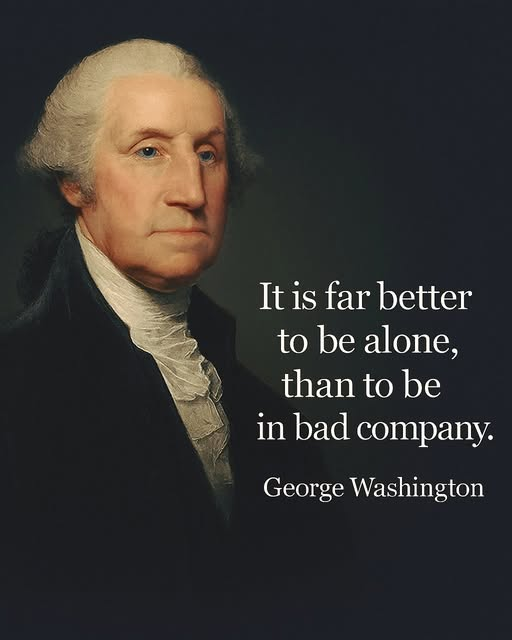
Quote of the Day: On Bad Company

Solitude becomes a strength when the alternative threatens your character.

When George Washington warns that it is better to be alone than in bad company, he’s reminding us that the people around us shape our values, choices, and future. Choosing solitude over harmful influences protects your integrity and keeps your path clear, steady, and self‑directed.

Why KFF Is Launching a Podcast on the Business of Health

To kick off the new show, KFF’s Business of Health with Chip Kahn, Charles Kahn III hosts Drew Altman who explains how KFF is continually evolving to research, analyze, and lead on health policy. They discuss how the new podcast will break down the business side of health care, artificial intelligence, and what it all means for health care delivery and patients.

Cigna Reports Q1 Gains, Announces ACA Marketplace Exit

Cigna’s earnings tell a story Wall Street loves but its retreat from the ACA Marketplace could accelerate a system already tipping toward collapse.

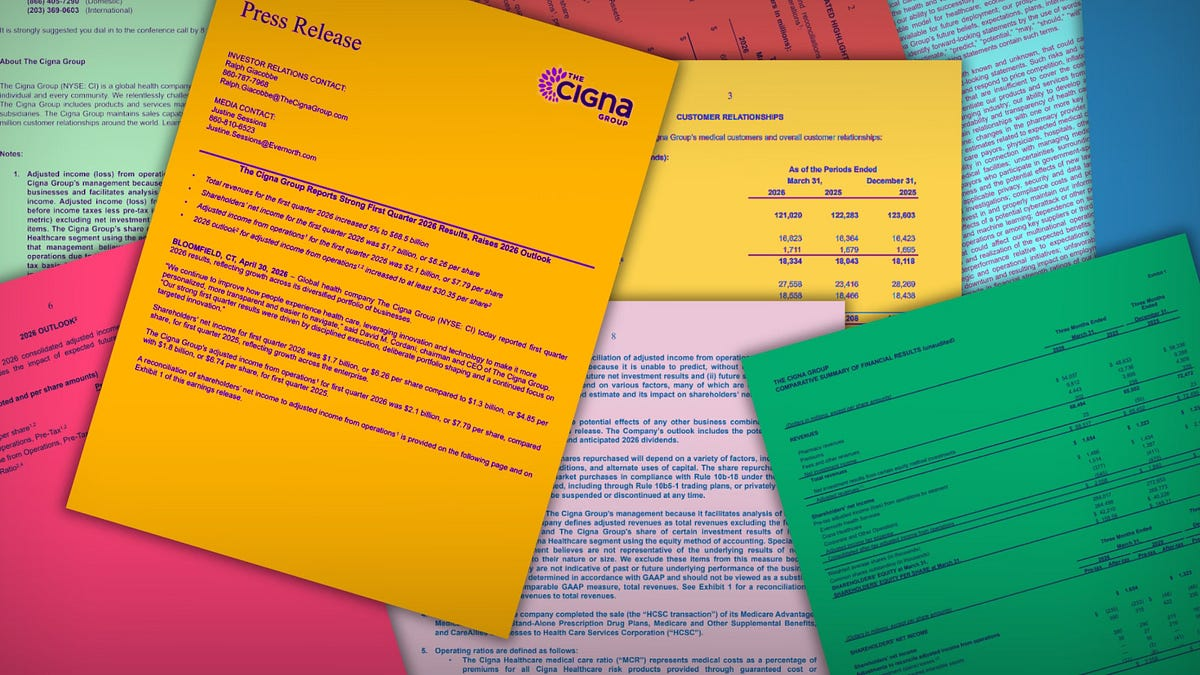
Cigna reported its first-quarter 2026 results last Thursday. Like most of the other big health insurance conglomerates that have reported so far, it did a better job of meeting Wall Street’s profit expectations in the first three months of the year than it did in all of 2025.

Total revenues rose 5% to $68.5 billion. Adjusted income from operations came in at $2.1 billion, or $7.79 per share — up 12% from a year ago, though missing analyst estimates by five cents. The company raised its full-year outlook for adjusted income from operations to at least $30.35 per share. David Cordani, in what he called a “somewhat bittersweet” moment as his final quarterly earnings call as CEO, described the results as reflecting “disciplined execution, deliberate portfolio shaping and a continued focus on targeted innovation.”

That jargon didn’t impress investors. Cigna’s stock price fell $3.19 on Thursday but was up 2.76% for the week, closing Friday at $282.90.

None of that is surprising. Cigna is a well-run company by the metrics Wall Street uses to measure well-run companies. What’s worth examining is what the numbers actually reveal about how the first quarter results were achieved and – equally if not more important – what Cigna announced alongside it.

Another big exit

The biggest news from Thursday’s release and call with analysts wasn’t about earnings. Cigna will stop offering plans on the Affordable Care Act marketplaces after the 2026 plan year. The exit will affect 369,000 members across 11 states, with coverage ending January 1, 2027.

Brian Evanko, who will succeed Cordani as CEO on July 1, framed the decision as a strategic choice to exit a market where Cigna is unlikely to achieve scale. “This is small business for us today, and it’s been shrinking in recent years,” he said.

He’s right about the numbers. What he didn’t say is why it’s shrinking — and what Cigna’s exit will do to the people left behind.

Cigna is by no means the first big insurer to announce an exit from the ACA Marketplace. Aetna pulled out at the end of 2025, forcing approximately 1 million members across 17 states to find new coverage for 2026. But even that headline understates the breadth of the retreat. At the end of 2025, when Congress chose not to renew some of the tax credits that had made ACA coverage affordable for millions of Americans, a wave of smaller insurers also left: Molina Healthcare announced significant changes to its service area; HAP CareSource exited Michigan; Chorus Community Health Plan withdrew; Mountain Health CO-OP left Wyoming; Primewell Health Services exited Arkansas and Mississippi; UM Health Plan and Michigan Care ended; and Celtic/WellCare left North Carolina. Blue Cross Blue Shield terminated PPO products in Arizona. And last month, Baylor Scott & White Health Plan announced it will no longer offer marketplace plans after the end of this year, affecting approximately 100,000 enrollees in Texas.

That means that before open enrollment for 2027 coverage even begins this fall, at least half a million people — Cigna’s 369,000 plus Baylor Scott & White’s 100,000, on top of the million who lost Aetna coverage last year — will either have to scramble to find comparable coverage (at a significantly higher price) or go uninsured.

And we may not yet know the full scope. Every spring and summer, health insurers file proposed premium rates with state regulators — filings that reveal what insurers are planning for the coming year. Those rate filings typically land in May and June. The Q2 earnings season follows in July and August. Each of those moments is an opportunity for another insurer to announce what Cigna announced Thursday. The exits we know about may be the beginning, not the end.

This is not a series of isolated corporate decisions. It is the beginning of a potential death spiral, and it is already in motion.

The mechanism is straightforward. ACA sign-ups for 2026 are already down by over 1 million people compared to the same period last year — the first decline since 2020. The main reason was the December 31, 2025 expiration of the enhanced premium tax credits that were enacted during the Biden administration. For subsidized enrollees who stayed in the same plan, average net premiums rose 114%. When premiums spike, the people who leave first are the healthy ones — younger, lower-utilization enrollees who do the math, decide the cost isn’t worth it and gamble that they’ll have another year of good health. The people who stay are the ones who have no choice: the chronically ill, the older, the people who know they will need care. The marketplace is already smaller and sicker, according to consultants and insurance executives, with more consumers choosing cheaper bronze plans that carry higher out-of-pocket costs.

A smaller, sicker pool means higher claims. Higher claims mean higher premiums. Higher premiums drive out even more healthy enrollees, which makes the pool sicker and more expensive still. And that is exactly what Evanko described when he noted that Cigna’s ACA enrollment had already dropped from 446,000 to 369,000 — a 17% decline in a single year.

The insurers aren’t abandoning a failed program. They are ensuring it fails — and then leaving before it does.

I wasn’t surprised to hear that Cigna is leaving the ACA Marketplace because it has never been a big player in the individual health insurance business. Around 90% of Cigna’s health plan enrollment is in its role as a third-party administrator (TPA) for large employers. The company also has sold all of its Medicare Advantage business.

What did surprise me was the company’s other big reveal: It has put its EviCore unit, which provides prior authorization and utilization management services to health plans (not just Cigna’s), up for sale. Evanko told analysts that the industry’s prior authorization standardization push (which I wrote about last Wednesday) could “open new doors for the EviCore business, which could potentially result in a partnership or a combination with complementary industry participants.”

EviCore is the prior authorization machinery — the infrastructure through which doctors’ requests for patient care get approved, delayed, or denied. Cigna is exploring selling it, or spinning it off, at precisely the moment that prior authorization is under the most intense public and regulatory scrutiny it has ever faced.

Think about what that means. Just days after the industry announced a voluntary reform campaign to standardize the prior authorization process, Cigna said it might sell the business unit that does the prior authorizing. That tells me that the company’s executives don’t think EviCore will be able to continue contributing to Cigna’s profits.

What the numbers say — and don’t

One of the most important numbers in any health insurer’s earnings report isn’t revenue. It’s the medical loss ratio — the percentage of premium dollars actually spent on patient care. The lower the MLR, the more the company keeps.

Cigna’s MLR for Q1 2026 was 79.8%, down from 82.2% a year ago. That 240-basis-point decline is the engine behind the strong earnings performance. For every dollar Cigna collected in premiums this quarter, it paid out roughly two cents less in medical claims than it did a year ago.

The company attributes the decline primarily to the 2025 sale of its Medicare Advantage business to Health Care Services Corporation — older, costlier populations leaving the risk pool.

What no analyst asked: Is the MLR decline connected to Cigna’s prior authorization practices? The company’s own Transparency Report, published in March, claims a 15% reduction in prior authorization volume. Did tighter scrutiny on the remaining high-cost requests contribute to lower medical costs and therefore a better MLR? We don’t know because Wall Street analysts chose not to ask.

Another thing analysts didn’t explore was litigation against its PBM, Express Scripts. Evernorth — the division that encompasses Express Scripts and that now accounts for 85% of Cigna’s revenue — generated $58.4 billion in adjusted revenues, driven by specialty drug volume and biosimilar adoption. What the earnings release doesn’t mention is that Express Scripts is currently the subject of federal RICO litigation alleging the company created a Swiss entity called Ascent Health Services to divert drug rebates away from plan sponsors and patients.

On Thursday’s call, analysts asked about Evernorth’s growth trajectory, capital deployment, the EviCore strategic review, and the CEO transition. No one asked what happens to the 369,000 people who will lose their Cigna coverage on January 1. No one asked whether the cascade of ACA exits constitutes a market failure requiring a policy response. No one asked what the prior authorization denial rate was for the quarter, or how many denials were later overturned on appeal.

Those questions have answers, but Wall Street analysts don’t ask because they assume most investors have little interest in such matters. And they are right.

Health Care Costs is the Issue Voters Can’t Afford to Ignore

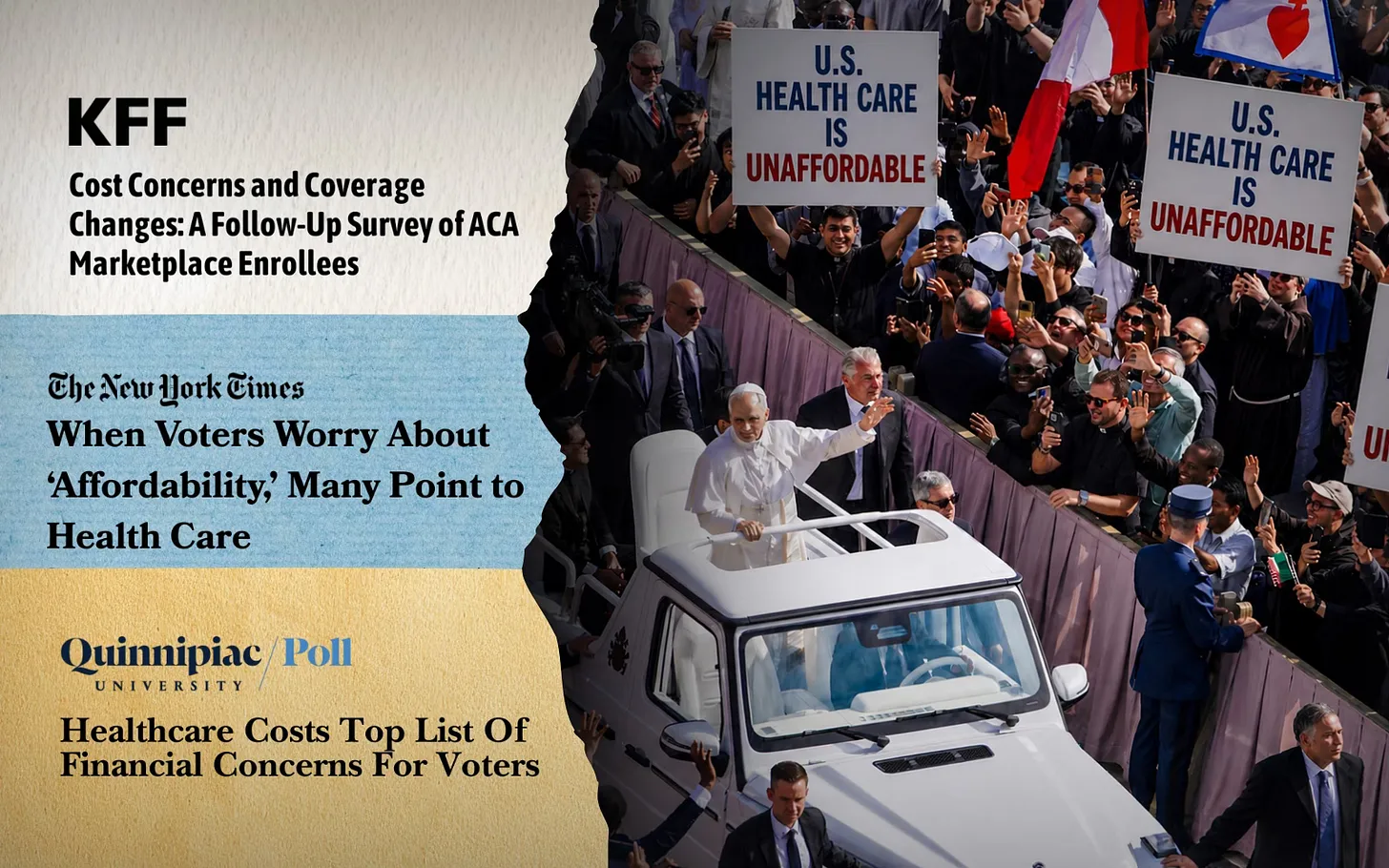
New data shows middle-class Americans cutting essentials, dropping coverage, and delaying care — just as Pope Leo XIV calls health care a “moral imperative.”

Pope Leo XIV (who became pope a year ago this week) isn’t just the first American pontiff—he’s also, as a Chicago native and Villanova University alum, the first leader of the Roman Catholic Church to have experienced the U.S. health care system firsthand. So it shouldn’t come as a surprise that this world spiritual leader born as Robert Prevost would use his lofty new platform to call for radical change.

“Health cannot be a luxury for the few,” Leo told a recent conference on health care inequality in Europe organized by both Catholic bishops and the World Health Organization, adding that good health care is essential for social peace.

“Universal health coverage is not merely a technical goal to be achieved; it is primarily a moral imperative for societies that wish to call themselves just,” the pope said. “health care must be accessible to the most vulnerable, then, not only because their dignity requires it but also to prevent injustice from becoming a cause of conflict.”

In less than a year on the job, the new pontiff has shown a lot of political savvy, and a knack for good timing. Leo’s endorsement of health care as a human right coincided with a couple of new, important U.S. surveys showing that both rising insurance premiums and high out-of-pocket medical bills have become the major driver of an affordability crisis that is hitting middle-class families hard.

To back this up, the leading health care non-profit KFF conducted a followup survey with more than 800 Americans who last year had been enrolled in Affordable Care Act (ACA) insurance in 2025. It found broadly that most have been struggling to pay medical bills since Congress failed late last to extend the federal subsidies that had made ACA coverage affordable for many in recent years.

WATCH NOW

HEALTH CARE un-covered

WATCH NOW: Prior Authorization: Care, Delayed | EP 3

In the third episode of the HEALTH CARE un-covered Show, we take a deep dive into prior authorization’s toll — from doctors to federal policy — featuring Dr. Wendy Dean, Dr. Seth Glickman and Rep. Suzan DelBene (D-WA) on CMS’s new AI-driven WISeR model.


Watch the full episode here.

Most of the respondents (80%) said they were paying more now for health care than in 2025, with just over half (51%) reporting they are now spending “a lot more.” For middle-class Americans, the critical need to stay healthy has meant cutting their budget for other essentials. KFF found that a majority (55%) were reducing spending on food or other household basics, but that jumped to 62% for people getting treatment for chronic disease.

Faced with drastically higher monthly premiums, KFF found, has forced these families to make difficult, consequential choices. Some 28% switched into a different ACA plan in an effort to hold down their monthly premiums – which means much higher deductibles and thus the risk of large out-of-pocket medical expenses. Even worse, some 9% told the KFF survey that they have dropped health insurance altogether, which means they are one accident or major illness away from a financial disaster.

A 34-year-old Texan who dropped his Obamacare coverage told the KFF pollsters that the sole reason was the cost. “The prices are simply too high,” he said. “$800 a month for the absolute cheapest plan for two people. Our income is $120k, so we don’t qualify for subsidies in Texas. I don’t think we could afford our mortgage if I had to pay for health insurance.”

Another respondent reported that his “Income exceeded the subsidy limit, forcing us to pay the full cost, so we switched down to a bronze from a gold plan. Even doing that our premiums are 3 times what they were in 2025, with lower plan features and a higher deductible.”

About 22% of the KFF respondents said they are still insured, but not through the ACA Marketplace. In some cases that is because they were able to switch to an employers’ health plan or because they were now eligible for Medicare and Medicaid. But others, KFF noted, switched into different types of high-deductible plans or a cost-sharing group – solutions that often lead to considerable out-of-pocket expenses.

One 56-year-old Texas man surveyed by KFF said that as a reaction to the higher insurance premiums he would “attempt to use health care as little as possible” – with the hope that by carefully consulting with his doctors and pharmacists he would avoid paying any out-of-pocket expenses that aren’t absolutely necessary.