2026: A Tough Road Ahead in Health Care

As we ring in the new year there is one thing – maybe the biggest thing – lingering from 2025 that can’t be dropped: The alarming state of health care.

Every aspect of the health care system feels like it’s working against its customers by prioritizing profits over care.

There are significant signs we could be at a breaking point.

  • More Americans than ever are opting to go without health insurance. Gallup poll found 1 in 3 are considering running that risk, saying they can’t afford the costs.
  • For the first time in history, concern for rising health care costs is stride for stride with housing and food costs as American wages are struggling to keep pace. For many income levels they feel left permanently behind.
  • And not only are people paying record-high premiums, what they have to pay for prescription drugs at the pharmacy counter is breaking the bank as insurance companies have gobbled up pharmacy benefit managers to capture more and more of what we spend on health care.
  • The number of pharmacies serving the country’s sick has dwindled to the lowest levels in more than 50 years. Rite-Aid, which once operated more than 5,000 stores across the country, closed all of its locations and declared bankruptcy last year. Thousands of independent pharmacies have also closed, largely because of the stranglehold PBMs now have on the prescription drug supply chain. The closures have created hundreds of pharmacy deserts, leaving patients with a dwindling number of low-cost and convenient options.
  • Medicaid cuts mandated by Congress and the Trump administration last year are expected to cause more rural hospitals to close. More than 100 closed in the last decade and hundreds more are on the brink, according to a Boston University study. Health care is in such a bad spot it’s near the top of the 2026 Congressional agenda. Democrats want to restore the enhanced subsidies that made coverage affordable for the more than 20 million Americans who rely on the Affordable Care Act marketplace for their health insurance but most Congressional Republicans say the subsidies are a waste of money. Despite all that, there’s pessimism that politicians have the appetite for real change.

“We are frogs in a boiling pot,” said Eric Pachman, co-founder of the prescription drug watchdog 46 Brooklyn and data analyst on Wall Street. “Every year health care plans cost more but the coverage we pay for gets crappier.”

Pachman was recently at home when he got a call from a close relative whose son was in the middle of an allergic reaction. The family didn’t have health insurance because the premiums were beyond their means.

“He gave his son an Epi Pen and then drove to the hospital close by,” Pachman said. “He sat there for a while with his son in the parking lot to make sure he didn’t get worse but he didn’t go in.”

Americans are making those alarming decisions while health insurance companies continue to make big profits.

The country’s three largest health insurance companies and their in-house pharmacy benefit managers have rocketed toward the top of the Fortune 500 list of richest companies.

UnitedHealth has become America’s third-richest company behind Walmart and Amazon. In 2024, the company, which has about 30 million Americans enrolled in its health plans, brought in more than $400 billion in revenue, according to its financial filings.

CVS Health is just behind UnitedHealth at No. 5 on the country’s Fortune 500 list, bringing in nearly $373 billion in 2024. Cigna is 13th with $247 billion in revenue.

Health care alarms similar to sirens of 2008 housing collapse

The warning signs of this health care crisis bear a haunting resemblance to the 2008 housing market crash.

  • Cost vs. Income: In 2006, the average employer-sponsored family health care plan cost $11,381, representing 23% of the average salary. In 2026, the average plan is expected to exceed $27,000 against an average salary of $84,000 — a staggering 32% of income.
  • Shifting Risk: Just as risky mortgages were offloaded onto consumers, employers have shoved a larger portion of health care costs onto their workers.
  • Debt: Half of American adults now report they could not pay a $500 medical bill without going into debt.
  • Opacity: Much like the complex derivatives in mortgages in 2008, PBMs and insurers refuse to make their pricing public. This lack of transparency leaves patients fearing to open their mail after a hospital visit.

The sad joke in Washington D.C. right now is that everyone keeps talking about the price of health care but no one knows what the actual prices are.

In that Gallup poll, those surveyed gave the U.S. health care system a grade of D+.

“Our government continues to apply band-aids to a bloated pricing system rather than prescribing real, system-wide solutions,” said Antonio Ciaccia, co-founder of the pharmacy drug data site 46Brooklyn.com and former head of government affairs for the Ohio Pharmacist Association.

Lawmakers in more than a dozen states have tried to rein in insurers and their PBMs with lawsuits and regulations. Those lawsuits have led to more than $400 million in payouts by the big three health insurers and their subsidiaries.

Despite that the system keeps on going.

After years of battling insurers and their PBMs, Ohio’s Republican Attorney General, Dave Yost, came to the conclusion that any major reforms would have to come at the federal level.

He formed a coalition with 39 other states and has made repeated trips to Washington D.C. urging Congress to act.

“PBMs were originally intended to reduce the financial burden on Americans for prescription drugs, but the reality today is starkly different,” Yost said. “Instead of prioritizing the interests of patients, PBMs have shifted their focus to maximizing profits and marginalizing local pharmacies from the marketplace.”

Pachman also said if more people do opt out of insurance they will still go to hospitals for medical care.

“Hospitals cannot turn those patients away because they are legally required to treat them,” Pachman. “That means the cost burden will be shifted to those that do pay for insurance.”

While any type of significant reforms seem unlikely, many states are at least starting to ban medical debt from credit reports.

Fifteen states have the ban in place and Ohio, Alaska, North Carolina and Michigan are exploring similar statutes this year.

Chris Deacon, an attorney, author, health care reform advocate and former director for the New Jersey treasury department said the only incentive right now is for insurers to keep growing the $5.3 trillion spent on health care in the United States in 2024.

“There’s no incentive to control prices,” Deacon said. “And there’s no transparency whatsoever in any of this.”
Drug prices to keep rising 

The drug price hikes that are helping drive the health affordability crisis will continue for the rest of President Trump’s term, key industry stakeholders are now predicting  despite his deals with drugmakers and Medicare negotiating lower prices.

The big picture: 

Insurers, drug supply middlemen and hospitals who represent 13% of all pharmaceutical purchases predict single-digit price increases for branded drugs over the next three years, according to a new survey by TD Cowen.

  • The increase will be largely driven by pricey new medications, such as drugs for cancer, diabetes and obesity, as well as cell and gene therapies, the purchasers said.
  • Drugmakers are already set to raise prices this year on at least 350 medications, including common vaccines and cancer treatments.

State of play: 

Democrat and Republican policymakers have prioritized lowering drug prices in recent years in response to mounting public concern over health costs.

  • Congress during the Biden administration passed the Inflation Reduction Act, allowing Medicare to negotiate lower prices for select drugs.
  • Trump has made direct deals with drugmakers for decreased U.S. prices on certain products.

Yes, but: 

TD Cowen’s latest annual drug purchaser survey shows these policy interventions aren’t driving prices down, at least in the near term.

  • Insurers, pharmacy benefit managers and other payers said they expect their cost of acquiring a drug to increase by 8%, on average, over the next three years. They gave the same figure when surveyed in 2024, 2023 and 2022.
  • Prices for generic drugs are predicted to increase by 2% over the same period.
  • “As long as biopharma delivers innovation, we see no change in the upward trend in drug prices,” TD Cowen wrote in its analysis.

By the numbers: 

44% of purchasers surveyed expect Medicare drug negotiations to have a modest impact on cost, and another 30% said they don’t think they will have any impact.

  • But 74% said they think drug usage will increase over the next five years due to the policy changes and the IRA’s out-of-pocket cost protections for seniors.

Reality check: 

Patients aren’t necessarily going to see an out-of-pocket increase as drug acquisition prices rise, due to rebates and other discounts.

  • But payers often pass increased costs along to patients, including by raising monthly premiums.
  • Net drug prices increased one-tenth of a percent in 2024 after accounting for rebates and discounts, per an IQVIA report published in April.

What they’re saying: 

Patients “bear an unfair burden as out-of-pocket costs have risen faster than the net prices paid by PBMs and insurers,” PhRMA spokesperson Chanse Jones said. “At the same time, innovation … continues to skyrocket.”

  • Advocacy group Patients for Affordable Drugs said in response to the survey results that the IRA’s reforms are working for seniors.
  • “[T]hat’s exactly why expanding and protecting the law matters,” Alyson Bancroft, director of policy, legislation and alliances, told Axios in an email.
  • Health and Human Services communications director Andrew Nixon told Axios the agency doesn’t weigh in on third-party analyses, but said HHS continues to advance policies to lower drug costs so patients can afford treatments.

What we’re watching: 

Purchasers expect coverage of obesity drugs to grow over the next three years.

  • Almost 30% of respondents said they currently have very limited coverage of GLP-1s for obesity, but nearly 20% said they expect to offer complete coverage for a finite amount of time within three years.
  • Medications for diabetes, obesity and rheumatological conditions were cited as likely to have the greatest decrease in price over the next three years. That’s due to coming patent expirations and increased competition among advanced products, TD Cowen noted.

U.S. Job Openings

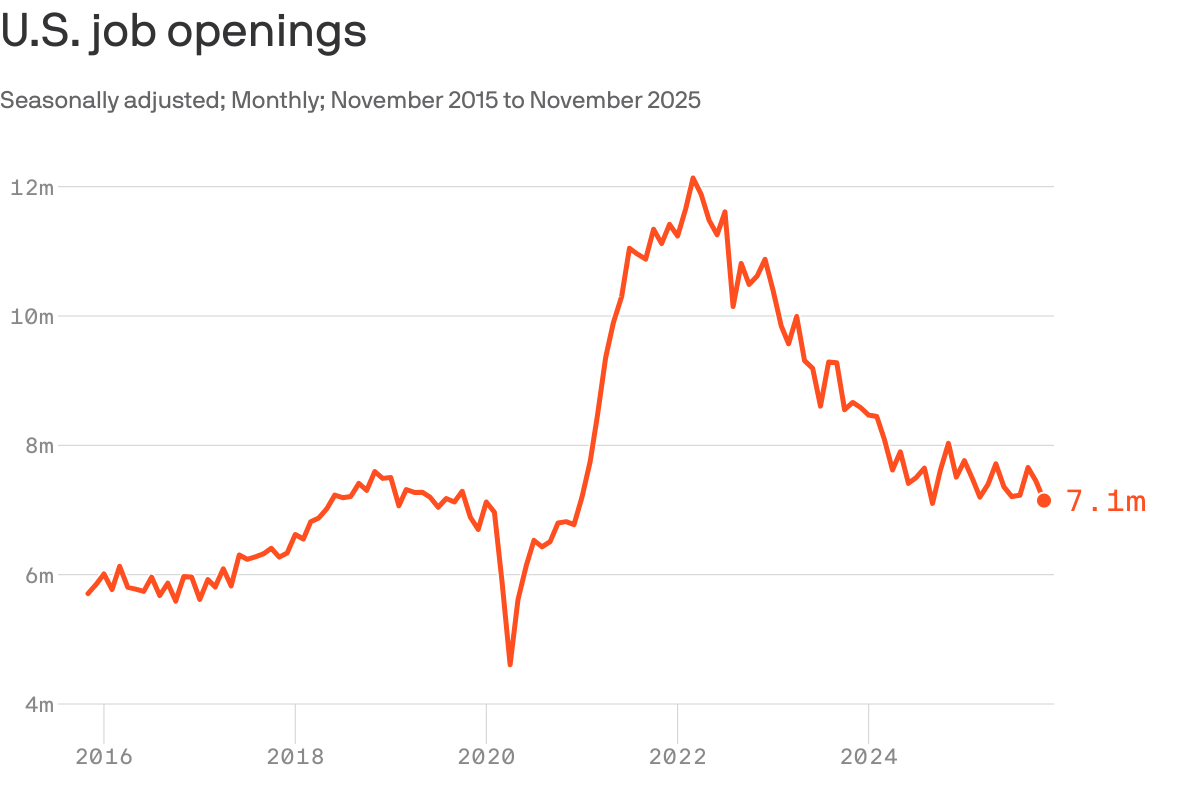
Notwithstanding the solid December private-sector data, the November Job Openings and Labor Turnover (JOLTS) numbers pointed to a low-hire, low-fire equilibrium persisting through the fall.

Zoom in: 

The number of posted job openings fell by 303,000 in November, the Labor Department said, bringing its rate down two ticks, to 4.3%, matching an August recent low.

  • Hiring also fell, by 253,000 positions, similarly driving the hiring rate down to 3.2%, matching the August low for this expansion.
  • The news was considerably better on layoffs and discharges, with the number falling by 163,000 and the rate by a tenth.
  • “Employers are reluctant to make moves, as uncertainty around tariffs and inflation still linger,” ZipRecruiter labor economist Nicole Bachaud wrote in a note, adding that “workers are staying put, with few opportunities emerging for job switching” and many choosing stability.

Between the lines: 

For all the talk of corporate head count reductions, companies — at least through November — were more in a mode of freezing hiring and reducing job openings than outright firing people.

  • It amounts to a labor market that is holding up OK for those who have a job, but is brutal for those looking for a job.

The bottom line: 

The open question for 2026 is whether the green shoots evident in December private employment data presage a stabilization or an improvement in employers’ willingness to hire more workers — and not just exercise caution in firing.

The year the U.S. economy bent but didn’t break

https://www.axios.com/2025/12/30/economy-trump-jobs-inflation

The U.S. economy was beaten and battered in 2025, and powered ahead despite it all.

The big picture: 

The question for 2026 is whether the underlying sources of weakness that are already evident will broaden out into something that threatens to undermine its overall resilience.

Threat level: 

Beneath buoyant growth in GDP and asset prices are serious worries.

  • The labor market is looking softer by the month.
  • Elevated inflation is pinching family budgets.
  • And fears are rising that the AI-fueled boom could leave ordinary workers worse off.

The big picture: 

Those pain points have already caused public opinion on the economy to turn sharply negative.

  • At the same time, one lesson of 2025 is that the U.S. economy is awfully adaptable and can withstand more challenges than you might expect.

Zoom in: 

In April, President Trump’s “Liberation Day” tariffs sent the stock market swooning and economists upgrading their recession odds.

  • It wasn’t the only sign of trouble. Job growth came to a near-halt over the summer. Deportations and restrictionist immigration are part of the story, along with the aging of the native-born workforce. But part of it is that companies are trying to get leaner.
  • Inflation, meanwhile, has become the fire that will not be fully doused. While the sky-high inflation of 2022 is a thing of the past, inflation has been above the Federal Reserve’s target 2% target every single month since March 2021.
  • Affordability is top of mind in public opinion.

Reality check: 

It’s important to remember, though, that the $30 trillion U.S. economy, for all its flaws, can weather a lot, at least at the macro level. It is, as RSM chief economist Joe Brusuelas puts it, a “dynamic and resilient beast.”

By the numbers: 

The headline data numbers have held up just fine, a trend punctuated by Tuesday’s report that GDP rose at a 4.3% annual rate in Q3, amid strong consumer spending and the AI-investment surge.

  • The S&P 500 is up more than 17% so far this year.
  • The unemployment rate edged up over the course of the year, to 4.6% in November. But that’s still lower than it has been in 69% of months dating back to 1948.

Yes, but: 

You can’t eat GDP, or points of the S&P. And the biggest issues for the U.S. economy — and the things that look like pre-eminent risks for 2026, are in what you might call the peripheral data.

  • While layoffs are still few, employers have slowed their hiring rates, which means those who do lose their jobs face hard sledding.
  • Job creation has been overwhelmingly driven by health care, with usual cyclical sectors like manufacturing and transportation and warehousing shedding jobs.
  • Consumer demand is displaying “K-shaped” trends, being highly concentrated among the affluent Americans enjoying surging stock wealth — while the household finances of lower earners are increasingly on a razor’s edge.

What they’re saying: 

The fact that strong third-quarter GDP growth coincided with weak job creation, Brusuelas writes in a note, “implies a decoupling between robust topline growth and soft jobs creation which in our estimation is likely to be the major economic narrative looking forward into 2026.”

What we’re watching: 

The 2026 economy is set to receive a boost from Washington, as the signature tax law passed in July — the One Big, Beautiful Bill Act — acts as a fiscal stimulus alongside the delayed impact of the Federal Reserve three interest-rate cuts since September.

  • It’s hard for companies to experience the kind of robust demand for goods and services they’ve seen in 2025 and not eventually have to hire more workers to help fulfill it.

The bottom line: 

There are plenty of risks on the horizon for 2026, but the economy’s striking resilience in 2025 is a reminder that doom-and-gloom predictions for the U.S. economy often prove wrong.

Drug rebate program frozen after court ruling

Axios.com

The Trump administration paused a contentious drug purchasing pilot program that was due to take effect on Jan. 1, after a federal judge ruled that officials didn’t sufficiently consider the impact on safety net hospitals.

Why it matters: 

It’s a blow to some large drugmakers, who want to make providers pay full price for medicines they currently get at a steep discount and reimburse them later if they’re found to qualify under the federal 340B program.

Driving the news: 

The payment experiment covering 10 outpatient drugs was paused after U.S. District Court Judge Lance Walker found on Dec. 29 that it likely violated the Administrative Procedure Act.

  • The American Hospital Association and individual facilities had challenged the program, saying individual facilities would have to make millions in upfront payments that would otherwise be spent on low-income and rural patients.
  • Critics of the pilot have said up-front savings from 340B discounts allow hospitals to invest billions of dollars annually into free clinics, charity care and community-based programs.

What’s next: 

The administration has said it’s appealing the ruling. For now, manufacturers who were approved for the pilot have to continue to offer all covered drugs with an up-front discount.

The 5 economic themes we’re watching in 2026

https://www.axios.com/2026/01/05/economy-tariffs-ai

Tariff drama and tax cuts! AI spending and AI-spurred job losses! New Federal Reserve leadership! It is on track to be a big year across all the key policy areas of interest to economy-watchers.

The big picture: 

Seismic changes have been set in motion by the Trump administration’s sweeping policy agenda and a mega-wave of investment in artificial intelligence — likely to determine the fate of the economy in 2026.

1. The AI economy

The biggest macro questions are whether the alarm bells about AI and the labor market will start to ring true — and whether the productivity effects move from just anecdotes to the economic data.

  • Last year, much evidence pointed to AI as a marginal part of the labor market slowdown. Some economists (and officials inside the White House) argue that broader adoption of the technology would boost the labor market, at least in the short term.

Of note: 

AI spending buoyed economic growth, at least in the first nine months of 2025. It is also lifting the stock market, which might help support spending among wealthier consumers.

  • Whether this turns out to be a bubble that pops — and the extent such a risk poses to the broader financial system as the Fed rolls back regulations — is the related theme to watch.
  • That said, any correction in AI investment looks more likely to be a down-the-road story than a 2026 issue.

2. Tax cut boost

The One Big, Beautiful Bill Act, signed into law in July, is set to have its maximum economic punch in the early months of 2026, a likely tailwind for overall economic growth.

  • But how large, how broad-based and how sustained that boost will turn out to be remains to be seen.

Zoom in: 

Fiscal policy is on track to add about 2.3 percentage points to first-quarter GDP growth, per data from the Hutchins Center Fiscal Impact Measure from the Brookings Institution.

  • On the individual tax side, beneficiaries of policies like a deduction for tip income, Social Security payments and expanded deductibility of state and local tax are on track to generate super-sized tax refunds this spring,
  • On the corporate side, businesses are enjoying new tax incentives for capital spending, especially on factories.
  • Federal spending on immigration enforcement, meanwhile, is ramping up due to the legislation.

3. Trade uncertainty (maybe) resolving

Any day now, the Supreme Court will hand down a decision that might scramble the centerpiece of President Trump’s economic agenda: the ability to impose huge tariffs unilaterally.

  • If the court strikes down the bulk of Trump’s tariffs, fiscal revenues could be put at risk, resulting in a chaotic refund process.
  • That said, the ruling will help create some guardrails on what kinds of legal authority the president has to impose unilateral tariffs. That, in turn, could lead to a more stable tariff picture (albeit with much higher rates than pre-2025).
  • While there are other authorities the president can use to enact tariffs besides the sweeping authority under the International Emergency Economic Powers Act he has claimed, they require a more deliberative process than the kind of whipsawing that importers faced last year.

4. Future of the Fed

Fed chair Jerome Powell’s term is up in May, and Trump’s selection of his successor is imminent, with Kevin Hassett and Kevin Warsh the leading job candidates.

Zoom out: 

Whoever takes the reins will face immense pressure from Trump to lower interest rates to rock-bottom levels — amid continued high inflation — and how they handle that pressure may determine the future of the central bank’s independence from the White House.

  • Trump expects the future Fed chair to consult with him on rates, while casting the intention to lower rates as a key qualification for the next leader.
  • The question is whether the next Fed chair can resist that political pressure and whether financial markets believe that is the case. If bond markets lose confidence that the Fed will raise short-term rates if necessary to combat an inflation surge, it could paradoxically drive up long-term rates.
  • Another huge question: the makeup of the influential Fed board, with the Supreme Court also set to decide whether Trump can fire governor Lisa Cook and, by extension, other Biden-appointed governors.

5. Affordability and the midterms

With voters going to the polls in November, the cost of living is emerging as a core battleground.

  • Democrats seeking to take control of Congress are making political hay about the affordability crisis.
  • Trump has called the term affordability a “con job,” but said recently that he believes “pricing” will be a major election issue.

Flashback: 

The Consumer Price Index is up a moderate 2.7% over the last 12 months, but that increase came on top of the Biden-era inflation surge.

  • The index is up 23.7% since January 2021, even more for some often-purchased subcategories, including groceries (up 24.6%).

Over the holiday break, the administration quietly shelved plans to impose levies on imported pasta and furniture.

  • It’s a hint that the White House is eager to avoid trade levies that might flow directly to prices consumers pay, as opposed to affecting input costs for businesses.

The Other Health Care Cliff Americans Are About to Fall Off

In mid-December, members of Congress members left Capitol Hill for the final time in 2025, thus ensuring that the year would end with a failure arguably more significant than anything they accomplished during the prior 12 months: the end, despite a widespread public clamor for action, of subsidies put in place during the pandemic that made premiums of ACA marketplace plans affordable for millions of Americans.

Although important health care stories often fail to get much media attention, the failed efforts – mostly, but not exclusively, by Democrats – to save the Affordable Care Act/Obamacare subsidies were different. As patients from Maine to California opened their yearly renewal letters, many were shocked to see their monthly premiums for 2026 would be doubling or even tripling – right when the rising cost of living was already the No. 1 voter concern.

But there’s another aspect to America’s looming health care crisis that almost no one is talking about.

This is the other side of the coin – the out-of-pocket expenses that everyday consumers pay for doctor visits or prescription drugs – because of higher deductibles, or because of the growing number of patients who will risk not having any insurance at all next year because they can no longer afford it.

Even before the new year began, many Americans were dreading a double whammy of skyrocketing premiums and a sharp spike of what they expect to pay on top of that, out of their own pockets.

For example, Doug Butchart of Elgin, Ill., told ABC News that while his wife Shadene – who is living with the neurological disorder amyotrophic lateral sclerosis (ALS) – paid about $3,000 in out-of-pocket costs last year, that’s expected to rise as high as $10,000 in 2026, on top of monthly premiums that are tripling with government inaction on the ACA subsidies. It’s all more than the senior couple currently earns from Social Security.

Of course, millions of other Americans who switched to insurance plans that trade lower monthly premiums for sharply higher deductibles are taking an economic gamble that won’t play out until they see how healthy they are in 2026. In particular, those joining the surge of patients switching their ACA health coverage from the common Silver plan to the lower-premium Bronze coverage could pay thousands more as a result.

An analysis by KFF, the health care think tank, found that the average deductible in 2026 for patients who sign up for a Silver plan, assuming no reductions for cost sharing, will rise to $5,304, but for those who opt into a Bronze plan, the average deductible will spike to $7,576 – meaning a more than $2,000 higher outlay for sicker patients who max out on their covered expenses.

Katie Keith, director of Georgetown University’s Center for Health Policy and the Law and a former Biden administration aide, said the skyrocketing cost of insurance means “people are so premium sensitive that they might still go with Bronze and kind of leave money on the table – then they’re facing at least a $9,000 deductible, or whatever out-of-pocket max is, and just huge burdens.”

Keith and other health policy experts see a perfect storm of negative factors for higher out-of-pocket expenses in 2026 – from the impact of generally rising health costs to the added burden of government inaction or indifference in Washington. Among the factors behind a looming crisis:

  • Last summer, the Trump administration finalized new rules for the ACA that changed a key calculation and thus increased the maximum in out-of-pocket expenses that can be set by insurers – a ruling that also affects the millions of Americans who receive health insurance through a private employer.
  • The new math proposed by the Trump administration’s Centers for Medicare and Medicaid Services (CMS) adds yet another 4% hike on top of an already expected steep increase. The higher limit means individuals in some plans will pay $10,600 before their insurance kicks in, with a bump to $21,200 for families – an overall increase of 83% for individuals and 67% for families since the out-of-pocket maximum established by the ACA went into effect in 2014.
  • The Center on Budget and Policy Priorities reported that, because of these changes, a family of two or more people on the same plan could face an additional $900 in medical bills if a family member is seriously ill or injured in 2026.
  • Increasingly, employers are putting more of the economic burden on their workers for health care costs, especially through higher deductibles. For one thing, the KFF Employer Health Benefits Study has found that – for employees whose coverage carries a deductible, on individual plans – that average out-of-pocket cost has outpaced inflation and more than tripled in less than two decades, from $567 in 2006 to $1,887 in 2025.
  • What’s more, increasing pressure for workers to share the cost burdens of their health insurance has also caused more employer plans to offer a higher deductible option, and more people are signing up for that risk. Federal data shows that while only 38% of private-company employees had the option for a high-deductible plan in 2015, that number has now risen to more than half.
  • Perhaps the biggest factor is the end, for now, of the tax credits that had been holding down the cost of monthly premiums for ACA marketplace coverage since the COVID-19 epidemic. In states gathering data about early enrollment trends this past fall as higher premium notices went out, the shift away from traditionally popular Silver plans into Bronze coverage, with its higher out of pocket costs, has been dramatic.

For example, in California, where the Covered California program is considered a trailblazer in public health plans, officials told NBC News they’ve seen a “substantial” movement of enrollees choosing the Bronze plans with the highest out-of-pocket deductibles. Typically, officials reported, about one in five new enrollees go with the Bronze option, but for 2026 that number has soared to more than one-third. It’s a similar story in Idaho, where officials told NBC that Bronze enrollments are running 5% higher than normal, with most moving from Silver plans.

“There’s a lot yet to be seen, but there are definitely some early warning signs in terms of the decisions consumers are having to make in reaction to the changing federal policy,” Jessica Altman, executive director of Covered California, told the network.

Even more worrisome, however, is the number of Americans who are cancelling their ACA marketplace coverage altogether, because – all evidence suggests – they can no longer afford the premiums for any level of plan. In Pennsylvania, after families began receiving notices that – in many cases – their premiums had doubled, officials reported that about 40,000 people dropped their coverage, which is double the total from the 2024 enrollment period. What’s more, new enrollments in the Keystone State are also running about 20% lower than this time last year.

This is on top of a growing number of people – especially in the younger age brackets – who are switching to other low-cost alternatives that also are essentially a big gamble. These include so-called short-term plans, which are not compliant with ACA coverage requirements and that often come with annual or lifetime caps on coverage, don’t cover certain critical expenses like prescription drugs or paternity care and can penalize patients with preexisting conditions. There are also so-called catastrophic plans, which usually carry the maximum allowable deductible and which – in recognition of the worsening health insurance climate in the U.S. – have been expanded as an option to consumers over age 30. You may have even heard ads for faith-based sharing plans, whose members pool their expenses. People who sign up for those plans often find out they are not covered for a serious illness.

No wonder growing numbers of us are more anxious about the cost of health care than any time since the ACA was enacted in 2010 – perhaps ever. In November, a West Health-Gallup survey found that 47% of U.S. adults are worried they can’t afford health care next year – the highest number since the survey began in 2021. Those surveyed cited the rising cost of out-of-pocket requirements for prescription drugs in particular. And the number of Americans who say the cost of health care is causing “a lot of stress” in their daily lives has nearly doubled since the survey began, to 15%.

Georgetown’s Keith noted that – with patients and their families getting hit with higher costs on all sides – both the federal government and individual states have shown there are legislative actions that can reduce out-of-pocket costs for these anxious consumers. These include the federal No Surprises Act, which was signed into law by President Donald Trump in 2020 to address surprise medical bills, and a $2,000 annual cap on prescription drug costs for Medicare beneficiaries that went into effect in 2025 (it will rise to $2,100 this year), as well as various state efforts to curb tack-on facility fees or impose limits on insulin charges.

“There are many different flavors – ways that patients are getting charged,” Keith said. Indeed, that’s the bad news, since many of the fixes that lawmakers have been working on feel like bail-out buckets of water against a tsunami of rising medical expenses that in 2026 threaten the broader American economy, not to mention the national psyche.

Rising out-of-pocket expenses might be the looming health crisis that no one is talking about, but the lack of media coverage is likely to change over the course of 2026 as horror stories trickle in from those who gambled on not getting sick over the next 12 months – and lost that wager.

Why health insurance is getting more expensive

There’s a good chance your health insurance premiums are going up next year, regardless of where you get coverage.

Why it matters: 

The spike in what millions of Affordable Care Act plan enrollees pay will be acute, but workplace insurance is getting more expensive, too — and all at a time when affordability is prominently on Americans’ minds.

ACA premiums have dominated the political discourse in Congress for weeks, but there’s no real sign that any relief is coming from Washington.

  • Even extending the Biden-era enhanced ACA subsidies — which most Republicans don’t want to do — would do nothing to address what’s driving the surging cost of care or employer insurance affordability issues.
  • And all signs point to Democrats hammering Republicans for high costs in all forms of health insurance leading up to next year’s midterm elections.

The big picture: 

Health insurance gets more expensive almost every year, keeping up with increases in the costs of procedures, tests, drugs and more. But some years see bigger jumps than others, and 2026 is looking like one of those years.

  • That means tough choices for families, employers and workers all faced with shouldering higher premiums or out-of-pocket spending. Some will conclude it’s prohibitively expensive and go uninsured.
  • Another thing that’s different about this year is that the white-hot political rancor around ACA premiums is putting health insurance back centerstage politically.

By the numbers: 

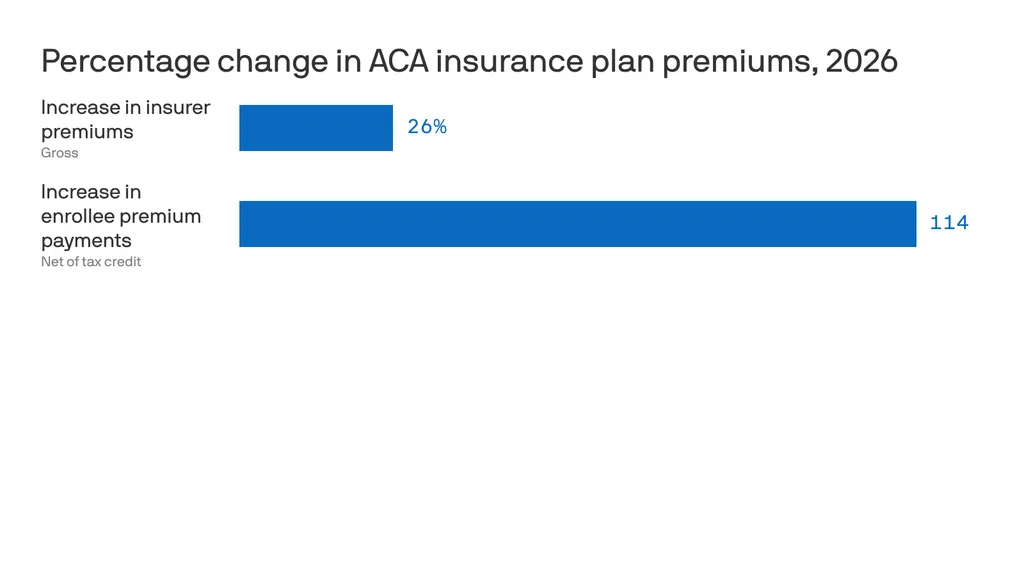
ACA insurers themselves are raising premiums by an estimated 26%, in part due to rising hospital costs, higher demand for pricey GLP-1 drugs like Ozempic, and the threat of tariffs.

  • But add in the loss of federal subsidies, and the increase is 114% — or more than double what they currently pay, according to KFF. 22 million out of 24 million marketplace enrollees now receive subsidies.
  • Premiums in the small group employer market will go up by a median of 11%, also per KFF, due to some of the same reasons insurers cite in ACA markets.

For employer health insurance, there’s no comprehensive data yet for 2026, but estimates from earlier this year put the increases in the high single digits.