A Secret to Better Health Care

https://www.realclearhealth.com/2019/05/28/a_secret_to_better_health_care_279059.html?utm_source=morning-scan&utm_medium=email&utm_campaign=mailchimp-newsletter&utm_source=RC+Health+Morning+Scan&utm_campaign=e0c8de7485-MAILCHIMP_RSS_EMAIL_CAMPAIGN&utm_medium=email&utm_term=0_b4baf6b587-e0c8de7485-84752421


A Secret to Better Health Care


It seems obvious: better social services. So why are things like food stamps and housing not part of the conversation?

Health care is at the center of the national policy conversation, and with the 2020 presidential election now in full swing, that is where it will probably remain. But for all the talk about how to increase access and reduce costs, we’re missing a critical piece of the puzzle: the inverse relationship between health care costs and spending on social programs.

One reason the United States spends more on health care than any other nation — more than 17 percent of gross domestic product, compared with an average of 9 percent for other advanced economies — is that we spend far less on social services like food stamps, free school lunches and public housing.

If our spending on social programs were more in line with other developed countries, our health care costs would fall. That means that as policymakers evaluate a social program, they should weigh not only its direct and second-order benefits — from reducing crime and recidivism to increasing productivity — but also its effect on lowering federal health care costs.

These safety net programs can lower health care costs by strengthening what medical professionals call the “social determinants of health”: the environment in which people are born, grow, live and work. Effective social programs provide access to good nutrition, clean and safe shelter and a subsistence income, which are critical to avoiding disease. They help food-insecure children receive nutrient-dense meals rather than empty calories, and families with incomes below the poverty line to live in sanitary environments free of serious health risks.

Especially important are programs that ameliorate poor housing conditions and prevent disease, including lead abatement, control of mold and dampness and heating-system repairs. Consider a real-life example.

Days after an elderly patient was treated for heart failure at Mount Sinai Hospital and returned home, the elevator in his apartment building broke down. Lacking the ability to climb stairs, he became a prisoner in his own home, unable to go out for a walk, shop for fresh food and visit his doctors for follow-up care.

A social service worker took up his case, and the elevator was repaired. His substandard housing was literally a threat to his health; the intervention of the social worker may have saved his life — and certainly saved him from a possible relapse and expensive hospital care.

Two programs — one in Chicago, the other in Los Angeles — show the multidimensional benefits of social spending. The Chicago program supplemented federal housing subsidies to help patients with chronic health problems afford stable housing. It reduced health care costs in the University of Illinois hospital system for participating patients by roughly 18 percent. And once in stable housing, beneficiaries can better pursue public benefits and job opportunities.

The Los Angeles program showed even greater cost savings, according to a study by the nonpartisan RAND Corporation. After receiving housing assistance, beneficiaries’ costs to the public health system plummeted. Inpatient services fell by 75 percent. Over all, the study found that, even accounting for the increased housing costs, recipients’ total social service and health care costs fell by 20 percent. And beneficiaries showed signs of reduced involvement in crime and improved mental health.

All of this is intuitive and supported by reams of data. But the United States continues to spend a relative pittance on such programs. Housing programs, including rental assistance, public housing and homeless-assistance grants, account for one-quarter of 1 percent of G.D.P. Nutrition programs, such as food stamps and the Women, Infants and Children nutrition program, amount to one-half of 1 percent of G.D.P.

Our underinvestment sets us apart from other advanced nations around the globe, particularly in Western Europe. France, Sweden and Britain commit far more than the United States to social services, as a percentage of their economy, while spending significantly less per capita and as a percentage of their economy on health care — and boast a higher life expectancy.

Many factors influence discrepancies in health care spending and outcomes between the United States and its counterparts: vastly different views about the financial incentives in health care; the high cost of prescription drugs, diagnostic tests and administrative expenses; and cultural expectations about end-of-life care. But we won’t effectively reduce costs, and improve outcomes, until we think bigger and recognize the critical link between health care spending and social programs.


Democrats Yet To Successfully Explain Medicare For All

https://www.forbes.com/sites/brucejapsen/2019/05/26/from-bernie-to-warren-democrats-yet-to-successfully-explain-medicare-for-all/#3e8b63126daf


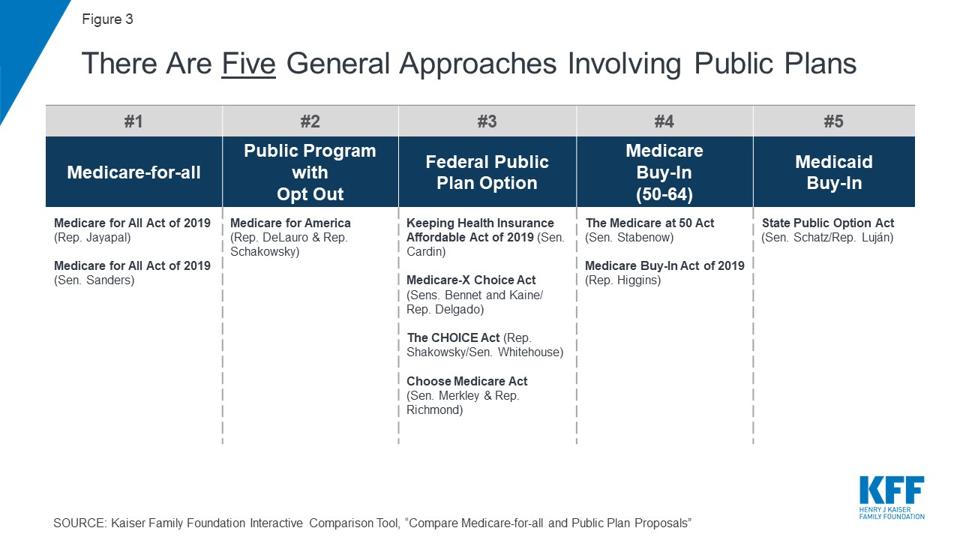
Kaiser Family Foundation Medicare For All briefing on national public healthcare plan approaches introduced in Congress (May 21, 2019).

Even with two dozen Democrats running for President and most touting an expansion of Medicare benefits to everybody, the public is still unclear how a national single payer health plan like “Medicare for All” will benefit them.

A briefing from experts at the nonpartisan Kaiser Family Foundation for health reporters last week revealed there are five general approaches to expanding coverage involving public plans.

Within those approaches are 10 national plans introduced in Congress that include everything from a single payer version of Medicare for All that would uproot private coverage to a “public program with an opt out” that would be offered along side commercial coverage. Other plans would allow Americans to buy into Medicare as young as 50 years old or buy into Medicaid coverage for the poor.

But no matter the effort to expand health insurance coverage, much is to be done to educate the public at large even as single payer supporters like Sens. Bernie Sanders, Elizabeth Warren and Kamala Harris push Medicare for All on the campaign trail.

“Our polling shows some Americans are unaware of how the implementation of a national health plan could impact them,” said Mollyann Brodie, Kaiser’s senior vice president and executive director, public opinion and survey research. “For example, many people (55%) falsely assume that would be able to keep their current health insurance under a single-payer plan.”

Democrats on the campaign trail hoping to challenge President Donald Trump should Republicans nominate him to run for re-election in 2020 see rising support for a national health plan that would make the government the only insurance carrier.

Kaiser data shows 56% favor a national health plan “in which all Americans would get their insurance from a single government plan.” Just 40% favored such a national health plan 20 years ago, Kaiser data shows.

“Our polls have shown a modest increase in support for the idea of a national health plan,” Kaiser’s Medicare for All presentation showed. Some of these health insurance expansions would be single payer versions of “Medicare for All’ like that proposed by Sanders in the U.S. Senate and Rep. Pramila Jayapal (D-Washington) in the U.S. House of Representatives that would uproot private coverage and replace it with government run Medicare.

Other public approaches would involve a “public program with an opt out” known as Medicare for America or a “Medicare Buy in” like that proposed by Sen. Debbie Stabenow (D-Michigan). Other public plans would involve a so-called “federal public plan option” that would be offered along side commercial coverage on a government exchange and there are also Medicaid buy-in proposals being floated in a number of states.

Politically, the lack of knowledge of Medicare for All and public option proposals offers opportunities for both Democrats who favor Medicare for All and Republicans who want to derail a government expansion of health benefits, particular an approach that would essentially replace much of the private system.

“As the public learns more about the implications of each of these proposals, support may increase or decrease,” Kaiser’s Brodie said.


Who is blocking ‘Medicare for All’?

Who is blocking ‘Medicare for All’?

Who is blocking 'Medicare for All'?

Decades of corporate-friendly politics and policy have decimated communities throughout the country. Centrist Democrats who have chosen corporate profits over people’s needs have aided and abetted this decimation. People are hungry for big ideas to improve their lives and to change the rules that serve only to make the rich richer.

Nowhere is this hunger more apparent than in the demand for improved “Medicare for All”. During a hearing at the House Budget Committee this week it was also apparent that the center-right and their wealthy donors won’t go down without a fight when it comes to health care. 

With guns-a-blazing, they are out to block an incredibly successful and popular program: Medicare, from being improved, expanded and provided to everyone.

Yet polling shows that across party lines,majority of Americans are in favor of Medicare for All. And why not? Right now, nearly 30 million people in this country are uninsured; 40 million can’t afford health-care co-pays and deductibles and 45,000 die annually as a result of not having access to health care.

Those reaping the excessive profits from our illnesses and injuries are in a panic. They’re laying all their chips on the table to make sure Medicare for All never becomes reality. It would mean the end of private insurance companies that profit mightily off the most costly and least effective health-care system in the industrialized world.

So, to continue to rake in their profits, they’ve created the Partnership for America’s Health Care Future, a partnership of corporate hospitals, insurance and drug companies. They must have a lot to lose: last year alone, the group spent $143 million developing attack ads and launching fear campaigns to kill Medicare for All.

It’s time to admit it, while nearly every modern country in the world provides quality, accessible health care for free or very inexpensively to their citizens, the United States stands alone in its willingness to let corporations suck the last pennies out of sick or injured people.

Well, the jig is up. Decades under a corporate-run private health insurance system have proven that we can’t rely on profiteers to provide access to quality health care. We need a publicly held system that is accountable to the people who rely on it. We are able to do so and save trillions of dollars over the next decade.

Medicare for All would reduce national health-care spending by anywhere between $2 trillion to $10 trillion over ten years. Research shows that countries with single-payer systems spend much less on drugs.

Yet opponents continue to decry the “costs” of Medicare for All. They will continue to focus on the cost to taxpayers, conveniently avoiding the truth that already we pay excessive health care costs through insurance premiums, co-pays and deductibles.

Americans suffer from poor health outcomes because they can’t afford to see a doctor until their illness becomes catastrophic. Many weigh the choice between financial ruin and life-saving medicines and treatment. In one of the richest countries in the world that is nothing short of shameful.

The U.S. is a country with abundant resources and more than enough wealth to go around. It’s time to share the wealth in America. It’s a new day and it starts with Medicare for All. Buckle up — because the fight is just beginning.


Toward 2020: A Survey of ACA Market Insurers

Click to access Toward_2020_A_Survey_of_ACA_Market_Insurers.pdf