Thought of the Day: Reflection on Life

“I know that I have less to live than I have lived.

I feel like a child who was given a box of chocolates. He enjoys eating it, and when he sees that there is not much left, he starts to eat them with a special taste.

I have no time for endless lectures on public laws – nothing will change. And there is no desire to argue with fools who do not act according to their age. And there’s no time to battle the gray. I don’t attend meetings where egos are inflated and I can’t stand manipulators.

I am disturbed by envious people who try to vilify the most capable to grab their positions, talents and achievements.

I have too little time to discuss headlines – my soul is in a hurry.

Too few candies left in the box.

I’m interested in human people. People who laugh at their mistakes are those who are successful, who understand their calling and don’t hide from responsibility. Who defends human dignity and wants to be on the side of truth, justice, righteousness. This is what living is for.

I want to surround myself with people who know how to touch the hearts of others. Who, through the blows of fate, was able to rise and maintain the softness of the soul.

Yes, I hustle, I hustle to live with the intensity that only maturity can give. I’ll eat all the candy I have left – they’ll taste better than the ones I already ate.

My goal is to reach the end in harmony with myself, my loved ones and my conscience.

I thought I had two lives, but it turned out to be only one, and it needs to be lived with dignity.”

Brilliant Anthony Hopkins

and free interpretation of Mario de Andrade’s poem

The most important elements of emotional IQ for healthcare leaders today

https://mailchi.mp/f9bf1e547241/gist-weekly-february-23-2024?e=d1e747d2d8

At a recent dinner with my good friend and colleague Dave Blom, the former President and CEO of Ohio Health, he and I discussed the difficulties of leading and managing complex healthcare organizations in the post-Covid era.

We agreed that the leadership issues that matter most right now center around the ability of executives to possess and demonstrate an authentic emotional IQ. 

Taking care of patients—in fact, taking care of communities—is not only managerially complicated but also emotionally testing. 

Success cannot be achieved by technical and clinical excellence alone; rather, it must be built on a platform of an emotional IQ that is supported, valued, and shared by the entire organization.


The below list is what Dave and I settled on as the most important elements of emotional IQ for healthcare leaders today, and we think that leadership teams that fully embrace these behaviors unlock a higher level of organizational trust, as well as corporate and managerial integrity.


–Empathy. 

A leader needs to understand and share the feelings of his or her entire organization, as well as understand the difference between sympathy and empathy: sympathy is a passive emotion while empathy is an active emotion. A leader with empathy not only notes the problem but immediately moves to be of help at either the personal or organizational level, whichever is required.


–Vulnerability. 

Historically, executive leadership, especially in corporate situations, has been trained and encouraged not to show emotion or weakness. But organizations are changing, and the composition of the today’s workforce is different. The patient care process is emotional in and of itself, and daily operational interactions demand a different kind of leadership—a leadership that is comfortable with both emotion and weakness.


–Humility. 

Executives who show humility are willing to ask for help, and don’t insist on everything being done their way; they are quick to forgive and are known for their patience. Humility supports a collaborative and cooperative leadership model, which has at its core a heavy dose of decentralization and delegation.

CMS finalizes DSH cuts for some hospitals

https://mailchi.mp/f9bf1e547241/gist-weekly-february-23-2024?e=d1e747d2d8

On Tuesday, the Centers for Medicare and Medicaid Services (CMS) published a final rule redefining how disproportionate share hospital (DSH) payments are determined.

Hospitals used to calculate their Medicaid shortfalls based on the costs and payments associated with all of their Medicaid-eligible patients, even if some of those patients used a different primary payer. Prompted by Congress to address this issue in 2021, CMS is now limiting the scope of Medicaid shortfall to only patients for whom Medicaid is their primary payer. The rule exempts safety-net hospitals providing care to the highest percentages of low-income patients, defined as those in the 97th percentile of inpatient days treating Medicare SSI (Social Security Income) recipients.

This change is expected to amount to an $8B annual reduction in DSH payments over the next four years. Congress has repeatedly delayed the implementation of these cuts, which are now set to go in effect on March 8, 2024.

The Gist: Though the formula for calculating appropriate DSH payments has always been complex, the point of the program is to provide additional support to hospitals caring for underserved, low-income populations.

This $8B cut may be targeted at hospitals with slightly better payer mixes, but it will be felt heavily by many safety-net providers reliant on the payments, especially in today’s challenging financial operating environment where over 40 percent of hospitals are still losing money on operations.

Thought of the Day: Advice from a Farmer

Your fences need to be horse-high, pig-tight and bull-strong.

Keep skunks, bankers, and lawyers at a distance.

Forgive your enemies. it messes up their heads.

Do not corner something that you know is meaner than you.

Every path has a few puddles.

When you wallow with pigs, expect to get dirty.

If you find yourself in a hole, the first thing to do is stop diggin’.

Always drink upstream from the herd.

Lettin’ the cat outta the bag is a whole lot easier than puttin’ it back in.

Life is simpler when you plow around the stump.

Live a good, honorable life. Then when you get older and think back, you’ll enjoy it a second time.

Financial distress increasingly prevalent in health system M&A deals

https://mailchi.mp/1e28b32fc32e/gist-weekly-february-9-2024?e=d1e747d2d8

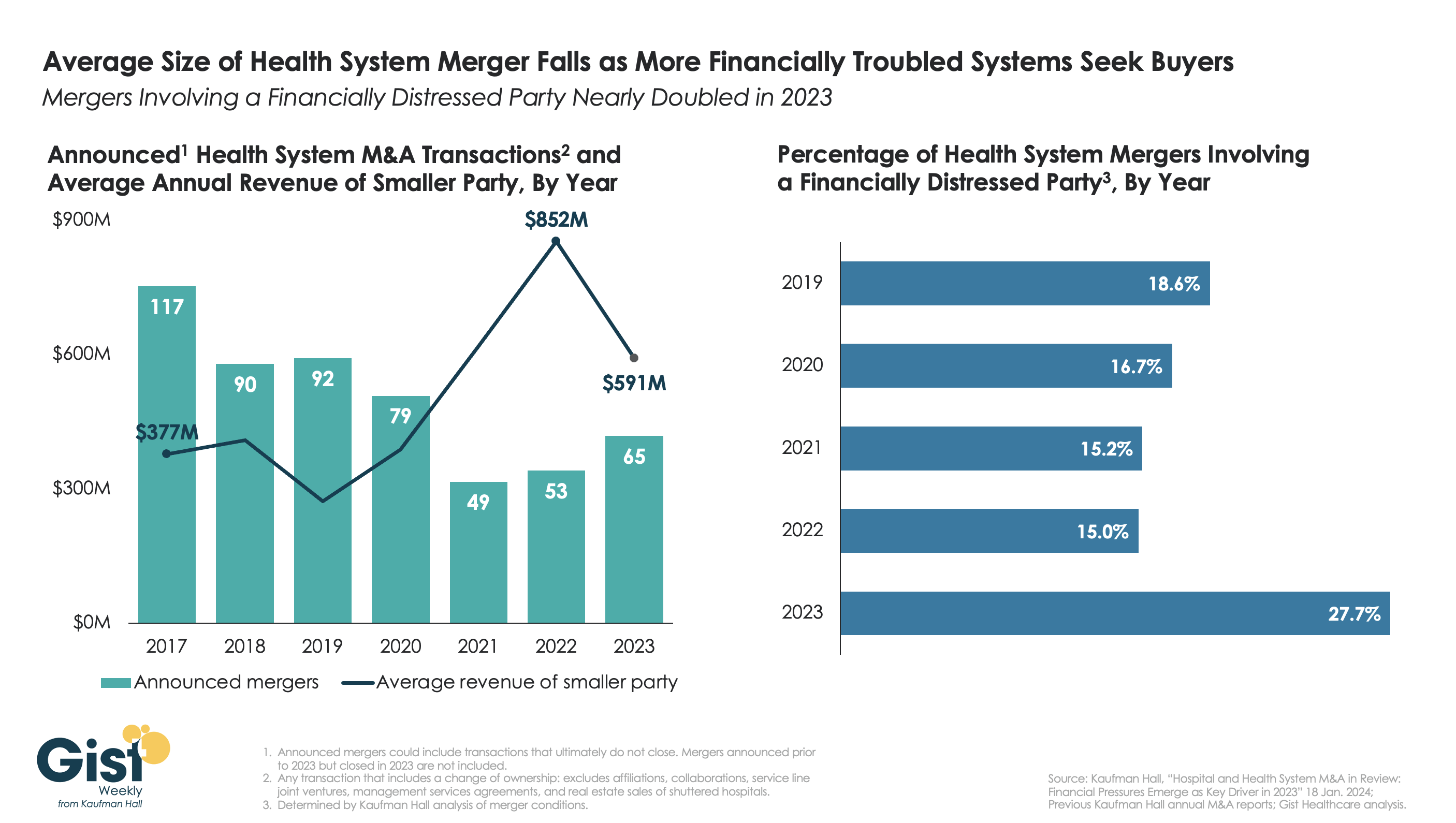
This week’s graphic highlights data from Kaufman Hall’s recently released 2023 Hospital and Health System M&A Report on the current dynamics in health system mergers and acquisitions (M&A) activity.

After a slowdown during the pandemic, 2023 saw an uptick in M&A activity with 65 announced transactions, the most since 2020. Continuing the trend of the past two years, the number of announced “mega mergers,” in which the smaller party had at least $1B in annual revenue, represented more than a tenth of total announced transactions. 

However, the average size of mergers fell in 2023, as financial distress emerged as a key driver of M&A activity. The percent of mergers involving a financially distressed party spiked to nearly 28 percent in 2023, almost double the level seen in prior years. 

CARES Act funding had buoyed some health systems’ balance sheets through the pandemic, but with the end of federal aid, more systems needed to seek shelter through scale. 

With the median hospital operating margin still barely hitting two percent, we anticipate this heightened level M&A activity to continue in 2024 as health systems search for stronger partners that can help them stabilize financially.