You Earn Trust When You Stand With Others

Newt Gingrich on John McCain

John McCain died of brain cancer on August 25, 2018.

Newt Gingrich shared a surprising story about McCain.

Standing with:

Gingrich writes, “One of my most personal encounters with John was in 1986 when I was in a very intense fight with the House Democratic leadership. Two physically large House Democrats came over and said they were sick and tired of what I was doing and I ought to know there would be a payback. One of them said, ‘We are coming for you.’

I had not realized that McCain had calmly come over to stand next to me. When the Democrat sounded threatening, John instinctively stepped closer to me and said, ‘When you come for Newt, come for me too, the name’s McCain.’”

McCain was a first term congressman when this happened.

Theatrics:

You might be tempted to attribute McCain’s behavior to political theatrics. I heard people say that McCain understood and leveraged political theatrics. But when you know that he refused early release in the late 1960’s from the Hanoi Hilton to stand with his fellow POW’s, you realize that McCain knows how to stand with people.

Cost:

It costs a leader to stand with others. It’s so costly that some leaders hang team members out to dry when they screw up.

You probably know what it’s like to drive a stake in the ground beside a team member only to have him casually drive a stake in your back. It might have been ignorance on their part. It may have been malice, but the pain is the same.

Advantage:

There IS advantage to standing with others when it seems there’s only disadvantage. Frankly, that’s the time it matters most.

You earn trust when you stand with others.

How might you stand with others today?


Engagement Isn’t Built, It’s Uncovered

https://www.leadershipnow.com/leadingblog/2018/08/engagement_isnt_built_its_unco.html

TITLE

WE ARE BORN with a desire to engage. We want to learn—to relate and interact. We want to connect.

But over the years, depending on our upbringing, our schooling, and our work, our desire to engage gets suppressed. It gets covered up.

Our job as leaders is to uncover and rekindle that child-like desire to engage with others and our environment. We can’t create engagement, but we can uncover it.

I was reading a remarkable little book written for teachers by retired professor Calvin Luther Martin entitled, Successful College Teaching Begins with Throwing Away Your Lecture Notes. We can learn a lot here because teaching, like leading, is about serving others while achieving a result. Indeed, teaching is a function of leading.

We teach much more than our subject matter; we teach trust or distrust, courtesy or discourtesy, warmth or coldness—the lessons between the lines.

The people we lead are not coming to us from our perspective. They have their own that has been years on the making.

Bear in mind that you are teaching young men and women with an educational past that has shaped them.

We bring our whole selves to work. Our hope, our scars, our dreams, our fears, our expectations, and our assumptions. Our childhood sense of wonder has been abused. It’s there, but it is cautious. We are conditioned to want to be right more than we want to be accurate.

Behold the class before you. They are not blank slates, nor are they ignorant. There is plenty written on those slates and your task is to rewrite much of that text—if they will trust you and if your good enough to get that close to them. They sit before you, thoroughly trained (brainwashed might be a better word) in ways of pedagogy that will determine how they hear you, what they hear and cannot hear, and how they will absorb what you say.

We are not leading another version of us. We are leading a human being similar in form but different in substance.

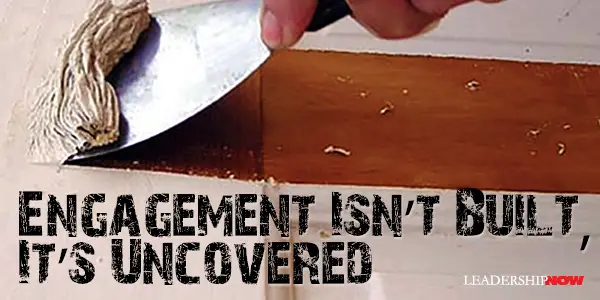
These people come to you with layers of expectations that have been created starting in the first grade. Like an old kitchen countertop, they have been painted over and over. The oak, cherry, or maple cabinet beneath is smothered by an amour of paint. It’s a bland countertop now. The fine wood underneath is unknown; it’s merely a rigid structure useful for covering with paint and, after that, supporting pots and pans.

Thirty countertops, each covered with a dozen coats of paint, file into your room, take a seat, and open their spiral-bound notebooks. They’re ready for yet another coat of paint, Professor Martin. They know the drill; go ahead, start brushing it on.

The sorrow of this parable is that they expect it. They actually expect you to drone on, giving them fact after fact while they fill their notebook and worry about memorizing all this information.

Surprise them; don’t do it.

A leader has to peel off the old paint and get to that desire to engage that has been unwittingly covered over. We have to uncover the desire to engage. The desire to learn. The desire to connect.

The tendency is to be instructing. We do need to instruct but it needs to be part of a larger, coherent story that people can feel a part of.

We are wired to engage. It’s already within us. Our task as leaders is to uncover what is already there.

Martin explains that to teach or to lead “is to give a concert, to perform a beautiful, passionate concerto which everyone in the audience yearns to play, improvise on, and even improve.”

We don’t build engagement, we uncover it.

Uncover engagement in your organization


450 hospitals at risk of potential closure, Morgan Stanley analysis finds

https://www.bloomberg.com/news/articles/2018-08-21/hospitals-are-getting-eaten-away-by-market-trends-analysts-say
Related image

More than 15 percent of U.S. hospitals have weak financial metrics or are at risk of potential closure, according to Business Insider, which cited a recent report from Morgan Stanley.

Morgan Stanley analyzed data from more than 6,000 hospitals and found 600 of the hospitals were “weak” based on criteria for margins for earnings before interest and other items, occupancy and revenue, according to Bloomberg. The analysis revealed another 450 hospitals were at risk of potential closure, according to Business Insider

Texas, Oklahoma, Louisiana, Kansas, Tennessee and Pennsylvania had the highest concentration of hospitals in the “at risk” pool, according to the report.

Industry M&A may be no savior as the pace of hospital closures, particularly in hard-to-reach rural areas, seems poised to accelerate.

Hospitals have been closing at a rate of about 30 a year, according to the American Hospital Association, and patients living far from major cities may be left with even fewer hospital choices as insurers push them toward online providers like Teladoc Inc. and clinics such as CVS Health Corp’s MinuteClinic.

Morgan Stanley analysts led by Vikram Malhotra looked at data from roughly 6,000 U.S. private and public hospitals and concluded eight percent are at risk of closing; another 10 percent are considered “weak.” The firm defined weak hospitals based on criteria for margins for earnings before interest and other items, occupancy and revenue. The “at risk” group was defined by capital expenditures and efficiency, among others.

The next year to 18 months should see an increase in shut downs, Malhotra said in a phone interview.

The risks are coming following years of mergers and acquisitions. The most recent deal saw Apollo Global Management LLC swallowing rural hospital chain LifePoint Health Inc. for $5.6 billion last month. Apollo declined to comment on the deal; LifePoint has until Aug. 22 to solicit other offers. Consolidation among other health-care players, such as CVS’s planned takeover of insurer Aetna Inc., could also pressure hospitals as payers push patients toward outpatient services.

There are already a lot of hospitals with high negative margins, consultancy Veda Partners health care policy analyst Spencer Perlman said, and that’s going to become unsustainable. Rural hospitals with a smaller footprint may have less room to negotiate rates with managed care companies and are often hobbled by more older and poorer patients.

Also wearing away at margins are technological improvements that allow patients to get more surgeries and imaging done outside of the hospital. They are also likely to be forced to pay more to attract and retain doctors in key areas, Bloomberg Intelligence analyst Jason McGorman said.

They “are getting eaten alive from these market trends,” Perlman cautioned.

Future M&A options could be too late — buyers may hesitate as debt laden operators like Community Health Systems Inc. and Tenet Healthcare Corp. focus on selling underperforming sites to reduce leverage, Morgan Stanley’s Zachary Sopcak said.

The light at the end of the tunnel is some hospitals are rising to the occasion, Perlman said. Some acute care facilities are restructuring as outpatient emergency clinics with free-standing emergency departments. “Microhospitals,” or facilities with ten beds or less, are another trend that may hold promise.


Steward Ohio hospital ups layoffs to 468 as closure looms

https://www.beckershospitalreview.com/human-capital-and-risk/steward-ohio-hospital-ups-layoffs-to-468-as-closure-looms.html

Image result for northside regional medical center a steward family hospital

Dallas-based Steward Health Care issued a revised notice Aug. 17 indicating job losses from the pending closure of one of its hospitals in Ohio will affect approximately 80 more people than previously reported, according to the Ohio Department of Job and Family Services.

Steward revealed plans last week to close Youngstown-based Northside Regional Medical Center on Sept. 20. The health system initially stated it would lay off all of the facility’s 388 employees, according to a WARN notice filed Aug. 15.

However, a revised WARN notice dated Aug. 17 indicates the closure will affect 468 employees. All hospital workers will be paid through Oct. 14.

Steward acquired Northside Regional and seven other facilities from Franklin, Tenn.-based Community Health Systems last year.

Area healthcare leaders expressed dismay over the planned closure to The Business Journal, but said the move was not entirely unexpected.