California Legislature bans short-term health insurance

https://www.sfchronicle.com/business/article/Defying-Trump-California-legislature-bans-13169686.php

Image result for california legislature


The California Legislature has passed a bill banning the sale of short-term health insurance plans — a type of insurance the Trump administration is seeking to expand.

The bill, SB910, authored by State Sen. Ed Hernandez (D-West Covina), was approved by the Senate on Monday and the Assembly last week. It will need the signature of Gov. Jerry Brown to become law.

Short-term plans are generally cheaper but do not need to cover all the benefits required under the Affordable Care Act, such as preventive care, essential health benefits and protections for people with pre-existing conditions. An estimated 10,000 people in California are currently enrolled in such plans.

The U.S. Department of Health and Human Services this month finalized a rule extending the amount of time consumers can be on short-term plans from three months to almost 12 months, after which they can be renewed for up to three years. However, the HHS rule allows states to regulate the sale of such plans on their own terms.

California had long capped the amount of time consumers could be on short-term plans to six months; the Obama administration limited it even further, to three months. Hernandez’s bill eliminates the sale of such plans altogether, for any amount of time.

If Brown signs the bill, California would join a handful of states, including New Jersey, Massachusetts and New York, that have severely restricted or banned short-term plans, according to the California Health Care Foundation.

If the bill becomes law, it would take effect in January 2019. Californians would still be able to buy short-term coverage — if they are in between jobs, for instance — through the state insurance exchange Covered California, or directly from health insurers like Blue Shield or Kaiser. These plans do comply with Affordable Care Act consumer protections like essential health benefits. Consumers would be able to do this at any time during the year, not just during annual enrollment, because losing job-based coverage counts as a qualifying life event.



Can ‘Medicare for All’ Carry Democrats at the Polls?

http://www.thefiscaltimes.com/2018/08/21/Can-Medicare-All-Carry-Democrats-Polls

Image result for Can ‘Medicare for All’ Carry Democrats at the Polls?

The idea of “Medicare for all” has support from top Democrats considered likely 2020 presidential contenders, including Sens. Kamala Harris of California, Elizabeth Warren of Massachusetts, Cory Booker of New Jersey and Kirsten Gillibrand of New York. But Politico’s Paul Demko reports that progressives promising a single-payer health care system have failed to win over voters in some Democratic primaries in swing districts this year:


Democratic candidates who made that a centerpiece of their campaigns in key districts this year lost their primaries, in some cases getting clobbered by rivals who offered vaguer health care plans or backed a more incremental approach. Democratic primary voters in battleground districts in Iowa, Texas, Kansas and New York passed over candidates who emphatically supported single payer.


The key quote: “The problem is Medicare for all just isn’t one of those litmus tests for Democratic primary voters,” John Anzalone, a Democratic pollster, tells Politico. “Voters are smart enough to know that Medicare for all isn’t going to happen right now, or maybe ever.”


Why it matters: While progressives may Medicare for all as a potent rallying cry, and polls show voters increasingly support the notion of a government-funded system, it’s still not a lock that the party will coalesce around such a plan, and it’s not clear how strongly the idea will motivate moderate swing-state voters. Some Democratic strategists and losing candidates argue that support for a single-payer system wasn’t the deciding factor in the contests Politico highlights, but the results still indicate just how complicated it can be for the party to turn the polling advantage it now has on health care into election — or policy — wins.


It’s not just the uninsured — it’s also the cost of health care

https://www.axios.com/not-just-uninsured-cost-of-health-care-cdcb4c02-0864-4e64-b745-efbe5b4b7efc.html

Image result for It's not just the uninsured — it's also the cost of health care

We still have an uninsured problem in the U.S., but we have a far broader health care affordability problem that hits sick people especially hard.

Why it matters: It’s time to think more broadly about who’s having trouble paying for the health care they need. The combination of lack of insurance and affordability affects about a quarter of the non-elderly population at any one time, but almost half of people who are sick.


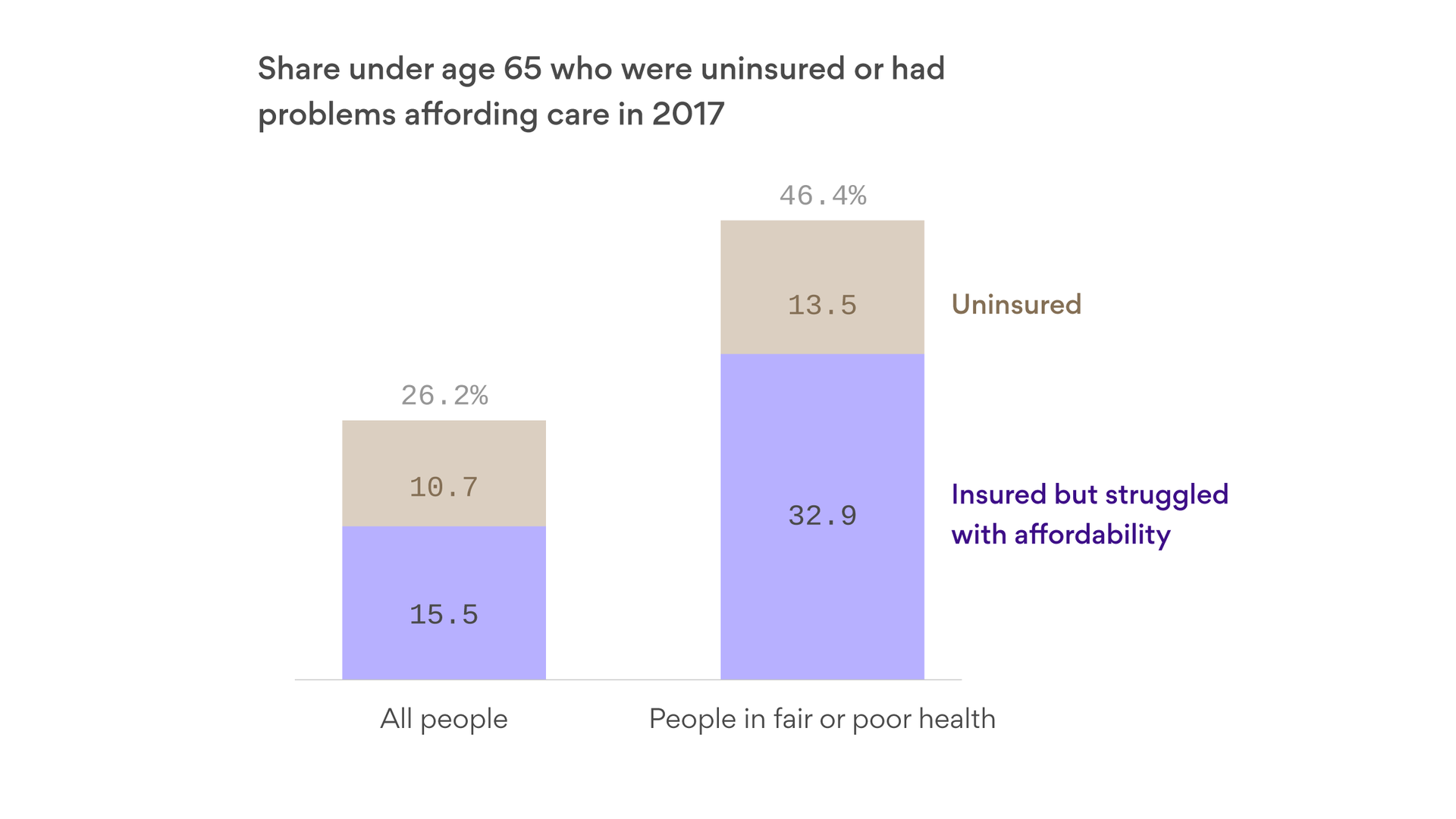
Now that the Affordable Care Act has expanded health coverage, the percentage of the non-elderly population that is uninsured is now just under 11%, the lowest level ever recorded. But as the chart shows:

  • Another 15.5% who have insurance either skipped or delayed care because of the cost or reported that they or someone in their family faced problems paying their bills in 2017.
  • That brings the total percentage of non-elderly people with insurance and affordability problems to 26.2%.


More striking: nearly half of all people in fair or poor health — 46.4% — are uninsured or have affordability problems despite having coverage.

  • That includes 13.5% who were uninsured and in fair or poor health — arguably the worst off in the entire system — and another 32.9% percent who have insurance but said they or a family member have had a problem affording care in the last year.


It’s not surprising that people who are sicker and need more care would have more problems paying for it. But arguably an insurance system should work best for people who need it the most.


All this says a lot about current health care politics.

  • It helps explain why so many people name health their top issue, despite the progress that has been made in covering the uninsured. And everyone who’s sick and can’t afford medical care has family members and friends who see what they are going through, creating a political multiplier effect.
  • It is also why health care is substantially an economic issue as well as an issue of access to care. When people have trouble paying medical bills, it’s a hard hit to their family budgets — causing many people to take a second job, roll up more debt, borrow money, and forego other important family needs.


For as long as I have been in the field, we have used two measures more than any others to gauge the performance of the health system: the number of Americans who are uninsured and the percentage of GDP we spend on health. Both measures remain valid today.

The bottom line: If we want a measure that captures how people perceive the system when the number of uninsured is down and overall health spending has moderated, we need better ways of counting up the much larger share of the population who are having problems affording care.

And whatever big policy idea candidates are selling, from single payer on the left to health care choices on the right, the candidate who connects that idea to the public’s worries about paying their medical bills is the one who will have found the secret sauce.


Hospitals are investing in housing — Here’s why

https://www.beckershospitalreview.com/finance/hospitals-are-investing-in-housing-here-s-why.html

Image result for population health management


Several factors, including changes in reimbursement, have motivated some hospitals to invest in community housing projects, according to NPR.

In the 1990s, 50 percent of the children in Southern Orchards — near Columbus, Ohio-based Nationwide Children’s Hospital — lived in poverty. Through a partnership called the Healthy Neighborhoods Healthy Families initiative, Columbus, community groups like United Way, and Nationwide Children’s began to invest in the neighborhood’s homes. In 2008, the organizations started renovating vacant homes for resale, building affordable housing and funding renovations for homeowners.

With a $6.6 million infusion from Nationwide Children’s, the $22 million project led to the construction of 58 affordable housing units, 71 renovated homes and 15 new homes. The organizations also gave out 149 home improvement grants from 2008 to 2018, according to the report, which cites Pediatrics.

Kelly Kelleher, MD, director of the Center for Innovation in Pediatric Practice at Nationwide Children’s, writes in Pediatrics that Nationwide Children’s is treating “the neighborhood as a patient.” The hospital is attempting to mend harmful socio-economic and physical environments in the hope it will lower the prevalence of health issues caused by those conditions. The investment could pay for itself if the number of hospital visits from Southern Orchards neighborhood falls, said Dr. Kelleher.

Hospitals across the country are taking similar approaches, though not as direct as owning and operating housing in a certain neighborhood, according to Megan Sandel, MD, who helps direct Boston Medical Center’s housing initiative. Dr. Sandel said Boston Medical Center’s projects are owned and operated by other community organizations. Similar projects are off the ground in Seattle, Boston, Atlanta and New York, among other places.

A potential motivator for these projects is a shift from fee-for-service medicine to reimbursement based on improving quality of care, according to the report. Some states are even starting to give healthcare organizations funding to manage populations.