


As the new coronavirus, called 2019-nCoV, spreads rapidly around the globe, the international community is scrambling to keep up. Scientists rush to develop a vaccine, policymakers debate the most effective containment methods, and health care systems strain to accommodate the growing number of sick and dying. Though it may sound like a scene from the 2011 movie “Contagion,” it is actually an unfolding reality.
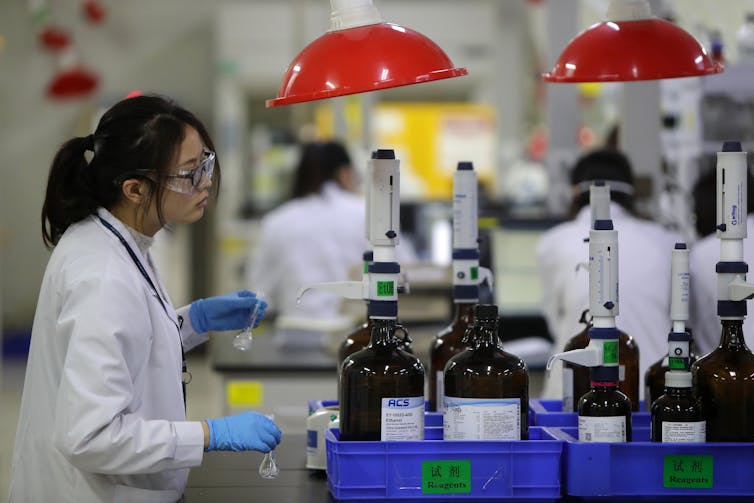
In the midst of all of this, a potential crisis simmers in the shadows: The global dependence on China for the production of pharmaceuticals and medical equipment.
We represent an interdisciplinary group of scientists and policymakers at the Scowcroft Institute’s Pandemic and Biosecurity Policy Program based at the Bush School of Government at Texas A&M University who have been holding annual summits addressing pandemic-related issues for the past five years. One of our goals is to promote dialogue on potential risks related to pandemics and U.S. security, in this case the disruption of supply chains and availability of medical supplies and drugs.
Today, about 80% of pharmaceuticals sold in the U.S. are produced in China. This number, while concerning, hides an even greater problem: China is the largest and sometimes only global supplier for the active ingredient of some vital medications. The active ingredients for medicines that treat breast cancer and lung cancer and the antibiotic Vancomycin, which is a last resort antibiotic for some types of antimicrobial resistant infections, are made almost exclusively in China. Additionally, China controls such a large market portion of heparin, a blood thinner used in open-heart surgery, kidney dialysis and blood transfusions that the U.S. government was left with no choice but to continue buying from China even after a contamination scandal in 2007.
China is not only the dominant global supplier of pharmaceuticals, but it is also the largest supplier of medical devices in the U.S. These include things like MRI equipment, surgical gowns, and equipment that measures oxygen levels in the blood. Supplies of these essential products have not yet been severely disrupted by the coronavirus, but if China is no longer will or able to supply them to the U.S., thousands of Americans could die.
More concerning still are the limited options available to the U.S. and the rest of the globe to make up the shortfall. It could take years to develop the necessary infrastructure to reestablish U.S. manufacturing capacities and obtain Food and Drug Administration licensure to overcome the loss of the Chinese supply.
When a disease reaches epidemic levels, the first obligation for leaders in any country is to protect their own people. As this current crisis progresses, there may come a point when political leaders in China will face decisions on whether to prohibit the export of pharmaceuticals, medical devices and other vital medical components in order to treat or protect their own people. Such acts would be the logical outcome of an escalating situation. For the 2009 H1N1 pandemic response, for example, the U.S. was pushed to the back of the queue for vaccine deliveries even though we had existing contracts with a major vaccine manufacturer located in another country. Those vaccine deliveries were delayed.
While a total loss of active ingredient imports from China might seem far-fetched, we believe the increasing scale of the outbreak moves it closer to the realm of possibility.
About six weeks into international recognition of the epidemic in China, there are already shortages of vital personal protective equipment in both China and the U.S. UPS has transported more than 2 million masks and 11,000 gowns to Wuhan to help alleviate the shortage. But what happens when everyone runs out of protective equipment?
Wuhan is a significant player in the biotechnology and pharmaceutical industry, with multiple pharmaceutical companies located in the city. How many of these factories have closed as a result of the pandemic, and when will those that have closed open back up? Global supply chains could reach a crisis point if they are compromised because Hubei province, where Wuhan is located, is in quarantine and factories are shut down.
Additionally, Wuhan is the location of China’s first Biosafety Level (BSL) 4 laboratory, which was opened in 2017 to research SARS and other emerging diseases. It is the only lab in China that can safely handle the world’s most dangerous pathogens that pose a significant risk of transmission. Infection, death and quarantine in Wuhan and the surrounding Hubei province is restricting the ability of all types of commerce in the region. Meanwhile, the virus is already creating a significant supply chain imbalance within China. That means those medical supply companies will be under pressure to keep any products produced within the country for protection of their own health care workers, laboratory personnel and the general public.
The regulatory apparatus to insure that the Chinese manufactured pharmaceuticals being exported meet the highest standards of safety and quality control are weak or nonexistent, according to a congressional report last year. The pressure placed on supply chains by the outbreak could further exacerbate existing quality control challenges. In doing so, the virus has highlighted our reliance on China as a U.S. national security issue due to outsourcing our manufacturing capabilities and inability to ensure quality control.
As with all pandemics, the complexity of this outbreak demands international collaboration and transparency. At the same time, U.S. public health officials must acknowledge the country’s vulnerability due to our dependence on Chinese production of pharmaceuticals and medical equipment. The U.S. must develop a response plan for the inevitable shortages in the near-term and take necessary actions to reclaim control of our medical supply chain. Continuing to overlook this long-known vulnerability will only lead to catastrophe.

A man in Miami went to Jackson Memorial Hospital last month to receive a test for coronavirus after developing flu-like symptoms. He didn’t have the virus, but he was hit with a $3,270 medical bill, according to the Miami Herald.
Osmel Martinez Azcue said he normally would have used over-the-counter medicine to fight his flu-like symptoms. However, since he had recently visited China, he followed the advice of public health experts and went to the hospital to get tested for coronavirus, known as COVID-19.
Mr. Azcue said hospital staff told him a CT scan would be necessary to screen for coronavirus. He asked to receive a flu test first. The flu test came back positive.
A few weeks after leaving Jackson Memorial Hospital, Mr. Azcue received a $3,270 medical bill. Though he was insured, Mr. Azcue had a so-called “junk plan,” which offered limited benefits and didn’t cover pre-existing conditions.
Based on his insurance plan, Mr. Azcue is responsible for $1,400 of the bill, hospital officials told the Miami Herald. However, to get the claim covered, Mr. Azcue said his insurance company requested three years of medical records to show that his flu didn’t relate to pre-existing conditions.
The sale of “junk plans,” like the one Mr. Azcue pays $180 per month for, expanded after President Donald Trump’s administration rolled back ACA regulations in 2018.
Access the full Miami Herald article here.

More than a dozen Americans who had tested positive for coronavirus and were flown home alongside others without the virus were transported despite objections from the Centers for Disease Control and Prevention (CDC), The Washington Post reported on Thursday.
The 14 Americans who tested positive were among more than 300 who arrived back in the United States earlier this week after being evacuated from the Diamond Princess cruise ship in Japan, which has been the center of scrutiny over a coronavirus outbreak on board.
When those individuals tested positive for the virus, U.S. officials had to make a choice as to whether to let them fly home alongside the other passengers.
The State Department and some Department of Health and Human Services (HHS) officials decided to allow it while the CDC objected, warning of the risk of the disease spreading on the plane, the Post reported.
The plane did have a plastic-lined enclosure that allowed the 14 people with the virus to be separated from the others, according to the newspaper.
The State Department and HHS explained the decision to allow the flights with sick passengers in a statement earlier this week, without mentioning the CDC objections.
The Post reported that the CDC asked to be taken off the press release.
“These individuals were moved in the most expeditious and safe manner to a specialized containment area on the evacuation aircraft to isolate them in accordance with standard protocols,” the departments said in the earlier statement.
“Every precaution to ensure proper isolation and community protection measures are being taken, driven by the most up-to-date risk assessments by U.S. health authorities,” they added.
All of the Americans evacuated from the cruise ship will be quarantined on military bases for 14 days to ensure they do not spread the disease to others.

Dozens of House Democrats wrote to President Trump Thursday to ask that he ensure any future coronavirus vaccines and treatments be “accessible, available and affordable.”
The Department of Health and Human Services (HHS) will help fund efforts by Janssen — a drug company owned by Johnson & Johnson — to create a coronavirus vaccine and treatment. HHS is also partnering with French drugmaker Sanofi to produce a potential coronavirus vaccine.
Rep. Jan Schakowsky (D-Ill.) led 45 House Democrats in warning that HHS should not give an exclusive license to any private manufacturer or risk making the vaccines or treatments unaffordable.
“Providing exclusive monopoly rights could result in an expensive medicine that is inaccessible, wasting public resources and putting public health at risk in the United States and around the globe,” the lawmakers wrote.
“If HHS or any other federal agency moves forward with such a proposal, we urge you to instead issue a limited license and implement requirements that a vaccine or treatment be made available at an affordable price.”
The efforts are in the early stages, and it could take years for a vaccine to be available to the public.
“Americans deserve to know that they will benefit from the fruits of their public investments,” the lawmakers wrote.
“That goal cannot be met if pharmaceutical corporations are given authority to set prices and determine distribution, putting profit-making interests ahead of public health priorities.”
But the concern from House Democrats comes as lawmakers increase their scrutiny of drugmakers over rising prescription costs.
“You have repeatedly called for action to lower drug prices and know that unjustifiably high drug prices are one of the most pressing public health concerns we face today,” the lawmakers wrote to Trump.
“We should not grant any manufacturer a blank check to monopolize a coronavirus vaccine or treatment developed with public, taxpayer support.”

