
The Implications of Losing Access to Tax-Exempt Financing

https://www.kaufmanhall.com/insights/thoughts-ken-kaufman/implications-losing-access-tax-exempt-financing

On January 17, 2025, a list of potential cost reductions to the federal budget was released by Republicans on the House Budget Committee. The list is long and covers the federal budget waterfront, but it spends considerable time focusing on reductions to healthcare spending. This laundry list of cost reductions is important because the highest priority of the Trump administration is a further reduction in federal taxes. A reduction in taxes would, of course, reduce federal revenue; if federal expenses are not proportionately reduced then the federal deficit will increase. When the deficit increases then the federal debt must increase and at that point the overall impact on the American economy becomes concerning and possibly damaging. There has already been much public speculation as to how the Federal Reserve might react to such a scenario.

It is not possible right now to highlight and describe all of the House budget proposals, but one proposal absolutely stands out: The suggestion to eliminate the tax-exempt status for interest payments on all municipal bonds, or potentially in a more targeted manner, for private activity bonds, including those issued by not-for-profit hospitals. Siebert Williams Shank, an investment banking firm, described the elimination of tax exemption for municipal bonds as “the most alarming of the proposed reforms impacting non-profit and municipal issuers.”[1] This is certainly true for hospitals, since over the past 60 years the growth and capability of America’s hospitals has been substantially constructed on the foundation of flexible and relatively inexpensive tax-exempt debt. Given all of this, it is not too early to begin speculating on the impact of the elimination of tax-exempt debt on hospital finances and strategy.

We should also point out that a separate topic is under discussion, related to the potential loss of not-for-profit status for hospitals and health systems. Such a maneuver could potentially expose hospitals to income taxes, property taxes, and higher funding costs. For now, that is beyond the scope of this blog but may be something we write about in future posts.

Below is a series of important questions related to the elimination of tax-exempt financing and some speculations on the overall impact:

  1. What immediately happens if 501(c)(3) hospitals lose the ability to issue tax-exempt bonds? Let’s treat fixed rate debt first. Assume for now that only newly issued debt would be affected and that all currently outstanding tax-exempt fixed rate debt would remain tax-exempt. We could see an effort to apply any changes retroactively to existing bonds, but we view that as unlikely. Therefore, our current expectation is that outstanding fixed-rate debt would not see a change in interest expense.

    However, it is possible that outstanding floating rate debt would immediately begin to trade based on the taxable equivalent. Historically the tax-exempt floating rate index trades at about 65% of the taxable index. The difference between the tax-exempt and taxable floating rate indices in the current market is 175 basis points. For every $100 million of debt, this would increase interest expense by $1.75m annually.
  2. How would new hospital debt be issued? New debt would be issued in the municipal market on a taxable basis or in the corporate taxable market. The taxable municipal market would need to adapt and expand to accommodate a significant level of new issuance. The concern in the corporate taxable market is greater. Currently, the corporate market requires issuance of significant dollar size and generally the issuer brings significant name recognition to the market. Many hospitals may have difficulty meeting the issuance size of the corporate debt market and/or the necessary market recognition. As such, smaller and less frequent issuers would expect to pay a penalty of 25-50 basis points for issuing in the corporate market.
  3. If tax-exempt debt goes away will certain hospitals be advantaged and others disadvantaged? Larger hospitals with national or regional name recognition that issue bonds with sufficiently large transaction size and frequency will likely borrow at better terms and lower rates. Smaller- to medium-sized hospitals may find borrowing much more difficult, and borrowing may come with more problematic terms and/or amortization schedules and likely higher interest rates.
  4. Will borrowing costs go up? The cost of funds for new borrowings would increase for all hospital borrowers. For a typical A-rated hospital, annual interest expense would increase by approximately 30%. For example, in the current market, on $100 million of new debt, average annual interest expense would increase by $815,000 annually.
  5. Will debt capacity go down? All other things being equal, interest rates will go up and hospital debt capacity will go down. Also, if the taxable market shortens amortization schedules, then that will decrease overall debt capacity as well.
  6. What would the impact of the elimination of tax-exempt debt be on synthetic fixed rate structures? Hospitals have long employed derivative structures to hedge interest rate risk on outstanding variable rate bonds and loans. The loss of tax-exemption for outstanding variable rate bonds and loans would precipitate an adjustment to taxable rates, but corresponding swap cash flows are not designed to adjust. Interest rate risk is hedged, but tax reform risk is not. The net effect to borrowers would be an increase in cost similar to the cost contemplated above for variable rate bonds.
  7. What are the rating implications of the elimination of the tax-exempt market? Rating implications will be varied. Hospitals with strong financial performance and liquidity are likely to absorb the increased interest expense of a taxable borrowing with little to no rating impact. In fact, over the past decade, many larger health systems in the AA rating categories have successfully issued debt in the taxable market without rating implications despite a higher borrowing rate. Even amid the pandemic chaos of 2021, numerous AA and A rated systems issued sizable, taxable debt offerings to bolster liquidity as proceeds were for general corporate purposes and not restricted by a third-party, such as a bond trustee.

    Lower-rated hospitals with modest performance and below-average liquidity will be at greater risk for a downgrade. These hospitals may not be able to absorb the increased interest expense and maintain their ratings. While interest expense is typically a small percentage of a hospital’s total expenses, it is a use of cash flow.

    We do not anticipate the rating agencies will take wholesale downgrade action on the rated portfolio as there would likely be a phase-in period before the elimination occurs. Rather, we expect the rating agencies will take a measured approach with a case-by-case evaluation of each rated organization through the normal course of surveillance, as they did during the pandemic and liquidity crisis in 2008. A dialogue on capital budgets and funding sources, typically held at the end of a rating meeting, would be moved to the top of the agenda, as it will have a direct impact on long-term viability.
  8. How would the loss of the tax-exempt market impact the pace of consolidation in the hospital industry? If a hospital cannot afford the taxable market, then large capital projects would need to be funded through cash and operations. This inevitably will limit organizational liquidity, which will lead to downward rating pressure. Some hospitals, in such a situation, will be unable to both fund capital and adequately serve their local community and, therefore, will need to find a partner who can. We anticipate that the loss of the tax-exempt bond market will lead to further consolidation in the industry.

Let’s indulge in one last bit of speculation. What is the probability that Congress will pass legislation that eliminates tax-exempt financing? Sources in Washington tell us that it is premature to wager on any of the items put forth by the Budget Committee. And it should be noted that over the years the elimination of tax-exempt financing has been proposed on several occasions and never advanced in Congress. However, one well-informed source noted that as the tax and related legislation moves forward, there is likely to be significant horse-trading (especially in the House) to secure the necessary votes to pass the entire package. What happens during that horse-trading process is anybody’s guess. So the best advice to our hospital readership right now is to not take anything for granted. But be absolutely assured that the maintenance of tax-exempt financing is an essential strategic component for the successful future of America’s hospitals.

Pace of Downgrades Slowed in 2024: Five Key Takeaways

https://www.kaufmanhall.com/insights/blog/pace-downgrades-slowed-2024-five-key-takeaways

Downgrades continued to outpace upgrades in 2024 although at a lower rate than in 2023. When combining the rating actions of the three rating agencies, the number of downgrades (95) declined while the number of upgrades (37) increased, compared to 116 and 33, respectively, in 2023. Many of the downgrades reflected ongoing expense pressure that exceeded revenue growth, even as volumes headed back to pre-pandemic levels and the use of contract labor declined. Other downgrades reflected outsized increases in debt to fund pivotal growth strategies. Most of the upgrades reflected mergers of lower-rated hospitals into higher-rated systems. Rating affirmations remained the majority rating action in 2024, as in prior years.

Key takeaways include:

  1. The ratio of downgrades to upgrades narrowed at Moody’s (2.0-to-1 in 2024 from 3.2-to-1 in 2023) and Fitch (1.5-to-1 from 3.5-to-1). S&P saw a wider spread in the ratio: 4.5-to-1 in 2024 from 3.8-to-1 in 2023.
  2. Downgrades reflected a wide swath of hospitals, from small independent providers to large regional systems. Large academic medical centers and children’s hospitals saw downgrades, even with exclusive tertiary services that provided differentiation with payers. Shared, recurring downgrade factors included weaker financial performance, payer mix shifts to more governmental and less commercial, and thinner reserves. Many of the downgrades were concentrated along the two coasts: California and the Pacific Northwest and New York and Pennsylvania. Many of the ratings were already in low or below investment grade categories.
  3. Multi-notch downgrades continued in 2024, ranging from two to four notch movements in one rating action. One of the hospitals that experienced a four-notch downgrade subsequently defaulted on an interest payment (Jackson Hospital & Clinics, AL). Multi-notch upgrades reflected mergers into higher-rated systems, the largest being a seven-notch upgrade of a small, single-site hospital into a 19-hospital system in the Midwest.
  4. Five hospitals experienced multiple rating actions in 2024, with rating committees convening not once but two and three times during the year. These were distressed credits whose financial performance and reserve levels dropped materially from quarter to quarter, a characteristic of high-yield or speculative rated borrowers.
  5. While some of the upgrades followed mergers, other upgrades reflected improved financial performance and stable or growing liquidity. Likewise, some of the upgraded hospitals began receiving new supplemental funds known as Direct Payment Programs (DPPs). Unlike other supplemental funds, DPPs are subject to annual federal and state approval, making their long-term reliability uncertain. Numerous types of providers saw upgrades—including academic medical centers, independent hospitals and regional health systems—and were located across the U.S. Most of the upgraded hospitals (excluding those involved in mergers) were already investment grade.

As in past years, rating affirmations represented the overwhelming majority of rating actions in 2024. This is welcome news for the industry as many hospitals and health systems will turn to the bond market to borrow for their capital projects. Investors’ view of the industry should be bolstered by the change in industry outlooks. S&P moved to Stable from Negative and Fitch moved to Neutral from Deteriorating in December 2024, joining Moody’s revision to Stable from Negative in 2023.

We expect rating affirmations will again be the majority rating action in 2025. However, even with the stability viewed by the agencies, we expect downgrades to outpace upgrades given a growing reliance on government payers, labor challenges and a competitive environment. Policy and funding changes will also cast uncertainty into the mix in 2025 and may cause credit deterioration in future years.

Financial Reserves as a Buffer for Disruptions in Operation and Investment Income

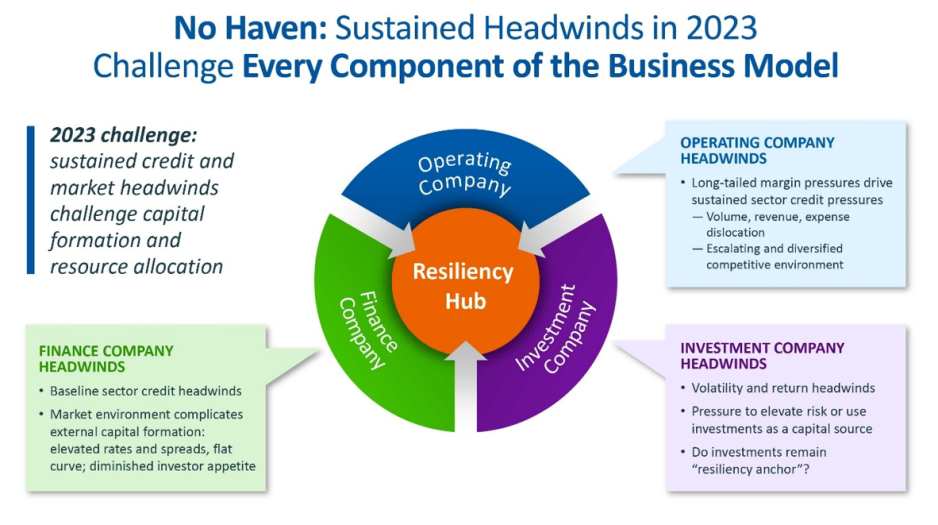
For the first time in recent history, we saw all three
functions of the not-for-profit healthcare system’s
financial structure suffer significant and sustained
dislocation over the course of the year 2022
(Figure above).

The headwinds disrupting these functions
are carrying over into 2023, and it is uncertain how
long they will continue to erode the operating and
financial performance of not-for-profit hospitals
and health systems.


Ÿ The Operating Function is challenged by elevated
expenses, uncertain recovery of service volumes, and
an escalating and diversified competitive environment.


Ÿ The Finance Function is challenged by a more
difficult credit environment (all three rating agencies

now have a negative perspective on the not-forprofit healthcare sector), rising rates for debt, and
a diminished investor appetite for new healthcare
debt issuance. Total healthcare debt issuance in
2022 was $28 billion, down sharply from a trailing
two-year average of $46 billion.


Ÿ The Investment Function is challenged by volatility and
heightened risk in markets concerned with the Federal
Reserve’s tightening of monetary policy and the
prospect of a recession. The S&P 500—a major stock
index—was down almost 20% in 2022. Investments
had served as a “resiliency anchor” during the first
two years of the pandemic; their ability to continue
to serve that function is now in question.

A significant factor in Operating Function challenges is
labor:
both increases in the cost of labor and staffing
shortages that are forcing many organizations to
run at less than full capacity. In Kaufman Hall’s 2022
State of Healthcare Performance Improvement Survey, for
example, 67% of respondents had seen year-over-year
increases of more than 10% for clinical staff wages,
and 66% reported that they had run their facilities at
less-than-full capacity because of staffing shortages.


These are long-term challenges,

dependent in part on
increasing the pipeline of new talent entering healthcare
professions, and they will not be quickly resolved.
Recovery of returns from the Investment Function
is similarly uncertain. Ideally, not-for-profit health
systems can maintain a one-way flow of funds into
the Investment Function, continuing to build the
basis that generates returns. Organizations must now
contemplate flows in the other direction to access

funds needed to cover operating losses, which in
many cases would involve selling invested assets at a
loss in a down market and reducing the basis available
to generate returns when markets recover.


The current situation demonstrates why financial
reserves are so important:

many not-for-profit
hospitals and health systems will have to rely on
them to cover losses until they can reach a point
where operations and markets have stabilized, or
they have been able to adjust their business to a
new, lower margin environment. As noted above,
relief funding and the MAAP program helped bolster
financial reserves after the initial shock of the
pandemic. As the impact of relief funding wanes
and organizations repay remaining balances under
the MAAP program, Days Cash on Hand has begun
to shrink, and the need to cover operating losses is
hastening this decline. From its highest

point in 2021, Days Cash on Hand had decreased, as
of September 2022, by:


Ÿ 29% at the 75th percentile, declining from 302 to 216
DCOH (a drop of 86 days)


Ÿ 28% at the 50th percentile, declining from 202 to 147
DCOH (a drop of 55 days)


Ÿ 49% at the 25th percentile, declining from 67 to 34
DCOH (a drop of 33 days)


Financial reserves are playing the role
for which they were intended; the only
question is whether enough not-for-profit
hospitals and health systems have built
sufficient reserves to carry them through
what is likely to be a protracted period of
recovery from the pandemic.

KEY TAKEAWAYS

All three functions of the not-for-profit healthcare
system’s financial structure—operations, finance,
and investments—suffered significant and
sustained dislocation over the course of 2022.


Ÿ These headwinds will continue to challenge not-forprofit

hospitals and health systems well into 2023.

Ÿ Days Cash on Hand is showing a steady decline, as
the impact of relief funding recedes and the need
to cover operating losses persists.


Ÿ Financial reserves are playing a critical role in
covering operating losses as hospitals and health
systems struggle to stabilize their operational and
financial performance.

Conclusion

Not-for-profit hospitals and health systems serve
many community needs. They provide patients
access to healthcare when and where they need it.
They invest in new technologies and treatments that
offer patients and their families lifesaving advances
in care. They offer career opportunities to a broad
range of highly skilled professionals, supporting the
economic health of the communities they serve.


These services and investments are expensive and
cannot be covered solely by the revenue received
from providing care to patients.


Strong financial reserves are the foundation of good
financial stewardship for not-for-profit hospitals and
health systems.

Financial reserves help fund needed
investments in facilities and technology, improve an
organization’s debt capacity, enable better access to
capital at more affordable interest rates, and provide a
critical resource to meet expenses when organizations
need to bridge periods of operational disruption or
financial distress.
Many hospitals and health systems today are relying
on the strength of their reserves to navigate a difficult

environment; without these reserves, they would
not be able to meet their expenses and would be at
risk of closure.

Financial reserves, in other words,
are serving the very purpose for which they are
intended—ensuring that hospitals and health systems
can continue to serve their communities in the face of
challenging operational and financial headwinds.

When these headwinds have subsided, rebuilding these
reserves should be a top priority to ensure that our
not-for-profit hospitals and health systems can remain
a vital resource for the communities they serve.

Financial Reserves and Credit Management

For large capital projects—construction of a new cancer
treatment center, for example, or replacement of an
aging facility—issuance of municipal debt is one of the
most affordable ways for not-for-profit hospitals and
health system to finance the project
.

The affordability of that debt is, however, partly contingent on the
organization’s ability to maintain a strong credit rating,
and financial reserves—again measured as Days Cash on
Hand—are a significant component of that credit rating.


There are two basic forms of municipal debt:


Ÿ General obligation bonds are backed by the full
taxing power of the issuing municipal authority and
are considered relatively low risk. Hospitals that are
owned by a city or county can be funded by general
obligation bonds, although there are practical
limitations on their ability to issue these bonds,
including in many instances the need to obtain voter
or county commissioner approval. Organizations

without municipal ownership—including most
not-for-profit hospitals and health systems—
cannot issue general obligation bonds.


Ÿ Revenue-backed municipal bonds are backed by
the ability of the organization borrowing the debt
to meet its obligation to make principal and interest
payments through the revenue it generates over the
life of the bond. Because revenues can be disrupted
by any range of factors, revenue-backed bonds are
higher risk for investors. Most healthcare bonds
are revenue-backed municipal bonds.


When determining whether to invest in revenue-backed
municipal healthcare bonds, investors will look to the
credit rating of the hospital or health system that is
borrowing the debt. Credit ratings—issued by one or
more of the three major credit rating agencies (Fitch
Ratings, Moody’s Investors Service, and S&P Global
Ratings)—provide an assessment of the probability

that the hospital or health system will be able to meet
the terms of the debt obligation. These ratings are
tiered. A credit rating in the AA tier is better than a credit
rating in the A tier, which is better than a rating in the
BBB tier. Ratings below the BBB tier are considered sub-investment grade.

Organizations with a sub-investment
grade rating can still access various forms of debt,
but the amount of debt they can access generally will
be lower, the cost of the debt will be higher, and the
covenants that lenders require will be more stringent
than for investment-grade rated organizations.


Financial reserves and credit ratings


Days Cash on Hand is one of the most important factors
credit rating agencies use because it is an indicator
of how long the rated organization could withstand
serious disruption to its operations and cashflow.
The rating agencies issue median values for the various
metrics they use to determine credit ratings. Median

values for Days Cash on Hand increased significantly
across most rating categories for all three agencies
in 2020 and 2021; this reflects the temporary inflow
of pandemic relief funding through, for example,
the Coronavirus Aid, Relief, and Economic Security
(CARES) Act.


We anticipate these medians will move
closer to pre-pandemic levels as relief funds are
exhausted and hospitals repay remaining balances
on Medicare’s COVID-19 Accelerated and Advanced
Payment (MAAP) program funds. But even before
the pandemic, organizations in 2019 had a median
Days Cash on Hand
of 276 to 289 days at the AA level,
173 to 219 days at the A level, and 140 to 163 days at
the BBB level.


In other words, the Days Cash on Hand
benchmark for organizations seeking to maintain an
investment-grade rating would be well over 100 Days
Cash on Hand, and well over 200 Days Cash on Hand for
organizations seeking to achieve a higher rating level.
Again, these reserves are proportionate to the operating
expenses of the individual hospital or health system.

Impact of credit ratings on access to capital


Organizations that can achieve a higher rating can
also borrow money at more affordable interest
rates. Figure 3 shows average interest rates for
municipal bonds across a range of maturities as of
mid-December 2022 (maturity is the term in years
for repayment of the bond at the time the bond is
issued). Lower-risk general obligation municipal bonds
are shown as the baseline, with lines for AA, A, and
BBB rated healthcare revenue-backed bonds above
it. As a reminder, most hospitals and health systems
cannot borrow money using general obligation bonds;
instead, they use higher-risk revenue-backed bonds
.
Because revenue-backed bonds are a higher risk for
investors than tax-based general obligation bonds,

even hospitals and health systems with a strong
AA credit rating will pay a higher interest rate than
would a city or county that could back repayment of
the bond with tax revenues (see the line for AA rated
Healthcare Revenue Bonds compared to the line
for AAA rated General Obligation bonds). But there
is also a significant gap between the interest rate a
hospital with an AA credit rating would pay compared
to the interest rate available to a hospital with a lower
BBB rating
. Here, the difference is approximately
three-fourths of a full percentage point. When the
amount borrowed for a major new hospital project
can run into the hundreds of millions of dollars,
that difference represents significant savings for
organizations with a higher credit rating.

Financial reserves and debt capacity


Financial reserves and the funds they generate—
including investment income—also help define an
organization’s debt capacity: essentially, the amount of
debt an organization can assume without jeopardizing
its current credit rating. There are two key ratios here:


Ÿ The first is total unrestricted cash and investments
to debt.
In general, the more favorable that ratio is,
the more latitude a hospital or health system has to
take on additional debt, especially if the organization
is toward the middle to top end of its rating tier.

Ÿ The second is the debt service coverage ratio,
which measures the organization’s ability to
make principal and interest payments with funds
derived from both operating and non-operating
(e.g., investment income) activity. A higher ratio
here means the organization has more funds
available to service debt.


The ability to assume additional debt is an important
safety valve
if, for example, an organization needs to
mitigate poor financial performance to fund ongoing
capital needs or strategic initiatives.

KEY TAKEAWAYS

Not-for-profit hospitals and health systems often
borrow debt through revenue-backed municipal
bonds, meaning that the debt obligations will be
met by the revenue the organization generates
over the life of the bond.


Ÿ Because revenue-backed bonds are higher
risk than general obligation bonds
backed by a
municipality’s taxing authority (revenues can
be disrupted), investors seek assurance that an
organization will be able to meet its obligations.


Ÿ Credit ratings offer investors an assessment of
an organization’s current and near-term ability to
meet these obligations.

Ÿ Days Cash on Hand is an important metric in
assessing the organization’s credit rating, and a
higher rating generally requires a higher number of
Days Cash on Hand.


Ÿ A higher credit rating allows organizations to
borrow money at more affordable interest rates.


Ÿ A higher level of financial reserves and investment
income in relation to existing debt obligations also
increases an organization’s debt capacity, creating
an important safety valve if an organization has
to borrow money to mitigate poor operating or
investment performance.