UPMC halts prepayment plan for Highmark Medicare Advantage members

https://www.goerie.com/news/20190605/upmc-halts-prepayment-plan-for-highmark-medicare-advantage-members

Image result for upmc highmark

The plan would have required those members to pay in full for out-of-network visits to UPMC hospitals and physician offices.

Highmark Medicare Advantage members will not have to pay in advance for medical services at UPMC hospitals and physician offices that will be out of network if the UPMC-Highmark consent decrees are allowed to expire June 30.

UPMC officials informed the Pennsylvania Insurance Department of the change Wednesday, according to a news release on UPMC’s website. They had said in late 2018 that UPMC would require patients with out-of-network Medicare Advantage plans to pay in advance for any nonemergency treatment and then seek reimbursement from their insurer.

In addition, UPMC will accept direct payment from Highmark for out-of-network emergency care at the same rate UPMC Health Plan now pays Highmark’s Allegheny Health Network hospitals, including Saint Vincent Hospital.

“As the consent decrees near their end on June 30, our intent is to ensure that Highmark members can receive emergency and other care that they need without being caught in the middle of billing issues created by their insurer,” UPMC spokesman Paul Wood said in the news release.

UPMC’s decision came after federal officials said they might be taking a closer look at UPMC’s prepayment policy, the Pittsburgh Post-Gazette reported.

UPMC will bill Highmark directly for its Medicare Advantage members who use out-of-network services and will accept reimbursement at the Medicare fee schedule amount, UPMC said in the news release.

The announcement comes about a week before a Pennsylvania Commonwealth Court judge will hold a hearing in Harrisburg regarding the state attorney general’s office’s attempt to modify and extend the consent decrees past June 30. The hearing is scheduled for Tuesday and Wednesday.



Breaking down blockchain’s role in healthcare

https://www.healthcarefinancenews.com/node/138760?mkt_tok=eyJpIjoiTVRWbU1UVmpOak13T1RZeSIsInQiOiJxVjJhTTVib1QwQkp3Qkl4QVExeUZTZVFoUDZYZ1NHa3U1VGhrQmQ5NklQdnc1c2g3WXJnMXJja09ldTVZTDRNSnZIZUJZQWxGTmg5M2JpS1BZb085UzFHblZvU3FTejVjRFRjV1BcL1ZcL1VoSzBCc2hPcEpVeHJ5c1BKaW9JMnFYIn0%3D

Image result for Breaking down blockchain's role in healthcare HIMSS

HIMSS Director of Informatics Mari Greenberger says that as pilot tests move into production, healthcare organizations should rally around a use case and understand who needs to be involved to reduce redundancies and costs.


Democrats Yet To Successfully Explain Medicare For All

https://www.forbes.com/sites/brucejapsen/2019/05/26/from-bernie-to-warren-democrats-yet-to-successfully-explain-medicare-for-all/#3e8b63126daf


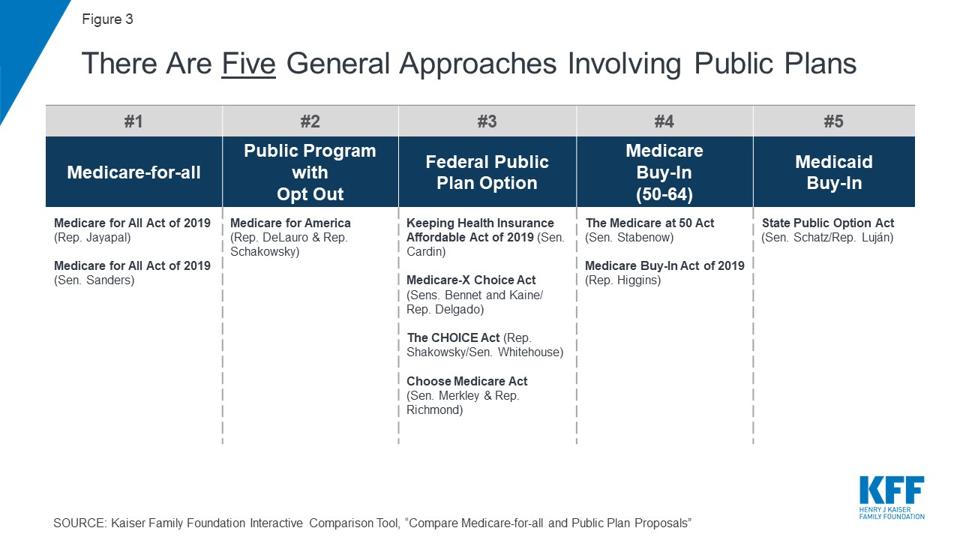
Kaiser Family Foundation Medicare For All briefing on national public healthcare plan approaches introduced in Congress (May 21, 2019).

Even with two dozen Democrats running for President and most touting an expansion of Medicare benefits to everybody, the public is still unclear how a national single payer health plan like “Medicare for All” will benefit them.

A briefing from experts at the nonpartisan Kaiser Family Foundation for health reporters last week revealed there are five general approaches to expanding coverage involving public plans.

Within those approaches are 10 national plans introduced in Congress that include everything from a single payer version of Medicare for All that would uproot private coverage to a “public program with an opt out” that would be offered along side commercial coverage. Other plans would allow Americans to buy into Medicare as young as 50 years old or buy into Medicaid coverage for the poor.

But no matter the effort to expand health insurance coverage, much is to be done to educate the public at large even as single payer supporters like Sens. Bernie Sanders, Elizabeth Warren and Kamala Harris push Medicare for All on the campaign trail.

“Our polling shows some Americans are unaware of how the implementation of a national health plan could impact them,” said Mollyann Brodie, Kaiser’s senior vice president and executive director, public opinion and survey research. “For example, many people (55%) falsely assume that would be able to keep their current health insurance under a single-payer plan.”

Democrats on the campaign trail hoping to challenge President Donald Trump should Republicans nominate him to run for re-election in 2020 see rising support for a national health plan that would make the government the only insurance carrier.

Kaiser data shows 56% favor a national health plan “in which all Americans would get their insurance from a single government plan.” Just 40% favored such a national health plan 20 years ago, Kaiser data shows.

“Our polls have shown a modest increase in support for the idea of a national health plan,” Kaiser’s Medicare for All presentation showed. Some of these health insurance expansions would be single payer versions of “Medicare for All’ like that proposed by Sanders in the U.S. Senate and Rep. Pramila Jayapal (D-Washington) in the U.S. House of Representatives that would uproot private coverage and replace it with government run Medicare.

Other public approaches would involve a “public program with an opt out” known as Medicare for America or a “Medicare Buy in” like that proposed by Sen. Debbie Stabenow (D-Michigan). Other public plans would involve a so-called “federal public plan option” that would be offered along side commercial coverage on a government exchange and there are also Medicaid buy-in proposals being floated in a number of states.

Politically, the lack of knowledge of Medicare for All and public option proposals offers opportunities for both Democrats who favor Medicare for All and Republicans who want to derail a government expansion of health benefits, particular an approach that would essentially replace much of the private system.

“As the public learns more about the implications of each of these proposals, support may increase or decrease,” Kaiser’s Brodie said.


Who is blocking ‘Medicare for All’?

Who is blocking ‘Medicare for All’?

Who is blocking 'Medicare for All'?

Decades of corporate-friendly politics and policy have decimated communities throughout the country. Centrist Democrats who have chosen corporate profits over people’s needs have aided and abetted this decimation. People are hungry for big ideas to improve their lives and to change the rules that serve only to make the rich richer.

Nowhere is this hunger more apparent than in the demand for improved “Medicare for All”. During a hearing at the House Budget Committee this week it was also apparent that the center-right and their wealthy donors won’t go down without a fight when it comes to health care. 

With guns-a-blazing, they are out to block an incredibly successful and popular program: Medicare, from being improved, expanded and provided to everyone.

Yet polling shows that across party lines,majority of Americans are in favor of Medicare for All. And why not? Right now, nearly 30 million people in this country are uninsured; 40 million can’t afford health-care co-pays and deductibles and 45,000 die annually as a result of not having access to health care.

Those reaping the excessive profits from our illnesses and injuries are in a panic. They’re laying all their chips on the table to make sure Medicare for All never becomes reality. It would mean the end of private insurance companies that profit mightily off the most costly and least effective health-care system in the industrialized world.

So, to continue to rake in their profits, they’ve created the Partnership for America’s Health Care Future, a partnership of corporate hospitals, insurance and drug companies. They must have a lot to lose: last year alone, the group spent $143 million developing attack ads and launching fear campaigns to kill Medicare for All.

It’s time to admit it, while nearly every modern country in the world provides quality, accessible health care for free or very inexpensively to their citizens, the United States stands alone in its willingness to let corporations suck the last pennies out of sick or injured people.

Well, the jig is up. Decades under a corporate-run private health insurance system have proven that we can’t rely on profiteers to provide access to quality health care. We need a publicly held system that is accountable to the people who rely on it. We are able to do so and save trillions of dollars over the next decade.

Medicare for All would reduce national health-care spending by anywhere between $2 trillion to $10 trillion over ten years. Research shows that countries with single-payer systems spend much less on drugs.

Yet opponents continue to decry the “costs” of Medicare for All. They will continue to focus on the cost to taxpayers, conveniently avoiding the truth that already we pay excessive health care costs through insurance premiums, co-pays and deductibles.

Americans suffer from poor health outcomes because they can’t afford to see a doctor until their illness becomes catastrophic. Many weigh the choice between financial ruin and life-saving medicines and treatment. In one of the richest countries in the world that is nothing short of shameful.

The U.S. is a country with abundant resources and more than enough wealth to go around. It’s time to share the wealth in America. It’s a new day and it starts with Medicare for All. Buckle up — because the fight is just beginning.


Toward 2020: A Survey of ACA Market Insurers

Click to access Toward_2020_A_Survey_of_ACA_Market_Insurers.pdf


Even the most seasoned patients are no match for the Medical Insurance Industrial Complex

https://www.kevinmd.com/blog/2019/05/even-the-most-seasoned-patients-are-no-match-for-the-medical-insurance-industrial-complex.html

Image result for Medical Insurance Industrial Complex

“Does my insurance cover this?”

I cannot calculate how often a patient poses this inquiry to me assuming wrongly that I have expertise in the insurance and reimbursement aspects of medicine. If I — a gastroenterologist — do not even know how much a colonoscopy costs, it is unlikely that I can speak with authority to a patient’s general insurance coverage issues.

Of course, patients assume that we physicians have an expansive expertise of the medical universe, both in the business and the practice of medicine. Often, friends and acquaintances will informally present a medical issue for my consideration that is wildly beyond my limited specialty knowledge, and yet they expect an informed opinion. “Hey, aren’t you a doctor?” Yes, I am, but if you think a gastroenterologist — a colonoscopy crusader — can advise you on your upcoming hip surgery, psoriasis treatment retinal detachment, or cardiac rehab, think again.

And, I likely know more about psoriasis treatment than I do about the enigma of insurance coverage. I have to check with our billing expert to understand my own medical coverage, and I’m in the business. And, at the risk of appearing as a simpleton to my erudite readers, I cannot aver that I fully grasp the meaning of the EOB (explanation of benefits) forms that I receive for my own care that purport to explain exactly where my insurance company responsibilities end and mine begin.

Imagine for a moment that you are an actual physician as you counsel a patient who is sent to you for a screening colonoscopy. (To assist you in this role play, a screening colonoscopy means there are no symptoms or any other abnormalities that would justify the procedure. A screening study is done on patients who are entirely well as a preventive medicine exercise. In contrast, if a patient has a symptom, such as pain or bleeding, then the colonoscopy is considered diagnostic and not screening.) You advise your 50-year-old patient that his screening colonoscopy will be fully covered by insurance. The patient is happy.

However, during the screening colonoscopy, a polyp is discovered and removed. Indeed, removing polyps is the mission of the procedure. However, polyp removal automatically changes the procedure from screening to diagnostic. And, guess what? Now, the procedure may not be free and the patient may be subject to copays or diving into his deductible. When the patient receives his EOB, and properly decodes it, he is no longer happy. Then, our office is likely to receive a phone call.

This is but one example of the Medical Insurance Industrial Complex. Even our most seasoned patients are no match against this machine. It’s not a fair fight. They make the rules, change them at will and serve as the referees. And, if the insurance company ruling doesn’t fall your way, relax, you can certainly appeal. This process is about as pleasurable as undergoing a rigid sigmoidoscopy. The appeals process is not for the faint of heart. You must have the patience of Job, the fortitude of a Navy SEAL, accept rejection gracefully, welcome irrationality, regard a dropped phone connection as an amusing event and have several consecutive hours available typically at times most inconvenient for you. On reflection, perhaps the sigmoidoscopy is the more pleasant option.