Cleveland Clinic more than quadruples operating income

https://www.beckershospitalreview.com/finance/cleveland-clinic-more-than-quadruples-operating-income.html

Cleveland Clinic’s revenues and operating income increased year over year in the second quarter of 2019, according to unaudited financial documents.

Cleveland Clinic’s revenues climbed to $2.7 billion in the second quarter of this year, up 20 percent from $2.2 billion in the same period of 2018. The boost was largely attributable to higher net patient service revenue, which increased 20.5 percent year over year.

The system’s operating expenses were up 16 percent year over year in the second quarter of 2019. Expenses grew across all categories, including supplies, administrative services, and salaries, benefits and wages.

Cleveland Clinic ended the second quarter of 2019 with operating income of $116.2 million, up from $25.1 million in the second quarter of last year. The system’s operating margin was 4.4 percent in the second quarter of this year, compared to an operating margin of 1.1 percent in the same period of 2018.

During the second quarter of this year, Cleveland Clinic’s nonoperating gains totaled $110.3 million. That’s compared to the second quarter of 2018, when the system reported nonoperating gains of $55.6 million. The system said the increase was primarily attributable favorable changes in the financial markets.

Cleveland Clinic ended the second quarter of 2019 with net income of $226.5 million, up from $80.7 million in the same period a year earlier.


California legislature passes bill requiring Kaiser Permanente to follow financial disclosure laws

https://www.healthcarefinancenews.com/node/139106?mkt_tok=eyJpIjoiT1RkbU5UVXpNMlkyTm1NeiIsInQiOiJ3YVpITnV3WlVcL0dzcGgxQVkxMHFBZjFOSFZLXC9SZ0pHd3ZuUE5aWGt6MHMxbXpoMG9GeDJxSUc1cVVjXC9cL2loR2tnd1lXb050QzFXXC9SU2hHQnZZQVdWQ1lZNlMwRTFWbXV2TUIwXC9MMlNYcFwvdkluODBUWXRwaEdHZTNndUZYN3QifQ%3D%3D

The bill would require Kaiser Permanente to provide more data about the revenue and profits of individual hospitals.

Legislation requiring healthcare giant Kaiser Permanente to follow more of the same financial disclosure laws as other healthcare providers in California passed the Senate Monday and now heads to Gov. Gavin Newsom, who has 10 days to decide whether to sign it into law.

The bill, SB 343, would require Kaiser Permanente to provide more data about the revenue and profits of individual hospitals, whereas now it lumps those figures for all facilities into two broad categories: “Northern California” and “Southern California.” Of the roughly 400 hospitals operating in California, all but the 35 owned by Kaiser Permanente must comply with financial reporting requirements on a per-facility basis.

WHAT’S THE IMPACT

The new requirements for Kaiser Permanente would include breaking out expenses and revenue at each facility; breaking out revenue by type of payor at each facility (Medicare, Medi-Cal or private insurance); and breaking out rate increases by type of service (hospital, physician services, pharmacy, radiology and laboratory).

For Kaiser Permanente to comply with the legislation, it is estimated it would need to hire two workers to compile and distribute related data on a quarterly basis. The corporation has 250,000 employees and operating revenue of nearly $80 billion.

Kaiser Permanente, despite being a nonprofit healthcare system, has reported $11 billion in profits since Jan. 1, 2017 — including $5.2 billion just in the first half of 2019. It has made more in profits in the first six months of 2019 than it has ever recorded in an entire year and sits on reserves of more than $37 billion. Meanwhile, premiums for Kaiser patients have gone up year after year as part of a rate-setting process.

With Kaiser controlling more than 65% of insured Californians with large group healthcare coverage, SB 343 would allow employers and others to negotiate fair rates when purchasing health insurance for their workers.

The measure passed the California Assembly 58-13 on Aug. 22, and it is supported by a coalition of healthcare, consumer, business and worker advocates.

Kaiser Permanente did not immediately respond to a request for comment.

THE LARGER TREND

In June, Kaiser Permanente announced plans to construct a new headquarters — The Kaiser Permanente Thrive Center — in Oakland, bringing together staff currently spread out across multiple locations. The health system said the impetus behind the $900 million project is reducing annual operating costs and delivering more affordable care and coverage.

Officials say the new downtown Oakland building will reduce operational costs by more than $60 million annually, addressing facilities maintenance, inefficient utility expenses, and rising commercial real estate leases. Reinvesting these savings will help the health system advance its mission of providing quality, affordable care.

ON THE RECORD

“For too long, Kaiser Permanente has operated under a different set of rules when it comes to financial transparency, and this bill will finally bring the corporation more in line with other hospitals and insurance companies,” said Sen. Richard Pan, D-Sacramento, the author of SB 343. “Employers and individual Kaiser customers deserve to know if they are getting value when Kaiser increases their premiums and copays.”


DOJ investigates Providence St. Joseph Health’s Swedish Health Services

https://www.modernhealthcare.com/providers/doj-investigates-providence-st-joseph-healths-swedish-health-services?utm_source=modern-healthcare-daily-finance-thursday&utm_medium=email&utm_campaign=20190829&utm_content=article1-readmore

The U.S. Department of Justice is probing Providence St. Joseph Health’s Swedish Health Services in a civil investigation, the not-for-profit integrated health system revealed in its recent quarterly earnings report.

The DOJ requested documents from Seattle-based Swedish related to certain arrangements, joint ventures and physician organizations, according to the report. Providence St. Joseph said that the investigation will not have a “material adverse effect” on its financials.

“Like all large institutions, Swedish is subject periodically to investigations and lawsuits,” Swedish said in a statement. “Per our policy, we are not able to discuss the specifics of any investigation. However, Swedish fully cooperates with all investigations.”

Renton, Wash.-based Providence St. Joseph also disclosed in the earnings report malpractice allegations against certain affiliates, although the “probable recoveries in these proceedings and the estimated costs and expenses of defense will be within applicable insurance limits or will not materially adversely affect the business or properties of the system,” the organization said.

The DOJ said in a statement that it does not confirm, deny or comment on investigations.

In 2014, HHS’ Office of Inspector General audited Swedish Health’s Swedish Medical Center–First Hill, an acute-care hospital in Seattle. It found that about two-thirds of 257 inpatient and outpatient claims from 2010 to 2012 did not fully comply with Medicare billing requirements, resulting in net overpayments of nearly $937,500.

Also, Swedish Health was accused in 2017 of asking neurosurgeons to increase patient volume and perform unnecessary surgeries.

The recent investigation involving Swedish may relate to a delicate balance providers must strike with their affiliates.

Health systems have been carefully navigating around the Stark law, which aims to curb Medicare and Medicaid spending by prohibiting physicians and hospitals from making referrals based on their financial self-interest. But the 1989 statutes conflict with outcome-oriented care, providers argue as the law dissuades them from incentive-based arrangements.

The Stark law offers little, if any, room for error and carries significant financial penalties, experts said. Maintaining compliance and abiding audits can drain resources.

Through six months of Providence St. Joseph Health’s 2019 fiscal year, it reported an operating income of $250 million on operating revenue of $12.6 billion, up from $30 million of operating income on $12 billion of operating revenue over the same period prior. The health system reported $41 million in restructuring costs, as it aims to streamline operations and boost productivity.

For 2018, the organization drew just $3 million in operating income last year on $24.4 billion in total operating revenue. Excluding asset impairment, severance and consulting costs related to restructuring, the system said its 2018 operating income would have been $165 million. The restructuring costs are being spread across 2018 and 2019.

As it restructures, Providence St. Joseph has been expanding its non-acute portfolio, forming a for-profit population health management company, launching its second, $150 million venture fund and buying a revenue-cycle management company based on blockchain technology.


Ohio State Wexner Medical Center clears $4B revenue mark

https://www.beckershospitalreview.com/finance/ohio-state-wexner-medical-center-clears-4b-revenue-mark.html?origin=cfoe&utm_source=cfoe

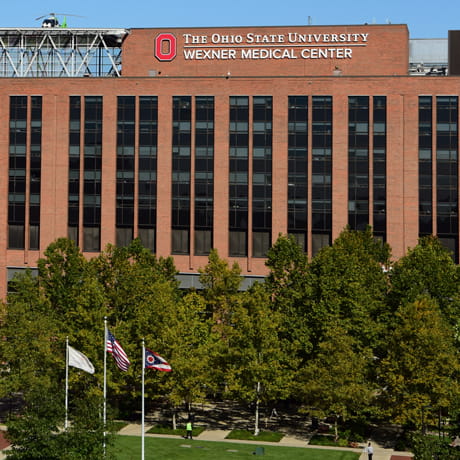
Image result for Ohio State Wexner Medical Center

The Ohio State University Wexner Medical Center in Columbus reported strong revenue in the fiscal year ended June 30, according to Columbus Business First.

The nonprofit medical center recorded revenue of more than $4 billion in fiscal year 2019, up 9.4 percent from the year prior, the newspaper reported, citing its analysis of financial results. The growth was partially attributable to a 4 percent year-over-year increase in inpatient admissions.

After factoring in expenses, Ohio State Wexner’s operating income reached $402 million in the fiscal year ended June 30. That’s the highest total since fiscal year 2015, when the medical center posted operating income of $358 million.

The financial results come as Ohio State Wexner plans inpatient and outpatient expansion projects, according to Columbus Business First. An 840-bed hospital tower and a parking garage are on the drawing board.


The provider lobby takes on Congress

https://www.axios.com/the-provider-lobby-takes-on-congress-57d2acc6-b26b-4b57-aa64-a75606e612b8.html

Illustration of a giant health plus on top of a pile of cash, the ground underneath is cracking.

Ending surprise medical bills inspires bipartisan kumbaya in a way nearly unheard of these days, and yet a brutal lobbying and public relations blitz by doctor and hospital groups is threatening to kill the entire effort.

Driving the news: Provider-backed groups are spending millions of dollars to sway lawmakers and the public opinion against Congress’s efforts to ban surprise billing, according to a handful of recent reports.

Details:

  • A dark money group called Doctor Patient Unity has spent more than $13 million on advertising in states where senators are up for re-election, Bloomberg Government reported on Monday — the most expensive campaign on any congressional health care topic this year.
  • Modern Healthcare’s Susannah Luthi reported yesterday that some congressional staffers worry that the provider onslaught will cause the entire surprise billing effort to collapse. The staffers say that may be what the groups want; providers insist this isn’t the case.
  • My colleague Bob Herman reported last week that physician outsourcing companies — which are often the source of surprise medical bills — and private equity firms have flooded Congress with lobbyists.

The other side: Other congressional aides are less worried about the surprise billing effort being killed.

  • “If anything, [providers’] tactics are backfiring. Compassion is winning. Members are more concerned for patients than a profit fight between industries,” a GOP aide familiar with the effort told me.
  • Instead, “members are beginning to question private equity’s interest in this. What is it they’re willing to invest $13 million to save and why are they hiding behind dark money?”


Advocate Aurora Health’s net income more than doubles in Q2

https://www.beckershospitalreview.com/finance/advocate-aurora-health-s-net-income-more-than-doubles-in-q2.html

Image result for advocate aurora health headquarters

Outpatient volume growth helped push Advocate Aurora Health’s revenue higher in the second quarter of 2019, according to unaudited financial documents released Aug. 22.

Advocate Aurora Health, which was formed in April 2018 and has dual headquarters in Downers Grove, Ill., and Milwaukee, reported revenue of $3.2 billion in the second quarter of 2019, up from $3 billion in the same period a year earlier. Patient service revenue climbed 8.8 percent year over year partially due to increased outpatient volume. The health system said capitation revenue dropped 9.9 percent year over year due to the conversion of a full-risk arrangement to fee-for-service.

After factoring in a 4.7 percent year-over-year increase in expenses, Advocate Aurora posted operating income of $132.3 million in the second quarter of 2019. That’s up from $107.2 million in the same period a year earlier.

The 28-hospital system reported nonoperating income of $286 million in the second quarter of this year, which includes investment income of $194.4 million. Advocate Aurora ended the second quarter of 2019 with net income of $418.4 million, up from $158.7 million a year earlier.


California hospital set to emerge from bankruptcy after 2 years

https://www.beckershospitalreview.com/finance/california-hospital-set-to-emerge-from-bankruptcy-after-2-years.html

Image result for Tulare Regional Medical Center

A U.S. bankruptcy court approved Tulare (Calif.) Local Health Care District’s Chapter 9 plan on Aug. 16. The district, which includes a 101-bed hospital, is now set to emerge from the bankruptcy process, according to The Porterville Recorder.

Tulare Regional Medical Center, the district’s hospital, entered Chapter 9 bankruptcy in 2017 and closed for a year. The hospital reopened in October 2018 and entered into a lease agreement with Roseville, Calif.-based Adventist Health. The hospital, now called Adventist Health Tulare, recently opened a birth center and plans to add a sleep lab and mammography services.

Adventist Health Tulare President Randy Dodd is pleased the court approved the healthcare district’s bankruptcy plan.

“This is the resolution we have all been hoping for,” he said, according to The Porterville Recorder. “The partnership we began with Tulare in 2018 is a perfect fit with Adventist Health’s commitment and service to the Central Valley. We are glad to be able to extend our excellent healthcare system to this underserved market.”


Merger creates 5-hospital system in Georgia

https://www.beckershospitalreview.com/hospital-transactions-and-valuation/merger-creates-5-hospital-system-in-georgia.html

Image result for Merger creates 5-hospital system in Georgia

The merger of Sandy Springs, Ga.-based Northside Hospital and Lawrenceville, Ga.-based Gwinnett Medical Center will be official Aug. 28.

Northside Hospital, a three-hospital system, and Gwinnett Medical Center, a two-hospital system, will create a combined organization with 1,636 inpatient beds, more than 250 outpatient locations and nearly 21,000 employees.

Several of Gwinnett’s facilities, including its two hospitals, will be renamed once the merger is finalized. Gwinnett Medical Center-Lawrenceville (Ga.) will be renamed Northside Hospital Gwinnett, and Gwinnett Medical Center-Duluth (Ga.) will be renamed Northside Hospital Duluth.


The Facts on Medicare Spending and Financing

https://www.kff.org/medicare/issue-brief/the-facts-on-medicare-spending-and-financing/

Figure 7: Sources of Medicare Revenue, 2018

Medicare, the federal health insurance program for more than 60 million people ages 65 and over and younger people with long-term disabilities, helps to pay for hospital and physician visits, prescription drugs, and other acute and post-acute care services. This issue brief includes the most recent historical and projected Medicare spending data published in the 2019 annual report of the Boards of Medicare Trustees from the Centers for Medicare & Medicaid Services (CMS) Office of the Actuary (OACT) and the 2019 Medicare baseline and projections from the Congressional Budget Office (CBO).

Key Facts
  • Medicare spending was 15 percent of total federal spending in 2018, and is projected to rise to 18 percent by 2029.
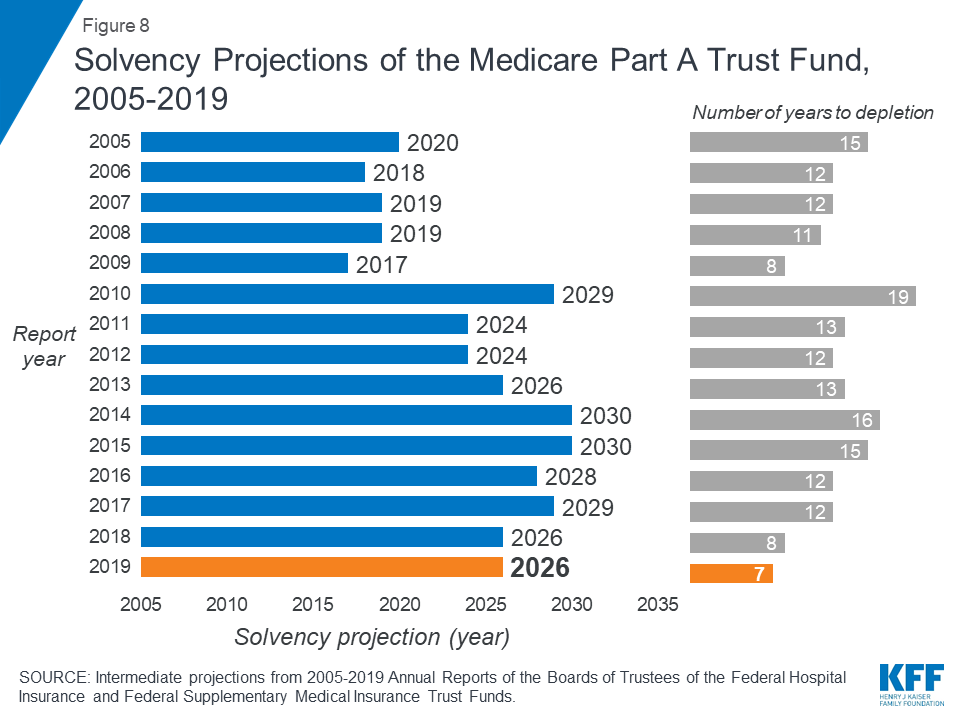
  • Based on the latest projections in the 2019 Medicare Trustees report, the Medicare Hospital Insurance (Part A) trust fund is projected to be depleted in 2026, the same as the 2018 projection.
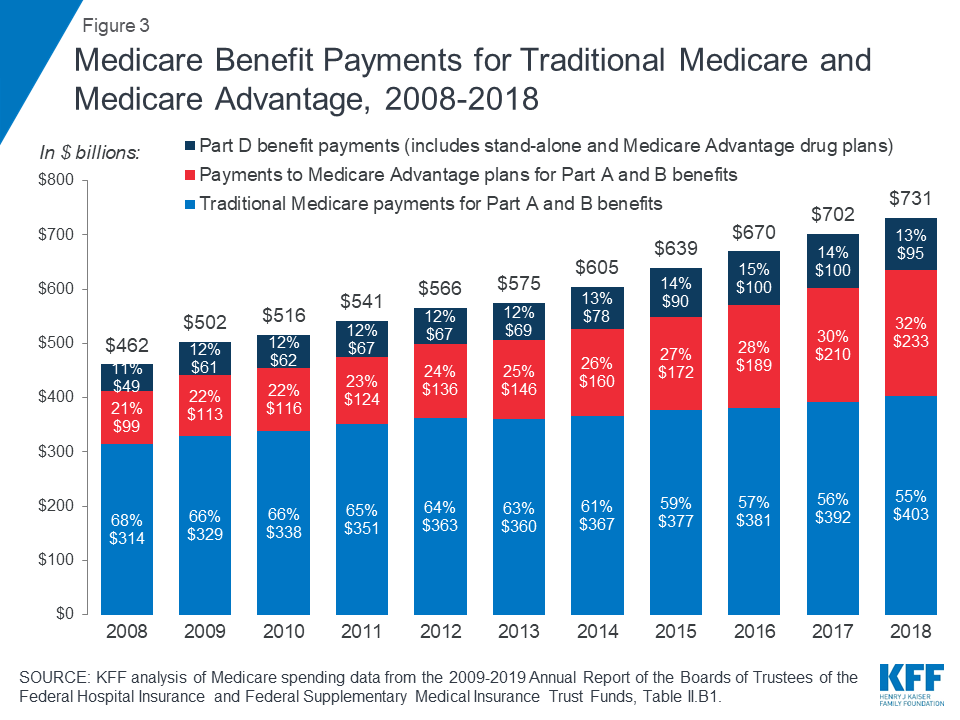
  • In 2018, Medicare benefit payments totaled $731 billion, up from $462 billion in 2008.
  • As a share of total Medicare benefit spending, payments to Medicare Advantage plans for Part A and Part B benefits increased by nearly 50 percent between 2008 and 2018, from 21 percent ($99 billion) to 32 percent ($232 billion) of total spending, as enrollment in Medicare Advantage plans increased over these years.
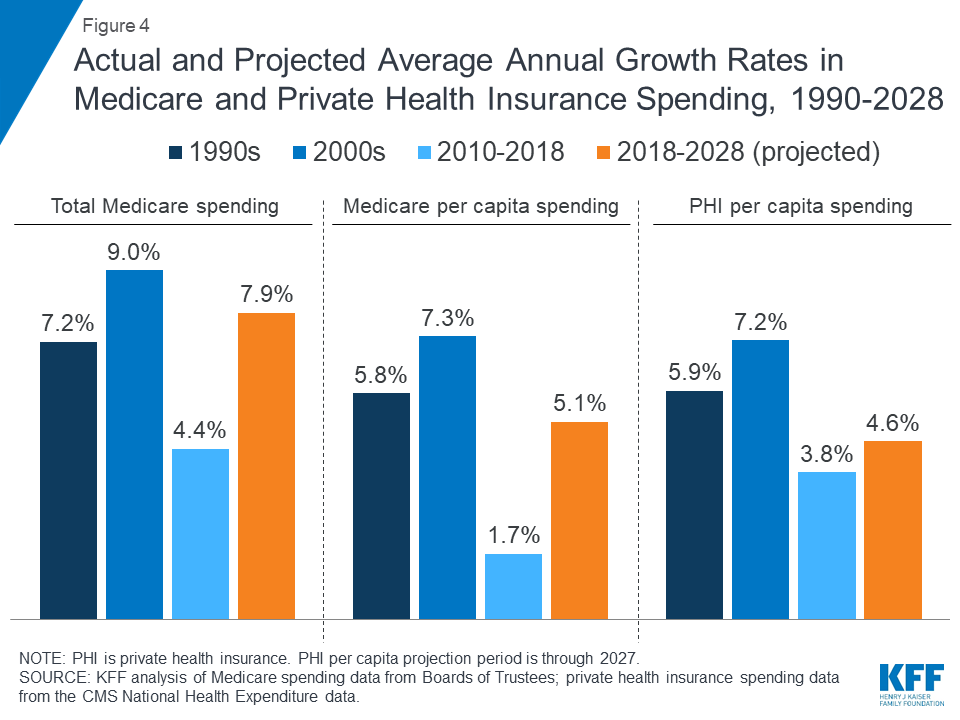
  • Average annual growth in Medicare per capita spending was 1.7 percent between 2010 and 2018, down from 7.3 percent between 2000 and 2010, due in part to the Affordable Care Act’s reductions in payments to providers and plans, and to an influx of younger beneficiaries from the baby boom generation aging on to Medicare, who have lower per capita health care costs.
  • Medicare per capita spending is projected to grow at an average annual rate of 5.1 percent over the next 10 years (2018 to 2028), due to growing Medicare enrollment, increased use of services and intensity of care, and rising health care prices.

Overview of Medicare Spending

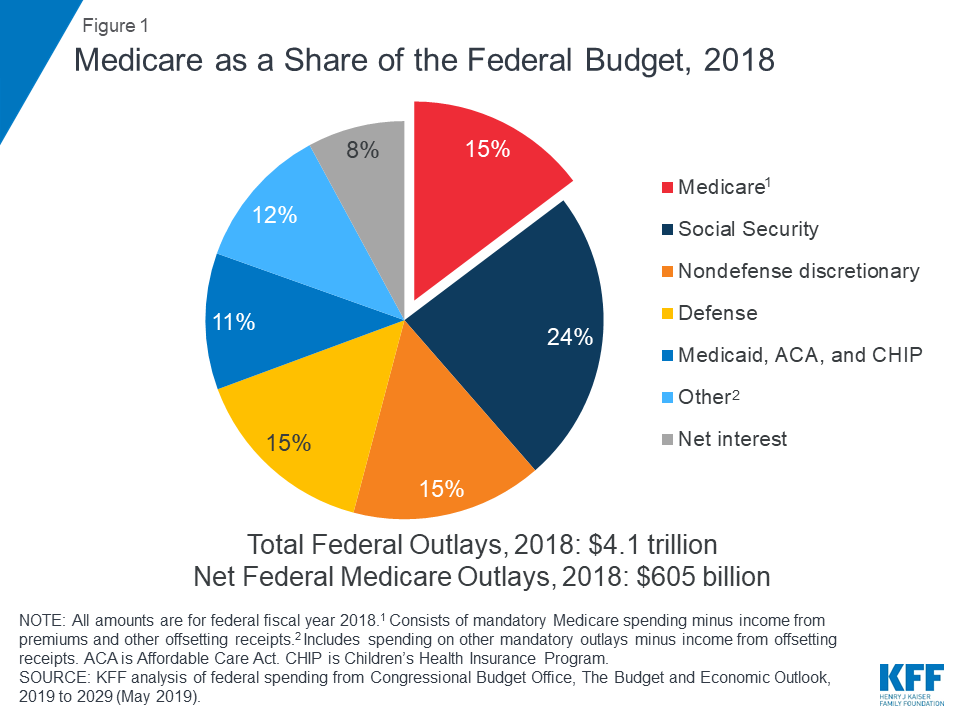
Medicare plays a major role in the health care system, accounting for 20 percent of total national health spending in 2017, 30 percent of spending on retail sales of prescription drugs, 25 percent of spending on hospital care, and 23 percent of spending on physician services. In 2018, Medicare spending (net of income from premiums and other offsetting receipts) totaled $605 billion, accounting for 15 percent of the federal budget (Figure 1).

Figure 1: Medicare as a Share of the Federal Budget, 2018

Historical Trends in Medicare Spending

Trends in Medicare Benefit Payments

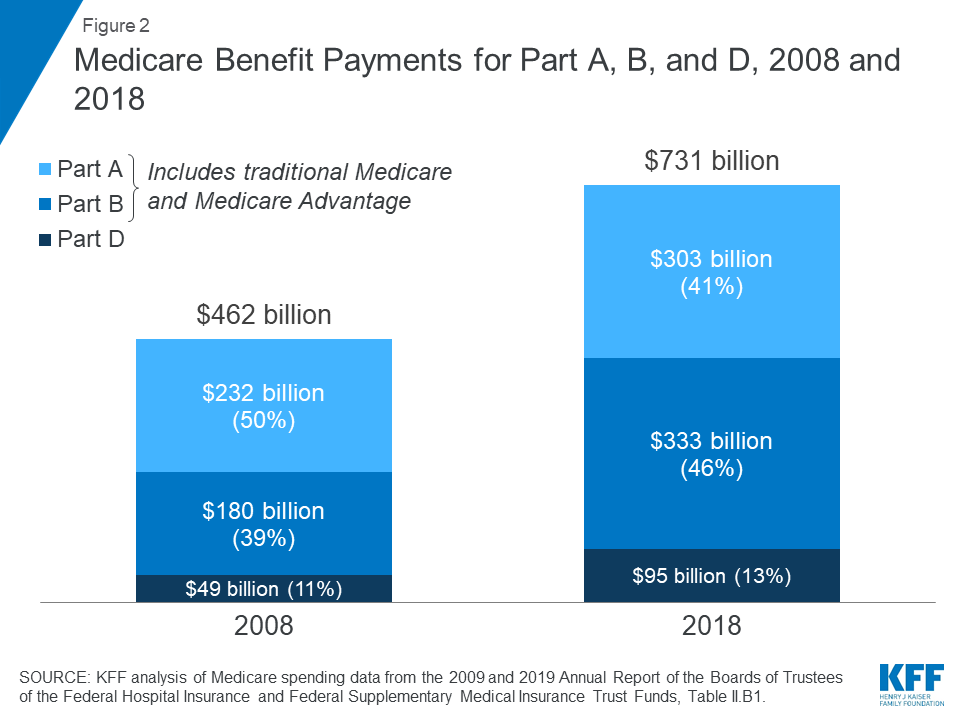
In 2018, Medicare benefit payments totaled $731 billion, up from $462 billion in 2008 (Figure 2) (these amounts do not net out premiums and other offsetting receipts). While benefit payments for each part of Medicare (A, B, and D) increased in dollar terms over these years, the share of total benefit payments represented by each part changed. Spending on Part A benefits (mainly hospital inpatient services) decreased from 50 percent to 41 percent, spending on Part B benefits (mainly physician services and hospital outpatient services) increased from 39 percent to 46 percent, and spending on Part D prescription drug benefits increased from 11 percent to 13 percent.

Figure 2: Medicare Benefit Payments for Part A, B, and D, 2008 and 2018

Another notable change in Medicare spending in the past 10 years is the increase in payments to Medicare Advantage plans, which are private health plans that cover all Part A and Part B benefits, and typically also Part D benefits. As a percent of total Medicare benefit spending, payments for Part A and Part B benefits covered by Medicare Advantage plans increased by nearly 50 percent between 2008 and 2018, from 21 percent ($99 billion) to 32 percent ($232 billion), as private plan enrollment grew steadily over these years (Figure 3). In 2018, 34 percent of Medicare beneficiaries were enrolled in Medicare Advantage plans, up from 22 percent in 2008.

Figure 3: Medicare Benefit Payments for Traditional Medicare and Medicare Advantage, 2008-2018

The overall cost of administering benefits for traditional Medicare is relatively low. In 2018, administrative expenses for traditional Medicare (plus CMS administration and oversight of Part D) were 1.3 percent of total program spending; this includes expenses for the contractors that process claims submitted by beneficiaries in traditional Medicare and their providers. This estimate does not include insurers’ costs of administering private Medicare Advantage and Part D drug plans, which are considerably higher. Medicare’s actuaries estimate that insurers’ administrative expenses and profits for Part D plans were 10.7 percent of total plan benefit payments in 2018. The actuaries have not provided a comparable estimate for Medicare Advantage plans; however, according to a recent analysis, simple loss ratios (medical expenses as a share of total premiums collected) averaged 86 percent for Medicare Advantage plans in 2018, which means that administrative expenses, including profits, were 14 percent for Medicare Advantage plans.

Trends in Total and Per Capita Medicare Spending

There has been a notable reduction in the growth of Medicare spending in recent years, compared to prior decades, both overall and per beneficiary.

  • Average annual growth in total Medicare spending was 4.4 percent between 2010 and 2018, down from 9.0 percent between 2000 and 2010, despite faster growth in enrollment since 2011 when the baby boom generation started becoming eligible for Medicare (Figure 4).
  • Average annual growth in Medicare spending per beneficiary was just 1.7 percent between 2010 and 2018, down from 7.3 percent between 2000 and 2010.
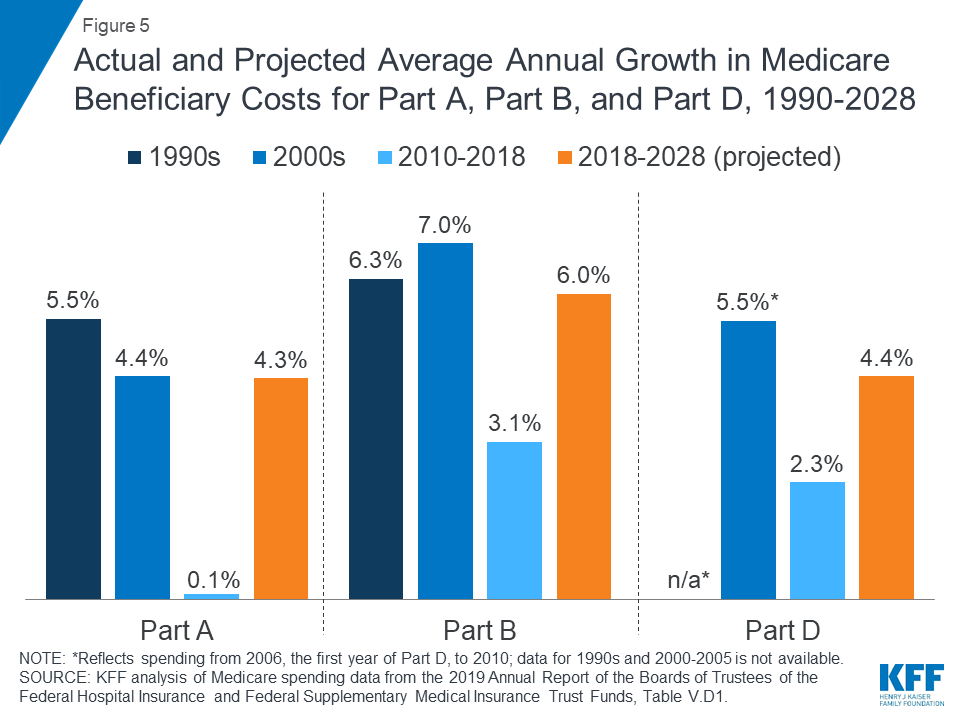
  • Spending on each of the three parts of Medicare (A, B, and D) has grown more slowly in recent years than in previous decades (Figure 5). For example, the average annual growth rate between 2010 and 2018 was 0.1 percent for Part A, compared to 4.4 percent in the 2000s, and 3.1 percent for Part B, compared to 7.0 percent in the 2000s.

Figure 4: Actual and Projected Average Annual Growth Rates in Medicare and Private Health Insurance Spending, 1990-2028

Figure 5: Actual and Projected Average Annual Growth in Medicare Beneficiary Costs for Part A, Part B, and Part D, 1990-2028

Slower growth in Medicare spending in recent years can be attributed in part to policy changes adopted as part of the Affordable Care Act (ACA) and the Budget Control Act of 2011 (BCA). The ACA included reductions in Medicare payments to plans and providers, increased revenues, and introduced delivery system reforms that aimed to improve efficiency and quality of patient care and reduce costs, including accountable care organizations (ACOs), medical homes, bundled payments, and value-based purchasing initiatives. The BCA lowered Medicare spending through sequestration that reduced payments to providers and plans by 2 percent beginning in 2013.

In addition, although Medicare enrollment has been growing between 2 percent and 3 percent annually for several years with the aging of the baby boom generation, the influx of younger, healthier beneficiaries has contributed to lower per capita spending and a slower rate of growth in overall program spending.

Spending Trends for Medicare Compared to Private Health Insurance

Prior to 2010, per enrollee spending growth rates were comparable for Medicare and private health insurance. With the recent slowdown in the growth of Medicare spending and the recent expansion of private health insurance through the ACA, however, the difference in growth rates between Medicare and private health insurance spending per enrollee has widened.

  • In the 1990s and 2000s, Medicare spending per enrollee grew at an average annual rate of 5.8 percent and 7.3 percent, respectively, compared to 5.9 percent and 7.2 percent for private insurance spending per enrollee (Figure 4).
  • Between 2010 and 2018, Medicare per capita spending grew considerably more slowly than private insurance spending, increasing at an average annual rate of just 1.7 percent over this time period, while average annual private health insurance spending per capita grew at 3.8 percent.

Medicare Spending Projections

Short-Term Spending Projections for the Next 10 Years

While Medicare spending is expected to continue to grow more slowly in the future compared to long-term historical trends, Medicare’s actuaries project that future spending growth will increase at a faster rate than in recent years, in part due to growing enrollment in Medicare related to the aging of the population, increased use of services and intensity of care, and rising health care prices.

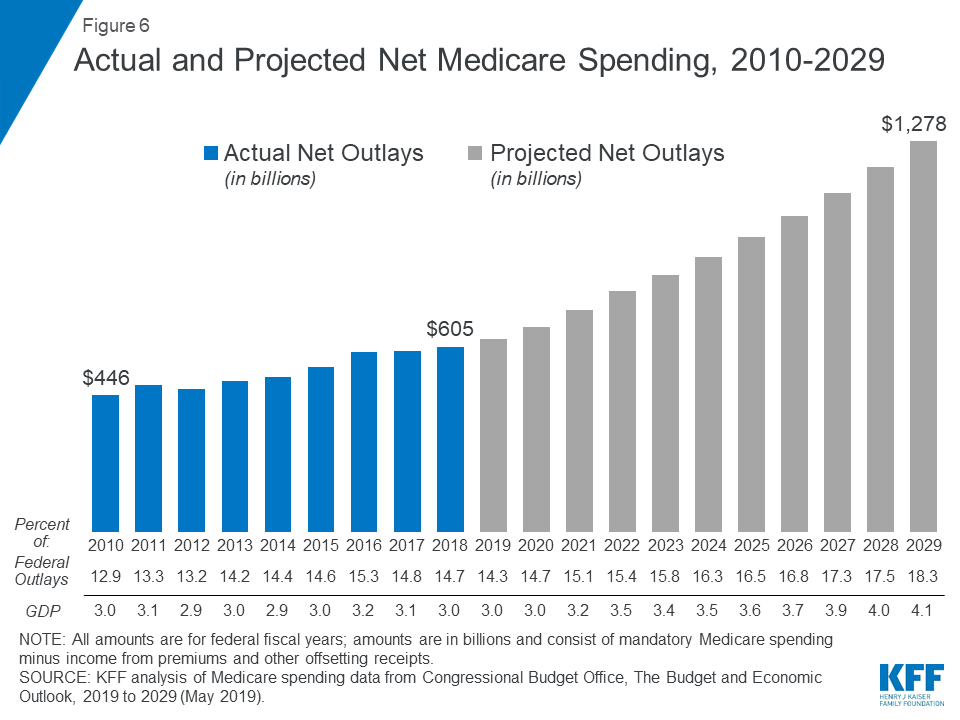
Looking ahead, CBO projects Medicare spending will double over the next 10 years, measured both in total and net of income from premiums and other offsetting receipts. CBO projects net Medicare spending to increase from $630 billion in 2019 to $1.3 trillion in 2029 (Figure 6). Between 2019 and 2029, net Medicare spending is also projected to grow as a share of the federal budget—from 14.3 percent to 18.3 percent—and the nation’s economy—from 3.0 percent to 4.1 percent of gross domestic product (GDP).

Figure 6: Actual and Projected Net Medicare Spending, 2010-2029

Spending Growth Rate Projections for the Next 10 Years

  • Average annual growth in total Medicare spending is projected to be higher between 2018 and 2028 than between 2010 and 2018 (7.9 percent versus 4.4 percent) (Figure 4).
  • On a per capita basis, Medicare spending is also projected to grow at a faster rate between 2018 and 2028 (5.1 percent) than between 2010 and 2018 (1.7 percent), and slightly faster than the average annual growth in per capita private health insurance spending over the next 10 years (4.6 percent).
  • Medicare’s actuaries project a higher per capita growth rate in the coming decade for each part of Medicare, compared to their 2010-2018 growth rates: 6.0 percent for Part B, 4.4 percent for Part D, and 4.3 percent for Part A (Figure 5).
  • Among the reasons cited for projected growth in Part B spending are legislative changes in the Bipartisan Budget Act (BBA) of 2018, including repeal of the Independent Payment Advisory Board (which also affects Part A and Part D spending projections) and repealing annual limits on therapy services covered under Part B, and higher Medicare Advantage spending. Projected increases in Part B per capita spending will lead to increases in the Part B premium and deductible.
  • The projected increase in Part D per capita spending growth is driven by a slowdown in the generic dispensing rate and increased specialty drug use, offset by higher manufacturer rebates negotiated by private plans and a decline in spending for hepatitis C drugs, which was a significant driver of higher total Part D spending in 2014 and 2015.

Long-term Spending Projections

Over the longer term (that is, beyond the next 10 years), both CBO and OACT expect Medicare spending to rise more rapidly than GDP due to a number of factors, including the aging of the population and faster growth in health care costs than growth in the economy on a per capita basis. According to CBO’s most recent long-term projections, net Medicare spending will grow from 3.0 percent of GDP in 2019 to 6.0 percent in 2049.

Over the next 30 years, CBO projects that “excess” health care cost growth—defined as the extent to which the growth of health care costs per beneficiary, adjusted for demographic changes, exceeds the per person growth of potential GDP (the maximum sustainable output of the economy)—will account for half of the increase in spending on the nation’s major health care programs (Medicare, Medicaid, and subsidies for ACA Marketplace coverage), and the aging of the population will account for the other half.

How is Medicare Financed?

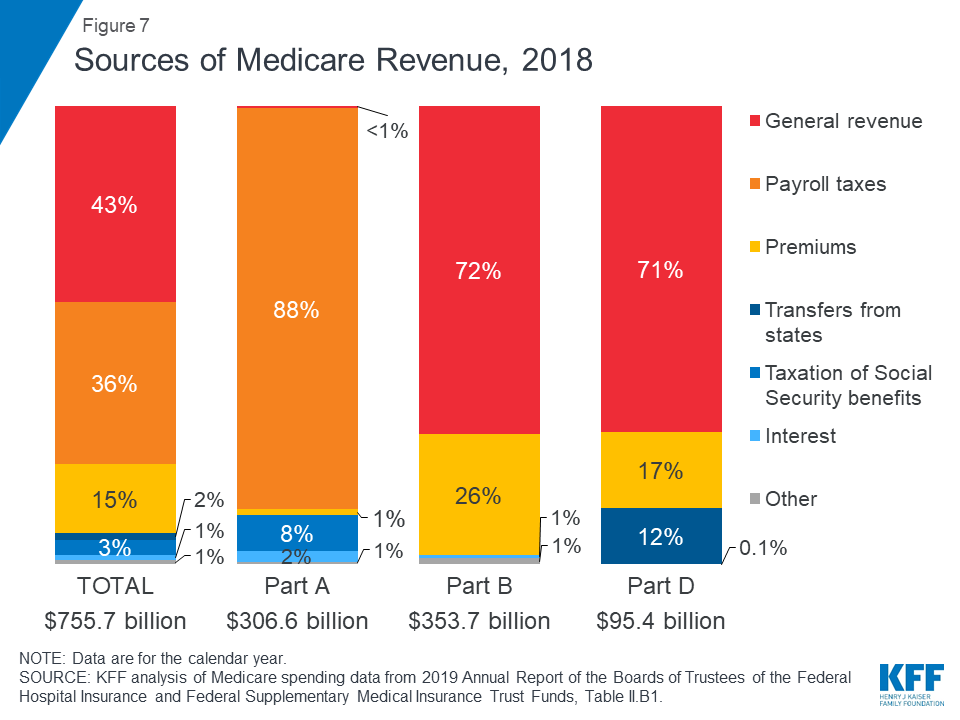
Medicare is funded primarily from general revenues (43 percent), payroll taxes (36 percent), and beneficiary premiums (15 percent) (Figure 7).

Figure 7: Sources of Medicare Revenue, 2018

  • Part A is financed primarily through a 2.9 percent tax on earnings paid by employers and employees (1.45 percent each) (accounting for 88 percent of Part A revenue). Higher-income taxpayers (more than $200,000/individual and $250,000/couple) pay a higher payroll tax on earnings (2.35 percent).
  • Part B is financed through general revenues (72 percent), beneficiary premiums (26 percent), and interest and other sources (2 percent). Beneficiaries with annual incomes over $85,000/individual or $170,000/couple pay a higher, income-related Part B premium reflecting a larger share of total Part B spending, ranging from 35 percent to 85 percent.
  • Part D is financed by general revenues (71 percent), beneficiary premiums (17 percent), and state payments for beneficiaries dually eligible for Medicare and Medicaid (12 percent). Higher-income enrollees pay a larger share of the cost of Part D coverage, as they do for Part B.
  • The Medicare Advantage program (Part C) is not separately financed. Medicare Advantage plans, such as HMOs and PPOs, cover Part A, Part B, and (typically) Part D benefits. Beneficiaries enrolled in Medicare Advantage plans pay the Part B premium, and may pay an additional premium if required by their plan; about half of Medicare Advantage enrollees pay no additional premium.

Assessing Medicare’s Financial Condition

Medicare’s financial condition can be assessed in different ways, including comparing various measures of Medicare spending—overall or per capita—to other spending measures, such as Medicare spending as a share of the federal budget or as a share of GDP, as discussed above, and estimating the solvency of the Medicare Hospital Insurance (Part A) trust fund.

Solvency of the Medicare Hospital Insurance Trust Fund

The solvency of the Medicare Hospital Insurance trust fund, out of which Part A benefits are paid, is one way of measuring Medicare’s financial status, though because it only focuses on the status of Part A, it does not present a complete picture of total program spending. The solvency of Medicare in this context is measured by the level of assets in the Part A trust fund. In years when annual income to the trust fund exceeds benefits spending, the asset level increases, and when annual spending exceeds income, the asset level decreases. When spending exceeds income and the assets are fully depleted, Medicare will not have sufficient funds to pay all Part A benefits.

Each year, Medicare’s actuaries provide an estimate of the year when the asset level is projected to be fully depleted. In the 2019 Medicare Trustees report, the actuaries projected that the Part A trust fund will be depleted in 2026, the same year as their 2018 projection and three years earlier than their 2017 projection (Figure 8). The actuaries estimate that Medicare will be able to cover 89 percent of Part A costs from payroll tax revenue in 2026.

Figure 8: Figure 8: Solvency Projections of the Medicare Part A Trust Fund, 2005-2019

In the 2018 and 2019 Medicare Trustees reports, the actuaries attributed the earlier depletion date to several factors, including legislative changes enacted since the 2017 report that will reduce revenues to the Part A trust fund and increase Part A spending:

  • lower-than-expected revenues from payroll taxes in 2017 and 2018 due to lowered wages and lower levels of projected GDP;
  • lower revenue projections from taxation of Social Security benefits (which provided 8 percent of Part A revenues in 2018) as a result of the tax cut legislation enacted in December 2017;
  • higher-than-expected spending for Part A benefits and higher projected provider payment updates;
  • higher spending projections due repeal of the ACA’s individual mandate, which is expected to increase the number of people without health insurance, which will result in an increase in Medicare’s disproportionate share hospital (DSH) payments for uninsured patients; and
  • higher spending projections due to repeal of the Independent Payment Advisory Board, which would have helped to control Medicare spending if the growth rate exceeded certain target levels.

In general, Part A trust fund solvency is also affected by the level of growth in the economy, which affects Medicare’s revenue from payroll tax contributions, by overall health care spending trends, and by demographic trends—of note, an increasing number of beneficiaries, especially between 2010 and 2030 when the baby boom generation reaches Medicare eligibility age, and a declining ratio of workers per beneficiary making payroll tax contributions.

Part B and Part D do not have financing challenges similar to Part A, because both are funded by beneficiary premiums and general revenues that are set annually to match expected outlays. Expected future increases in spending under Part B and Part D, however, will require increases in general revenue funding and higher premiums paid by beneficiaries.

The Future Outlook

Although Medicare spending is on a slower upward trajectory now than in past decades, total and per capita annual growth rates are trending higher than their historically low levels of the past few years. The aging of the population, growth in Medicare enrollment due to the baby boom generation reaching the age of eligibility, and increases in per capita health care costs are leading to growth in overall Medicare spending. At the same time, recent legislative changes, including repeal of the ACA’s individual mandate and repealing IPAB, have worsened the short-term outlook for the Medicare Part A trust fund and have led to projections of higher Medicare spending in the future.

A number of changes to Medicare have been proposed in the past to address the fiscal challenges posed by the aging of the population and rising health care costs. Lately, policymakers have been focused more narrowly on policy options to control Medicare prescription drug spending, rather than on broader proposals to reduce the growth in Medicare spending. And there has been little discussion of revenue options that could be considered to help finance care for Medicare’s growing and aging population, including raising the Medicare payroll tax or increasing other existing taxes. Meanwhile, Medicare has featured prominently in the 2020 presidential campaign, with proposals from some Democratic candidates to expand on it as part of a Medicare-for-all plan, and ideas from others to allow people to buy into it.

The prospects for proposals that would affect Medicare’s financial outlook are unknown, but they will require careful deliberation over the effects on not only the program’s finances but also its growing number of beneficiaries.


Trump considers payroll tax cut — what it could mean for healthcare

https://www.beckershospitalreview.com/finance/trump-considers-payroll-tax-cut-what-it-could-mean-for-healthcare.html?origin=cfoe&utm_source=cfoe

The White House is considering a payroll tax cut, President Donald Trump confirmed Aug. 20, according to The Washington Post.

The president’s confirmation comes after the White House disputed that it was considering a payroll tax cut, the Post reported Aug. 19. The tax would help jump-start a slowing economy by giving low- and middle-income Americans more spending power.

However, payroll taxes do help fund Medicare. A cut could significantly handicap that program, which is just seven years away from running dry, depending on how the tax is designed. A payroll tax cut of two percentage points in 2011-12 reduced taxes by more than $100 billion each year, according to The Washington Post. During those years, the Obama administration redirected revenue to Social Security programs and the federal deficit took the hit, according to the report.

Read more here.