Is Informed Consent Being Used as a Guise for Spreading Misinformation?

The website for the group Physicians for Informed Consent (PIC) reads like an apolitical, educational resource that provides information on vaccines and why they shouldn’t be government-mandated. Its mission is “that doctors and the public are able to evaluate the data on infectious diseases and vaccines objectively, and voluntarily engage in informed decision-making about vaccination.”

The group’s accompanying social media accounts, however, tell a different story. On PIC’s Facebook, Twitter, Instagram, and LinkedIn feeds, you’ll find post after post about reasons to be scared of vaccinesespecially for children – often highlighting selective portions of scientific research that contain vaccination risks.

Who’s Behind PIC?

The group was founded in 2015 after California passed a law that prohibited the use of personal belief exemptions from vaccinations required for children to attend any public or private school in the state.

Three years later, the number of waivers issued by doctors to parents seeking medical exemptions for their children tripled. As a result, another law was passed in 2019, cracking down on the inappropriate use of medical exemptions.

The group’s founder, Shira Miller, MD, is a concierge integrative medicine doctor based in Los Angeles, specializing in menopausal care. On her own Twitter profile, she describes herself as “Facebook’s Most Popular Menopause Doctor.”

Miller earned her medical degree in 2002 from Technion-Israel Institute of Technology in Haifa, Israel, and has reportedly been working as a concierge physician since 2010.

PIC’s leadership team also includes 20 physicians from a wide range of specialties, most of whom, like Miller, don’t specialize in infectious diseases.

Among its leaders is Paul Thomas, MD, an Oregon-based pediatrician. Thomas, who is listed as one of PIC’s founding directors, was issued an emergency suspension order of his medical license in 2021 by the state medical board, in which they cited at least eight cases of alleged patient harm. In line with PIC’s philosophy, Thomas maintains that he isn’t “anti-vax” – he’s pro-informed-consent.

Also on the team is Jane Orient, MD, internist and executive director of the Association of American Physicians and Surgeons (AAPS), a group that also opposes vaccine mandates. Orient received her medical degree from Columbia University and currently practices in Arizona. In 2020, the AAPS sued the federal government for withholding its stockpile of hydroxychloroquine from COVID patients, despite research showing that the drug is ineffective. The complaint was dismissed in September 2021.

Doug Mackenzie, MD, a plastic surgeon who graduated from Johns Hopkins University of Medicine, is PIC’s treasurer. He has previously identified himself as an “ex-vaxxer” rather than an anti-vaxxer when speaking on a panel in 2019.

The only RN on the team is Tawny Buettner. After California mandated vaccinations for healthcare workers, Buettner organized a protest outside of her place of work, Rady Children’s Hospital in San Diego; she later sued the hospital after she was dismissed from her job. According to the complaint, Buettner and the 36 other plaintiffs alleged that their requests for religious exemptions from the COVID-19 vaccine were all denied.

Kenneth Stoller, MD, also listed on the leadership team, graduated from the American University of the Caribbean School of Medicine and completed pediatric residency training at the University of California Los Angeles. Stoller was disciplined in 2019 for doling out medical exemptions to children without adequate evidence. According to state records, his license in California has since been revoked; he currently holds a medical license in New Mexico.

What’s PIC?

The most notable physician groups accused of spreading COVID-19 misinformation since the vaccine rollout have been affiliated with right-wing media, if not overtly proclaiming conservative, anti-vaccination beliefs.

For example, America’s Frontline Doctors, a group notorious for its support of hydroxychloroquine as a treatment for COVID-19, has made its values well-known. The group’s founder, Simone Gold, MD, JD, was arrested for participating in the Jan. 6 capitol riot and has openly opposed mask-wearing. Similarly, physician leaders of the Front Line COVID-19 Critical Care Alliance, known for promoting the use of ivermectin to treat COVID-19, tout their appearances on the ultra-conservative Newsmax on the website’s homepage.

PIC wants to be different. The group’s focus, according to its general counsel Greg Glaser, JD, of Copperopolis, California, is on the “authoritative citations that show, or calculate, the risks [of vaccines] to the public,” he told MedPage Today.

“We are pro-informed consent, pro-ethics, pro-health. PIC is not anti-vaccine, and PIC is not pro-vaccine – PIC is neutral,” Glaser said on behalf of the group.

In August 2021, Glaser submitted an amicus brief to the Supreme Court PIC’s behalf, arguing against the implementation of vaccine mandates. The document claims that “government statements confirm there is no evidence that COVID-19 vaccines prevent the spread of SARS-CoV-2 or COVID-19,” ignoring the breadth of existing literature that says otherwise.
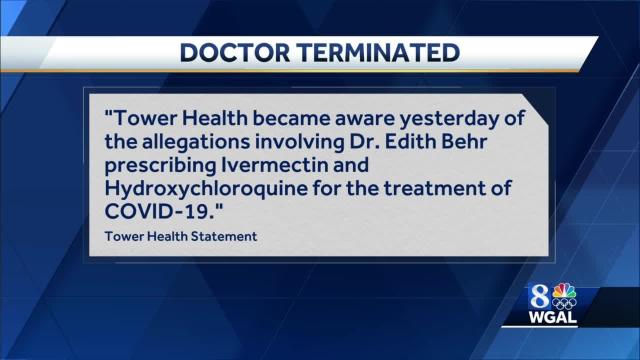
Tower Health fires physician accused of prescribing ivermectin, hydroxychloroquine to treat COVID-19

Tower Health doctor fired for allegedly prescribing ivermectin,  hydroxychloroquine to treat COVID

A Pennsylvania physician accused of prescribing ivermectin and hydroxychloroquine to treat and prevent COVID-19 has been terminated from Tower Health, PennLive reported Feb. 4.

Edith Behr, MD, is allegedly linked to Christine Mason, a woman who used a Facebook account to connect people to a physician for hydroxychloroquine and ivermectin prescriptions. A social media user claimed Dr. Behr was the source of the prescriptions and reported her to authorities and her employer, according to PennLive

West Reading, Pa.-based Tower Health officials became aware of the allegations against Dr. Behr Feb. 2 and took immediate action. 

“Tower Health became aware yesterday of the allegations involving Dr. Edith Behr prescribing ivermectin and hydroxychloroquine for the treatment of COVID-19,” Tower Health said in a Feb. 3 statement to PennLive. “We investigated the matter and, as a result, Dr. Behr’s employment with Tower Health Medical Group has been terminated effective immediately.”

Dr. Behr was a surgeon at Phoenixville (Pa.) Hospital, which is owned by Tower Health, according to the report. 

Ivermectin and hydroxychloroquine have not been approved by the FDA for prevention or treatment of COVID-19.

What should you take if you get Covid-19? 

https://link.vox.com/view/608adc4e91954c3cef03e60dfi7ya.jor/68bd1086

Hey readers, 

Last week, Florida Surgeon General Joseph Ladapo released a public service announcement talking about protecting your health from Covid-19. The PSA stood out for a couple of reasons:

1. While “vaccination” briefly appeared onscreen in a list of options, it didn’t merit a mention in the video.

2. The surgeon general listed guidance on “emerging” treatments that was … remarkably on point.

The absence of focus on vaccines in the video is unfortunate, if entirely in keeping with the GOP’s willingness to play to its anti-vax base. That’s bad, but not surprising.

What was surprising was No. 2. The information Ladapo shared about treatments was fairly accurate. In the video, he told Floridians to ask their doctor about monoclonal antibodies, fluvoxamine, and inhaled budesonide should they come down with Covid-19. 

I’ve been reporting on the Covid-19 treatment beat for much of this year, and I’ve uncovered a massively confusing pile of contradictory information. But those are the top three treatments I’d recommend sick loved ones talk to doctors about, and while there’s much we still don’t know, solid science suggests they have real promise.

That said, the fact that such important (and accurate) information stood out in a government PSA indicates just how dismal the state of public communications on treatments is — and just how much misinformation and distrust are hampering the fight against Covid-19. 

What should you take if you get Covid-19? 

There’s been little public health communication about which treatments to pursue if you get Covid-19, perhaps because for much of the pandemic, it’s been unclear what options are better for mild Covid than just resting at home. While in 2021 the best treatment recommendations have gotten clearer, public health messaging over the last year has rightly been focused on vaccination.

The official CDC page on what to do if you get sick with Covid-19 advises you to wear a mask, wash your hands, and clean high-touch surfaces to avoid infecting those around you. If your breathing deteriorates or you show signs of severe illness like confusion or an inability to stay awake, the CDC advises you to go to the hospital. 

All sound guidance — but what it doesn’t offer is advice on a question that patients who aren’t sick enough for hospitalization might desperately need to know: What medication should I take if I come down with Covid-19? 


That’s not because there’s a lack of options. For instance, the FDA has approved monoclonal antibodies as a treatment for Covid-19 patients at risk of progressing to severe disease. They recently expanded this approval to include monoclonal antibodies for children as well. The treatment has to be administered in a clinic, as an IV infusion or as four shots, but it is highly effective, with some high-quality studies finding an 85 percent reduction in the risk of hospitalization or death.

Meanwhile, large, high-quality, peer-reviewed, and published randomized controlled trials (RCTs) have found promise for cheap therapies that are already FDA approved for other purposes and have an established safety profile. 

One medication, fluvoxamine, is an antidepressant that appears to reduce hospitalizations from Covid-19 by about 30 percent. Another, budesonide asthma inhalers, was found in one large RCT to speed at-home recovery considerably and in another to reduce risk of hospitalization. In the US, there’s been no formal guidance on when to consider budesonide, but in the UK, health agencies have advised doctors they can consider prescribing it off-label to help older and at-risk patients recover at home, while in Canada doctors are encouraged to consider budesonide on a case-by-case basis.

Research underway will help provide a better understanding of both of these therapies, but there’s enough evidence that some doctors are already prescribing them to patients. If you have the opportunity to enroll in an ongoing clinical trial of these medications, you can get access to a potentially promising treatment and help contribute to our scientific understanding of whether these treatments really work.

Another exciting treatment in the pipeline is Paxlovid, an antiviral developed by Pfizer that showed impressive 90 percent efficacy in preventing hospitalization — so effective that in November, the clinical trial stopped enrolling new participants because investigators concluded it’d be unethical to put them in the control group. It has not yet been approved by the FDA, but it might be a game changer if, as is expected, it’s approved in January.

The FDA is also in the process of considering molnupiravir, another repurposed drug that looks to be moderately effective, though there are some concerns it could spur new viral variants.

Why is it so hard to find good guidance about treatments?

The US government has communicated little about Covid-19 treatment options. NIH guidelines about treatments like fluvoxamine haven’t been updated since this past spring, meaning results from recent high-quality studies haven’t been incorporated into that guidance. Without it, physicians considering whether to prescribe these medications can’t turn to official public health resources for help. 


From a certain perspective, that reticence is understandable. Learning which Covid-19 treatments work is very hard. While large-scale RCTs found promising evidence for fluvoxamine and inhaled budesonide, “promising” is still the most we can say — it could absolutely turn out that the real-world effects are much smaller than hoped for, or even fail to materialize altogether.

But it’s precisely because this area is so difficult to navigate for doctors and patients that the CDC, FDA, and NIH could play an important role in pointing out good treatments — yet it’s a role they have been puzzlingly reluctant to play.

Perhaps because of the dearth of formal federal government guidance on treatments — and because of politically driven crazes over drugs like hydroxychloroquine and ivermectin, which evidence thus far suggests do little to fight Covid-19 — Florida media has been critical of Ladapo’s PSA and its recommendations.

Politicians who pander to anti-vax sentiment are harming their constituents, and it’s very reasonable to be frustrated with their conduct. Ladapo is a DeSantis appointee who has forcefully opposed Covid-19 restrictions — and has refused to wear a mask in meetings with immunocompromised legislators — and lots of people are reasonably reading his PSA in that light. 

But that justified irritation shouldn’t get in the way of a needed conversation about the possible benefits and drawbacks of monoclonal antibodies, fluvoxamine, and budesonide. As the US braces for an omicron surge that is likely to hit even vaccinated people, effective treatment is going to be essential for saving lives. Yes, promoting vaccines is a must, but tens of thousands of Americans are getting sick each day, which makes clear, accurate communication about which treatments to ask your doctor about extremely important. 

The more society and public health get aligned on what works, the better off we’ll be in confronting omicron and other future variants.

The Research on Ivermectin and Covid-19

Interest in the antiparasitic drug Ivermectin has increased drastically as of late thanks to the belief that it can help to prevent and/or treat Covid-19. In today’s episode we examine recent data on the efficacy of Ivermectin as an antiviral and discuss the history behind how it gained this reputation.