


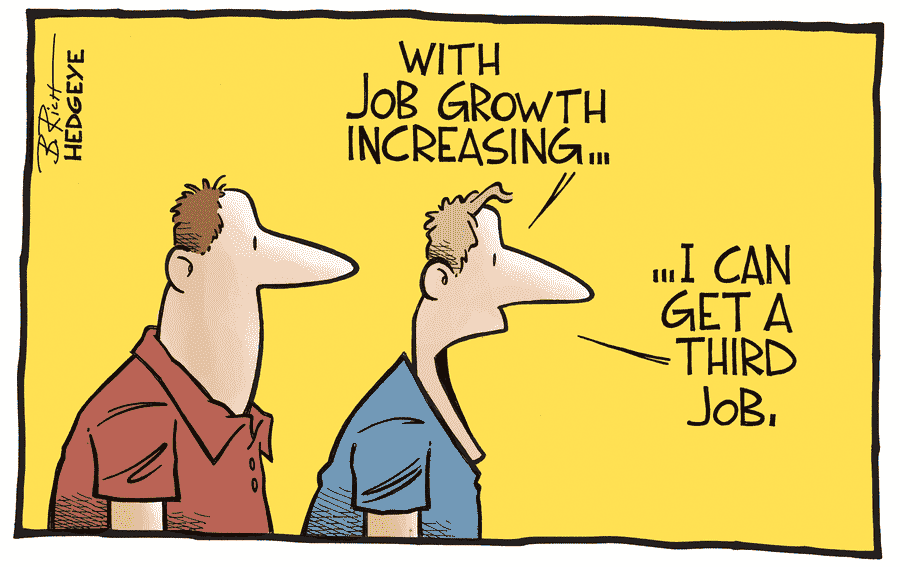
Cartoon – Sign of the Times (Job Search)
https://altarum.org/publications/june-2021-health-sector-economic-indicator-briefs

Altarum’s monthly Health Sector Economic Indicators (HSEI) briefs analyze the most recent data available on health sector spending, prices, employment, and utilization. Support for this work is provided by a grant from the Robert Wood Johnson Foundation. Below are highlights from the June 2021 briefs
National health spending growth reflects rebound from COVID-19
Health care price growth remains stable amid economywide inflation
Health employment up modestly in May, returning to the December 2020 level


Hospitals added 2,900 jobs in May, after four months of job losses this year, according to the latest jobs report from the U.S. Bureau of Labor Statistics.
The May count compares to 5,800 hospital jobs lost in April, 600 jobs lost in March, 2,200 jobs lost in February and 2,100 jobs lost in January. Before January, the last job loss was in September, when hospitals lost 6,400 jobs.
Overall, healthcare added 22,500 jobs last month — compared to 4,100 jobs lost in April and 11,500 jobs added in March — and employment in the industry is down by 508,000 compared with February 2020.
Within healthcare, ambulatory healthcare services saw 22,000 added jobs in May, and nursing and residential care facilities lost 2,400 jobs in May.
Overall, the U.S. gained 559,000 jobs in May after gaining 266,000 in April. The unemployment rate was 5.8 percent last month, compared to 6.1 percent in April.
To view the full jobs report, click here.


https://interimcfo.wordpress.com/2021/04/06/i-just-got-fired-2-0/

Abstract: This article is the second in the series that addresses the initial stages of going through a career transition. Career management articles in the blog have been popular. A transition is a traumatic event, to say the least, especially the first time. These articles address what you should be doing BEFORE your transition occurs.
In the last piece that is the first in this series, I addressed the fact that there is little relationship between how good you are at what you do and the probability that you will end up in a transition.
This article addresses what you should be doing to prepare for an unplanned transition.
The ACHE tracks hospital CEO turnover. The average annual rate is around 18%. According to Challenger, Gray, and Christmas, hospital CEO is one of America’s most dangerous occupations measured by potential longevity or lack thereof in a position. One of my most popular articles discusses some of the many reasons for executive turnover that have little to do with performance. A lot of people are very interested in the topic.
HFMA does not track CFO turnover, but it is probably equally rampant as CFOs too often get credit for substandard organizational performance despite having little control or influence over the incurrence of operating cost or results. CFOs and other C-Suite inhabitants bear a disproportionate risk of having their career disrupted by CEO turnover.
If you start asking around, you might be surprised to learn how many healthcare executives were involuntarily ‘freed up to seek other opportunities’ at least once in their career. When I told my friend John at a reunion that I had decided to go into the consulting business, he immediately accused me (correctly) of having been fired. John went on to tell me how lucky I was because few executives that are disruptive innovators have not been fired at least once. To my friend, having been fired is a rite of passage.
John’s career goal at the time was to become the CEO of a large hospital, and he believed that a transition would strengthen his CV. As fate would have it, not too long after the reunion, I got the call from John and, you know, the rest of the story. John went on from this setback to become the long-running CEO of one of the largest Baptist hospitals in the southeast.
For those who push hard in organizations to get them to change their culture for the better and get on a better track, the risk of being let go is much higher. With one exception, every person that I have ever worked with through a transition has emerged a wiser, stronger person in a position much better suited for their skills and talents. While I would never encourage anyone to go through a transition, the process’s outcome has been both cathartic and career-enhancing.
So, given this risk, what should you be doing? Your preparation for a turnover event should start IMMEDIATELY!! If you wait until you are out, you have waited WAY TOO LONG!! If you do not have a networking database, you need to start immediately to develop this asset. My networking database commenced during my first transition. It now has over 3,000 companies and over 4,100 contacts. Most of my contacts are business-related, and most of them will respond to an email or return a call. Contrast this with the call I get too often from a newly terminated executive asking for connection assistance, that never bothered to record phone numbers or email addresses of people that may be in a position to be of help. Too many friends had contact files stored on a corporate phone or a corporate database and lost them when they turned over a phone or access to corporate systems was terminated. Frequently, access is restricted right before the victim learns of their fate as a security measure of the organization. Getting your data back if this happens is not going to be easy or fun.
For this reason, I have successfully refused to use a company-owned phone or put my networking database developed over twenty years on a computer system I do not control. The problem with having business and personal data on the same device is if you give the organization access to ‘their data, they cannot lock it selectively. When they lock or wipe the device, they are going to destroy everything on the device. My networking database is my most valuable personal asset. There is an article in my blog dedicated to networking. The time to start building your networking database and skill is before you need it.
You should start the process of thinking through the next step in your career. Get out a piece of paper. What do you like about your current situation and wish to preserve? What do you want to change? Where are you willing to relocate? What is your idea of the perfect relationship with a superior? What will the effect of a termination/relocation be on your family, and how will you manage that? In other words, what are you going to be when you grow up? A turnover event is sometimes the catalyst that causes someone to decide to start their own business. Is there a path forward in your current situation, or should you be thinking about proactively inducing your turnover event or at least beginning preparations? People that have been through transitions will tell you from experience that it is a lot easier to get a job while employed than when you are not employed.
A turnover event is a huge psychological and physical burden. Everyone around you is going to be affected. Do not delude yourself into thinking you can manage a transition without help, especially the first one. My dad had a sign in his shop,
Shop Rates
Labor – $20
If you watch – $40
If you help – $80
If you already worked on it yourself, $200
My most significant learning from consulting experience is recognizing when an expert is needed and understanding the necessity of getting my ego out of the way in the process of seeking and availing myself or my client of expert assistance. Clients and consultants do more harm than good by trying to do something they have no business doing in a frequently futile effort to save money. Sometimes, the results are disastrous. We have all heard the adages that a doctor treating himself has an idiot patient or a lawyer who represents himself has a moron for a client.
Contact me to discuss any questions or observations you might have about these articles, leadership, transitions, or interim services. I might have an idea or two that might be valuable to you. An observation from my experience is that we need better leadership at every level in organizations. Some of my feedback comes from people who are demonstrating an interest in advancing their careers, and I am writing content to address those inquiries.
The easiest way to keep abreast of this blog is to become a follower. I will notify you of updates as they occur. To become a follower, click the “Following” bubble that usually appears near each web page’s bottom.
I encourage you to use the comment section at the bottom of each article to provide feedback and stimulate discussion. I welcome input and feedback that will help me to improve the quality and relevance of this work.
This blog is original work. I claim copyright of this material with reproduction prohibited without attribution. I note and provide links to supporting documentation for non-original material. If you choose to link any of my articles, I’d appreciate a notification.
If you would like to discuss any of this content, provide private feedback or ask questions, you can reach me at ras2@me.com.


 HENRY KOTULA