What to look for the in the Labor Department’s May jobs report

https://www.cbsnews.com/news/jobs-report-may-inflation-interest-rates/


The US labor market added more jobs than expected in May defying previous signs of a slowdown in the economy.

Data from the Bureau of Labor Statistics released Friday showed the labor market added 272,000 nonfarm payroll jobs in May, significantly more additions than the 180,000 expected by economists.

Meanwhile, the unemployment rate rose to 4% from 3.9% the month prior. May’s job additions came in significantly higher than the 165,000 jobs added in April.

The print highlights the difficulty the Federal Reserve faces in determining when to lower interest rates and how quickly. The economy and labor market has held up overall, and inflation has remained sticky, building the case for holding rates higher for longer. Yet some cracks have emerged, such as signs of inflation pressuring lower income consumers and rising household debt.

“They’re really walking a tight rope here,” Robert Sockin, Citi senior global economist, told Yahoo Finance of the central bank. He noted the longer the Fed holds rates steady, the more cracks could develop in the economy.

Wages, considered an important metric for inflation pressures, increased 4.1% year over year, reversing a downward trend in year-over-year growth from the month prior. On a monthly basis, wages increased 0.4%, an increase from the previous month’s 0.2% gain.

“To see more confidence that inflation could move lower over time, you’d really like to see the wage numbers look a little lower than we’ve seen them today,” Lauren Goodwin, New York Life Investments economist and chief market strategist, told Yahoo Finance.

Also in Friday’s report, the labor force participation rate slipped to 62.5% from 62.7% the month prior. However, participation among prime-age workers, ages 25-54, rose to 83.6%, its highest level in 22 years.

The largest jobs increases in Friday’s report were seen in healthcare, which added 68,000 jobs in. May. Meanwhile, government employment added 43,000 jobs. Leisure and hospitality added 42,000 jobs.

The report comes as the stock market has hit record highs amid a slew of softer-than-expected economic data, which had increased investor confidence that the Federal Reserve could cut interest rates as of September. After Friday’s labor report, that trend reversed with investors pricing in a 53% chance the Fed cuts rates in September, down from a roughly 69% chance seen just a day prior, per the CME FedWatch Tool.

Other data out this week has reflected a still-resilient labor market that’s showing further signs of normalizing to pre-pandemic levels. The latest Job Openings and Labor Turnover Survey (JOLTS), released Tuesday, showed job openings fell in April to their lowest level since February 2021.

Notably, the ratio between the number of job openings and unemployed people returned to 1.2 in May, which is in line with pre-pandemic levels.
February Jobs Report-U.S. Hiring Remains Strong

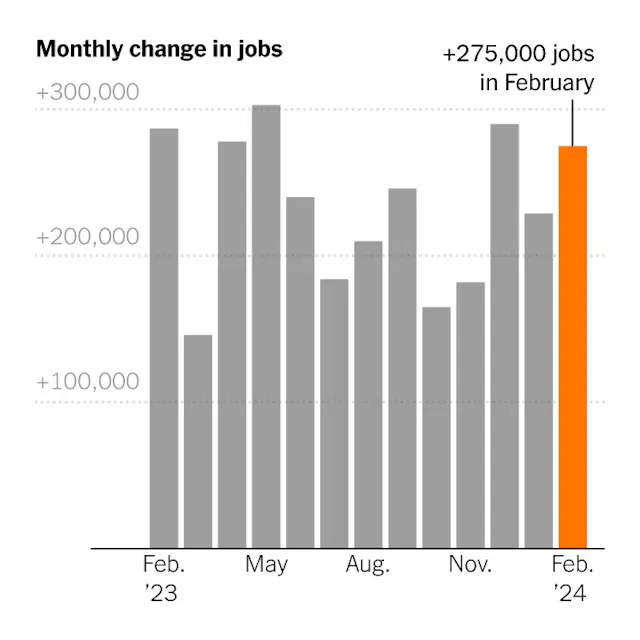
The labor market showed resiliency in February, adding 275,000 jobs, a sign that economic growth is still solid.

If the economy is slowing down, nobody told the labor market.

Employers added 275,000 jobs in February, the Labor Department reported Friday, in another month that exceeded expectations.

It was the third straight month of gains above 200,000, and the 38th consecutive month of growth — fresh evidence that after surging back from the pandemic shutdowns, America’s jobs engine still has plenty of steam.

“We’ve been expecting a slowdown in the labor market, a more material loosening in conditions, but we’re just not seeing that,” said Rubeela Farooqi, chief economist at High Frequency Economics.

The previous two months, December and January, were revised down by a combined 167,000 jobs, reflecting the higher degree of statistical volatility in the winter months. That does not disrupt a picture of consistent robust increases, which now looks slightly smoother..

At the same time, the unemployment rate, based on a survey of households, increased to a two-year high of 3.9 percent, from 3.7 percent in January. A more expansive measure of slack labor market conditions, which includes people working part time who would rather work full time, has been steadily rising and now stands at 7.3 percent.

The unemployment rate was driven by people losing or leaving jobs as well as those entering the labor force to look for work. The labor force participation rate for people in their prime working years — ages 25 to 54 — jumped back up to 83.5 percent, matching a level from last year that was the highest since the early 2000s.

Average hourly earnings rose by 4.3 percent over the year, although the pace of increases has been fading.

“We’ve recently seen gains in real wages, and that’s encouraged people to re-enter the labor market, and that’s a good development for workers,” said Kory Kantenga, a senior economist at the job search website LinkedIn. As wage growth slows, he said, the likelihood that more people will start looking for work falls.

As late as last fall, economists were predicting much more modest employment increases, with hiring concentrated in a few industries. But while some pandemic-inflated industries have shed jobs, expected downturns in sectors like construction haven’t materialized. Rising wages, attractive benefits and more flexible work schedules have drawn millions of workers off the sidelines.

Elevated levels of immigration have also added to the labor supply. According to an analysis by the Brookings Institution, the influx has approximately doubled the number of jobs that the economy could add per month in 2024 without putting upward pressure on inflation, to between 160,000 and 200,000.

Health care and government again led the payroll gains in February, while construction continued its steady increase. Retail and transportation and warehousing, which have been flat to negative in recent months, picked up.

No major industries lost a substantial number of jobs. Credit intermediation continued its downward slide — that sector, which mostly includes commercial banking, has lost about 123,000 jobs since early 2021.

That doesn’t mean the employment landscape looks rosy to everyone. Employee confidence, as measured by the company rating website Glassdoor, has been falling steadily as layoffs by tech and media companies have grabbed headlines. That’s especially true in white-collar professions like human resources and consulting, while those in professions that require working in person — such as health care, construction and manufacturing — are more upbeat.

“It is a two-track labor market,” said Aaron Terrazas, Glassdoor’s chief economist, noting that job searches are taking longer for people with graduate degrees. “For skilled workers in risk-intensive industries, anyone who’s been laid off is having a hard time finding new jobs, whereas if you’re a blue-collar or frontline service worker, it’s still competitive.”

The last few months have been studded with strong economic data, leading analysts surveyed by the National Association for Business Economics to raise their forecasts for gross domestic product and lower their expectations for the trajectory of unemployment. It’s occurred even as inflation has eased, leading the Federal Reserve to telegraph its plans for interest rate cuts sometime this year, which has raised growth expectations further.

Mervin Jebaraj, director of the Center for Business and Economic Research at the University of Arkansas, helped tabulate the survey responses. He said the mood was buoyed partly by fading trepidation over federal government shutdowns and draconian budget cuts, after several close calls since the fall. And he sees no obvious reason for the recovery to end soon.

“Once it starts going, it keeps going,” Mr. Jebaraj said. “You had this external stimulus with all the trillions of dollars of government spending, Now it’s sort of self-sustaining, even though the money’s gone.”

U.S. economy adds whopping 353,000 jobs in January as labor market heats up

https://www.axios.com/2024/02/02/us-jobs-report-january-2024

The U.S. economy added 353,000 jobs in January, while the unemployment rate held at 3.7%, the Labor Department said Friday.

Why it matters: 

The first look at the 2024 labor market shows it’s on fire — not slowing down as previously thought.

Details: 

The January payroll figures show hiring picked up from the 333,000 added the prior month, which itself was revised higher by 117,000.

  • Job gains in November were revised slightly higher, too, by 9,000 to 182,000 jobs added.

What’s new: 

The hiring boom last month came amid strong job gains in health care, retail and professional and business services, while mining and oil and gas extraction are among the sectors that shed jobs.

  • Meanwhile, the labor force participation rate — the share of workers with or looking for a job — was 62.5% in January.
  • Average hourly earnings, a measure of wage growth, soared by 0.6%. Over the past 12 month, average hourly earnings increased by 4.5%.

The big picture: 

The data is the latest in recent weeks to show that the economy is revving up, with fading inflation and steady hiring — a welcome development for the Biden administration that is touting its economic agenda ahead of the 2024 election.

The intrigue:

The strong growth in both jobs and earnings will make the Federal Reserve reluctant to cut interest rates soon, out of fear that labor market strength could reverse progress on inflation.

  • Already this week, Fed chair Jerome Powell threw cold water on the idea of a March rate cut.

The bottom line:

Despite high profile layoffs at media and technology companies, the report shows that broader labor market is heating up.

More Americans over 65 are working — here’s why

https://www.axios.com/2023/12/14/older-american-adults-working-wages-economy

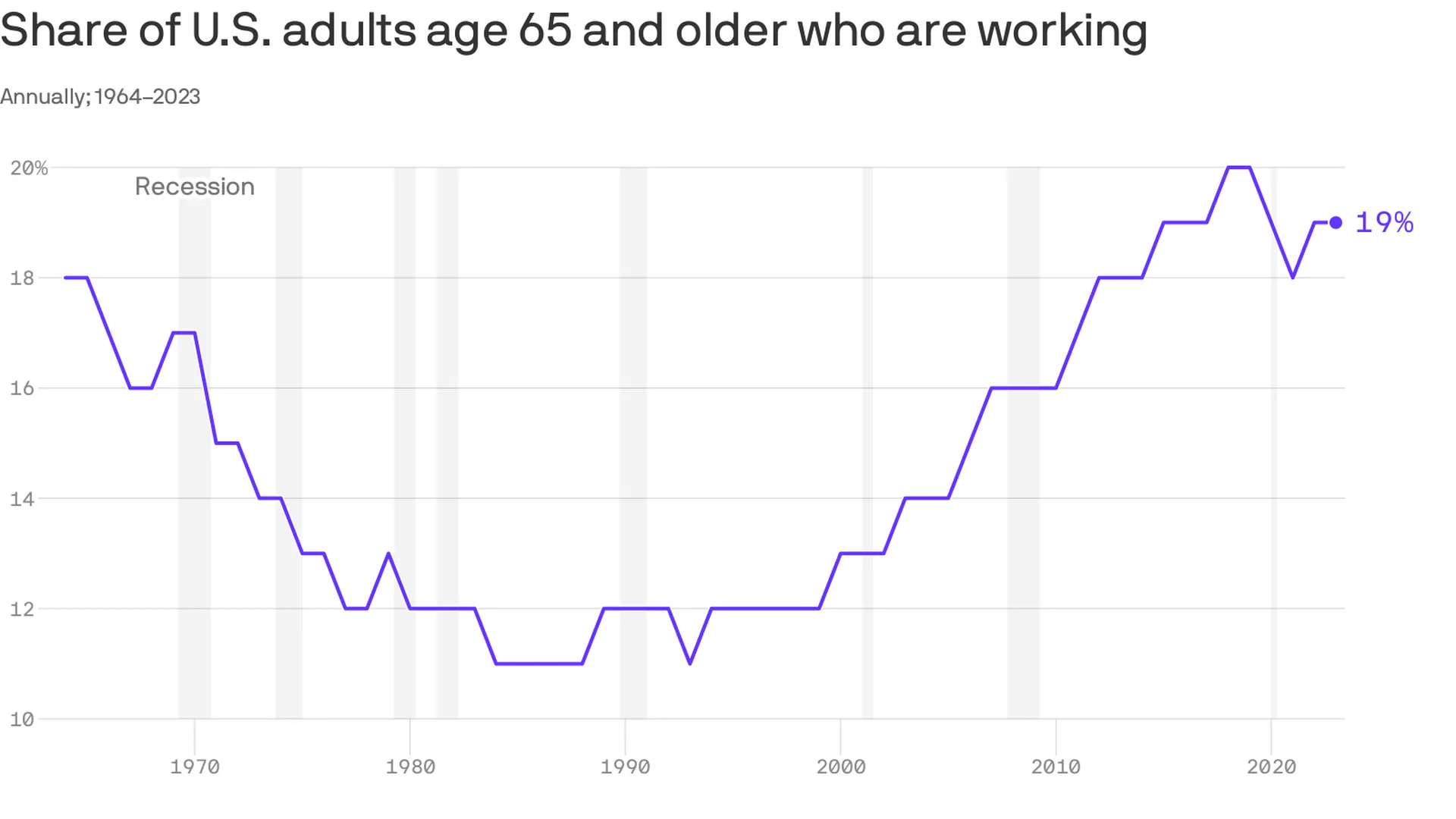
An increasing number of Americans age 65 and older are working — and earning higher wages, per a study from the Pew Research Center out Thursday.

Why it matters: 

This is good for the economy, especially as the U.S. population ages — but whether or not it’s good for older Americans is a bit more subjective.

Zoom in: 

The share of older adults working has been steadily increasing since the late 1980s, with a detour during the pandemic as older folks retired in greater numbers. Several forces are driving the shift:

  • Older workers are increasingly likely to have a four-year degree, and typically workers with more education are more likely to be employed.
  • Technology has made many jobs less physically taxing, so older workers are more likely to take them.
  • Meanwhile, changes in the Social Security law pushed many to continue working past 65 to get their full retirement benefits.
  • At the same time, there’s been a shift away from pension plans, which typically force people out of a job at a certain age, into 401(k) style plans that are less restrictive (and less generous, critics say).

By the numbers: 

Last year, the typical 65+ worker earned $22 an hour, up from $13 (in 2022 dollars) in 1987. That’s about $3 less than the average for those age 25-64, and the number includes wages of full- and part-time workers.

Be smart: 

Before Social Security existed, older people worked — a lot. In the 1880s, about three-fourths of older men were employed, said Richard Fry, senior researcher at Pew. They also didn’t live as long.

  • Meanwhile, the 65+ age group is a fast-growing one — by 2032 all the baby boomers will be in this category, per the BLS’s projections, and their increased workforce participation is good for an economy that is struggling with long-term labor shortages.

The big picture: 

“If people are working longer because they find purpose in their jobs and want to stay engaged, that’s good for them individually,” said Nick Bunker, head of economic research at Indeed Hiring Lab.

  • It’s also good for the productive capacity of the economy, and the firms where they work. “Older folks have lots of experience and knowledge to pass down,” he said.
  • Yes, but: If there are people who want to retire, but can’t because of financial constraints, “that’s bad,” he added.

What to watch: 

The share of older adults working peaked before the pandemic — will it surpass those levels?

  • The number hasn’t bounced back as much as anticipated partly because older Americans benefited hugely from the stock market surge and real estate gains of the past few years — and didn’t need to work anymore.

Rebound in Labor Supply

One of the most persistent economic narratives of 2021 and 2022 was that of missing workers. Many Americans seemed to have simply vanished from the labor force during the pandemic, leaving employers in a lurch.

  • That’s no longer the case, White House economists argue in a new post presenting evidence that labor supply has returned to its pre-pandemic trend.

Why it matters: 

It would be way less painful if the U.S. labor market were to come into a better, non-inflationary balance because labor supply increased, rather than labor demand decreased.

  • And contrary to a widespread economic narrative of the last couple of years, that seems to be happening — as the Biden team seeks to emphasize.

State of play: 

There has been ample speculation about why labor supply was depressed in the aftermath of the pandemic, the White House Council of Economic Advisers notes.

  • Maybe fear of COVID, or long COVID symptoms, kept people out of work. Maybe it was excess savings from the pandemic, or reassessment of life priorities, or a “collective loss of work ethic.”

Nah. It increasingly looks as if it just took some time for potential workers to match up with jobs and return to the labor force.

By the numbers: 

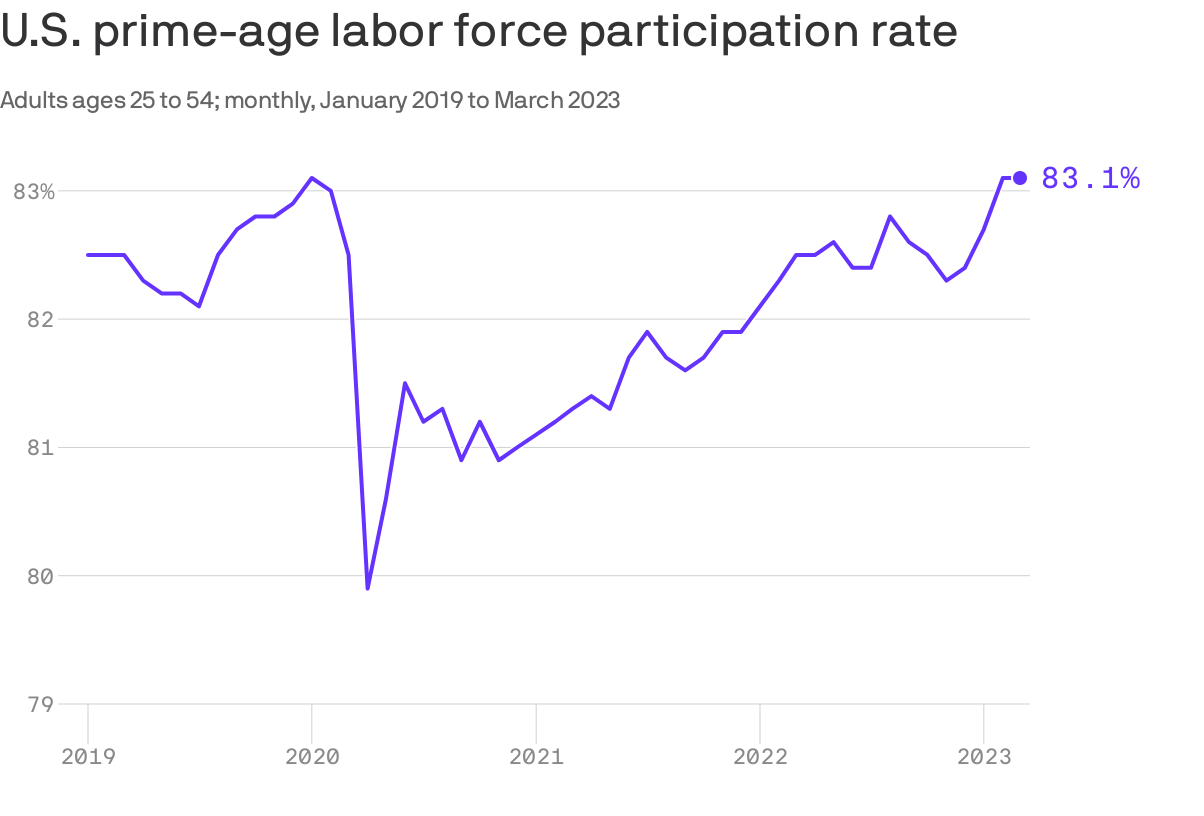
The share of prime-age workers — those between 25 and 54 — who are part of the workforce is now a tick higher than it was before the pandemic: 83.1%, compared with 83.0% in February 2020.

  • The overall participation rate is down (62.6%, from 63.3% in February 2020), but that is due to the Baby Boom generation retiring. It’s on track with what forecasters at the Congressional Budget Office anticipated before the pandemic.
  • Moreover, immigration rates surged in 2022 after a pandemic collapse, also adding to the supply of labor.

What they’re saying: 

“The swift but lagged response of labor supply to surging demand suggests that with time workers do respond to favorable economic conditions,” the White House economists write.

  • “There are many plausible reasons that explain why this response is lagged. Most obviously, the job search process itself is not frictionless; it may take workers some time to find a good job,” they wrote.
  • “Also, if households adapted to the pandemic in ways that can take a while to unwind (such as giving up formal child care), this would delay the labor supply response to growing demand.”

The bottom line: 

“There’s still an inaccurate view that prime-age labor supply is depressed,

that immigration is way down, and that labor force participation rates aren’t back on trend following the pandemic shock to our economy,” Ernie Tedeschi, the chief economist at the CEA, tells Axios.

  • In fact, he said, tight labor markets “pull folks back into the workforce and, while we have more to do to break down barriers to entry, the ‘missing worker’ story doesn’t quite apply anymore.”

U.S. economy adds 263,000 jobs in November

The jobs market stayed strong last month: Employers added 263,000 jobs, while the unemployment rate held at 3.7%, near the lowest level in a half-century, the Labor Department said on Friday.

Why it matters: The figures are the latest signal of a roaring labor market that continues to defy fears of a recession.

  • November’s payroll gains are above the addition of 200,000 jobs that economists had expected.

By the numbers: Job growth last month was slightly slower than the 284,000, added in October, which was revised up by 23,000. In September, the economy added 269,000 jobs, 46,000 fewer than initially estimated.

  • Average hourly earnings, a measure of wage growth, rose by 0.6% in November — faster than the prior month, when earnings rose by 0.5%. Over the past year ending in November, average hourly earnings increased by 5.1%.
  • The share of people working or looking for work, known as the labor force participation rate, ticked down to 62.1%, compared to 62.2% in October.

The backdrop: Economists have been bracing for cracks in the labor market that have yet to appear.

  • It has been an ugly stretch for layoffs in a handful of sectors like technology, with large-scale job cuts announced at MetaAmazon and Twitter.

But overall, the booming job market has continued for workers, even in the face of ultra-aggressive efforts by the Federal Reserve to try to cool demand for labor to help put a lid on inflation.

  • Last month, Fed chair Jerome Powell said that employers bidding up wages to attract workers is not “the principal story of why prices are going up.”
  • Still, the labor market may point to clues about how inflation will evolve in certain categories, including industries within the services sector where wages make up the biggest costs for businesses, Powell said on Wednesday.

Recession fears are rising. Why are people still quitting their jobs?

Interest rates are rising, inflation is lingering at four-decade highs, the economy appears to be slowing and experts fear a recession is on the way. But Americans are still quitting their jobs at near-record rates in the face of growing economic uncertainty. 

The percentage of American workers who quit their jobs set a record earlier this year and has only dropped slightly as the economy slows from two years of torrid growth. After reaching 2.9 percent this spring, the quits rate dropped to 2.7 percent in July, according to data released Tuesday by the Labor Department.

The idea of quitting a job amid a period of increased cost of living and a dubious economic future may seem counterintuitive. But the labor market has remained stacked in favor of workers, who see ample opportunities to boost their earnings to supplant increased costs from inflation.

Despite recent declines, job openings still outnumber unemployed workers by a sizable margin, illustrating just how tight the labor market remains,” wrote AnnElizabeth Konkel, an economist at Indeed Hiring Lab, in a Monday analysis.

There were roughly two open jobs for every unemployed American, according to Labor Department data, giving job seekers ample opportunities to find new jobs with better pay or working conditions. Businesses are still scrambling to find enough workers to keep up with consumer spending — which is well above pre-pandemic levels — from a workforce that remains smaller than it was before COVID-19.

“It seems possible that employer demand would need to cool significantly more before recruiters start to notice an easing in recruiting conditions,” Konkel wrote.

In other words, employers still have too many open jobs and not enough candidates to avoid boosting wages and other perks to find talent. And that means workers still have ample incentive to quit for a better-paying job, particularly with inflation still high.

Job seekers on Indeed.com are looking for ever-higher wages, Konkel explained. The number of Indeed users seeking jobs with a $20 per hour wage rose above those seeking $15 per hour in June 2022, and the number of jobseekers looking for $25 per hour is up 122 percent over the past 12 months.

Konkel attributed the spike in job seekers looking for more money to the steady increase in advertised wages and the inflation they’ve helped to feed.

Once job seekers know it’s possible to attain a higher wage, their expectations may shift and act as a pull factor in searching for a higher dollar amount. In this case, the shift in job seeker expectations from searching for $15 to instead $20 is clear,” Konkel explained.

“On the flip side, inflation continues to take a bite out of workers’ paychecks,” she continued, noting that only 46 percent of workers saw wage gains that outpaced inflation.

The pressure to quit for a higher paying job has been highest in the private sector, where 3.5 percent of the workforce left their current employer in July. Workers in industries with historically low wages, tough working conditions and limited teleworking options have led the charge.

The leisure and hospitality sector posted a whopping 6.1 percent quit rate in July, down sharply from 6.9 percent a year ago but still nearly twice the national quit rate.

Restaurants and bars in particular have struggled to return to pre-pandemic employment levels despite rapidly raising wages. The pressure has also made it nearly impossible for those businesses to fire or lay off employees, even amid usual season turnover.

“Hospitality companies tell us that what was once a ‘one strike, you’re out’ rule for employees who failed to show up at work without notice is now more like a ‘ten strikes, you’re out’ rule. They cannot afford to fire workers because they cannot afford to replace them,” said Julia Pollak, chief economist at ZipRecruiter.

“The decline in terminations in industries like hospitality have been so large, they have more than offset the increase in layoffs in the tech sector,” she explained.

Quits have also remained high in retail (4 percent) and the transportation and warehousing sectors (3.5 percent), with both industries facing threats from a decline in goods spending and rising interest rates.

Even so, there are some signs of waning worker confidence, which may lead to a decline in quits.

ZipRecruiter’s job seeker confidence index dropped 4.5 points in August to an all-time low of 97.8, Pollak said, with a greater number of applicants looking for job security over higher wages.

Since the pandemic, job seekers have been looking for higher pay, less stress, and greater flexibility. In August however, job security rose to the second-place spot in their priority ranking,” Pollak explained.

“One in four employed job seekers say they feel less secure about their current job than they did six months ago. Rising risk of a recession, paired with a wave of recent tech layoffs, has made employees more concerned about the precarity of their jobs.”

Hospitals face increasing competition for lower-wage workers 

https://mailchi.mp/8e26a23da845/the-weekly-gist-june-17th-2022?e=d1e747d2d8

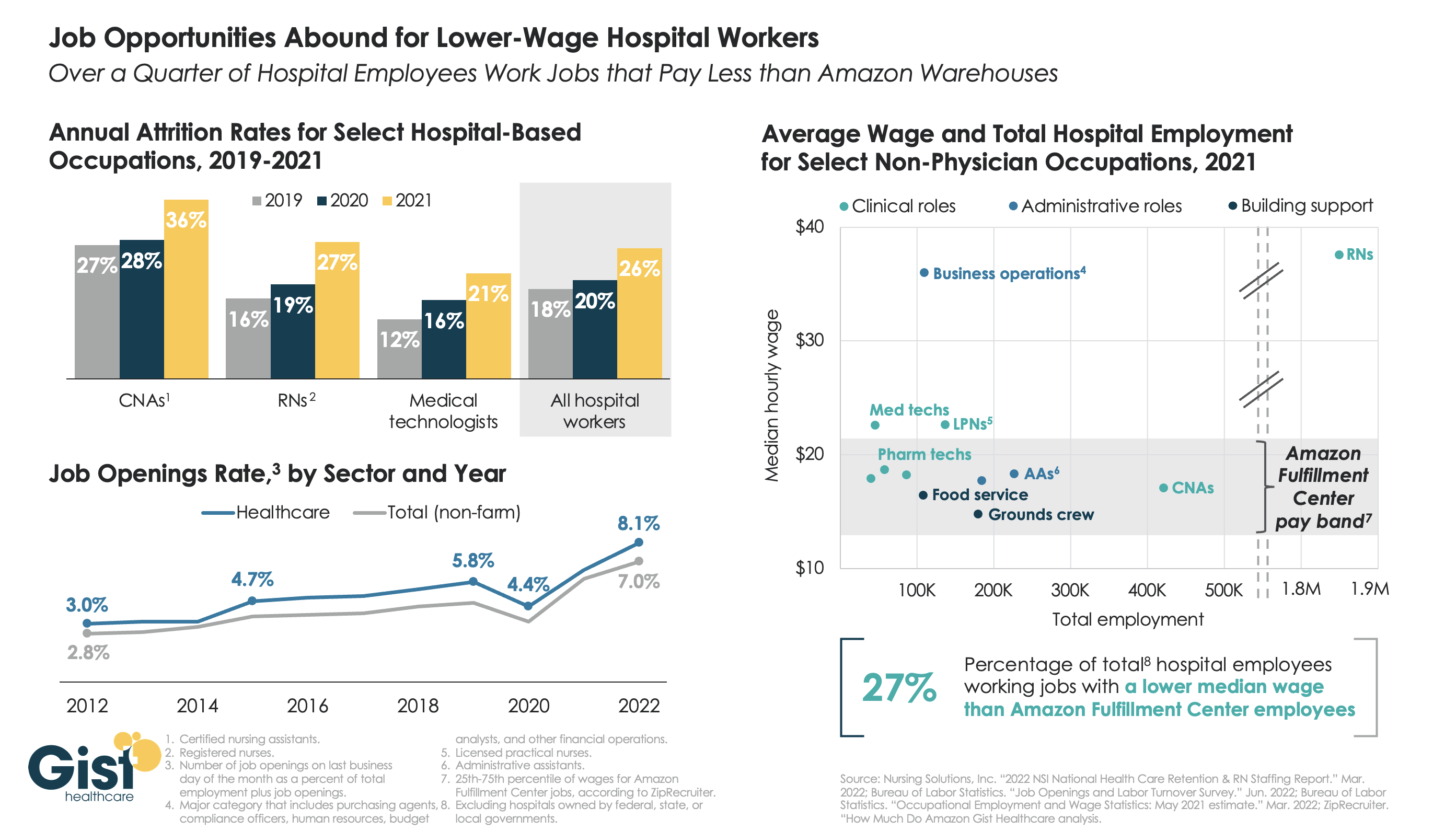
Although the nursing shortage has attracted much attention in recent months, the healthcare workforce crisis is hitting at all levels of the labor force. As the graphic above shows, the attrition rate for all hospital workers in 2021 was eight percentage points higher than in 2019. 

Among clinicians and allied health professionals, certified nursing assistants (CNAs) have the highest turnover levels. Given the demands of the job and relatively low pay, CNA openings have been consistently difficult to fill. But it’s become even harder to hire for the role in today’s labor market as job openings near an all-time high. 

Although labor force participation rates have rebounded to 2019 levels, pandemic-induced economic shifts have led to a boom in lower-wage jobs. In 2021 alone, Amazon opened over 250 new fulfillment centers and other delivery-related work sites. The company is competing directly with hospitals and nursing facilities for the same pool of workers at many of these new sites.

In fact, our analysis shows that more than a quarter of hospital employees currently work in jobs with a lower median wage than Amazon warehouses. Health systems have historically relied on rich benefits packages and strong career ladder opportunities to attract lower-wage employees, but that’s no longer enough—Amazon and other companies have ramped up their benefits, such that they now meet, or even surpass, what many hospitals are providing. 

The time has come for health systems to reevaluate their position in local labor markets, and better define and promote their employee value proposition.