Is ‘toxic positivity’ a healthcare problem? One CEO thinks so.

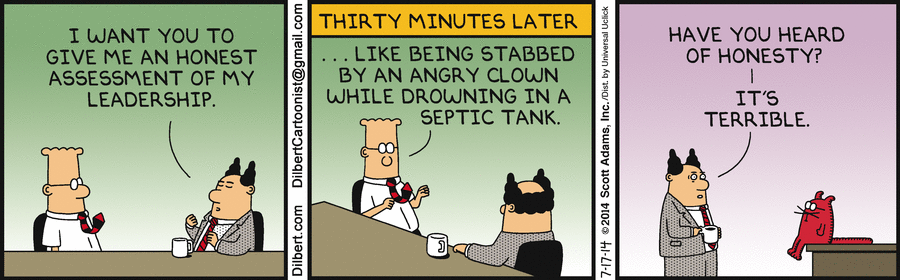
Writing for Forbes, Sachin Jain, president and CEO of SCAN Group and Health Plan, argues that “toxic positivity,” or the idea that one should only focus on what’s going right rather than identifying and working on the underlying causes of a problem, is rampant throughout the healthcare industry and offers a few ideas on how to fix it.

Toxic positivity in healthcare

Jain writes that toxic positivity is a “somewhat understandable reaction to seemingly insurmountable obstacles, which perhaps explains toxic positivity’s ascendancy in the healthcare industry.” But now, toxic positivity is “bleeding into situations involving challenging but fully solvable problems.”

For example, Jain writes that nearly every company in the healthcare industry eventually pays a marketing agency to craft “glorious-sounding mission statements” that are then used by leaders whenever they are confronted with their shortcomings.

“Your health system just christened a new billion-dollar hospital, but is unleashing bill collectors on the indigent? Our mission is clear: Patients first!” Jain writes. “Your startup appears to be serving only the wealthiest and healthiest retirees, while pulling no cost from the healthcare system? We’re proudly committed to doing right by seniors by offering value-based care!”

Jain clarifies that he doesn’t believe all healthcare executives are cynically trying to avoid hard issues. Rather, they are “often too far removed from the front lines of the system, and even their own companies’ patient-facing operations, to witness the flaws.”

Often executives don’t notice the flaws in their health systems until a loved one needs help, Jain writes. “Only then do the industry’s leaders confront the reality that, at a person’s most vulnerable point in life, healthcare companies often treat you like a consumer … instead of just taking care of you.”

Without that reality check, it’s easy for executives to rely on their lofty mission statements and value propositions, and to “see their companies as distinct from, rather than intrinsically connected to, the industry’s biggest issues,” Jain writes.

How to fix toxic positivity

One simple intervention won’t fix toxic positivity in the healthcare industry, Jain writes, but companies can start by talking about their flaws.

“In a perfect world, the healthcare industry would commit to a culture of relentless interrogation of its flaws as a means of driving to better results,” Jain writes. Healthcare leaders need to “stop hiding behind company mission statements and ‘just-so stories’ about their impact and start speaking publicly about the steep challenges we each face as we fall short of fulfilling our specific corporate mission,” Jain adds. That means publicly addressing issues at events and discussing strategies for addressing them.

Private behavior within a company can also help reverse toxic positivity, Jain writes. Leaders should continue celebrating the accomplishments of frontline healthcare providers, but they should also “bring a critical eye to their operations and demand — not just encourage — that their colleagues help them uncover ways they can individually and collectively do better.”

That means asking questions like, “If our organization disappeared tomorrow and people were forced to find their healthcare insurance or services or devices elsewhere, would anyone be truly worse off and why?” Jain writes. If your company doesn’t have an answer for that, then you should work harder to increase your replacement value and drive competitive differentiation.

Addressing toxic positivity also means addressing the flaws in value-based care and having “honest, authentic conversations about what works and what doesn’t and why,” Jain writes. “About whether companies that proclaim to improve care are merely benefitting from arbitrage opportunities in reimbursement systems or are actually, meaningfully improving service to patients.”

Executives need to stop treating the healthcare industry like all other industries and “call BS on the idea that it’s somehow okay to be financially successful without making an actual difference in anyone’s lives,” Jain writes.

The healthcare industry needs to welcome thoughtful, critical, and reflective voices to every table, Jain writes. “Because nothing — absolutely nothing — will actually get better without them.” 

Achieving True Health Care Transformation Requires Rethinking Compensation Models and Executive Performance Metrics

https://medcitynews.com/2023/01/

Healthcare leaders now need to strike a delicate balance that requires managing financial and growth metrics, increasing the speed of transformation, and building the health systems of tomorrow. So how do we redefine compensation models to reward all these behaviors?

Executive compensation might not spring to mind as a key driver of healthcare transformation, nor does it seem naturally connected to critical issues such as health equity, patient safety, or quality of care – just a few of the areas where significant changes can be made to transform healthcare. But, in fact, executives leading not-for-profit health systems today are tasked with delivering measurable results that improve the health status of their patients and their communities. And to ensure that these new performance metrics are met, we must change how we think about —and deliver—compensation.

Defining a new model

While executive compensation has always been tied to specific objectives, they have historically leaned heavily toward financial performance, volume and margins, with a modest portion of compensation aligned to quality of care and patient outcomes. But transformative approaches such as population health, value-based care, patient wellness and health outcomes are shifting the mark.

Healthcare leaders now need to strike a delicate balance that requires managing financial and growth metrics, increasing the speed of transformation, and building the health systems of tomorrow. So how do we redefine compensation models to reward all these behaviors?

Some might say that the answer lies in adjusting incentive plans. While incentive plans across health care have not changed significantly in the past decade, the sophistication of the plans has changed, reflecting greater attention to delivering a better patient experience. But delivering better experiences does not imply that health systems have transformed from the top down. In my mind, adjusting incentive plans only solves part of the problem.

If we want true health care transformation—and we should, in order to best serve patients and communities—health systems need to re-evaluate the outcomes for each stakeholder and create incentives to evolve leadership as a whole. We need to rethink executive compensation models to align with value-based care, patient experience, and the resulting outcomes, along with traditional performance measurements.

Leading through lingering disruption 

But rethinking executive compensation models won’t be an easy task, especially given the external challenges and changes thrust upon the health care system over the last few years.

As with nearly every other aspect of health care, pay for performance was disrupted during the pandemic. Demand for health services changed dramatically, labor and attrition issues intensified, and supply chain problems and operational costs increased. These new pressures required executives to manage through long periods of uncertainty where meeting operational pay-for-performance goals was nearly impossible. Fast-forward to today, the executive talent market remains extraordinarily competitive. Demand outpaces supply due to higher-than-typical retirements, effects of the great resignation, the need for new skill sets and overall burnout.

As a result, there has been upward pressure on compensation to address and fulfill unexpected but immediate needs such as rewarding executives for managing in a unique and challenging performance environment, increasing efforts to recruit and retain, and recognizing leaders for their hard-won accomplishments.

Considerations and changes

When considering adjusting models for 2023 and beyond, CEOs and compensation committees need to take these pressures and disruptions into account. They should look closely at their own compensation data from the past two years – not as a lighthouse for future compensation, but as data that may need to be set aside due to the volume of performance goals and achievements that were up-ended by the pandemic. When relying on external industry data, the same rules apply; smaller data sets or those that don’t account for the past two years may be misleading, so review carefully before using limited data sets to inform adjusted models.

Just as important, CEOs and compensation committees should consider new performance measurements tied to both financial and quality or value-based transformation metrics. We don’t need to eliminate traditional financial and operational goals because viability is still a business mandate. But how can we articulate compensation-driven KPIs for stewardship of patient and community health, improved outcomes and reduced cost of care? Too many measures are akin to having no measures at all.

The compensation mix should take into account a more focused approach to long-term measures. The old paradigm of 12-month incentive cycles is not enough to address the time required to truly transform health care. Another consideration should be performance-based funding of deferred compensation based on achieving transformation goals, and greater use of retention programs to support the maintenance of a stable executive team during the transformation period. Covid-19 proved how crisis can be an accelerator for change. True transformation should blend the skills gained from crisis management with planful, thoughtful and intentional change.

In addition, some metrics may need to incorporate a discretionary component, considering ongoing disruption within the workforce, supply chain limitations, and energy, equipment and labor cost increases. More organizations are also including health equity, DE&I, and ESG goals in incentive programs to tighten alignment with mission-critical board-mandated goals.

Transformative change 

There are four elements that are vital in the journey to transform health care from “heads in beds” to the public-service-oriented organizations that they were meant to be—and can be again. With mounting pressure from patients, communities, and payers to boards and employees, CEOs and compensation committees must become key drivers of change, setting the right goals and incentives from the top down.

  • Affordability: can patients afford the care they need?
  • Quality: is the care being delivered of the utmost quality?
  • Usability: how can we reduce hurdles to undertaking the care plan?
  • Access: are all community members able to access needed care?

Solving for each of these elements is one of the biggest challenges we face, and as we begin to emerge from the disruption of the pandemic, leaders will be watched closely to ensure that they deliver—and can clearly show the path to delivery.

Ideally, end achievements would include patients spending less to achieve better health; payers controlling costs and reducing risk; providers realizing efficiencies and greater patient satisfaction; and alignment of medical supplier pricing to patient outcomes. And when you zoom out to reveal the bigger picture, all of these pieces come together to achieve healthier populations and lower overall health care costs, while still meeting the financial goals of the organization.

We’re asking a lot of already-overburdened health care executives. Stakeholders must prove that we value leaders with the right mindset and skillset in order to attract executives who can shepherd organizations through the transformation journey. This requires a setting where there is supportive leadership, a compelling mission and opportunity for personal growth and development. It will not be easy, but without rethinking how we design compensation models from the top down, it will be unnecessarily challenging.

Strategic misalignment at the heart of a governance issue

https://mailchi.mp/016621f2184b/the-weekly-gist-december-3-2021?e=d1e747d2d8

When Innovation and Strategy Don't Align - TENZING Strategic

In our work with health systems, physician groups, and other organizations over the years, we’ve often been asked to facilitate board-level discussions about governance—resolving board conflicts, navigating difficult decisions, evaluating board composition.

A recent discussion again highlighted one of our main observations in working with boards: governance problems are often strategy problems in disguise. Working with a system that has grown through acquisition over the years, and whose board includes members from several of the “legacy” hospitals which had merged into the system over time, we were asked to help facilitate a dialogue about investment priorities across the component parts of the system.

At the root of the issue: each of the “representatives” of the subsidiary entities were pushing to have their own investment needs take precedence. On the face of it, that’s a governance problem: boards shouldn’t be constituent assemblies, with each member representing the interests of a sub-unit. Rather, they should act with one purpose: to advance the interests of the whole.

But that misalignment turned out to be a symptom of a larger problem: there was no consensus at the board level about what the strategic direction of the combined system should be, and what role each component part played in that direction.

That’s a strategy problem, masquerading as a governance issue. Identifying the strategic issue allowed the board to reframe the dialogue around vision, which then unblocked the subsequent decisions about investments. Good strategy and good governance go hand in hand.