6 DEFINING VALUES OF A LEADERSHIP CULTURE

http://www.leadershipdigital.com/edition/daily-innovation-leadership-2019-06-16?open-article-id=10712652&article-title=6-defining-values-of-a-leadership-culture&blog-domain=n2growth.com&blog-title=n2growth-blog

Twelve years after launching culture change consulting services, I am finally sitting down to write about six defining values of a leadership culture. These are factors I’ve learned that define whether an organization can improve their Culture or not. No surprise that all six values rise and fall on leadership.

Before I unpack the six values, let me paint the backdrop of how it all began. In 2006, one of my CEO clients in Sarasota, FL shared with me his annual employee engagement survey. Most Type A leaders are charming, demanding, and unlovable, but not Steve. He had a caring heart just below the surface of his Type A layer. Even in his frustration, he oozed care and concern for people. We sat in his office while he shared his most recent employee engagement survey, and because he cared so much, he was frustrated. He didn’t like the pre-formulated questions, and he didn’t know what to do with the report results. He was delivered a canned report with no clear direction. “David,” he asked, “can you build me an employee engagement survey that we can customize around the kind of culture I want to create?” Like all good consultants, I said, “probably, let me do a little research and get back to you.” After I flew home from my monthly trip to sunny Sarasota, I did as I said and began to research and evaluate his request. As I dug around the internet, three data points came to light.

The first data point revealed that most employee engagement surveys were un-customizable. Surveys were built for mass production, not carefully and strategically customized for unique cultures. Why should the 8-year old, first generation, 88-person software development company in San Diego expect to have the same desired culture as the 48-year old, 3rd generation, 268-person manufacturing company in Rochester, NY? To me, that made no sense for the client, but all the sense to the vendors who mass-produced their expertise to increase profit over quality. Their research determined that one of the most important questions that define a good corporate culture is “Do you have a best friend at work.” Really? How does that define one’s culture? I am quite blessed to have had many best friends over the years, but none of them worked with me. Whether my best friend worked in Chicago or with me in Allentown never impacted my like or dislike of corporate culture.

The second data point was that most employee engagement surveys and the firms that employed them were extremely heavy on reporting data overload, but weak on meaningful implementation. Before starting Walton Consulting, Inc. in 2001, I worked for a boutique strategy consulting firm out of Princeton, NJ that developed and delivered high-cost elaborate strategic plans. The client would outwardly applaud the mountain-sized strategic planning document full of analysis, logic, and recommendations. However, inside I am sure they were asking themselves, “what the hell do I do now, and why did I pay so much for something I don’t know what to do with…maybe I should hide it on the bookshelf and refer to it in ‘name’ whenever I want to drive a random point home to my employees.” It is the same way with employee engagement surveys. The client gets a pretty report, but without the creator of the report, the expert on the topic to help with implementation, the report becomes an article of affection or dissatisfaction (depending on the results of course). As with many consultants, the implementation phase becomes an afterthought, a monumental chore that gets swept under the carpet and ignored.

The third data point was an epiphany that corporate culture was the missing cog. At this juncture of Walton, I had been focused on delivering consulting services to CEOs and business owners to help them grow healthy organizations. I was already delivering strategic planning, sales and marketing strategy and leadership recruiting services, all of which helped grow organizations, but the culture cog was missing. As I pondered on the importance of corporate culture, I intuitively understood that the culture cog acted as a fuel valve that could either spur on growth or squelch it. I reflected on how much corporate culture was really the vineyard soil that determined the environment’s capability and capacity for growing good fruit and producing a rich yield.

Wow, I must build this tool for my client I thought. It is not only critical as a foundation for successful organizational growth, but it also fits neatly into my core service offerings focused on “healthy” growth. In 2006 I launched the Culture offering. Now, 13 years later, with over 3,000 employees surveyed, and a marketplace foaming at the mouth about culture with quotes like Peter Drucker’s, “Culture Eats Strategy for Breakfast,” I am ready to share six values that leadership needs to employ if they plan on truly Changing Culture. Check back next issue where I will reveal what they are and why they are so important to growing a healthy organization.

Here are six leadership values that impact culture:

  1. Leadership Cares
  2. Leadership Alignment
  3. Leadership Listens
  4. Leadership Commitment
  5. Leadership Implementation
  6. Leadership Flexibility

For the purposes of this article, leadership is defined as the CEO and his or her executive team. Let’s deep dive into each factor…

LEADERSHIP CARES

There are different reasons why leaders care.  I had one client who cared because he was experiencing an employee revolt.  He was truly concerned that if he did not get his arms wrapped around his dysfunctional corporate culture that he would have a mass exodus on his hands.  Some leaders care because they understand that improved culture leads to improved profitability.  Other leaders care because they want to enrich the lives of their employees.  Bottom line, the leadership needs to care.  A friend and colleague of mine who was the President of a mid-market global firm told me flat out; he just didn’t care.  The employees to him were a means to an end.  Another human resource colleague of mine cares deeply about changing their culture, but she isn’t the CEO, and without the CEO caring, it will never get the attention it needs.

LEADERSHIP ALIGNMENT

When beginning a culture change endeavor, the likelihood that the CEO and all of the executive team really cares, views culture impact with the same gravity, and has the same cultural values is rare.  For successful culture change to occur, leadership needs to be aligned.  This is not an easy task, but my pill for the cure is training.  With each culture change engagement I deliver, I interview and train the leadership team together.  We review how it impacts their business, and we talk about what kind of culture they have and want.  We even design the employee engagement survey together for aligned executive level buy-in.  People own what they help to create, so in this manner, the leadership team owns their culture and shifts into alignment.

LEADERSHIP LISTENS

One of the most important messages you can send to people that follow you is that you listen.  That means you ask for opinions and give others an opportunity to influence.  When you incorporate a strong feedback mechanism in your employee engagement survey, you create a pathway for communication that fuels employees’ personal value.  The key though is to listen.  The biggest mistake to corporate culture change is to ask and not act.  Essentially communicating that you are not listening.  I encourage my clients to respond to culture change feedback even if the ideas cannot be adopted—this reinforces that you have listened.

LEADERSHIP COMMITMENT

As a leader of your organization, if you are not ready to commit to the adventure of change, then don’t get off the porch.  I mean that—do not start unless you are committed to finish!  I have seen firsthand companies that have turned culture change into an organizational minefield.  The CEO will tell me it didn’t work, and unfortunately, I have to remind them that they weren’t committed to change and that the entire initiative turned into a hollow promise.  Yes, it will backfire if there is a lack of commitment.

LEADERSHIP IMPLEMENTATION

As a 20-year consultant veteran, I differentiate myself by emphasizing implementation.  When an organization begins culture change, the transformation will only occur through implementation.  I do not stop with a report and recommendations. I help my clients build actionable implementation plans.  I work with the leadership team to identify and select employees who can play a role in helping the execution of those plans.  This spreads the implementation buy-in throughout the company and ensures greater success of implementation.  Leadership’s role is to coach and facilitate implementation.

LEADERSHIP FLEXIBILITY

When a company embarks on transforming their corporate culture, they are embarking on a journey into the unknown.  Culture is fluid, ever-changing, impacted by the daily weather, disruptive, moody and explosive.  During culture change implementation, leaders need to be flexible, understanding that the environment will shift actions and initiative throughout the process.  Leaders need to use their corporate values as the compass, to ensure they are going in the right direction, yet be flexible to allow deviations.

The bottom line is simple. Culture change rises and falls on leadership, but a strong culture can make the difference between winning and losing, so I encourage leaders to embrace the challenge and lead their organizations toward a healthy corporate culture.


The Critical Role of Trust In Avoiding a “Charge of the Light Brigade”

https://www.tlnt.com/the-critical-role-of-trust-in-avoiding-a-charge-of-the-light-brigade/?utm_source=Marketo&utm_medium=Email&utm_campaign=tlntcom-daily-newsletter&utm_content=the-critical-role-of-trust-in-avoiding-a-charge-of-the-light-brigade&mkt_tok=eyJpIjoiWXpGbFlXWTBaalF4WkRReSIsInQiOiJ1TGlrM2FsYTZQZlhkUU5zcnVXa1pwc2dEb253U3hQRUVKcDMxQ2wrZXVyaUJhVnVESmpKd0prNmZzb3pkTUtEZFhZZVlSTXZwd3N6N3ZpWjlNVW9YRVk1UDlFWXRNb3NpSGRqUFBHNjhFRnJzZkZVZWxZMEZUQXpROFVjSEFrUCJ9

The importance of leadership trust increases as the pace of change accelerates. Leaders in hyper-competitive and turbulent business environments need employees to support decisions without a lot of extensive explanation and back and forth discussion. It is not that change management topics like “what’s in it for me” are not important. It is simply a matter that when you need quick action, you may not have time to fully explain why this action is critical.

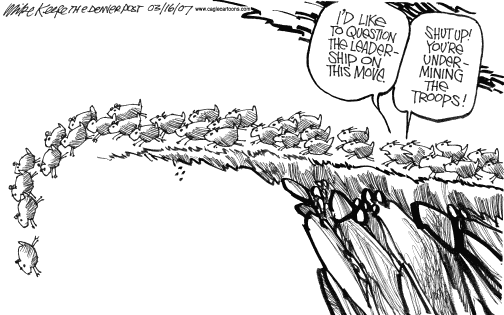
The need for fast action creates a dilemma for leaders. To move quickly, leaders need employees to accept and believe in their decisions without demanding a lot of discussion and justification. On the other hand, leaders do not want employees to blindly accept leadership decisions if they know these decisions could be leading the company down a path of failure. This issue was famously captured in Tennyson’s poem “The Charge of the Light Brigade where he described soldiers responding to a questionable order with the stanza “theirs not to make reply, theirs not to reason why, theirs but to do & die.” While this phrase summons up notions of courage and duty, the story it describes is a tragic example of people following leadership orders they knew were foolish. In the case of the Light Brigade, the unwillingness to question the wisdom of their leaders led to 278 needless casualties of which 156 were killed.

Leadership in fast moving world requires asking employees to trust your decisions while ensuring employees are willing to criticize your decisions. To quote General Colin Powell, “Leadership is solving problems. The day soldiers stop bringing you their problems is the day you have stopped leading them.” How can leaders create the sort of trust that strikes this balance between employees accepting decisions but also questioning them? The following are some suggestions based on psychological research studying trust in organizations.

If you do not trust your employees, they will not trust you.

People are good at picking up subtle cues that show whether their co-workers trust their commitment and abilities. If a leader lacks trust and confidence in their employees, then employees will soon lack trust and confidence in that leader. This is a major issue when companies restructure. It is common to assign leaders to “fix” struggling divisions of a company. If these leaders believe existing employees are to blame for the previous problems, then they are almost certain to fail in gaining the trust of those employees when they most need it.

Trust depends on sharing bad news.

Some leaders believe the best way to build employee confidence is to hide bad results and downplay challenges the company is facing. This behavior damages leadership trust. Employees put more trust in leaders who openly share information with them, both good and bad. This goes back to employees trusting leaders who trust them. Leaders who trust employees with sensitive information about company performance are both educating employees on the realities the company is facing and building leadership trust in return. There is a right way to share bad news to avoid undermining confidence. But not sharing bad news at all undermines trust.

Trust comes from you knowing your employees (not just them knowing you).

One often hears leaders attempt to build trust by saying things like, “Anyone who knows me will tell you I am a person of my word.” What these leaders fail to understand is trust, particularly when it comes to providing critical upward feedback, is often more dependent on leaders knowing their employees then employees knowing their leaders. Employees put themselves at risk when they say things that might be viewed as critical of leadership decisions and behaviors. And employees do not want their only interactions with leaders to be centered on them sharing problems. This is captured by something a colleague once told me, “Why would I tell our division president what he is doing wrong if he doesn’t even know what I do. He’d just think of me as that person who complains.”

Building trust with employees depends on getting to know employees. The only way to know your employees is to spend time with them. Short personal interactions have big effects on trust. One way to see the difference between effective and ineffective leadership in this area is to observe executives at company conferences. The ones employees trust are the ones who spend time with employees two or three levels below them. These leaders intentionally start conversations with employees they do not know. Executives employees often mistrust are ones who spend their time in closed conference rooms or fancy dinners talking with other senior executives and people they already know.

Leadership trust comes through manager trust.

Managers play a critical role in building leadership trust. Managers have more time to spend getting to know employees, and as a result they can build far stronger relationships. What is interesting is that how much employees trust their managers depends in part on how much managers trust their own leaders. There is as a “trickle down” effect associated with trust. When leaders build trusting relationships with their managers, their managers are more likely to build trusting relationships with their employees. This is good news for leaders because it means that they can delegate the role of building trust to managers. But the only way to do this is to spend time with their own direct reports. And increasingly companies are adopting organizational structures where executives will have 15 or more people reporting to them. This increases the risk that executives may not spend enough time building trusting relationship with their own reports, which in turn will undermine leadership trust lower within the company.

It is often said that “trust takes years to build but seconds to destroy.” The first part of this statement is not necessarily true. Trust can be built fairly quickly. This is good news for leaders in a fast-moving world where trust needs to be established in a matter of days or weeks. But leadership trust will not come from leaders simply saying, “Trust me.” The only way to build leadership trust is for executives to demonstrate that they trust the employees, communicate with employees in a transparent manner, make time to get to know employees at all levels, and focus on building strong relationship with the people who actually manage the employees. Building leadership trust may not take years, but it does take active time and attention.


Will you get your Money’s Worth?

Will you get your Money’s Worth?

InterimCFO

All about Interim Executive Services in healthcare administration.

Will you get your Money’s Worth?

Abstract: This article is a continuation of the series on the value proposition of Interim Executive Consulting.  In this article, I look at the value proposition from the consultant’s perspective.

Recently, I was discussing an interim opportunity in a smaller hospital with a referral source.  The prospective argument was that the client did not have the capacity (did not want) to pay a market rate fee.  You never hear hospitals argue with their lawyers or other consultants on this point, but I digress.

Based on my experience, there are two things that you can be sure of in any interim engagement.  One is that as soon as you think you have an idea of what is going on around you, you had better get ready for a big and sometimes very nasty surprise.  The other is that you are going to find challenges and problems in the situation that the client either intentionally withheld or that the client had no idea of in the first place.  Some clients have told me after skeletons started falling from closets that they harbored the fear that if they were fully transparent that an interim consultant would refuse the gig.  What they do not know is that as professional Interim Executives, we usually do not get the call until the situation is challenging and that if we are distressed by the surprises and uncertainty that characterize Interim Executive Services, we would have found something else to do.  Remember, firefighters run toward a fire when everyone else is running away.

Another principle of doing interim work in my experience is that there is no correlation between the size of the organization and its capacity to produce drama, challenges, and vexing problems.  An argument can be made, and my on-point experience confirms that the risk is higher the smaller the organization because smaller organizations do not have the intellectual and bandwidth resources necessary to avoid creating or falling into serious problems.  If the issues have anything to do with compliance, the potential risks to the interim executive increase exponentially, especially if they are going to be executing documents or making representations on behalf of the organization.  Compliance related signatory authority risk is a risk that cannot be insured by either the consultant or the client. I told the referral source that if anything, there should probably be a significant premium associated with going into a smaller place.

What is a client to do?  I try to mitigate this risk for my client by offering a no-notice, no-fault termination clause in my contract.  The day that the client decides that I am not providing value, I am out of there.  I do not wish to become a perceived burden to an organization during what is already likely an awkward transition.  I have not been released from an interim engagement.  To the contrary, the opposite is true.  In every one of my interim engagements, the timeline has been extended, extensively in some cases once the client appreciates the value proposition.  My average ’90 – 120′ day gig lasts around nine months, and my longest has been over two years.

I have stated repeatedly in these articles that I do not follow bad people and I stand by that contention.  However, this does not mean that there will not be serious problems in an organization.  I followed a CFO that was compelled to resign among other things for digging in over what he believed was a non-compliant acquisition of a physician practice that had millions of dollars of goodwill baked into the deal along with lavish estimates of the value of furniture, fixtures, and equipment.  In another situation, the CEO had been overridden on multiple occasions by a Board that was determined to do non-compliant deals with physicians.  I could go on and on about these types of challenges.

Problems do not have to be compliance related to be challenging and of high potential value.  During the course of every engagement, I am routinely asked, “Is this the worst you have ever seen?”  Most of the time the answer is no, and in every case, it is situation specific.  I was engaged by a hospital to assess the revenue cycle.  Other than the AR being currently fairly valued following multiple unfavorable audit adjustments, about everything else in the revenue cycle process was broken as the client had expected.  The resulting intervention increased cash collections more than $10 million in the next year on around $300 million of revenue.  As an aside, in an organization of this size with a typical operating margin in the 3% range, this intervention more than doubled operating income so, in context, it was a pretty big deal.  This organization was trying to save money by doing things like buying thinner tongue depressors and cutting the amount of soap housekeeping could put in mop buckets while it threw away all of the savings and more in the revenue cycle.  It was the worst revenue cycle operation I have seen measured by results or lack thereof.  This same organization had some of the strongest and highest performing functions in other areas that I have experienced.  Even in the revenue cycle, I got to meet some of the smartest, most dedicated people I have ever known.  They were handicapped by a dearth of leadership and decrepit systems.  None of this supported a conclusion that the organization was terrible or on balance, it was the worst I have ever seen although the revenue cycle concerns did have something to do with the prior CFO being ‘freed up to seek other opportunities.’

What is a consultant to do?  My advice is to the degree possible and reasonable, stand your ground on your professional fee.  It would be nice if you knew you were going to a cake-walk that would mainly be a paid vacation and that you could confidently offer a come-on rate to land the gig.  You know the reality is that you are probably going into a complicated, high-stress situation that is going to tax all of your physical and mental capacity.  This situation is exacerbated by desperate or ignorant consultants and firms that will take any gig at any rate when they have an unsophisticated buyer or just to have something to do.  I have considered offering such a price based on not finding any problems.  For example, I could offer a 30% – 50% discount for a lush sabbatical that would be reversed if (when) issues begin to emerge.  Maybe I could even bargain to double my rate upon discovery of the first compliance problem.   Unfortunately, the world does not work this way, and if you are up against an unsophisticated or ignorant potential client, there is an excellent chance you are going to be undercut by an equally ignorant potential consultant.  You have to decide for yourself how much risk you are willing to take on.  How much is it worth to you to put yourself, your net worth and your family’s livelihood into play in a situation where you may be exposing yourself to the risk of becoming the target of a government compliance investigation?  In a bad case scenario, you could become a witness in a hostile position vis-a-vis the client. The government is currently pursuing multiple felony charges against John Holland (look him up on the internet) even though he alleges and there is apparently little evidence that he benefited directly or indirectly from compliance problems that occurred in organizations he served.  By the way, John may and probably did inherit some of the issues that resulted in criminal charges, i.e., the problems were present in the organization when he started.  Tell me again Mr. cut-rate consultant or firm how anxious you are to get yourself into a situation like this?  By the way, if you are placed by a firm and compliance problems emerge, you are going to be on your own.  Do not forget this.

If you are a decision maker and you are getting resistance to rate discounting from interim executive services providers, it is probably because of their prior experiences and bias about potential problems in your organization.  Instead of dismissing them for something cheaper, you might want to understand better where they are coming from and how that might translate into risk you are bearing that you might not even recognize.  You have to accept the fact that you would not be seeking interim services if you did not have a significant challenge on your hands.  Your best defense against getting into a deal that could make the situation worse is to negotiate an agreement that can be exited rapidly and without recourse. You may have problems that are as yet undiagnosed.  Your run in your current situation could be riding on the ability of the interim executive you choose to pull your bacon out of a fire and potentially save many of your direct reports’ jobs in the process.  What is that worth to you?

Contact me to discuss any questions or observations you might have about these articles, leadership, transitions or interim services.  I might have an idea or two that might be valuable to you.  An observation from my experience is that we need better leadership at every level in organizations.  Some of my feedback is coming from people that are demonstrating an interest in advancing their careers, and I am writing content to address those inquiries.

The easiest way to keep abreast of this blog is to become a follower.  You will be notified of all updates as they occur.  To become a follower, click the “Following” bubble that usually appears near the bottom of each web page.

I encourage you to use the comment section at the bottom of each article to provide feedback and stimulate discussion.  I welcome input and feedback that will help me to improve the quality and relevance of this work.

This blog is original work.  I claim copyright of this material with reproduction prohibited without attribution.  I note and provide links to supporting documentation for non-original material.  If you choose to link any of my articles, I’d appreciate a notification.

If you would like to discuss any of this content, provide private feedback or ask questions, you can reach me at ras2@me.com.


Hospital Boards Seeing Low Turnover Rates, AHA Finds

Click to access aha-2019-governance-survey-report_v8-final.pdf

https://www.healthleadersmedia.com/strategy/hospital-boards-seeing-low-turnover-rates-aha-finds

A survey of hospital and health system CEOs noted opportunities for improvement in board governance, alongside some positive trends.

The boards of trustees governing U.S. hospitals and health systems have relatively low turnover rates in an industry that’s shifting rapidly, according to a survey report released Wednesday by the American Hospital Association.

The survey asked more than 1,300 CEOs of nonfederal community hospitals and health systems in the U.S. about their organizations’ governance structures and practices, then the AHA compared their responses to data collected in a similar survey five years ago.

The researchers found that the policies and norms in place for most healthcare organizations result in low levels of board turnover.

The report cited several related opportunities for improvement:

  • Nearly a third of all respondents said their boards do not use term limits at all.
  • More than 75% of respondents said their organizations either didn’t replace board members during their terms or kept reappointing them (when eligible) within the past three years, rather than recruiting a fresh face.
  • Formal assessments were not conducted within the past three years for boards, board members, or chairpersons at 31% of respondent organizations.
  • Older board members are increasingly common. Overall, 12% of board members were age 71 or older in 2018, up from 9% in 2005, the report states. The percentage of members age 50 or younger was 22% last year, down from 29% in 2005.

Luanne R. Stout, president of Stout Associates based in the Dallas/Fort Worth area and a retired Chief Governance Officer of Texas Health Resources, wrote in commentary included with the report that healthcare organizations have a number of options when trying to foster a healthy degree of board turnover.

“Term limits (usually three or four consecutive, three-year terms) are helpful in accomplishing board turnover; however, some boards are reluctant to adopt term limits for fear of losing highly valued board members,” Stout wrote. “Boards that annually review board member attendance, performance and contribution can achieve desired levels of rotation and competency enhancement without utilizing term limits.”

The AHA report also notes some positive trends around healthcare board governance, including the following:

  • There has been some increase in racial and ethnic diversity among board members. The survey found 58% of respondents had boards with at least one non-white member, up from 53% in 2014. (That means about 42% of boards were still composed last year entirely of white members.)
  • A majority of boards restructured to improve their governance.
  • Nearly half of all system boards include members from outside the communities served.

“This year’s survey demonstrates how hospitals and health system boards are rising to meet tomorrow’s challenges through redefining roles, responsibilities and board structures,” said AHA President and CEO Rick Pollack in a statement. “These changes are not surprising given the continued transformation in where, how, when and from whom patients receive care.”