


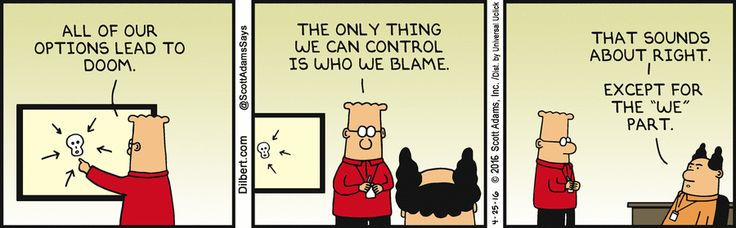
Cartoon – Total Waste of Time
https://mailchi.mp/ce4d4e40f714/the-weekly-gist-june-10-2022?e=d1e747d2d8

A consultant colleague recently recounted a call from a health system looking for support in physician alignment. He mused, “It’s never a good sign when I hear that the medical group reports to the system CFO [chief financial officer].” We agree. It’s not that CFOs are necessarily bad managers of physician networks, or aren’t collaborative with doctors—as you’d expect from any group of leaders, there are CFOs who excel at these capabilities, and ones that don’t.
The reporting relationship reveals less about the individual executive, and more about how the system views its medical group: less as a strategic partner, and more as “an asset to feed the [hospital] mothership.” Or worse, as a high-cost asset that is underperforming, with the CFO brought in as a “fixer”, taking over management of the physician group to “stop the bleed.”
Ideally the medical group would be led by a senior physician leader, often with the title of chief clinical officer or chief physician executive, who has oversight of all of the system’s physician network relationships, and can coordinate work across all these entities, sitting at the highest level of the executive team, reporting to the CEO. Of course, these kinds of physician leaders—with executive presence, management acumen, respected by physician and executive peers—can be difficult to find.
Having a respected physician leader at the helm is even more important in a time of crisis, whether they lead alone or are paired with the CFO or another executive. Systems should have a plan to build the leadership talent needed to guide doctors through the coming clinical, generational, and strategic shifts in practice.



Oracle’s chairman Larry Ellison outlined a bold vision Thursday for the database giant to use the combined tech power of Oracle and Cerner to make access to medical records more seamless.
Days after closing its $28.3 billion acquisition of electronic health record company Cerner, Ellison said Oracle plans to build a national health record database that would pull data from thousands of hospital-centric EHRs.
In a virtual briefing Thursday, Ellison highlighted many long-standing problems with interoperability in healthcare. “Your electronic health data is scattered across a dozen or separate databases. One for every provider you’ve ever visited. This patient data fragmentation and EHR fragmentation causes tremendous problems,” he said.
“We’re going to solve this problem by putting a unified national health records database on top of all of these thousands of separate hospital databases. So we’re building a system where the health records all American citizens’ health records not only exist at the hospital level but also are in a unified national health records database.”
The concept of the national health records database, which would hold anonymized data, Ellison said, is to help doctors and clinicians have faster access to patient records when providing care. Anonymized health data in that national database could also be used to build artificial intelligence models to help diagnose diseases such as cancer.
“Better information is the key to transforming healthcare,” he said. “Better information will allow doctors to deliver better patient outcomes. Better information will allow public health officials to develop much better public health policy and it will fundamentally lower healthcare costs overall.”
Oracle also plans to modernize Cerner’s Millennium EHR platform with updated features such as voice interface, more telehealth capabilities and disease-specific AI models, Ellison said.
He highlighted a partnership between health tech company Ronin, a clinical decision support solution, and MD Anderson to create a disease-specific AI model that monitors cancer patients as they work through their treatments.
“The people at Oracle are not going to be developing these AI models. But our platform, Cerner Millennium, is an open system and allows medical professionals at MD Anderson, who are experts in treating cancer, to add these AI modules to help other doctors treat cancer patients,” Ellison said.
The purchase of Cerner, which marks Oracle’s biggest acquisition, gives the database giant a stronger foothold in healthcare. Ellison said the company’s enterprise resource planning (ERP) and HR software already is widely used in healthcare.
But the company will face the same long-standing barriers to sharing health data that have stymied other interoperability efforts. There also could be pushback from the industry to any effort by a tech giant to build a nationalized health database.
In March 2020, the federal government released rules laying the groundwork to give patients easier access to their digital health records through their smartphones. The regulation, which went into effect in April 2021, requires health IT vendors, providers and health information exchanges to enable patients to access and download their health records with third-party apps. Under the rule, providers can’t inhibit the access, exchange or use of health information unless the data fall within eight exceptions.
Interoperability experts point out there are already efforts underway to create a more unified database of health records, such Cerner competitor Epic’s Cosmos, which is a de-identified patient database combining the company’s EHR data of over 122 million patients.
Former U.K. Prime Minister Tony Blair is backing Ellison’s vision for building a unified health database. Blair, who leads the nonprofit Tony Blair Institute for Global Change, partners with Oracle to use its cloud technology to tackle health issues.
Speaking at the virtual event, Blair said a unified health records system will “empower citizens and provide clinicians and other care providers with immediate access to their health history and treatment without chasing it down from disparate sources.”
David Feinberg, M.D., who took the reins as Cerner CEO just four months before the acquisition was announced in December, said he was excited about the potential for Oracle and Cerner to advance data sharing.
“We’re bringing world-class technology coupled with a deep and long history of understanding how healthcare works. I don’t think anyone’s ever done that,” said Feinberg, now president and CEO of Oracle Cerner.
https://mailchi.mp/31b9e4f5100d/the-weekly-gist-june-03-2022?e=d1e747d2d8

On Wednesday afternoon, an aggrieved patient shot and killed four people, including his orthopedic surgeon and another doctor, at a Saint Francis Hospital outpatient clinic, before killing himself. The gunman, who blamed his surgeon for ongoing pain after a recent back surgery, reportedly purchased his AR-15-style rifle only hours before the mass shooting, which also injured 10 others. The same day as this horrific attack, an inmate receiving care at Miami Valley Hospital in Dayton, OH shot and killed a security guard, and then himself.
The Gist: On the heels of the horrendous mass shootings in Buffalo and Uvalde, we find ourselves grappling with yet more senseless gun violence. Last week, we called on health system leaders to play a greater role in calling for gun law reforms. This week’s events show they must also ensure that their providers, team members, and patients are safe.
Of course, that’s a tall order, as hospital campuses are open for public access, and strive to be convenient and welcoming to patients. Most health systems already staff armed security guards or police officers, have a limited number of unlocked entrances, and provide active shooter training for staff.
This week’s events remind us that our healthcare workers are not just on the front lines of dealing with the horrific outcomes of gun violence, but may find themselves in the crosshairs—adding to already rising levels of workplace violence sparked by the pandemic.
Something must change.
 HENRY KOTULA