Workplace violence costs hospitals more than $18B: report

https://www.axios.com/2025/06/05/hospital-assaults-workplace-violence-costs

Assaults against health care workers are costing hospitals upward of $18 billion a year in added security, training, workers compensation and other expenses, including treating victims, according to a new industry report.

Why it matters: 

Attacks by patients and visitors in hospitals and clinics already were a problem before the pandemic and got worse with backlash against public health measures.

  • The American Hospital Association says there’s a human toll beyond the financial burden, with burnout, staff turnover, legal concerns and negative public perceptions all plaguing health systems.

By the numbers: 

The University of Washington report for the trade group found prevention measures like active shooter training, hiring more security and reinforcing entry points and creating designated safe areas cost health systems $3.6 billion a year.

  • The cost of care for fatal and nonfatal injuries, lost productivity and replacing damaged equipment and infrastructure total about $14.6 billion a year. Health expenses for treating injuries alone account for more than $13 billion of that amount.

Between the lines: 

Violent incidents most often occur in psychiatric units, emergency departments, waiting rooms and geriatric units, with rural areas having higher prevalence than urban areas, the report found.

  • Registered nurses, nursing assistants and patient care assistants experience particularly high rates of workplace violence. A 2024 American Hospital Association poll found half of U.S. nurses reported being either verbally abused, physically assaulted or both by a patient or a patient’s family member within the previous two years.

What we’re watching: 

Congress is again considering legislation that would make assaulting hospital staff a federal crime, similar to protections for flight crews and airport workers.

New York governor to curb hospitals suing patients

New York Gov. Kathy Hochul has vowed to protect New Yorkers from medical debt, limit hospitals’ ability to sue patients and expand financial assistance programs as part of her 2024 State of the State.

Ms. Hochul aims to introduce legislation that would curb hospitals’ ability to sue patients earning less than 400% of the federal poverty level ($120,000 for a family of four). 

The legislation would also expand hospital financial assistance programs for low-income New Yorkers, limit the size of monthly payments and interest charged for medical debt, among other protections to improve access to financial assistance and mitigate the effects of medical debt.

“More than 700,000 New Yorkers have medical debt in collections. Individuals with medical debt are less likely to seek necessary medical care and report being forced to cut back on critical social determinants of health, including food, heat, and rent,” Ms. Hochul’s office said in a Jan. 2 news release. “As a result, substantial debt levels threaten not only the financial stability of many individuals and families, but also undermine the state’s commitment to improving health equity and health outcomes.”

The governor also aims to eliminate insulin cost-sharing through proposed legislation and provide financial relief to New Yorkers and improve adherence to these medications. With 1.58 million New Yorkers diagnosed with diabetes, Ms. Hochul’s office estimates this initiative will save about $14 million in 2025 alone. 

“Too many New Yorkers today must overextend their finances to afford critical healthcare, like insulin, and to pay everyday expenses, like rent,” New York State Department of Financial Services Superintendent Adrienne Harris said. “When an individual is forced to choose between the two, deprioritizing their health impacts their lives, their families, and ultimately increases costs across the healthcare system. The alternative is no better. Without enough cash to cover all expenses, New Yorkers have turned to buy now, pay later products, racking up debt with companies that have operated without guardrails in this state for too long.”

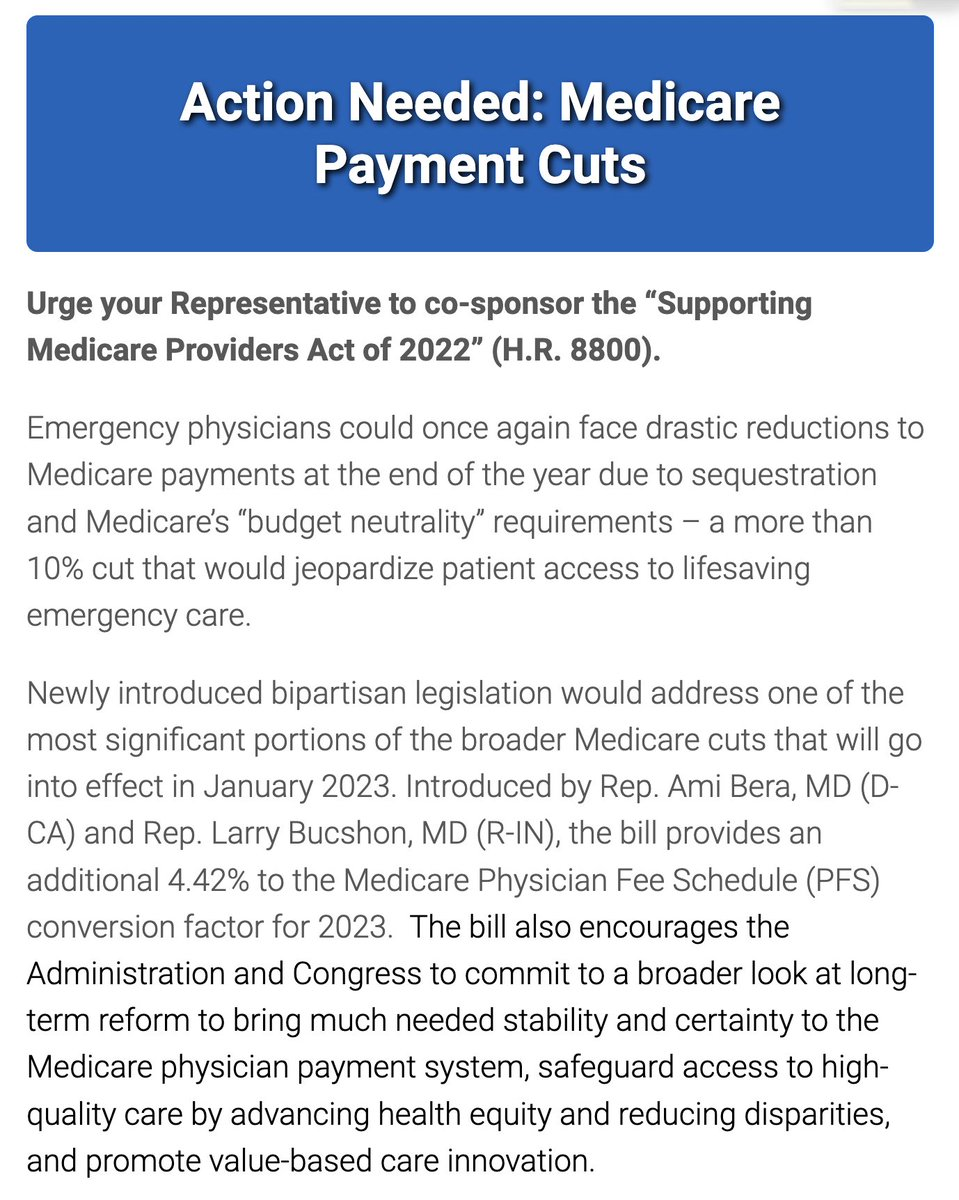
H.R.8800 – Supporting Medicare Providers Act of 2022

Due to the ongoing recess leading to the midterm elections, very important legislation introduced in September, H.R. 8800 – Supporting Medicare Providers Act of 2022, has stalled.

This critical, bipartisan legislation would stabilize Medicare for physicians and patients because it:

  1. Stops the 4.42% of the Medicare cuts related to the budget neutrality adjustment in the Medicare Physician Fee Schedule (MPFS), helping to buoy physician practices that are still recovering from the pandemic;
  2. Protects patients access to care, particularly in underserved communities; and
  3. Provides a commitment to long-term Medicare payment reform.

President Biden lays out his sweeping legislative agenda

https://mailchi.mp/097beec6499c/the-weekly-gist-april-30-2021?e=d1e747d2d8

Legislative Agenda

In his first address to a joint session of Congress, delivered on the eve of his 100th day in office, President Biden laid out his vision for two major legislative proposals to follow the $1.9T stimulus package he signed into law last month.

The first, described as an “infrastructure” bill, focuses largely on investing in transportation-related improvements, building projects, and “green” upgrades to the nation’s energy grid, along with a $400B investment in home-based care for the elderly and people with disabilities—which amounts to over 17 percent of the package’s $2.3T price tag.

The second, which he unveiled in Wednesday’s speech, is a $1.8T “families” bill, is largely aimed at expanding childcare subsidies, early childhood education, paid family and medical leave, and educational investments. Included in that package is $200B to extend the temporary subsidies—approved as part of last month’s stimulus law—for those seeking health insurance coverage on the individual marketplaces created by the Affordable Care Act (ACA).

Notably absent from either proposal were two categories of healthcare reform that received much focus and airtime during last year’s election campaign: reducing the cost of prescription drugs and lowering the eligibility age for Medicare to 60 or below. Given the closely divided makeup of the new Congress, and the relatively moderate position staked out by the Biden administration on healthcare issues (with a bias toward bolstering the ACA rather than pursuing sweeping changes), we’re not surprised to see the Medicare expansion go unmentioned. 

But the bipartisan popularity of lowering prescription drug costs seems like a missed opportunity for Biden, who encouraged the Congress to return to it separately, later in the year. We’ll see. For now, with even some Democrats expressing concern about the $4.1T price tag of Biden’s proposals, we would be surprised if all $600B of the healthcare-related spending makes it to the final legislation. In particular, our guess is that some portion of the home-care spending will get traded away in favor of other components of the package. Expect negotiations to be intense.