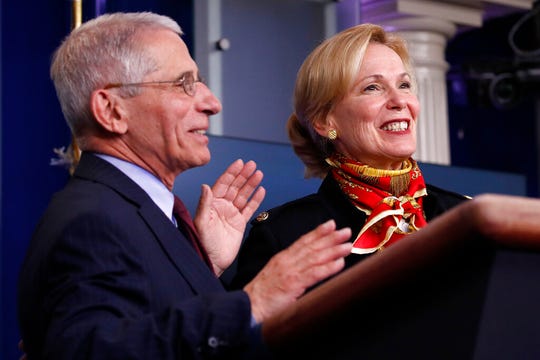
Pence Blocks Fauci, Birx from Appearing on CNN after Network Stops Airing Full White House Coronavirus Briefings

https://news.yahoo.com/pence-blocks-fauci-birx-appearing-163022678.html

Anthony Fauci and Deborah Birx are diving into social media to ...

Vice President Mike Pence has blocked Drs. Anthony Fauci and Deborah Birx, as well as other top U.S. health officials, from appearing on CNN following the network’s decision to not air the White House coronavirus press briefings in full.

“When you guys cover the briefings with the health officials then you can expect them back on your air,” a spokesman for the vice president told CNN.

Trump and the White House Coronavirus Task Force, led by Pence, have been giving daily briefings to the press for several weeks after rising numbers of Americans have been infected. A CNN executive said that the network has sometimes cut away from the briefings after Trump speaks, and turns to a panel to fact-check the president. However, the network usually broadcasts only the president’s question-and-answer session.

Fauci and Birx regularly appear at the briefings to give updates on the status of the coronavirus epidemic within the U.S. Fauci has also appeared on CNN virtual townhalls on the coronavirus for the past five weeks, but will not be present this Thursday.

The New York Times, another outlet that has been a target of the Trump administration’s ire, stopped airing the briefings on its website entirely.

“We stopped doing that because they were like campaign rallies,” Elisabeth Bumiller, the paper’s Washington bureau chief, told the Washington Post. “The health experts often have interesting information, so we’re very interested in that, but the president himself often does not.”


Wisconsin Election: Voters Find Long Lines and Closed Polling Sites

Wisconsin Election: Voters Find Long Lines and Closed Polling ...

The state is the first to hold a major election with in-person voting since stay-at-home orders were widely instituted because of the coronavirus.

Many voters say they never received the absentee ballots they requested.

  • Wisconsin is the first state to hold a major election with in-person voting despite stay-at-home orders for Americans protecting themselves from the coronavirus.

  • Polls will close at 9 p.m. Eastern time. Long lines have been seen in cities like Milwaukee, which has only five polling places open, and social distancing is a concern.

  • Wisconsin is holding its presidential primary between former Vice President Joseph R. Biden Jr. and Senator Bernie Sanders. Mr. Biden had a strong lead in a recent, widely respected poll.

  • The state’s elections commission has ordered municipal clerks not to release any results until April 13, in compliance with a federal court ruling.

  • Wisconsin Democrats wanted to extend absentee voting and even postpone the election altogether, but Republicans successfully blocked both in court. As a result, Democratic turnout is likely to be depressed because of the virus and the deadlines for absentee voting. A crucial seat on the State Supreme Court is on the ballot.

A morning of voting brings disruption and confusion.

MILWAUKEE — After a morning of voting across Wisconsin, in an election that has drawn derision from public health experts and inflamed partisan tensions, a picture is emerging of long lines, some flaring tempers and a dose of chaos and confusion in the state’s most heavily populated areas.

Voters in Milwaukee, the state’s Democratic base and most populous city, have experienced significant disruptions at polling places. Election workers in the city expected more than 50,000 voters on Tuesday, but the number of polling locations was drastically reduced, from more than 180 to just five. Some voters waited in line for more than two hours, spread out over blocks as they tried to practice social distancing to guard against the coronavirus.

In other parts of the state, especially in smaller communities that tend to be less Democratic, the in-person voting process was running relatively smoothly, with wait times more closely resembling a normal election.

Democratic officials in Wisconsin have lashed out at Republicans, saying they created an atmosphere that amounts to voter suppression with a key statewide Supreme Court race on the ballot. It remains to be seen how the disruptions could affect the Democratic presidential primary contest between Mr. Biden and Mr. Sanders.

Many voters say their absentee ballots never arrived.

Across Wisconsin, would-be voters complained that the absentee ballots they requested had never arrived in the mail, even though figures released by the state seemed to indicate the problem was not widespread.

Representative Gordon Hintz, the Democratic minority leader in the State Assembly, said there may have been a glitch in the system, perhaps because of overwhelmed elections offices. “It appears that people who requested their ballots between March the 20th and 24th, or maybe the 25th, have not received their ballots,” Mr. Hintz said.

Official state figures showed that of 1,282,762 ballots requested, 1,273,374 had been sent, a shortfall of about 9,000.

But Mr. Hintz estimated that hundreds, it not thousands, of voters in his Oshkosh district alone had not received the ballots they asked for, leaving them in a predicament over whether to vote in person and risk contracting or spreading the coronavirus.

One of them was Mr. Hintz himself, who had decided not to vote Tuesday because the ballot he requested on March 22 had not arrived. The Wisconsin Elections Commission’s website says it was mailed to him on March 24.

Roger Luhn, a psychiatrist in Milwaukee, said Tuesday that he was also among the voters who had not received an absentee ballot.

“According to the website, they mailed the ballot to me on March 23,” said Dr. Luhn, who is medical director of a psychiatric hospital. “Yesterday, I gave up. I called the election commission. They put you on extended hold.”

Dr. Luhn said he would not go to the polls on Tuesday out of concern for his family, his patients and his fellow staff members. “There is no good outcome for today’s election,” he said. “No matter what happens, not enough people will have had an opportunity to safely cast their ballots.”

Voters encounter long lines — and social distancing.

The effects of shuttering so many polling sites in Milwaukee were immediately apparent on Tuesday morning: Across the city, lines stretched for blocks even before 7 a.m. local time.

On the South Side of the city, the parking lot of Alexander Hamilton High School was already full as daylight broke. By 8 a.m., more than 300 voters waited in a line that snaked through the parking lot and down the street.

At other locations nearby that would have normally been open for voting, signs were posted directing voters to Hamilton High School. But many of the locations were in heavily immigrant neighborhoods, predominantly Spanish or Hmong, and the only signs posted were in English.

At Marshall High School, in the northern part of Milwaukee, the line stretched for more than three blocks, with voters keeping six feet of space between each other. Most wore masks or other facial coverings.

The northern part of the city, which is predominantly black, has been hit the hardest by the coronavirus. Yet hundreds of voters had already queued by early morning.

The lines weren’t limited to Milwaukee. In Waukesha, a suburb just outside of Milwaukee, only one polling location was open for a city of 70,000. A similarly long line wrapped around a parking lot, as cones denoting a safe distance between voters helped break up the line.

A woman sick with coronavirus is unable to vote.

Hannah Gleeson is a health care worker who lives in Milwaukee, is 17 weeks pregnant and recently tested positive for the coronavirus. She says she has voted in every election she has been eligible for — “I enjoy going in person. I like getting my sticker,” she said — but since contracting the virus she realized that going to a polling place would not be an option.

“I feel like especially right now, when there are so many things that can make you feel hopeless, voting is one of the only things that is still within your power,” Ms. Gleeson, 34, said.

So she requested an absentee ballot a week ago, well within the deadlines set by the state. But she never received one. When she saw that the U.S. Supreme Court had struck down an extension of the deadlines, she called the state elections commission.

“They kind of said, yeah, that really sucks, hopefully you’ll have better luck with the next election,” Ms. Gleeson said. She said that some friends in Milwaukee had also not received ballots: one who made a request on March 26, and another on March 9.

Now, Ms. Gleeson and her husband, who is not showing symptoms but is also isolating himself since Ms. Gleeson is sick, are not able to vote, or at least not able to do so without putting hundreds of people at risk. “I’ve always said that every vote matters, every vote counts, and it’s your one chance to have your voice heard,” she said. “And it’s now something that I really feel has been taken away from me, and my husband as well.”

A missing absentee ballot snaps a 30-year voting streak.

In the city of Oshkosh, where officials have implemented curbside voting, Brian Binder, 49, was one of many Wisconsin voters who reported not receiving the absentee ballots they applied for. Mr. Binder’s wife, who applied at the same time, received hers.

“There’s a large number of people who just did not get them,” said Mr. Binder, an employee of a food packaging company.

As a result of all the confusion and the coronavirus, Mr. Binder said he would not vote in this election, breaking a 30-year streak.

“I vote in every election, local primaries, since I was 18. I’m a person that takes it very seriously, your right and your responsibility to vote. However, given the situation with the virus I’m not sure I want to endanger myself or other people at the polls,” said Mr. Binder, who has been working from home for the past two weeks.

He also expressed frustration with the state’s deeply entrenched political division.

“I feel that this is something they shouldn’t play politics with,” said Mr. Binder, a lifelong Republican who said his support for the party had waned since President Trump’s election. “I don’t know why we couldn’t postpone to keep people safe. I don’t know what the goal was.”

Partisan brawling and a logistical tangle have led to chaos.

Like so much else in Wisconsin over the last decade, the state’s coronavirus response and opinions about moving the election broke along partisan lines.

Democrats, aiming to expand turnout especially in the state’s largest cities, Milwaukee and Madison, sought to expand mail voting and delay the election until June. Republicans, wary of affording new powers to a Democratic governor and content with suppressing turnout in urban centers where the coronavirus has struck hardest, refused to entertain proposals for relief.

“Thousands will wake up and have to choose between exercising their right to vote and staying healthy and safe,” Gov. Tony Evers said Monday after the state’s Supreme Court blocked his effort to postpone the election.

But Dean Knudson, a Republican former state legislator who is chairman of the Wisconsin Elections Commission, said late Monday that voters who wished to participate in Tuesday’s contest would have no recourse but to venture to the polls — even if they had requested but had not yet received an absentee ballot.

“If they haven’t got their ballot in the mail,” he said, “they are going to have to go to the polling place tomorrow.”

Other Republicans have played down the danger to public health of voting during a pandemic. One Republican county chair, Jim Miller of Sawyer County, said the process would be similar to people picking up food to eat during the state’s stay-at-home order.

“If you can go out and get fast food, you can go vote curbside,” Mr. Miller said. “It’s the same procedure.”

Why are Wisconsin Republicans so adamant about holding Tuesday’s elections?

It’s not just a presidential primary on the ballot in Wisconsin. Also at stake is the makeup of the Wisconsin Supreme Court — the very court that struck down Mr. Evers’s effort to delay Tuesday’s elections.

Statewide races in Wisconsin tend to be close, and Supreme Court elections, which come with 10-year terms, are often even closer.

Last year Brian Hagedorn, a conservative judge, defeated a liberal challenger by less than 6,000 votes out of 1.2 million cast. In 2011, another conservative, David T. Prosser Jr., won by 7,000 votes after officials in Waukesha County found 14,000 overlooked ballots the day after the election.

For now, conservatives hold five of seven seats on the officially nonpartisan court. The incumbent in Tuesday’s contest, Justice Daniel Kelly, was appointed to replace Justice Prosser by Gov. Scott Walker in 2016 and is seeking his first full term. He faces Jill Karofsky, a liberal circuit court judge.

President Trump has posted several messages on Twitter endorsing Justice Kelly in recent days.

If Justice Kelly wins, it will cement the conservative majority’s ability to block future Democratic efforts to change the state’s strict voting laws and litigate an expected stalemate over congressional and state legislative boundaries during post-2020 redistricting.

Liberals would need to flip just one of the conservatives’ votes if Judge Karofsky wins. Unless a justice retires or resigns, they would not have an opportunity to win a court majority until the 2023 elections.

Polls will close at 9 p.m. Eastern, but that’s unlikely to be the end of the elections.

Though voting may end on Tuesday night, there will most likely be a new round of lawsuits challenging both the results and the disenfranchisement of many voters. Many allied groups in Wisconsin were already gathering accounts of voters unable to get a ballot or vote in anticipation of litigation.

Adding to the uncertainty, the results themselves will most likely be delayed by almost a full week: The Wisconsin Elections Commission has directed local municipal and county clerks not to release results until next Monday afternoon, in compliance with a federal court ruling.

“Instead of having Iowa-style results where no one knows what to expect, if we stick to this we’re going to have a clean election tomorrow but we’re not going to report the results until the following week,” said Mr. Knudson, the elections commission chairman.


Political hackery at its worst: Supreme Court gives Wisconsin a green light to disenfranchise voters during the pandemic

https://www.yahoo.com/news/political-hackery-worst-supreme-court-021006989.html

Opinion: Hackery at its worst: Supreme Court conservatives just ...

The Los Angeles Times warned in an editorial last month that the COVID-19 pandemic threatened not only the health of individuals but the democratic process. The Supreme Court exacerbated that infection Monday when the justices blocked a lower court’s decision to extend the period in which Wisconsin voters could mail in absentee ballots.

Tuesday is election day in that state, and the Democratic presidential primary is only one of many contests on the ballot. As the COVID-19 crisis deepened, it became obvious that some voters would face a choice between exercising the franchise and protecting their health by staying home. But first the Wisconsin Supreme Court and then the U.S. Supreme Court failed to rise to the occasion.

On Monday the state Supreme Court rebuffed an attempt by Wisconsin’s Democratic governor to suspend in-person voting on Tuesday and expand voting by mail. Then late Monday the U.S. Supreme Court, with Democratic and Republican appointees on opposite sides, stayed an order by a lower federal court requiring Wisconsin to count mail-in ballots if they arrived by April 13 even if they were mailed after election day.

In an unsigned opinion, the court’s conservative justices providing a textbook example of exalting form over substance. The majority complained that the extended deadline for absentee ballots “fundamentally alters the nature of the election.” It cited the precedent of a 2006 decision in which the court overturned an injunction preventing Arizona’s use of a photo ID requirement — a ruling from a calmer time. Precedent loses its force in unprecedented circumstances.

This ruling is outrageously oblivious to the emergency posed by the pandemic. In the 2006 case the court emphasized that a state “indisputably has a compelling interest in preserving the integrity of its election process.” But given the pandemic and the disruptions it creates for the election process, the lower court’s order promoted exactly that objective.

As Justice Ruth Bader Ginsburg noted in a dissent signed by three other Democratic appointees, the court’s order means that absentee voters must postmark their ballots by Tuesday, even if they didn’t receive their ballots by that date because of a backlog. The result, she warned, could be “massive disenfranchisement.”

As disturbing as the result of the court’s ruling is the fact that it pitted conservative justices appointed by Republican presidents against liberal justices appointed by Democratic presidents, seeming to validate the perception that the justices are “politicians in robes.” So much for Chief Justice John G. Roberts Jr.’s campaign to portray the court as being aloof from partisan politics.


Wisconsin Votes Tomorrow. In Person.

Wisconsin Votes Tomorrow. In Individual. - Hindi2News

The state’s Supreme Court ruled against the governor’s last-minute effort to delay the election.

The Summer Olympics are delayed. March Madness was canceled. Even the pope celebrated Palm Sunday Mass before a nearly empty St. Peter’s Basilica.

But in Wisconsin, there could still be an election tomorrow.

Yes, you read that correctly: A state that has been under a stay-at-home order for nearly two weeks is about to hold an in-person election amid the coronavirus pandemic.

Just over an hour ago — and with just hours to go before the polls are scheduled to open — the Wisconsin Supreme Court ruled against a last-minute effort by Gov. Tony Evers to postpone the election until June 9, siding with a Republican-controlled State Legislature that has resisted making nearly any changes to voting during the worldwide crisis.

The last-minute fighting over whether it is safe for people to vote tomorrow injects even more chaos into an election already rife with legal challenges and public safety concerns.

It’s a situation that could foreshadow the kind of politically toxic battles over voting that the country may face this fall, if the virus lingers into the November election. (Wisconsin has more than 2,000 reported coronavirus cases and at least 80 deaths.)

Mr. Evers, a Democrat, had previously said that he lacked the legal authority to move the election, but today he argued that a postponement was necessary to protect voters and slow the spread of the virus.

Within minutes of his order, Republican legislative leaders called his move unconstitutional, instructing clerks to move forward with the election and challenging the order in the State Supreme Court, which has a conservative majority.

Already, 15 other states and one territory had either pushed back their presidential primaries or switched to voting by mail with extended deadlines.

Dysfunctional politics kept Wisconsin from doing the same. On Saturday, state lawmakers rejected Mr. Evers’s proposals for holding an all-mail election and extending voting to May, gaveling out a special legislative session within seconds. That prompted Mr. Evers and his team to reassess what authority he might have to postpone the election with an executive order.

Even with voters’ very lives at stake, Wisconsin’s politicians were unable to come to an agreement — a fight that mirrors the dynamics of battles over voting access already underway at the national level.

As Democrats push for billions of dollars in federal funds to bolster voting by mail and other absentee options, Republicans say those kinds of options would increase the risk of electoral fraud. Some, including President Trump, also argue it would harm the electoral prospects of Republican candidates.

“The things they had in there were crazy,” Mr. Trump said of the Democratic proposal. “They had things — levels of voting that, if you ever agreed to it, you’d never have a Republican elected in this country again.”

While Wisconsin Republicans have not made that argument explicitly, they do have a competitive State Supreme Court election on the ballot on Tuesday (along with the presidential primary and thousands of local offices).

Wisconsin, one of the most gerrymandered states in the country, has a long history of electoral shenanigans. Two years ago, the Republicans in charge tried to move Tuesday’s State Supreme Court election to a different date to help their candidate.

Even if in-person voting does happen tomorrow, the legitimacy of the election will most likely be thrown into question. Turnout is expected to be dismal, given the warnings about contracting the virus and confusion over the actual elections.

Already, more than 100 municipalities have said they lack enough staff members to run even one polling place. Milwaukee typically has about 180 sites; this election the city will have five open. The head of the state elections commission has raised the possibility that some voters may have to head to a different town because no one will be staffing the polls in their hometowns.

The poll workers who remain are overwhelmingly older. Some have serious health conditions. Many have been waiting to receive protective equipment.

In Wisconsin, it seems, maintaining democracy means risking your health — to both toxic politics and a deadly virus.


Pandemic Provides Defining Moment for Government Leaders

https://www.governing.com/now/Pandemic-Provides-Defining-Moment-for-Government-Leaders.html?utm_term=READ%20MORE&utm_campaign=Pandemic%20Provides%20Defining%20Moment%20for%20Government%20Leaders&utm_content=email&utm_source=Act-On+Software&utm_medium=email

Image result for crisis leadership

Governors and mayors don’t run for office with the intention of managing emergencies. But when a crisis strikes, they become the public face of government response and need to be ready to communicate accurately and calmly.

Mike DeWine didn’t pull any punches.

At a news conference on Thursday, the Ohio governor announced he was ordering that K-12 schools shut down until April 3 and banning most gatherings of 100 people or more. Ohio had only five confirmed coronavirus cases at that point, but DeWine’s health director Amy Acton, standing by the governor’s side, said they suspected that well over 100,000 state residents were already infected — a number expected to double every five days.

DeWine made it clear that his state, like others, faces massive challenges. In response, he offered resolve but not sugar-coated optimism. “This is temporary. We will get back to normal in Ohio. It won’t happen overnight,” DeWine said. “We must treat this like what it is, and that is a crisis.”

Around the country, other governors and mayors have been offering similar messages. Many are out in front, holding news conferences on a daily basis. Maryland Gov. Larry Hogan announced Thursday that he was putting his lieutenant governor in charge of most state operations so he could devote his full attention to the coronavirus crisis. Michigan Gov. Gretchen Whitmer held a news conference just before midnight on Thursday to announce a statewide school closure.

“Crises and disasters are what separates legislators from executives,” says Jared Leopold, a former communications director for the Democratic Governors Association. “For those executives who face a major disaster, crisis management becomes their defining legacy, whether they like it or not. Nothing else matters.”

Executives become the public face of the government’s response. Whether it’s natural disasters, mass shootings or a pandemic, their role is not only to share information, but to convey the sense that someone is in charge and has a plan that will see the city, state or nation through the worst of times. “That’s what the governor has to do in this situation,” says Bob Taft, a former Ohio governor.

“He’s been very visible, very prompt and as much ahead of the curve as possible in terms of taking decisive action,” Taft says of DeWine. “He’s also putting out good information and he’s obviously listening to the public health experts and the knowledgeable staff on his team.”

There are plenty of examples of politicians winning either acclaim or scorn for their handling of emergency situations. Sen. Joe Manchin’s enduring popularity in West Virginia — he’s the only Democrat still capable of winning statewide election in that increasingly red state — is rooted in his handling of the Sago Mine explosion as governor back in 2006. A year earlier, Mississippi Gov. Haley Barbour won applause for his handling of Hurricane Katrina, while Louisiana Gov. Kathleen Blanco was widely criticized and decided not to run for re-election.

“Do it right, and you’ll be remembered as a leader for decades,” Leopold says. “Do it wrong, and you’ll be voted out of office.”

No One Signs Up for This

Politicians campaign on issues such as taxes and education. No one pledges to provide stalwart leadership if and when there’s a crisis. It doesn’t seem relevant until it happens. But, once elected, they end up being judged by how they respond to the worst challenges.

“People watch very carefully what leaders do during these situations,” says Jay Nixon, who coped with a deadly tornado in Joplin and the Ferguson shooting, along with other challenges, during his tenure as Missouri governor.

Leaders need a plan, Nixon says. It may change daily or even hourly, but having a plan gives them, their teams and the public some sense of where they’re going. They also need to convey information in a reassuring and convincing way. “You have to have a clear source of information that’s not only accurate, but one that people trust,” Nixon says. “Leaders need to remain calm and normal.”

When new governors are elected, they’re often warned by sitting governors they’ll likely need to respond to disaster in some form or other. Taft, who was in office during the 2001 terrorist attacks, said that event opened up governors’ eyes to all manner of contingencies.

“Of course, all governors expect to have to weather emergencies,” he says. “That was something new and different — like today, a whole new set of threats.”

Governors are well-equipped to respond. There’s a whole structured apparatus, whether it’s called an emergency operations center or something else, that offers them plans, a command structure and communications tools to deal with unexpected tragedies.

If you’re a governor, you’re likely to be faced with a flood or a tornado or some other event with devastating consequences you must respond to. No matter their other priorities, they’re always ready to go on an emergency footing.

“To me, governors and states are always well-prepared, because in effect they’re always training for it,” says Scott Pattison, former executive director of the National Governors Association. “Whatever one says about a particular governor, they know that’s the expected role and they step right into it and rise to the occasion.”

The All-Dominant Issue

When executives aren’t seen as responding swiftly and competently, it can imperil both their re-election chances and their broader agendas. It’s a well-established part of political folklore that mayors lose their jobs when cities don’t dig out promptly following snowstorms. “We’ve probably spent as much time on snow as we have on the budget,” Massachusetts Gov. Charlie Baker said not long after taking office in 2015.

Andy Beshear was sworn in as Kentucky’s governor four months ago. Lately, he has been holding daily news conferences to provide updates on caseloads and policy changes. In recent days, he has called for schools to close for two weeks, for church services to be held virtually and for the state’s 200 senior centers to shut down in-person activities. “Let me say once again: We’re going to get through this,” he said on Friday.

People are not looking for uplift, but rather find confidence in knowing that there’s someone in charge offering a serious, smart response, says George C. Edwards III, a political scientist at Texas A&M University. “You get credibility from two things — one, from recognizing the problem as it is, and two, from acting,” he says.

One of Winston Churchill’s most famous wartime speeches begins, “The news from France is very bad.” When asked about the death toll on Sept. 11, 2001, Rudy Giuliani, then New York City’s mayor, said, “The number of casualties will be more than any of us can bear, ultimately.”

“People want reassurance and so (politicians) give it,” Edwards says. “They want to know it’s going to work out. At the same time, what’s critical is credibility, showing you have a firm handle on the crisis.”

No More Rallying Around the Leader

“During crises, people turn to the government for leadership, including what actions to take and how to return to stability,” according to a 2018 communication study. “Leaders are responsible for and expected to minimize the impact of crises, enhance crisis management capacity and coordinate crisis management efforts.”

In Kentucky, Beshear has won praise, so far, for sharing information personally and presenting the advice and counsel offered by public health and safety experts. “Party’s aside (he’s not mine) Beshear has done an excellent job with all this,” Samuel Keathley, a resident of Martin, Ky., tweeted on Thursday. “He’s never seemed panicked; he’s also never made it seem like nothing. He sounds and acts like a leader.”

The 2001 terrorist attacks offer one of the most dramatic examples of a politician winning acclaim for response to a crisis. Within 10 days, President George W. Bush’s approval ratings had jumped from 51 percent to 90 percent, according to Gallup.

“Presidents must take charge of crises right away,” says Matthew Eshbaugh-Soha, who chairs the political science department at the University of North Texas. “If presidents do well, the American people will respond with support.”

That hasn’t happened for President Trump. For weeks, Trump has sought to downplay the crisis, offering optimistic assessments that contradict warnings from federal public health officials. His speech from the Oval Office on Wednesday was hastily written and included a number of factual errors regarding policy positions that had to be quickly walked back by the administration.

“He’s not telling the truth and he is not trusted in that sense,” says Nixon, the former Missouri governor. “He doesn’t have a plan and he seems to be in a completely reactive mode.”

In general, Trump’s style is combative. His presidency has been disruptive, not designed to offer calming reassurance. His supporters have loved him for it, but there are more Americans, as measured by polls, that went into the coronavirus period already distrusting him.

“Trump has a very dedicated base who are absolutely steadfast, but he’s got an even larger opposition coalition that is equally steadfast,” says Edwards, the Texas A&M presidential scholar. “If you already hate him, you’re much less likely to be reassured.”

At the same time, the news media also has a problem when it comes to trust. That’s something predating Trump, but which he has encouraged with his frequent complaints about “fake news.” On Thursday, Megyn Kelly, a former news anchor and correspondent for NBC and Fox News, tweeted that while she didn’t believe Trump was a credible source, “we can’t trust the media to tell us the truth without inflaming it to hurt Trump.”

On Thursday, the city of Murfreesboro, Tenn., posted a statement on its website advising residents not to turn to media outlets for coronavirus information: “Unfortunately, today’s media know that negative or overtly controversial stories receive more attention and thereby generate traffic to their publications, broadcasts and websites.”

That assertion has since been deleted, but it spoke to the polarization that continues even in a country beset by crisis.

According to an ABC News/Ipsos poll released Friday, 47 percent of Democrats are “very concerned” about catching coronavirus, while only 15 percent of Republicans share that level of concern. Just 17 percent of Democrats say they are not concerned about being infected, compared with 44 percent of Republicans.

As the virus spreads and more businesses and activities shut down, public opinion will necessarily shift. No one can say how this will play out. No one can predict the ultimate costs in terms of health and mortality.

“It may take an event of this magnitude to shake people on both sides of the political equation,” Nixon says. “This may be that moment where, as a country, both Democrats and Republicans realized that there are some things that should be analyzed separately from political partisanship.”