Fifth Circuit Appeals Court Strikes Down the Affordable Care Act’s Individual Mandate

https://www.commonwealthfund.org/blog/2019/fifth-circuit-appeals-court-strikes-down-affordable-care-acts-individual-mandate

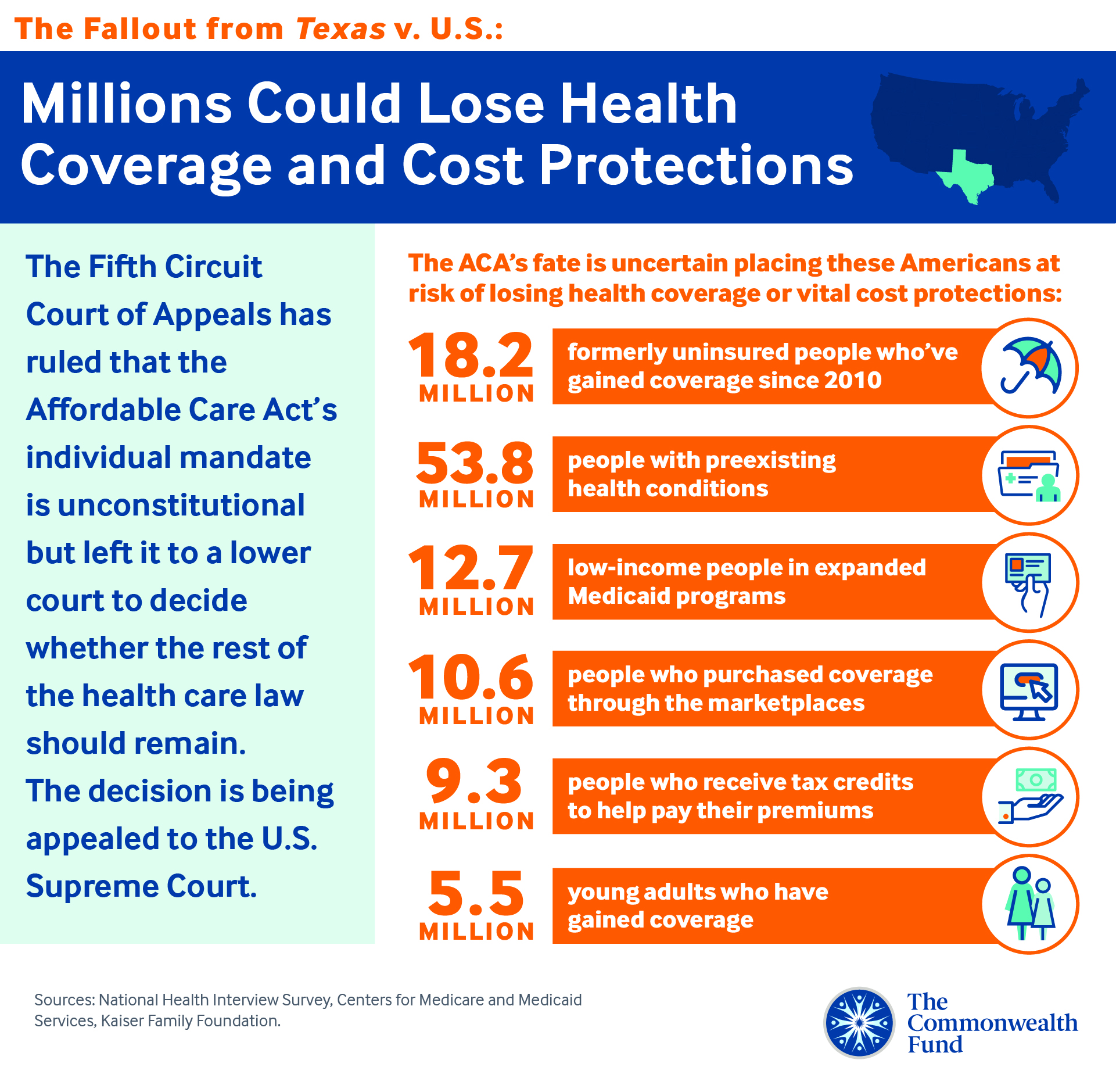
The Fallout from Texas v. U.S.:

Yesterday, a three-judge panel from the Fifth Circuit Court of Appeals struck down the Affordable Care Act (ACA)’s individual mandate. The judges agreed with a lower court decision issued in the case, Texas v. U.S., in December 2018 that the individual mandate is unconstitutional but, unlike the lower court, did not decide that the rest of the ACA is also unconstitutional. Instead, the judges remanded, or sent back, the decision to the same lower court judge to consider. California Attorney General Xavier Becerra, who is leading the 21 Democratic state attorneys general defending the law, along with the U.S. House of Representatives, immediately announced he would appeal the decision to the Supreme Court.

Whether the Supreme Court will decide to take the case now or wait for the decision of Judge O’Connor’s, of the lower court, is uncertain. If the Court decides to take the case now, they could expedite the briefing process and issue a decision in 2020. If it does not take the case now, a ruling will be delayed until after the 2020 presidential election.

No one knows how the Supreme Court will ultimately rule. But we do know that if the Court decides to strike down the ACA, the human toll will be immense and tragic. The law has granted unprecedented health security to millions:

  • 18.2 million formerly uninsured people have gained coverage since 2010
  • 53.8 million Americans with preexisting health conditions are now protected
  • 12.7 million low-income people are insured through expanded Medicaid
  • 10.6 million people have coverage through the ACA marketplaces, 9.3 million of whom receive tax credits to help them pay their premiums
  • 5.5 million young adults have gained coverage, many by staying on their parents’ plans
  • 45 million Medicare beneficiaries have much better drug coverage.

Such a decision will also trigger massive disruption throughout the U.S. health system. The health care industry represents nearly 20 percent of the nation’s economy; the ACA has touched every corner of it. The law restructured the individual and small-group health insurance markets, expanded and streamlined the Medicaid program, improved Medicare benefits, and reformed the way Medicare pays doctors, hospitals, and other providers. It was a catalyst for the movement toward value-based care and established a regulatory pathway for biosimilars — less expensive versions of biologic drugs. States have rewritten laws to incorporate the ACA’s provisions. Insurers, hospitals, physicians, and state and local governments have invested billions of dollars in adjusting to these changes.

The law’s popular preexisting health condition protections have made it possible for people with minor-to-serious health problems to apply for coverage in the same way healthier people have always done. These protections have given the estimated 53.8 million Americans with preexisting health conditions the peace of mind that they will never be denied health insurance because of their health.

More than 150 million people who get coverage through their employers now are eligible for free preventive care, and their children can stay on their policies to age 26.

The wide racial and income inequities in health insurance coverage that have been partly remedied by the ACA would return. Hospitals and providers, especially safety-net institutions, would struggle with mounting uncompensated care burdens and sicker and more costly patients who are not receiving the preventive care they need.

The ACA tore down financial barriers to health care for millions, many of whom were uninsured for most of their lives. It has demonstrably helped people get the health care they need in states across the country. Research indicates that Medicaid expansion has led to improved health status and lower mortality risk.

To date, neither the Trump administration, which has sided with the plaintiffs in the case, nor its Republican colleagues in Congress have offered a replacement plan in the event the law is struck down. The historic progress made by Americans, particularly those with middle and lower incomes and people of color, could unravel. Voters are already telling policymakers they are worried about their ability to afford health care. Yesterday’s decision and the uncertain path forward to the Supreme Court is certain to escalate those worries. With the nation entering the 2020 presidential election year, the Supreme Court may decide to take up the case this term.


The Justice Department’s New Brief in Texas v. United States

The Justice Department’s New Brief in Texas v. United States

Image result for The Justice Department’s New Brief in Texas v. United States

Last week, the Fifth Circuit asked the parties to Texas v. United States—the broadside challenge to the constitutionality of the Affordable Care Act—to submit letter briefs on whether anyone had standing to appeal. (Jonathan Adler has offered excellent analysis of that order here.)

Though the briefs won’t all be filed until Friday, the Justice Department submitted its brief this afternoon. In a welcome surprise, I agree with most (but not all) of it. It should lay to rest any of the Fifth Circuit’s qualms that the case is not properly before it.

* * *

In its brief, the Department says that it’s got standing to take the appeal, even if no one else does. “[T]he government remains an appellant in this case and, critically, continues to enforce the Affordable Care Act.” Until it stops enforcing the Act, the red states and the Trump administration are at odds over the constitutionality of its continued implementation. That’s enough for a case or controversy.

Confirming the point is the Supreme Court’s decision in United States v. Windsor, the case in which the Obama administration declined to defend the Defense of Marriage Act. As the Department explains:

[H]ere, as in Windsor, the United States has both appealed that judgment and continued to enforce the statute to the detriment of the plaintiffs pending final judicial resolution of the constitutional question, even though the Executive Branch agrees with the district court’s legal conclusion. In both cases, the government’s refusal to acquiesce to the relief entered against it by the district court suffices to preserve an Article III controversy.

Significantly, the Justice Department now says that it will continue to enforce the ACA “pending a final judicial determination of the constitutionality of the individual mandate as well as the severability of the ACA’s other provisions.” Ongoing enforcement means there’s a live dispute.

I think that’s right. Not only is it consistent with Windsor, but it would avoid a very odd result. If no one could appeal, Judge O’Connor’s decision invalidating the ACA would likely remain in place—even as the Trump administration continued to interpret it as allowing for continued enforcement. But that outcome wouldn’t satisfy the red states, which seek to blow up the ACA altogether. And so the parties would still be at loggerheads, their nominal agreement on the legal questions in the case notwithstanding.

The Department also points out that it’s not in total agreement with Judge O’Connor. In a strange portion of its opening brief, it argued that parts of the ACA that didn’t directly give rise to the plaintiffs’ injuries should be sustained. The Department flagged certain anti-fraud statutes as examples, but it’s not at all clear how far that argument goes. Does it apply to the biosimilar program? Calorie-count labels in chain restaurants? The Medicaid expansion? Regardless, the point holds that the red states and the federal government disagree about how much of the ACA should be invalidated if the individual mandate is unconstitutional. That should be enough for standing.

* * *

Because the federal government itself has standing to appeal, the Justice Department thinks it’s “immaterial” whether the House of Representatives or the blue-state coalition—both of which have intervened in the case—can also take an appeal. For now, I think that’s right.

Nonetheless, the Department offered its views, as the Fifth Circuit asked. As to the House of Representatives, the Department says that the Supreme Court’s decision in Virginia House of Delegates v. Bethune-Hill confirms that the House, as one part of a bicameral legislature, can’t sue to vindicate an injury sustained by Congress as a whole. I think that’s right, as I’ve argued before.

But who cares? Unless the blue states also lack standing, it’s irrelevant. And that’s where I think the Justice Department’s brief goes astray.

The Department says that the blue states also lack standing to appeal because nothing in O’Connor’s decision—which was a declaratory judgment, not an injunction—alters their “tangible legal rights.” In essence, the Department argues that O’Connor’s declaration that the ACA is invalid should be understood to bind only the 19 red states that brought the case, not “nonparties like the [blue] state intervenors.” As such, the blue states don’t have an interest in the case and can’t take an appeal.

That’s wrong, however. Intervention makes you a party to a lawsuit. And you’ve got a right to intervene when disposing of the case in your absence would “impair or impede” your interest in the case.

When the red states filed their complaint, they sought complete invalidation of the ACA—not just invalidation in the 19 red states. Whatever the Fifth Circuit says on appeal could determine (or at least influence) whether the red states get the relief they asked for. Indeed, because an appeals court can affirm “on any grounds supported by the record,” it’d probably be within the Fifth Circuit’s authority to interpret O’Connor’s order to apply outside the 19 red states. It’s risible to say that California is a stranger to litigation that could wipe out the ACA within its borders.

Matters might be different if the red-state plaintiffs had dropped their demand for nationwide relief. But they haven’t. (They did at one point ask O’Connor to enter red-state specific reliefif he was unwilling to grant nationwide relief. But that’s not the same thing as abandoning the claim.) Matters might also be different if district courts were prohibited from granting relief that extended beyond the plaintiffs. Though I’m on record in support of such a prohibition, that’s not the world we live in.

So yes, the blue states have standing to appeal. But it shouldn’t matter. We’ve got a live case or controversy between the red states and the Trump administration over whether it should continue enforcing the ACA. That should end the matter of whether this appeal is properly before the Fifth Circuit.