The real driver of health care spending

https://commonwealthmagazine.org/opinion/the-real-driver-of-health-care-spending/
An inefficiency gap is boosting costs — and profits

THE HEALTH CARE DEBATES that occurred in Washington over the past year were largely irrelevant to what’s happening in the health care marketplace. Republicans couldn’t repeal the Affordable Care Act but they made some changes that weakened it. Those changes will increase insurance premiums in the individual market but they do nothing to address the most significant trends that are evolving across the system. To understand the important trends, one must look elsewhere.

In March, three researchers from the Harvard T. H. Chan School of Public Health published a study in JAMA analyzing the well-known reality that the United States spends dramatically more on health care than other wealthy countries. They compared the US, where health care consumes 17.8 per cent of gross domestic product, to 10 comparable nations where the mean expenditure is 11.5 percent. Despite spending much less, the other countries provide health insurance to their entire populations and have outcomes equal to or better than ours. The researchers found that this inefficiency gap is primarily driven by two characteristics of the US system: the high cost of pharmaceuticals and inordinate administrative expenses.

The high administrative spending derives in large part from the fact that 55 percent of the people in the US are covered by private health insurers who embed their own billing requirements, expenses, and profit into the system. The next highest country in this regard is Germany, where 10.8 percent of the population is covered by private insurers. In many countries, there are no such middlemen.

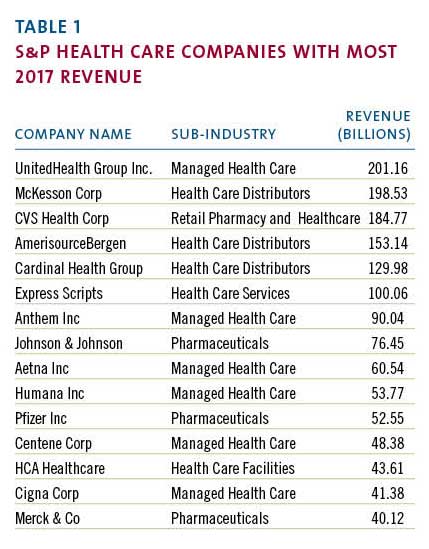
Coincidentally, when the JAMA study was published, the large publicly traded health care companies that dominate the US market had just finished disclosing their 2017 financial results. Examining those results provides additional insight into the economic forces that make our system so expensive and inefficient. The scale of the money involved is sometimes hard to grasp. The largest health care corporations, those included in the S&P 500, had almost $2 trillion in revenue last year. (Table 1)

Most of these enormous companies are engaged in one of two businesses: they’re either selling drugs or they’re selling health insurance. The excess costs reported by the Harvard researchers serve mainly to support the revenue of the companies in those fields.

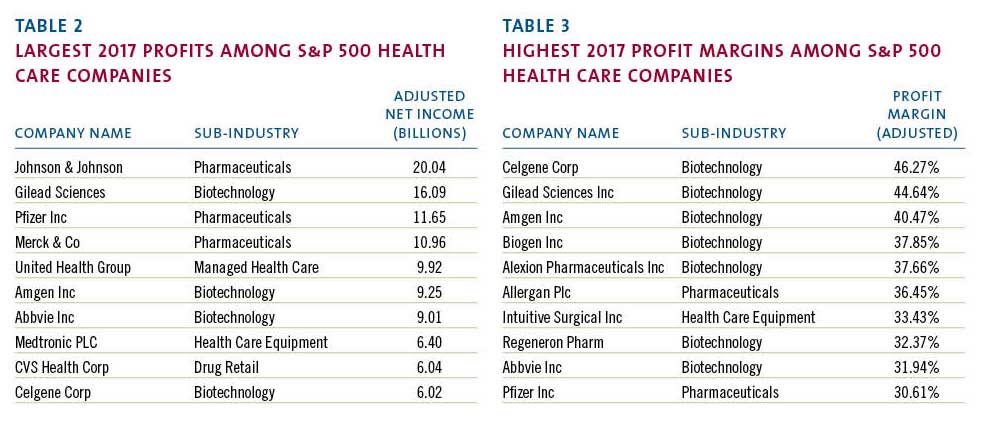
The 2017 reporting of corporate profits was complicated by the passage of the new tax bill. But most companies also reported “adjusted net income,” which shows their normalized profits after accounting for the one-time impact of the tax law. The chart below (Table 2) uses the adjusted numbers to show the largest annual profits among S&P health care companies.

Health insurers such as United Health and retailers such as CVS have enormous revenue and impressive profits but, when profit is measured as a percentage of revenue, they can’t compete with biotech and pharma. The highest relative profitability, using the same reported adjusted results, is in the chart below. (Table 3)

These profit margins show that there are many situations where between a third and a half of every dollar spent on a prescription drug falls to the bottom line of the of the company that made it. This profit derives in large part from the enormous difference in drug prices in the US versus other countries where such prices are more effectively controlled.

The high administrative cost of the US system stems from the large portion of the market dominated by insurance companies looking to maximize their profits.  Notwithstanding many news stories about turmoil in the insurance markets, 2017 was a banner year for the largest health insurers. The big players all had significant increases in annual profitability in 2017.

Note that Humana did not report “adjusted” numbers even though its profit was swollen by unusual events. A major distortion was a huge break-up fee the company received from a failed merger. That accounted for approximately $630 million in after-tax profit. Even discounting that, it was a very good year.

The revenue and profitability of these corporations support the proposition that high pharmaceutical prices and insurance-related administrative costs account for much of the extraordinary expense of our system. US health policy, or the absence thereof, has enabled these businesses annually to drive costs up for the benefit of their bottom line. That effect will continue. Not surprisingly, the big health care companies are developing new strategies to enhance their businesses and drive their profits going forward.

The term now heard often among health care giants is “vertical integration,” which means combining upstream suppliers with downstream buyers to control the flow of business. If this strategy persists, health care delivery will evolve significantly although it is unlikely to become less expensive. The most prominent current example of  vertical integration is the planned $68 billion acquisition of Aetna by CVS.

How would these companies work together? A Wall Street analyst recently described the vision as a way to “identify high risk patients and preemptively get them into a Minute Clinic.” Thus, your health insurer could send you to a local store for diagnosis, treatment, drugs, and anything else you might need from the shelves. This will keep even more of the health care dollar under their control.
Similarly, Cigna is in the process of acquiring Express Scripts, a huge pharmacy benefits manager, for $54 billion, another attempt to bring more services under one roof. The combined company would have annual revenue of $142 billion and, presumably, enough leverage with drug companies to improve profits although not necessarily to lower costs to patients. United Health, a leader of vertical integration, previously bought a pharmacy benefit manager but co-pays and deductibles for its patients have continued to climb. United has aggressively acquired physician practices in recent years and is now in the process of buying DaVita Medical Group, which operates nearly 300 clinics and outpatient surgical centers.

More striking are reports of a potential but unsigned merger of Walmart and Humana, a combined company that would have revenue of $550 billion. Walmart is a large operator of retail pharmacies inside its stores and the logic is similar to the Aetna-CVS deal. Humana, a huge insurer, is separately in the process of acquiring a large home health business from Kindred so this could represent yet another level of vertical integration.

If this course continues, the health care system will evolve quickly, giving fewer and larger companies even more market leverage. Integration of this kind benefits the large corporations that initiate it but there is no evidence it will lead to lower costs, improved access, or enhanced quality. These changes are driven by highly focused corporate financial interests and are occurring without reference to public policy. That’s because there is no coherent public policy to guide these changes.

On May 11, President Trump made a long-awaited speech to reveal what he described as “the most sweeping action in history to lower the price of prescription drugs for the American people.” His typically firebrand language struck at “drug makers, insurance companies, distributors, pharmacy benefit managers, and many others” who contributed to “this incredible abuse.” His attack seemed to target the large public companies that have benefited from the abuse. Unsurprisingly, his speech did not include specifics. His staff then released tepid policy details, which immediately generated a significant upward spike in the biotech stock index as well as the stock prices of other large health care companies. For all the presidential bombast, investors saw Trump’s policy for what it is: indifference to the current path and no threat to high prices.

It is not in the interest of huge profit-making corporations to restrain the overall cost of the US health care system. In fact, their interest is served by driving health care expenditures higher. When combined with the spending analysis provided by researchers, the financial data disclosed by public corporations point to a path that the country must follow to make our system more coherent and less costly. Any progress will require driving down pharmaceutical pricing and reducing administrative costs imposed by middlemen. We are not doing that yet but, ultimately, we must.


Just how bleak is the financial outlook for rural hospitals?

https://www.healthcarefinancenews.com/news/just-how-bleak-financial-outlook-rural-hospitals?mkt_tok=eyJpIjoiWm1abU9EWXhZMlppT0dSbSIsInQiOiJtQm1aMUNkVFBZWmNoUlpQMHRkOHBJcHlEMTg1MDRCa2xPR3h0bXJLWDVjSG1pZU5kZmx5ejNDbWFxMTRHVWR4N0FrQzA4cGgzXC9IdlpLMlBHcFBWemhOWTc3SHR0QUJjdXcxcHk2TTRBZFZxTk55Sis5NVJ2TnRyWFpyaHVWcVMifQ%3D%3D

Nearly half are operating with negative margins, according to new research, which says a high rate of uninsured patients is among the reasons.

With healthcare services being concentrated more and more among major health systems and larger providers, rural hospitals are struggling.

A new study from Chartis Group and iVantage Health Analytics sheds light on the scope of the problem. About 41 percent of rural hospitals faced negative operating margins in 2016, the report found.

If those hospitals were located in a state that elected not to expand Medicaid under the Affordable Care Act, those margins were generally worse than those of their peers, suggesting that such expansion had a mitigating effect on financial pressures.

Due to those financial pressures, 80 rural hospitals closed from 2010 to 2016, indicating that the rural health safety net has seen better days.

One of the key factors behind this was a high rate of uninsured patients, and a payer mix heavy on public insurers with lower claims reimbursement rates. More patients are seeking care outside rural areas, which isn’t helping, and many areas see a dearth of employer-sponsored health coverage due to lower employment rates. Many markets are also besieged by a shortage of primary care providers, and tighter payer-negotiated reimbursement rates.

Demographics aren’t helping rural hospitals, either. Patients in rural markets are generally more socioeconomically disadvantaged, with many patients over 65 years old and suffering from multiple health disparities, which lead to higher general healthcare costs.

To make matters worse, there’s a shortage of physicians in rural communities as well, with only about 39.8 physicians per 100,000 people. By contrast, the ratio in non-rural areas is 53.3 physicians per 100,000 people.

All this comes at a time when the shift from fee-for-service payment models to value-based reimbursement is in full swing, putting pressure on all hospitals to reduce costs — which is especially problematic for rural hospitals given that their demographic and staffing challenges have a tendency to drive costs up, not down.

The researchers pointed to the Graves-Loebsack Save Rural Hospital Act as a possible means of mitigating the problem. The bill, introduced by the House in 2015, would create a payment structure whereby 105 percent of “reasonable” costs would be reimbursed; 100 percent of bad debt would be reimbursed; and rural hospitals would be exempt from 2 percent of sequestration of payments.

The authors suggested revisiting the bill, which would also establish the Community Outpatient Hospital Program, a measure aimed at preserving emergency and outpatient care for rural markets. It would also recoup $5.4 billion in lost Medicare reimbursement among rural hospitals over 10 years.


Why acquiring a cash-strapped hospital brings new levels of risk

https://www.healthcarefinancenews.com/news/why-acquiring-cash-strapped-hospital-brings-new-levels-risk?mkt_tok=eyJpIjoiWm1abU9EWXhZMlppT0dSbSIsInQiOiJtQm1aMUNkVFBZWmNoUlpQMHRkOHBJcHlEMTg1MDRCa2xPR3h0bXJLWDVjSG1pZU5kZmx5ejNDbWFxMTRHVWR4N0FrQzA4cGgzXC9IdlpLMlBHcFBWemhOWTc3SHR0QUJjdXcxcHk2TTRBZFZxTk55Sis5NVJ2TnRyWFpyaHVWcVMifQ%3D%3D

Image result for cash strapped

A look at the financial, branding and cultural considerations when deciding to acquire or merge with another hospital.

Mergers and acquisitions are common occurrences in healthcare. The impetus behind consolidation can range from shifting patient demographics to new and disruptive technologies, but financial concerns are almost always at the root — which means the acquiring entities always assume some modicum of risk when pulling the trigger on these deals.

Oftentimes, the acquirer will subsume members, who then become part of the larger system. This brings risk if the hospital being acquired is distressed. These hospitals either don’t have the in-house expertise or aren’t willing to hire outside expertise, or they take shortcuts with physicians and kickbacks, according to Roger Strode, a partner with Foley and Lardner, who said he has seen it time and time again.

“They tend to be so cash-strapped, and they’re in such dire need, that they’ll take risks that other systems won’t take,” said Strode. “You might not have a pool of indemnification, so it takes a lot to get these deals done. The other risk is that they’ve brought on a base of employees so you’ve got cultural risk.”

Cash-strapped hospitals, for instance, are likely to operate under a different culture than organizations that have the financial means to pay for strong leadership. And then there’s the risk of how the healthcare provider is going to be perceived in the community. Will they be looked at as the hero swooping in to rescue the struggling hospital, and keep its promises, like maintaining services in the community? There’s risk if the acquirer hasn’t done its due diligence and realizes only after the fact they they can’t keep all the services it said they would. The health of a company’s branding is on the hook.

There’s a tremendous amount of diligence to keep in mind when making these deals, said Strode. There are lawyers and outside accountants to hire. There’s understanding the material contracts. And there’s hashing out what the five-to-10-year financial plan is going to be.

“There’s a certain amount of mission-driven thinking that goes into this,” said Strode. “If you’ve seen one of these deals, you’ve seen one of these deals. Healthcare is local, markets are different, so every deal is a little bit different. Some feel that if they don’t grab it now, their competitors will grab it, so they’ll fix the problems after they get it. Sometimes there’s a concern they’ll go to bankruptcy, and then it’s really difficult to acquire them.”

Rob Fraiman, president of Cain Brothers, sees most merger and acquisition activity taking place among nonprofit entities, more so than in the investor-owned world. There’s certainly some of the latter — Tenet and Universal Health come to mind — but they’re generally the exception, and structurally, most of these nonprofit transactions are outright sales of a hospital. They’re essentially mergers with a membership substitution, so a tax exempt entity merges with another tax-exempt entity and substitutes the tax-exempt member of the company with the new business.

“They don’t pay any cash, typically,” said Fraiman. “And the acquirer essentially picks up all the liabilities as well as all of the assets of the system. As far as risks, they’re merging with an enterprise that may have financial stress, which may be what’s leading the board to choose to do a transaction. Those financials don’t go away just because a transaction happens. It happens if the acquiring entity can go in and make some significant changes.”

There are also elements related to what kind of payer contracts the entity has. When two systems join together, replacing the contracts the acquirer has with the payer is not a quick, snap-of-the-finger type of move. It happens over time. Initially, the buyer is stepping into the shoes of whatever the seller has in place. Those contracts are a part of the reason there’s stress on the part of the target entity, so the acquirer is assuming that risk, though it tends to be short-term risk.

Capital is what drives a lot of those transactions, said Fraiman. Ultimately, the hospital industry is very capital intensive. In many of these instances, the target hospital or health system looks at the three-to-five-year time horizon and concludes they don’t have enough capital to invest in their business, and they need some deeper pockets. It’s not about price. It’s about terms, and how much capital they’re prepared to commit.

“There’s a huge risk the buyer is taking to assess whether the amount of capital they’re willing to commit over five or eight years is in fact going to be a good investment,” said Fraiman. “And if it’s not, that’s a huge risk, obviously, for the acquirer. At that point they’re really committed to it.”

There’s a view in the healthcare industry that scale is critically important, said Fraiman. Large corporate players are transforming how they’re operating in the healthcare economy.

“You’ve got some very, very large transactions that are happening in other parts of the healthcare economy, typically in the payer world, and that has a huge impact on hospitals,” he said. “In a given market or state, there’s a handful of insurance companies, and if a couple of them combine, that can have a real impact on the hospital system. Similarly, physician groups are going through a massive consolidation. All of that has a direct or indirect impact on health systems.”

Strode said that risk is slowly shifting away from insurance companies, and that this has had a catalytic effect on the ways mergers and acquisitions have played out in healthcare over the past several years.

“Insurance companies used to handle all the risk,” said Strode. “Now when they’re pushing that risk on hospitals and health systems, they have to spread that risk over larger and larger populations of people. They need more people to spread that risk. They need more doctors to spread that risk. The system needs to be bigger. You’re looking to be bigger because bigger geography gets the attention of payers. Smaller hospitals and community health systems can’t keep up. They can’t negotiate the same deals. They’d rather join them than fight them.”

Strode said that, despite the decreased number of independent facilities due to consolidation, the trend is still good in terms of market competition — at least for now — because it tends to drive down prices. He sees continued consolidation in the coming years, partly because there are still a lot of fragmented markets throughout the country. There are also a lot of academic medical centers that are expanding their sphere of influence by swallowing up some of the smaller hospitals around them.

Fraiman said the key to these deals is to be as prepared as possible.

“Like any business, it’s all about management,” said Fraiman. “Do they have the management capability to actually implement what they say they’re going to implement? That’s really hard. The implementation is harder than the deal. The deal might takes six months or a year, but you’ve got to live with it forever.”


Abortion debate surfaces in California governor’s race

http://www.latimes.com/politics/la-pol-ca-john-cox-gavin-newsom-governor-abortion-20180707-story.html#

Abortion debate surfaces in California governor’s race

The nation’s divide over abortion rights is expected to be a telltale flashpoint between the two candidates for California governor who embrace starkly different views on the issue, even though protections for legal access to abortion have been cemented into state law for decades.

Staunchly anti-abortion and endorsed by organizations opposed to abortion, Republican John Cox argued in 2006 that cases of rape and incest should be no exception to a ban on abortion. Democrat Gavin Newsom wants to increase funding and accessibility for abortion and family planning and is strongly backed by Planned Parenthood, a frequent target of the Republican-led Congress and the Trump administration.

“I think anybody who has a rape and incest exception to abortion really hasn’t thought it through. Killing the baby is not going to absolve the crime of rape,” Cox said at the Conservative Political Action Conference in Washington 12 years before he finished in second place in the California primary.

Cox made the comment shortly before announcing an unsuccessful campaign for president. He also said he was “100% and proudly pro-life and I offer no apologies for it.”

With President Trump’s pending appointment to the U.S. Supreme Court rekindling the nation’s longstanding political clash over the issue, advocates on both sides foresee the court shifting to the right and a possible overturning of Roe vs. Wade, the landmark 1973 decision that guaranteed a nationwide right to abortion. Though just speculation ahead of having an actual nominee and confirmation hearings, a change in abortion rights probably would be tossed back into the mire of state politics.

“Depending on who Trump nominates, this issue starts to become an advantage to Democrats,” said Chapman University political scientist Lori Cox Han. “For John Cox, there’s really not any advantage at all.”
Though Cox in 2017 trumpeted his endorsement by the California Pro-Life Council and made his opposition to abortion clear, the issue has not been a major focal point of his campaign for governor. Instead, Cox has portrayed himself more as the conservative antidote to the policies of California Democrats that he says have wrought record poverty and homelessness and unaffordable housing and saddled residents with high taxes, including the recent increase in gas taxes.
It’s unlikely that Newsom or his supporters will let Cox’s past statements on abortion go unmentioned.
Cox has cited his Catholicism and also said his views on abortion were shaped after learning that his father “took advantage” of his mother before marrying her. The couple later divorced.
“She didn’t have the choice of an abortion because it wasn’t legal. If it had been, it might have been an easy decision to terminate me,” Cox wrote in “Politics, Inc.,” a political position paper that was published in 2006. “She didn’t, thank God, and so was born my absolute opposition to abortion on demand.”
Cox, a wealthy businessman from Rancho Santa Fe, also is a strong opponent of the death penalty.
“His personal positions on the death penalty and abortion are well known, but as Governor, he would abide by the law,” Cox campaign spokesman Matt Shupe said in an emailed statement to The Times.
Amy Everitt, director for NARAL Pro-Choice California, said the differences between the two candidates for governor who will be on the November ballot have never been more clear.
“John Cox, who’s never held elected office, has been consistent in one way, and that is as an anti-choice leader,” she said. “His values lie far outside mainstream California values.”
She said the group considers Newsom as someone who has been a strong supporter of abortion rights throughout his political career.
California’s lieutenant governor, formerly the mayor of San Francisco, boasted during the gubernatorial primary campaign about his efforts to raise money for Planned Parenthood to increase access to abortion and other healthcare services for women.

Newsom also has called for the state to increase Medi-Cal reimbursement rates to healthcare providers, including Planned Parenthood, and to provide a permanent $100-million allocation for reproductive healthcare from the money raised by Proposition 56, the tobacco tax increase approved by voters in 2016.

Newsom said California’s next governor needs to be a leader in defending abortion rights throughout the country.
“There’s a deliberative effort to roll back reproductive rights in the country, to attack women, to demean women,” Newsom said during a candidate forum sponsored by NARAL Pro-Choice California in January.
“You need leaders to step into that debate. You need to call it out. You need to explain it. You need to expose it.”
Organizers said Cox was invited to the NARAL event, but that he did not respond. It ultimately featured only Democratic candidates.
California first legalized abortion in 1967, years before the Roe vs. Wade decision, and those protections have since been expanded and solidified through legislative statute and rulings by the California Supreme Court. Those protections include the right for funding for abortions provided to women covered by the Medi-Cal program and the right of minors to obtain an abortion without parental consent.
Still, a California governor who opposes abortion possesses enough executive authority to, at the very least, disrupt access, said Susan Berke Fogel, director of the reproductive health and justice programs at the National Health Law Program in Los Angeles. The governor could appoint an anti-abortion director to the California Health and Human Services Agency and cut funding for state programs that help pay for abortions and provide access to birth control, she said.
The governor also appoints judges, including to the state Supreme Court, and could attempt to reshape the judiciary and subsequent legal decisions regarding abortion rights in California.

Decades ago, Republican Gov. George Deukmejian made several cuts to the state’s family-planning programs. Fogel doubts a similar move would survive a legal challenge, but that wouldn’t stop an activist anti-abortion governor from trying, and “it would be disruptive,” Fogel said.

Unlike the U.S. Constitution, California’s Constitution includes a clear-cut right to privacy, a legal foundation protecting a woman’s right to choose to have a child or a legal abortion.

Wynette Sills, director of the anti-abortion organization Californians for Life, agrees with Fogel that even if Roe vs. Wade was overturned, abortion would still be legal in the state.
Still, electing Cox to be the next governor would help prevent the Legislature from making abortion even more prevalent in California. Cox, for example, could use his veto power to reject Senate Bill 320, pending legislation that would require health clinics on University of California and California State University campuses to provide drugs prescribed for medication abortion by 2022.

“Reasonable citizens of California will agree that our state Legislature is to the far extreme in promoting abortion,” Sills said. “We are seeking a reasonable and critical balance to the aggressive abortion actions we’re seeing at the Capitol, and John Cox would provide that balance.”

Most Californians consider abortion to be a settled issue in the state, Han said. For years, they have rejected every attempt to chip away as those protections, including voting against statewide initiatives to require greater parental consent for minors seeking abortions.

A 2017 poll by the Public Policy Institute of California found that more than 70% of Californians believe government should not interfere with a woman’s access to abortion, compared with the 27% who wanted the government to pass more restrictions. That view was held across the political spectrum, including by a majority of Republicans, and the overall findings were consistent in surveys going back to 2000.


Insurers warn of rising premiums after Trump axes Obamacare payments again

https://www.reuters.com/article/us-usa-healthcare-obamacare/insurers-predict-market-disruption-after-trump-suspends-obamacare-risk-payments-idUSKBN1JY0RI

Image result for Insurers warn of rising premiums after Trump axes Obamacare payments again

Health insurers warned that a move by the Trump administration on Saturday to temporarily suspend a program that was set to pay out $10.4 billion to insurers for covering high-risk individuals last year could drive up premium costs and create marketplace uncertainty.

The Affordable Care Act’s (ACA) “risk adjustment” program is intended to incentivize health insurers to cover individuals with pre-existing and chronic conditions by collecting money from insurers with relatively healthy enrollees to offset the costs of other insurers with sicker ones.

President Donald Trump’s administration has used its regulatory powers to undermine the ACA on multiple fronts after the Republican-controlled Congress last year failed to repeal and replace the law propelled by Democratic President Barack Obama. About 20 million Americans have received health insurance coverage through the program known as Obamacare.

America’s Health Insurance Plans (AHIP), a trade group representing insurers offering plans via employers, through government programs and in the individual marketplace, said the CMS suspension would create a “new market disruption” at a “critical time” when insurers are setting premiums for next year.

“It will create more market uncertainty and increase premiums for many health plans – putting a heavier burden on small businesses and consumers, and reducing coverage options. And costs for taxpayers will rise as the federal government spends more on premium subsidies,” AHIP said in a statement.

It could also encourage more insurers to bow out of Obamacare.

“This is occurring right at the time of year that people (insurers) are making decisions about whether to participate in the exchanges and what premiums to charge if they do,” said Eric Hillenbrand, a managing director at consultancy AlixPartners. “This will affect their thinking on both of those decisions.”

The Centers for Medicare and Medicaid Services (CMS), which administers ACA programs, said on Saturday that months-old conflicting court rulings related to the risk adjustment formula prevent them from making payments.

CMS was referring to a February ruling from a federal court in New Mexico that invalidated the risk adjustment formula, and a January ruling from a federal court in Massachusetts that upheld it.

CMS administrator Seema Verma said in a statement the administration was “disappointed” in the February ruling and that CMS has asked the court to reconsider and “hopes for a prompt resolution that allows CMS to prevent more adverse impacts on Americans.”

But supporters of the ACA criticized the CMS announcement as the latest move by the Trump administration to undermine Obamacare.

“We urge the Trump administration to back off of this dangerous and destabilizing plan, and instead begin working on bipartisan solutions to make coverage more affordable,” said Brad Woodhouse, the executive director of Protect Our Care, a progressive group that supports Obamacare.

The administration has made several other moves in recent years to scale back or halt implementation of certain aspects of the ACA.

Late last year, it said it would halt so-called cost-sharing payments, which offset some out-of-pocket healthcare costs for low-income patients.

It has also scaled back the advertising budget for Obamacare healthcare plans during the open-enrollment period by about 90 percent.

“What you are effectively doing is dismantling pieces of [the ACA] without replacing them,” Hillenbrand said. “It moves us back to some extent to the status quo where people with pre-existing conditions found it very difficult to get insurance.”