


Cartoon – Brainstorming Meeting

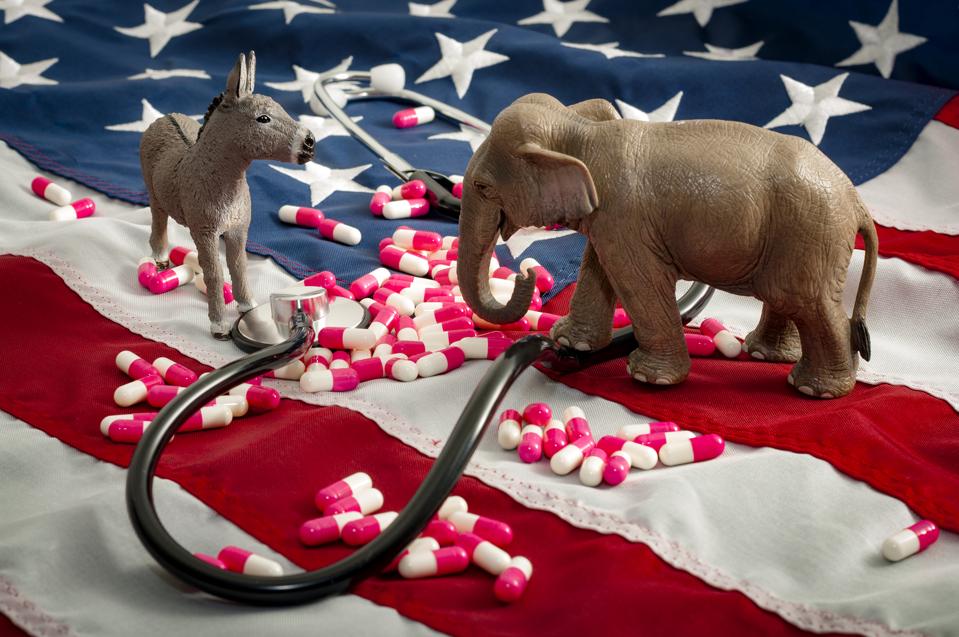
Eight years ago, former Democratic Senator John Breaux and I wrote: “Given the acrimony that’s developed over efforts to reform our nation’s health insurance system, many Americans wonder whether true bipartisan agreement on health reform can ever be possible. In short, it can.” Back then, we watched contentious debate over what came to be known as Obamacare, and we never saw bipartisanship materialize. But in 2003 we both participated in creating and enacting the bipartisan Medicare Modernization Act that established the enormously successful Medicare Part D. Bipartisanship was alive then. We missed an opportunity eight years ago, but over the next few weeks we have another prime chance.
The healthcare (and health) of 11 million Americans hangs in the balance. This may sound like a small portion of America’s insured population, and as a percentage it is, but these are all people we know. The 6 percent of Americans who buy their insurance on the individual market are the small business people, contract workers, entrepreneurs, musicians, stay-at-home parents, job seekers, and the millions of Americans who can’t receive coverage through their employers. They are Republicans, Democrats, and Independents. Trump supporters and Hillary voters. And their ability to purchase coverage on the exchanges is in jeopardy, as mixed signals from Congress and the Administration have left insurers scrambling to decide whether to hike already costly premiums or pull out entirely—triggering the beginnings of collapse in some regions.
In my home state of Tennessee, two thirds of our 95 counties are projected to only have one insurer in 2018, while hundreds of counties nationwide at are risk of having no insurer offering individual coverage at all. Waiting for collapse may force Congress to the negotiating table as some have suggested, but it would hurt many innocent, poor, and sick people in the process.
The American people agree. A Kaiser Family Foundation surveyfound three-quarters of the public—including over half of Trump supporters—want the President and his administration to do what they can to make the Affordable Care Act work rather than trying to make it fail so they can replace it later.
My former colleague and current Chairman of the U.S. Senate Committee on Health, Education, Labor and Pensions (HELP), Senator Lamar Alexander, said, “There are a number of issues with the American health care system, but if your house is on fire, you want to put out the fire, and the fire in this case is the individual health insurance market.”
The first step in extinguishing this fire is to extend the cost-sharing reduction (CSR) payments. These are the payments President Donald Trump has repeatedly threatened to cut off, creating serious uncertainty and instability in the markets. The Affordable Care Act requires insurance companies to offer discounts to lower-income consumers on the exchanges (those who make 100 – 250 percent of the Federal Poverty Level, or roughly $30,000 for an individual or $60,000 for a family of four). Thus would be a money-losing proposition for insurers without the federal reimbursement provided by the CSR payments. If insurers don’t get reimbursed through the CSRs, they will drop out of the market or raise rates significantly to cover their projected $7 billion loss. States that did not expand Medicaid—which are more likely to have Republican elected leadership and Trump voters—will be hardest hit, since they have a greater number of low-income individuals reliant on the individual market.
Some have termed the CSR payments “bailouts” for insurers, but the irony is that failure to extend them will actually cost taxpayers 23% more than the savings generated by their elimination. According to the Kaiser Family Foundation, the resulting premium hikes would trigger automatic increases in the size of premium tax credits paid by the federal government, totaling a net increase cost of $2.3 billion for fiscal year 2018.
Extending these payments not only makes sound fiscal sense, it will help millions of Americans maintain access to health care coverage and give Congress the breathing room necessary to craft meaningful reforms to the system that accounts for nearly one-fifth of our economy.
In the last few days, we have seen hopeful signs of bipartisanship returning to Washington, with the Senate HELP Committee announcing hearings in September with input from all committee members, to the bipartisan House Problem Solvers Caucus coming forward with a short-term plan for stabilization supported by over 40 Republicans and Democrats. We are seeing growing support for the use of waivers to establish reinsurance programs for high-cost, high-need individuals – as has been proposed in Alaska and Minnesota—and for a “stabilization fund” for states to be used in multiple ways including premium support or reinsurance. These are bipartisan concepts that appeal to both red and blue states and deserve serious debate in Congress. As Senator John McCain wisely said on the Senate floor last week, “The Obama administration and congressional Democrats shouldn’t have forced through Congress without any opposition support a social and economic change as massive as Obamacare. And we shouldn’t do the same with ours.” Any lasting, successful reform to our healthcare system depends on a bipartisan solution,and we must stabilize the markets now to give our Congress time to begin these negotiations in earnest.
Since last March I have co-chaired with former Senator Tom Daschle a bipartisan group of healthcare leaders at the Bipartisan Policy Center (BPC). This politically diverse group of five Republicans and five Democrats have consistently called for a two-year extension of the CSR payments. We reiterate that call again today. Time is of the essence. Right now, insurers are filing corrections to their 2018 plan rates and petitioning states to change their service areas. Final premium prices are due August 16, and by September 27 health insurers must sign the final marketplace participation contracts. Many insurers, with the uncertainty of whether CSR payments will continue, have initially filed two different pricing options. Without more certainty of extension, they will use the higher rates that are nearly double what they would be if the CSR payments were continued. Or worse, they may simply pull out altogether at the last minute if the payments are still in jeopardy when these deadlines hit (four major insurers—Anthem, Cigna, Health Care Service Corp and Molina Healthcare—have all said they are weighing pulling out).
At the BPC we have held numerous roundtables and listening sessions with insurers, providers, healthcare leaders, state policymakers, and those on the ground implementing care, and routinely the number one recommendation to stabilize markets in the short-term is to extend the CSR payments . The White House has indicated it plans to make a decision this week, and I urge President Trump to heed the advice of our nation’s healthcare industry and policy leaders, as well as the very real needs of 11 million Americans, and allow payments to continue . It would also avoid ensnaring the Administration in costly lawsuits with states over the payments, which a federal appeals court ruled on August 1st could be permitted.
It’s time to stop the partisan sniping and get to work on crafting sound policy. We should put out the fire and begin to rebuild, instead of letting it all burn to the ground.

If either of us were building the American health care system from scratch, we’d probably end up in different places.
We have contrasting ideas — one of us is a Democrat, the other a Republican — about what ails the system and how to reshape it. But this is not the time for more partisan fighting. It’s time to build a better system, even if incrementally, because that’s what the American people deserve. It’s time to put aside blame and stabilize a health care marketplace where premiums are expected to rise by more than 15 percent in most states and millions of people are worried about obtaining or affording coverage.
This week the 43-member House Problem Solvers Caucus — which we lead and which is almost evenly split between Democrats and Republicans — released a carefully drafted compromise to shore up the struggling insurance exchanges.
Ultimately, everyone had to give a little and endorse provisions that purists in both our parties may not like. This is how American democracy is supposed to work, even if it has not for quite some time.
Our proposal first focuses on the most urgent crisis: the skyrocketing cost of individual health insurance premiums. The Trump administration is considering suspending cost-sharing payments that defray out-of-pocket payments like deductibles and co-payments for people earning less than 250 percent of the poverty line. Because of uncertainty about this subsidy, insurers have said premiums could rise by 15 percent or more. On Aug. 16, insurers must submit their 2018 rates to state regulators for approval; many may be forced to leave the individual marketplace altogether.
Our plan would stabilize markets by making the cost-sharing payments mandatory and thereby prevent rates from rising sharply.
Second, we provide a relief valve to help states deal with the high cost of pre-existing and chronic conditions. The costliest 5 percent of patients account for nearly half of all health care spending in the country. We propose a dedicated stability fund — essentially a form of reinsurance — that states could use to reduce premiums and limit losses for providing coverage for these high-cost patients.
Third, our proposal provides relief to certain businesses from the mandate that they provide insurance to full-time employees. It also defines “full time” as a 40-hour workweek to discourage businesses from manipulating employees’ weekly hours to skirt the mandate. More than 90 percent of large businesses offered health care before the Affordable Care Act, and studies show that they would continue to do so under this change; others would move to find employee coverage in the individual marketplace.
Fourth, our plan eliminates the Medical Device Tax, an excise charge of 2.3 percent that is often passed onto consumers and reduces funds for research and development. And finally, we provide states with additional flexibility to enter into agreements — such as enabling the sale of insurance across state lines — that would provide more choice and lower costs.
This proposal would not increase the federal deficit, offering several options to offset the new spending.
Our plan isn’t intended to rectify everything that’s wrong with American health care. We aim to solve an immediate problem and move past a seven-year stalemate in Washington that has featured Republicans trying to repeal the current health care law, Democrats trying to preserve it and neither side willing to discuss anything in between.
That approach has led us to our current moment, in which no one is happy with the status quo, least of all the American people, whose trust and confidence in Washington weakens every day that we spend fighting instead of solving real problems.
Health care is one of those problems — and a textbook example of why we formed the Problem Solvers Caucus this year. We all knew the partisanship in Washington had gotten out of control and felt the need to create a bipartisan group committed to getting to “yes” on important issues. We have agreed to vote together for any policy proposal that garners the support of 75 percent of the entire Problem Solvers Caucus, as well as 51 percent of both the Democrats and Republicans in the caucus.
If Washington does not act to stabilize the insurance exchanges, many families we represent will lose coverage or be hit with premiums they can’t afford. This isn’t conjecture.
If that does happen, people will be justifiably livid that Republicans and Democrats in Congress did nothing to stop a train wreck we all saw coming.
There is a growing recognition on Capitol Hill that something must be done, as evidenced by this week’s announcement from Senator Lamar Alexander — the Tennessee Republican who is chairman of the Senate Health, Education, Labor and Pensions Committee — that he will soon hold hearings focused on repairing the individual insurance market.
Our proposal isn’t perfect, but it represents the first and only serious bipartisan health care proposal released in this Congress. We hope our colleagues in the House and Senate, as well as the White House, will use our plan as the foundation for the health care solution that America desperately needs and deserves.
http://www.reuters.com/article/us-lemieux-healthcare-commentary-idUSKBN1AJ286
With John McCain’s dramatic “no” vote, the Health Care Freedom Act (HFCA) died early last Friday morning and with it any hope of repealing the Affordable Care Act (ACA) for the foreseeable future. While conservatives might prefer to blame incompetent vote-whipping in the Senate, the ACA could prove resilient for the same reason Medicare and Social Security have: most voters prefer not to wonder if they will be able to eat when hungry or see a doctor when sick. Any program that gives more economic security to a broad, politically powerful group will be dangerous to meddle with, even in these polarized times.
Conservative activists and pundits who don’t want to contend with that reality may point to the president they were dealt: Donald Trump knew essentially nothingabout health care and he alternated between disengagement and crude bullying of wavering senators ahead of the vote.
Blaming Senate Majority Leader Mitch McConnell is less convincing. McConnell is a masterful legislative strategist and it took his maneuvering to bring a bill supported by less than 30 percent of the public to within one vote of passing. Indeed, McConnell may only have come even that close because he skipped the normal committee hearing process, protecting the proposal from more public and media scrutiny.
The real lesson here is that once major social programs are in place, it’s simply very hard to eliminate them.
In his 1994 book “Dismantling the Welfare State?” the political scientist Paul Pierson showed that major social welfare programs were very resilient, and conservative attempts to repeal them generally failed. This was true even in parliamentary systems with fewer choke points to stop repeal than the American system.
In the United States, the clearest example is Social Security. Before becoming president, Ronald Reagan had a desire to make it a voluntary program, but he quickly abandoned any thoughts of radically restructuring the program after taking office. Instead he oversaw a bipartisan plan to protect the program’s solvency through a combination of regressive tax increases and benefit cuts. When the Republican controlled-Senate narrowly passed a one-year freeze to seniors’ annual cost-of-living adjustment freeze during Reagan’s second term, the president abandoned the unpopular proposal, letting it die in the House of Representatives.
George W. Bush, after winning re-election in 2004, made Social Security privatization his signature domestic issue. Bush travelled the country, making the case for a system of voluntary private accounts to partially replace Social Security for young workers. But the idea was politically toxic, actually becoming less popularthe more Bush discussed it. Congressional Democrats, who had collaborated with Republicans on major domestic legislation during Bush’s first term, came out against the proposal en masse. Republicans controlled both houses of Congress but they refused to take responsibility for highly unpopular changes to a cherished program. No Social Security privatization bill came close to a vote. Republicans have not actively pursued the goal since.
Nor have Republicans had any success at attacking the Great Society’s cornerstone health policy, Medicare. Sometimes they actively go in the opposite direction. In George W. Bush’s first term, Bush worked with Republicans to pass a corporate-friendly expansion of Medicare to partially cover payments for prescription drugs. Tea Party activists consider this one of the Bush era’s major betrayals of small government conservatism. But even arch-conservatives like Rick Santorum voted for the law. The politics were irrefutable: senior citizens vote, mostly Republican, and they fill a lot of prescriptions.
In 2011, now-Speaker of the House Paul Ryan proposed a plan to convert Medicare into a system in which seniors received vouchers (whose value would decrease over time) to purchase health insurance on private markets. The proposal was extremely unpopular and created a major backlash. Ryan has never officially abandoned some form of vouchers as a goal, but he has not put any Medicare restructuring on his legislative agenda since taking the Speaker’s gavel. The Ryan budget’s threat to Medicare, however, proves a reliably spooky specter for Democrats to invoke when sending fundraising emails or appealing to older swing voters.
Social programs are often not fully appreciated by their beneficiaries until someone proposes getting rid of them. Facing an existential threat made the Affordable Care Act much more popular – as then-Speaker of the House Nancy Pelosi predicted, support for it increased once people found out what was in it. The Republican proposals to replace the ACA, conversely, are staggeringly unpopular. As recently as last year, more Americans disapproved of the ACA than supported it, but its approval ratings are now over 50 percent, while the repeal bills started out unpopular and became more so.
The majority support for the ACA wasn’t soft, either. Supporters of the ACA were far more motivated than its opponents during the repeal struggle, putting their time and sometimes their bodies on the line, such as when disabled people were ejected from the offices of members of Congress. This helps to explain why moderate Republican Senators Susan Collins of Maine and Lisa Murkowski of Alaska (not to mention Democratic senators representing states that Trump won in landslides such as West Virginia and Montana) were unwavering in their opposition. The weekend after the HCFA was voted down, Murkowsi was repeatedly greeted by supporters, some in tears, thanking her for her no vote, while Nevada Senator Dean Heller was rewarded for his “yes” vote by seeing his approval rating plummet to 22 percent.
This doesn’t mean that supporters of the ACA should be complacent. Even when Republicans have failed to eliminate major social programs, they have been able to make them less generous in ways that caused real harm, Reagan’s Social Security adjustment included. Trump is signaling that he will damage the ACA administratively, and 19 states are still refusing the ACA’s generous Medicaid expansion.
Moreover, the failure to eliminate major welfare programs is a tendency, not an iron law. In 1996, President Bill Clinton signed a welfare “reform” bill that led to more than 6 million mothers with children losing welfare benefits.
That was possible partly because welfare, unlike Obamacare, only benefits the poor, who are politically disempowered.
Still, Republicans just came closer to passing a partial repeal of the ACA than many would have thought possible.
The battle over healthcare is far from over, but the repeated failures of the GOP efforts to repeal it prove the political durability of the social safety net.


Republicans in Congress are mired in political quicksand. Following passage of the Affordable Care Act (ACA) in 2010, they locked themselves into a promise to repeal and replace it at the behest of ultra-conservative donors and party activists who control the GOP’s nomination process. Since 2010, however, Americans and rank-and-file Republicans increasingly came to expect help meeting the rising costs of medical care and insurance and to accept the ACA’s tangible programs to address these concrete challenges.
The Democrats created their own political trap. They passed the ACA on the promise of making health care affordable but deductibles and rising premiums continued to present a burden to many Americans.
Both parties are missing, however, the vital center on health reform that has formed since 2010. Americans are frustrated with Democrats for not delivering on their promise of affordability, and they are now alarmed with Republican efforts to repeal—instead of improve—the ACA’s coverage of costs.
Most public opinion polls are unable to track these changes in opinion about health care because they are only snapshots, drawn from a moment in time. To remedy this, we have been gathering panel data, tracking the views of the same group of Americans every two years since the ACA’s passage in 2010. This equips us to study how individuals respond to the ACA as they experience or learn more about the law’s provisions over time. Specifically, we conducted four waves of interviews in the two-month period leading up to national elections from 2010 to 2016 when health reform received heightened attention; this avoided the risk of choosing an arbitrary month when health reform might have arbitrarily lost or gained salience.
The first wave was conducted by the Survey Research Institute (SRI) at Cornell University and consisted of a national sample of 1,200 adults. Abt SRBI (now part of Abt Associates) conducted the last three waves, returning to the same individuals. All waves asked identical questions and were administered by telephone, using only landlines in 2010 and adding mobile phones in 2012, 2014, and 2016. Forty-nine percent of the original 2010 survey (587 individuals) responded to all four waves. Survey weights were applied to each survey to match representative demographic targets and allow us to generalize from our panel to the adult population in the United States.
Republicans have been eager to highlight the unpopularity of the Affordable Care Act, also known as “Obamacare.” Exhibit 1 shows that unfavorable assessments of the ACA have steadily increased since its passage. Unfavorability rose from 44 percent in 2010 to 58 percent in 2016.

Question: “As you may know, a major health care bill was signed into law in 2010. Given what you know about this law, do you have a generally favorable or generally unfavorable opinion of it, or do you have a neutral opinion, neither favorable nor unfavorable?” Exhibit 1 presents the “unfavorable” responses.
Why are Americans increasingly disenchanted with the ACA? The public’s displeasure emanates to a large extent from frustrations with health care costs. Democrats promised to lower the costs of medical care and insurance with the enactment of the ACA. They did succeed to slow the rate of increase in national health care spending and insulate most subsidized enrollees in its insurance Marketplace from premium increases, as the Congressional Budget Office reports (Note 1). Yet, the costs of medical care remain high, and premiums and deductibles are out of the reach of some Americans.
The source of the public’s rising frustration with health care costs is picked up in Exhibit 2. The first grouping of bars on the left shows increasing frustration with costs for medical treatments that are not covered by insurers. By 2016, 14 percent expressed dissatisfaction with the amount and number of treatments that their insurance covered, a 6-point increase from 2014. One-third of Americans also expressed dissatisfaction in 2016 with the out-of-pocket costs that they were forced to pay because of gaps in their insurance coverage, as shown in the middle cluster. This is an 8-point increase from 2014.

Question: Several questions asked respondents to indicate their satisfaction or dissatisfaction with individual features of the health care system—“The number and kind of treatments your health insurance will cover” and “The amount you spend out of pocket on health care costs your insurance doesn’t cover.” A separate item asked respondents to indicate their agreement or disagreement with the statement: “Public officials care about making health care more affordable for people like me.” (Exhibit 2 shows “disagreement” with the statement.)
The public’s disappointment with the persistent burden of health care costs leads it to blame lawmakers for a lack of responsiveness. The bars on the right in Exhibit 2 indicate that a growing majority of Americans disagree with the statement that, “Public officials care about making health care more affordable for people like me.” Fifty-eight percent of Americans disagreed with this statement in 2016, a 10-point increase since 2012.
In addition, the sense that the ACA has not delivered the affordability that Democrats promised may help account for the sharply stronger conclusion in recent years that the ACA’s taxes present a heavier burden. Exhibit 3 shows that the proportion of Americans who believe that their taxes have increased a lot or a little has risen from 43 percent in 2012 to 56 percent in 2016. This growing perception that the ACA has increased taxes rests on inaccurate assumptions. The ACA’s financing primarily relies on two taxes on individuals whose yearly income exceeds $200,000 or for married couples earning more than $250,000—an increase in Medicare’s tax on earnings by 0.9 percent and a new 3.8 percent tax on capital gains from investments. These taxes fall on less than 2 percent of tax filers, according to the non-partisan Tax Policy Center (Note 2).

Question: “Do you think that the new health care law enacted in 2010 has increased the taxes that you pay, decreased the taxes that you pay, or has it had no impact on the taxes that you pay?”
Considering the strong public disapproval of repeal, President Donald Trump and congressional Republicans are discovering that it is a mistake to equate the public’s frustrations with the ACA with support for repealing its programs. When respondents reported “unfavorable” views of the law, we followed up with a question asking them whether they would prefer either “repeal[ing] [the ACA] as soon as possible,” or “giving the law more time to have a chance to work, with lawmakers making necessary changes along the way.” In Exhibit 4, we combined those who favored giving it “a chance to work” with those who expressed “favorable” overall views of the law. This shows that since 2010 more Americans favored the law or wanted to give it time to be improved than backed repeal. Although support for repeal inched up since 2010, a greater percentage of Americans consistently favored the ACA and improving it over repeal by a 41-to-37 margin in 2010 and by 49-to-43 in 2016.

Question: This figure is based on two survey questions. The first is the following: “As you may know, a major health care bill was signed into law in 2010. Given what you know about this law, do you have a generally favorable or generally unfavorable opinion of it, or do you have a neutral opinion, neither favorable nor unfavorable?” Respondents who had an unfavorable view were asked a second question about their view about the law’s future: “The law should be given more time to have a chance to work, with lawmakers making necessary changes along the way, OR the law should be repealed as soon as possible?” The repeal bar reports responses from the second question; the other bar adds together favorable responses in the first question with the “law should be given more time” responses.
Support for keeping and improving the ACA stems from a growing appreciation for its concrete effects. Exhibit 5 shows that rising percentages pinpoint the ACA’s tangible programs as having either “a great deal” or “quite a bit” of an impact on themselves and their family (other options included “some,” “a little,” and “none”). There is greater recognition in 2016 compared to 2010 or 2012 of the impact of allowing parents with insurance to continue to cover their children until they are 26 years old. More than one in five Americans now report that the ACA expanded their access to health insurance. In addition, nearly one in four Americans, 24 percent, voiced appreciation for the impact of the ACA’s assistance to seniors to pay for prescription medications. Moreover, recognition of a personal impact resulting from the ACA’s tax credits and other subsidies to help people purchase health insurance has remained stable since 2014 and is higher than in earlier years.

Question: “I’m going to read to you a list of some of the features of the health care law that was enacted in 2010. For each one, please answer this question: “How much of an impact has this feature had on you and your family: a great deal, quite a bit, some, a little, none?” Respondents are asked about the following features of health reform: coverage of adult children on their parents’ insurance plans until they are 26 years old; access to health insurance or medical care supported or provided by government; help for seniors to pay for prescription drugs; and tax credits and other subsidies to help people pay for health insurance. Exhibit 5 combines “a great deal” and “quite a bit.”
Overall evaluations of the ACA follow the partisan pattern that is familiar today: 68 percent of Democrats have favorable views versus 9 percent of Republicans. What stands out, however, is that the ACA’s tangible effects are starting to loosen rigid partisan dividing lines. Exhibit 6 shows the percentage of Americans reporting a personal impact from at least one of the four provisions presented in Exhibit 5. Democratic elected officials enacted the ACA, and, not surprisingly, majorities of rank-and-file Democrats have generally singled out the law’s effects from early on: 51 percent of Democrats reported an impact from at least one of the law’s features in 2010; by 2016, this recognition remained largely stable, inching up to 54 percent. Strikingly, however, the percentage of Republicans perceiving an impact on themselves or their families has increased by 8 percentage points, from 26 percent in 2010 to 34 percent in 2016 despite vociferous GOP attacks on the ACA. Among independents, the proportion soared by 23 points, from 28 percent to 51 percent. These findings indicate that appreciation for the ACA has expanded beyond the ranks of Democratic partisans who were predisposed to favor it; growing numbers of Americans across the political spectrum increasingly value the impacts of health reform in their own lives.

Exhibit 6 presents the percentage of respondents who reported that at least one of the four provisions presented in Exhibit 5 had a “great deal” or “quite a bit” of impact on themselves or their family.
The crux of the public discontent with the ACA—and the repeal proposals by Republicans—is the amount paid for insurance coverage. Respondents to the survey appear to share the complaint of ACA critics that insurance costs are too high. After high expectations following the ACA’s enactment, satisfaction with the cost of health coverage has dropped by 10 points—from 73 percent satisfied in 2010 to 63 percent in 2016. This general assessment misses, however, a crucial condition—whether or not individuals are covered by government programs such as Medicare, Medicaid, or a subsidy financed by the ACA. We found a striking pattern among Republicans, Democrats, and independents: By a margin of 20 points or more, individuals with government coverage were consistently more satisfied with the cost of insurance than those who rely on private health plans. For instance, 79 percent of Republicans with government coverage were content with insurance costs as compared to 56 percent without this coverage. Independents outside the sway of either major party expressed the highest satisfaction when experiencing government coverage (100 percent) and exhibit the largest gap between those covered and those without coverage (41 points).
In short, Republican public officials continue to spotlight what they perceive as the disappointment of Americans with ACA coverage, but the reality is that the most dissatisfied are those who lack government insurance. In fact, most Americans (including Republicans) who benefit from government insurance are content with their coverage.
Public opinion toward the ACA has been poorly understood because of an apparent contradiction. On the one hand, a growing share of the public harbor unfavorable views of the ACA as a whole, and proponents of repeal have seized on this dissatisfaction to claim a popular mandate. On the other hand, the discontent of Americans stemmed from disappointment with the ACA for not satisfying their expectations of genuine protection from the burden of costs. Far from wanting to be rid of the ACA, Americans are looking to it to deliver more effective protection.
In the immediate aftermath of World War II, the historian Arthur Schlesinger, Jr., wrote of the “vital center” about the direction of America that was supported by both major political parties and most Americans. Despite today’s fractiousness in Washington over health reform, everyday Americans are converging toward a new vital center of support for health care reform.
Awareness of the ACA’s tangible impacts fits into a robust notion of collective responsibility instead of the individualist approach advocated by conservatives. Since the ACA’s passage, nearly nine out of 10 Americans have consistently embraced access to health care as a “basic right.” Not surprisingly, nearly all Democrats embrace the principle of health care as a right. What stands out is that rank-and-file Republicans overwhelming and increasingly hold the same view—rising from 64 percent in 2010 to 72 percent in 2016. Contrary to the position of Washington Republicans, establishing health care as a birthright owed to Americans is now widely shared. Republican proposals, such as those that would allow states to opt out of some of the ACA’s core consumer protections (including those guaranteeing coverage for individuals with preexisting medical conditions), may well tap into this strain of public opinion and provoke broad opposition.
Elected officials in Washington and, particularly, steadfast opponents of health reform are sliding to the margins of public opinion. The daily problems that Americans face in paying for medical care and insurance mean that pragmatism is trumping ideology. In the past, federal lawmakers responded to broad public agreement and worked across the aisle to improve the flaws in the original legislation that produced Social Security in 1935 and Medicare in 1965. The question today is whether Washington can return to that pragmatic tradition and catch up to the emerging vital center in Americans’ attitudes toward health reform.
Congressional Budget Office. American Health Care Act: cost estimate. Washington (DC): CBO; 2017 Mar 13.
Tax Policy Center. Tax units above and below the $250,000/$200,000 threshold, 2013–2022. Washington (DC): TPC; 2012 Nov 26
On August 1, 2017, the United States Court of Appeals for the District of Columbia granted the motionof the attorneys general of 17 states and the District of Columbia to intervene in House v. Price. House v. Price is before the D.C. Circuit on appeal from the ruling of a district court judge in favor of the House of Representatives in its lawsuit claiming that the reimbursement of insurers for reducing cost sharing for low-income qualified health plan enrollees is illegal because Congress had not appropriated funding for the payments. The judge enjoined the payments but stayed her order pending an appeal and the Obama administration in fact appealed. The states had moved to intervene, claiming that they had an interest in the action and that the Trump administration was not adequately defending their interest.
The three-judge appellate panel held first that the states had demonstrated that they had standing to intervene because they “would suffer concrete injury if the court were to grant the relief the plaintiffs seek.” The states established that a judgment for the House terminating the payments would “lead directly and imminently to an increase in insurance prices, which in turn will increase the number of uninsured individuals for whom the States will have to provide health care.” This would in turn result in state-funded hospitals suffering financially when they have to cover emergency care for uninsured individuals.
The court further held that the states had established a right to intervene in the action. First, the states had established an interest in the subject matter of the lawsuit.
Second, the court held that allowing the injunction of the court below would impair the states’ rights. The court observed that the administration’s “claim that it could unilaterally suspend payments is a debated legal question, not an answer to the injury the States have evidenced. The injunction sought, which would forbid the payments at issue, would erect a roadblock to the States’ goal of either persuading or compelling the Department to make the payments.”
Third, the court held that the states had raised a sufficient doubt concerning the adequacy of the administration’s representation of their interest. The court noted that the administration had nowhere argued that it would protect the states’ interest or continue to pursue the appeal.
Fourth, the court held that the motion to intervene was timely. The states, the court held, “had filed within a reasonable time from when their doubts about adequate representation arose due to accumulating public statements by high-level officials both about a potential change in position and the Department’s joinder with the House in an effort to terminate the appeal.” The court, in short, took President Trump’s threats to terminate the cost-sharing reduction (CSR) payments seriously.
Finally, the court held that permissive intervention was also warranted in the case.
The court further ordered that the case would continue to be held in abeyance, with status reports at 90-day intervals and the next one due on October 30, 2017. With their status as parties to the case, however, the states may well next seek to get the case moving again.
The decision does not mean that the Trump administration is barred from ending the cost-sharing reduction payments. It does mean, however, that the administration cannot unilaterally stop the CSR payments, dismiss the appeal, and claim judicial imprimatur for its doing so. If the administration does stop making the payments, the states—or insurers, or possibly consumers—would be able to sue to require the payments to be made and the injunction entered by the lower court would not be as much of a “roadblock” to their prevailing. Finally, if the states ultimately convince the appellate court that the CSR funding has in fact been appropriated, the administration would be required to pay it. The decision is, therefore, a major development in the ongoing CSR saga.

