As repeal and replace falters, more say GOP should abandon repeal plan

http://www.cnn.com/2017/07/20/politics/health-care-poll-abandon-repeal-replace/index.html?lipi=urn%3Ali%3Apage%3Ad_flagship3_feed%3BUMCVso0rSd6nYA7sO0FoTg%3D%3D

Image result for As repeal and replace falters, more say GOP should abandon repeal plan

A new CNN poll conducted by SSRS finds a growing share of Americans want to see the GOP abandon its effort to repeal and replace the 2010 health care law known as Obamacare, as majorities across party lines want congressional Republicans to aim for a bill with bipartisan support.

Overall, 35% in the poll say they’d like President Donald Trump and the Republicans in Congress to give up their plans for repealing and replacing Obamacare, up from 23% who said the same in a March survey.
A majority still favor some form of repeal (34% would prefer repeal with replacement at the same time, and 18% favor repeal regardless of whether the law is replaced at the same time). The share in favor of repeal without replacement has held roughly steady since March; it remains the least popular option.
But public preferences are shifting away from repealing the law and enacting replacements concurrently (down from 59% in March), and more now say they’re unsure how they want Republican leaders to proceed (13% say so in the new poll).
Increases in support for abandoning repeal have come largely among groups that aren’t central to the GOP’s base: Younger adults, non-whites and those with lower incomes have become notably more supportive of leaving the ACA as is.
On the growing uncertainty, the percentage of respondents in a poll who say they don’t know how they feel about an issue is often related more to the methodology and administration of the survey than to real uncertainty about an issue, however, given the real-life uncertainty about the Senate’s plan to replace the ACA while the poll was in the field, in this case, it’s possible there’s been a meaningful increase in unknown feelings about the law itself.
The poll also finds that with several failed efforts at repealing and replacing the bill in the rear view mirror, about half think it’s likely the President and Republicans in Congress will ultimately be able to reach a deal to repeal and replace Obamacare. That’s down from 58% who felt it was likely in an April CNN/ORC survey, but remains above the share who say it’s unlikely the ACA will be repealed and replaced (41%).
Republicans themselves remain optimistic that their party’s leaders in the White House and Congress will be able to come together to achieve this long-standing goal, 78% say it’s very or somewhat likely to happen, but less than half of independents or Democrats agree.
Overall, almost eight in 10 in the new poll say they’d like Republicans in Congress to try to work with Democrats to pass a health care bill that has bipartisan support (77% say so). Just 12% favor continuing to try to pass a bill that only has GOP backing. Even among Republicans, only about a quarter favor an approach that only has the backing of Republican lawmakers.
Interviewing for the CNN poll conducted by SSRS was completed July 14-18 among a random national sample of 1,019 adults. The survey included 405 respondents reached on landline telephones and 614 reached on cellphones. The margin of sampling error for the full sample is plus or minus 3.7 percentage points.


Podcast: On the failed health care bill

https://www.brookings.edu/podcast-episode/on-the-failed-health-care-bill/?utm_campaign=Brookings%20Brief&utm_source=hs_email&utm_medium=email&utm_content=54432878

Image result for On the failed health care bill

Molly Reynolds, a fellow in Governance Studies, describes why it has been so difficult for Senate Republicans to even begin writing legislation to repeal and replace Obamacare and outlines the uncertainties in the future of national health care policy.


AHCA savings, $487 billion in Medicare cuts remain in House budget proposal

http://www.modernhealthcare.com/article/20170719/NEWS/170719888/ahca-savings-487-billion-in-medicare-cuts-remain-in-house-budget

Image result for medicare cuts

The House Budget Committee on Wednesday agreed to bake in hundreds of billions in Medicaid cuts from its ACA repeal bill to the budget resolution, plus an additional $114 billion in cuts over 10 years.

The committee’s Republicans’ unanimously approved the decision with no Democrats on board. The budget resolution, which is the foundation for passing tax reform in the Senate without Democratic votes, also assumes Medicare will reduce spending by $487 million from 2018 to 2027.

Some of the additional savings would come from imposing a work requirement on Medicaid adult beneficiaries who are younger than 65 and are not on Social Security disability as a condition of eligibility.

The Medicare savings are built on an idea long-favored by Republicans — using vouchers to buy insurance, though Republicans say future beneficiaries will have the option to buy traditional Medicare too. Democrats during Wednesday’s hearing complained that traditional Medicare would cost 25% more than it does now if vouchers come into play.

The Republicans also included savings that would stem from raising the Medicare eligibility age for future beneficiaries who are 51 or younger. Under the proposal, those individuals would not become eligible for full Social Security benefits or Medicare until the age of 67. The Congressional Budget Office has estimated that would reduce Medicare spending by 2% once everyone in the program is covered by the later eligibility age.

The proposal includes a requirement that affluent seniors pay higher premiums, and that people with incomes of $1 million or more pay the full cost of Medicare premiums without any federal subsidy.

Rep. Matt Gaetz, R-Fla., said during the hearing that the proposed changes are based on math rather than Tea Party politics, as some have alleged.

The Republican spending outline also assumes the government will do better at recouping or avoiding improper payments. The proposal said that there was $59.7 billion in improper Medicare payments in in the last fiscal year, and $36.3 billion in improper Medicaid payments. The outline assumes future improper payments will be 50% lower than today’s levels.

Rep. Debbie Wasserman-Schultz, D-Fla., introduced an amendment that would have changed the resolution so that it no longer assumed American Health Care Act changes would be future law, citing the Senate bill’s collapse this week.

But every Republican present on the committee voted against the amendment. “This is the official position of the House on repeal and reform efforts,” said Rep. Bill Johnson, R-Ohio.

The budget resolution also includes a reduction in health spending of $43.9 billion over 10 years, the CBO estimate of how much the malpractice reform bill that passed the House would save.

Ranking Member John Yarmuth, D-Ky., called the budget disgraceful and others called the cuts to Medicare, Medicaid and food stamps draconian, several Republicans worried what it envisions might not come to pass.

“We might fail to achieve savings in mandatory spending,” which includes Medicaid and Medicare, Johnson said, noting that the budget resolution might make it harder to pass tax reform in the Senate.

The first hurdle, however, is for the resolution to pass the entire House of Representatives.

Senate Republicans still at impasse after late-night health care meeting

http://www.politico.com/story/2017/07/19/trump-congress-no-recess-health-care-240718

Image result for Republican plan to ‘repeal and delay’ will leave millions more Americans uninsured

A key group of Senate Republicans met late into the night Wednesday to try to salvage their health care bill, but emerged without any breakthroughs and still appeared far from finding the votes to repeal Obamacare.

Still, as GOP senators left the nearly three-hour meeting, they professed optimism.

The Republicans initially planned to bring in chiefs of staff and health care wonks to advance the negotiations. White House Chief of Staff Reince Priebus was expected to join and help push the disagreeing GOP senators to yes.

But as the senators kept talking, they reevaluated their plan and decided not to allow staff in and keep the room to members only. Priebus strolled out of Sen. John Barrasso’s office, as did White House legislative director Marc Short. The senators would keep talking amongst themselves.

Talks “narrowed down to try to figure out what is causing members not to be able to vote in favor or problems they have with the bill,” said Sen. Jerry Moran (R-Kan.), who opposes the GOP’s latest repeal and replace draft. “It had merit and it’s something that should have been taking place.”

Added Sen. John Kennedy (R-La.): “We’re at our best when we’re among ourselves.”

As the night dragged on, however, Republicans cited good progress but nothing to suggest they had overcome the obstacles that have stymied their previous efforts.

At least 20 Republicans, including leadership allies, moderates and conservatives, worked through the party’s myriad disagreements over Medicaid, coverage numbers, lowering premiums and cutting regulations.

Health and Human Service Secretary Tom Price and top Medicaid official Seema Verma were in the room too. And earlier at the White House, senators and administration officials discussed adding billions more to help states worried about Medicaid cuts under the bill.

Yet the conversation among senators focused on the broad contours of the issues.

“We weren’t getting into the specifics,” said Sen. Dan Sullivan (R-Alaska). “We weren’t tossing around numbers.”

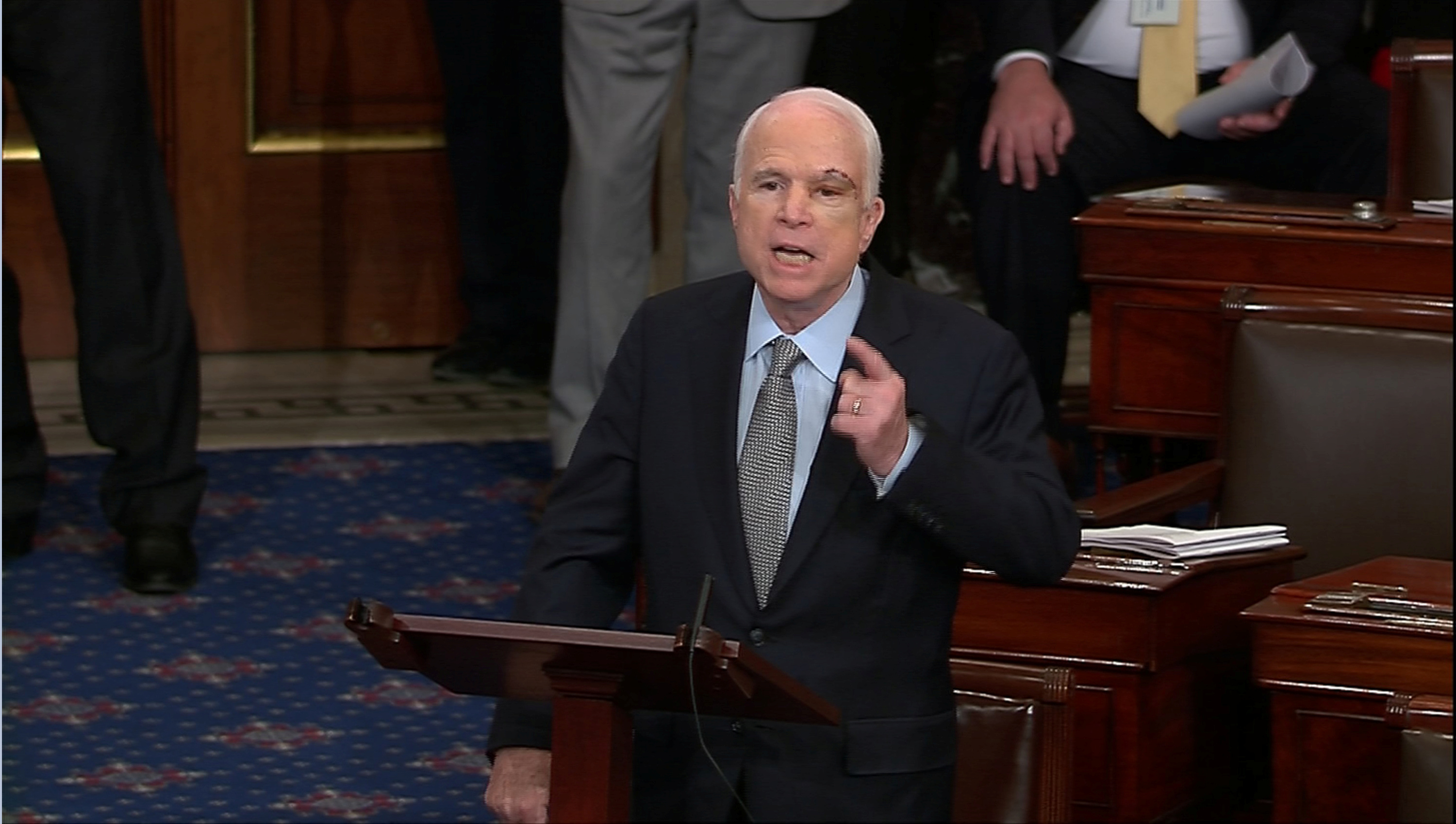
Indeed, senators left uncertain of how a planned vote will go next week, or whether it should even occur while Sen. John McCain (R-Ariz.) is being treated for cancer.

Senate Majority Leader Mitch McConnell (R-Ky.) has pledged to hold a vote next week, but with McCain gone and Sens. Rand Paul (R-Ky.) and Susan Collins (R-Maine) opposing the repeal and replace plan and not even attending the meeting, success appears far off. Republicans said privately they doubt McCain will be back next week.

“Hard to say [if we’re closer]. I’m fine voting next week,” said Sen. Pat Toomey (R-Pa.). McCain’s absence “does complicate things. And I just don’t know if he’s going to be back.”

Privately, senators doubted they could get the 50 votes together for a health care overhaul despite the productive meeting. There was a feeling that while a session that occasionally turned into venting was therapeutic, the challenges facing the fractious 52-member majority may be too great to bridge.

“You understand the math. It just makes things kind of more difficult,” said Sen. Bob Corker (R-Tenn.).

“We do have work to do to get to a vote of 50,” Barrasso said.

The meeting followed a gathering with President Donald Trump, who ordered senators to stay in Washington until they pass a bill to repeal and replace the 2010 health law. Barrasso said the meeting was planned before the White House lunch.

But with a new flicker of optimism, GOP leaders are still pushing for a way to advance a health bill next week even after two different repeal plans fell apart. Republican senators left a health care meeting at the White House Wednesday sounding more optimistic that they could revive their bill to replace the Affordable Care Act.

“We’re discussing that,” Senate Majority Whip John Cornyn (R-Texas) said when asked whether some version of the Better Care Reconciliation Act was coming back. “I’m more optimistic that that would be the case. But if there’s no agreement, then we’ll still vote on the motion to proceed but it’ll be to the 2015 just-repeal bill.”

“We have at least momentum. Before there was none,” said Sen. Bill Cassidy (R-La.).

Sens. Mike Lee (R-Utah) and Paul say the bill isn’t conservative enough, making it difficult for McConnell to get the 50 votes he needs. And it was unclear if billions more for Medicaid will be enough to move the moderate holds outs, with one senator saying there’s an “outside chance” of success next week. At the White House Trump, the senator said, was more effective than he’s been on healthcare in weeks.

The Senate GOP’s latest attempt to craft a replacement for Obamacare fell apart earlier this week, as four Republican senators announced that they would oppose the current version of the bill. But Cornyn told reporters following the White House meeting that about 40 members of the GOP conference are prepared to vote on any health care deal replacing Obamacare, and the “differences are narrowing.” Trump also sounded a note of optimism during the meeting.

But centrist GOP senators like Sens. Rob Portman (R-Ohio) and Sen. Shelley Moore Capito (R-W.Va.) are not happy about future reductions to Medicaid spending, worried it would kick hundreds of thousands of their constituents off healthcare. GOP leaders threw more than $100 billion to lower premiums and fight drug addiction into the bill, but thus far it hasn’t been enough.

Cornyn said a key procedural vote to take up legislation will be held regardless of whether it will succeed. McConnell, speaking to reporters after the White House meeting, said he expected to be able to at least proceed to the bill.

But three Senate Republicans — Sen. Lisa Murkowski of Alaska, Capito and Collins — said they would oppose proceeding to a repeal-only measure on Tuesday, effectively tanking the prospects that a floor debate over getting a straight repeal of Obamacare can even begin.

And some key holdouts said their position is unchanged. Portman, who is undecided on a procedural vote but has signaled opposition to a repeal-only bill, said the legislation needs “to do more to show low-income people that they have options” and said the vote next week will fail unless those improvements were made.

Capito said she’ll still vote no on proceeding to a bill unless there’s a replacement plan she supports.

“The president emphasized repeal and replace. We’re still working on it. It’s moved a lot farther in terms of where it was in terms of congealing,” Capito said.

Murkowski said she wasn’t even sure what they would be voting on.

“It’s not clear whether there will be a motion to proceed to this repeal and replace. I think that’s still under consideration. There will be a vote on something that much is certain,” she said, adding that it was hard to answer “unless you know what the question is.”

Collins said she was not invited to the meeting and wouldn’t be attending.

“I guess it’s open invitation but I didn’t know that until it was brought up at the White House. I’m unfortunately committed to something else,” she said.

Earlier at the lunch, Trump said he was surprised to see his “friends” — “They might not be very much longer,” he quipped — oppose Senate GOP leaders’ plan.

Trump singled out Dean Heller, who is widely considered the GOP’s most vulnerable incumbent in 2018, suggesting he was once worried but is now confident the Nevada senator will come around to supporting a replacement bill.

“Look,” Trump told the room of Republicans, “he wants to remain a senator, doesn’t he? OK? And I think the people of your state, which I know very well, I think they’re gonna appreciate what you hopefully will do.”

A chuckling Heller said as he returned to the Capitol that those comments were “President Trump being President Trump.” And after the late-night Senate meeting, Heller seemed a bit more optimistic.

“It was probably one of the most productive meetings I’ve been to in a long time,” Heller said. “We have some real honest brokers in there who are really trying to solve the problem.”

Republican plan to ‘repeal and delay’ will leave millions more Americans uninsured

http://www.politico.com/interactives/2017/republican-obamacare-repeal-uninsured-double/?lo=ap_a1

Image result for Republican plan to ‘repeal and delay’ will leave millions more Americans uninsured


Majority Leader Mitch McConnell wants to hold a vote on a bill that would repeal major parts of Obamacare and give Republicans two years to pass a replacement. A new CBO report finds that repealing Obamacare without a replacement would result in 32 million more Americans losing health insurance over a decade — far deeper coverage losses than any of the health plans Republicans have proposed. Further, 75 percent of Americans would live in areas without any insurers selling coverage in the individual market by 2026.

The latest GOP health plan would strike:

  •  Individual mandate
  •  Insurance subsidies
  •  Medicaid expansion
  •  Planned Parenthood funding

The bill would effectively kill Obamacare’s individual and employer coverage mandates, strike health insurance subsidies, roll back Medicaid expansion and defund Planned Parenthood.

Repealing Obamacare would more than double the number of Americans without health insurance.

Under Obamacare, 10 percentof Americans would lack health insurance.

But if Republicans repeal Obamacare, the number could grow to 21 percent by 2026.

The uninsured rate plunged under the ACA, but would now skyrocket

ACARepeal ACA0510152025%1997201020172026Before the ACAACA passed10%21%

In the first year alone, nearly 17 million more people would no longer have insurance — or (16 percent) of Americans. That includes 10 million fewer buying plans on the individual market, 4 million fewer people covered through Medicaid, and 2 million fewer with job-based coverage.

But once Medicaid expansion and subsidies were repealed (roughly two years after enactment), the number of uninsured Americans would increase by 27 million in 2020. By 2026, about 59 million people or 21 percent of Americans would be uninsured.

Capitol Hill health bill drama is leaving Obamacare exchanges in limbo

Capitol Hill health bill drama is leaving Obamacare exchanges in limbo

Question mark heap on table concept for confusion,


California’s Obamacare exchange scrubbed its annual rate announcement this week, the latest sign of how the ongoing political drama over the Affordable Care Act is roiling insurance markets nationwide.

The exchange, Covered California, might not wrap up negotiations with insurers and announce 2018 premiums for its 1.4 million customers until mid-August — about a month later than usual. Similar scenarios are playing out across the country as state officials and insurers demand clarity on health care rules and funding, with deadlines fast approaching for the start of open enrollment this fall.

“It’s insane,” said John Baackes, CEO of L.A. Care Health Plan, which has about 26,000 customers on the California exchange. “Here we are in the middle of July and we don’t even know what rules we will be operating under for open enrollment. It is not how you want to run a business.”

Consumers could face sharply higher premiums and fewer choices if more health insurers leave the insurance marketplaces due to lingering uncertainty. State and industry officials around the United States are concerned that the federal government could stop funding so-called cost-sharing subsidies that reduce out-of-pocket costs for low-income consumers. And they worry the Trump administration won’t enforce the individual mandate that requires people to purchase health coverage or pay a penalty.

Amid those concerns, there was a sense of relief Tuesday among many exchange officials and insurers after the U.S. Senate’s latest attempt to replace the Affordable Care Act failed.

Two large insurer trade groups bluntly warned last week that parts of the Senate plan were “unworkable” and could plunge the market into chaos. In a letter to the Senate, America’s Health Insurance Plans and the Blue Cross Blue Shield Association particularly objected to an amendment by Sen. Ted Cruz (R-Texas) that would have allowed insurers to sell bare-bones health plans to people who wanted cheaper premiums. That provision, the insurers said, would split the market between the healthy and the sick, driving up costs for people with pre-existing conditions.

However, the Republicans’ failure to pass that ACA replacement plan did not resolve questions swirling around the current health law.

Tuesday, President Donald Trump expressed disappointment at the outcome in the Senate, telling reporters, “We’ll let Obamacare fail and then the Democrats are going to come to us and they’re going to say, ‘How do we fix it?’”

Some Senate Republicans struck a more conciliatory tone, suggesting that lawmakers should work on a bipartisan measure that would help stabilize the individual insurance markets.

Sen. Lamar Alexander (R-Tenn.), chairman of the Senate Committee on Health, Education, Labor and Pensions, said he plans to hold hearings in the coming weeks on ways to shore up the individual insurance market. Lawmakers may look at creating a new stabilization fund that helps compensate insurers for higher-cost patients. Such a fund would be similar to one that existed during the first three years of the ACA exchanges.

Some insurance industry executives welcomed the talk of bipartisanship, but they said action must be taken quickly to resolve key issues affecting consumers.

“We are running out of time and we need a resolution on what we are charging for 2018,” said Gary Cohen, vice president of public affairs at Blue Shield of California in San Francisco, the largest Covered California insurer by enrollment.

Cohen, who helped launch the exchanges in 2014 as an official in the Obama administration, noted that the Republican bills in both the House and Senate included money for reinsurance that can help lower premiums industry wide. Those provisions are among the “immediate steps Congress and the Trump administration need to take in order for markets to provide coverage that is affordable.”

A federal reinsurance program helps compensate insurers for the high costs incurred by the sickest patients. That, in turn, allows health plans to keep their overall premiums lower and attract healthier customers into the insurance pool.

Lawmakers could also appropriate federal funds for the cost-sharing subsidies, which have a price tag of about $7 billion a year. Those payments, made directly to insurers, help reduce deductibles and other out-of-pocket costs for policyholders who earn up to 250 percent of the federal poverty level. This year, that’s up to about $29,000 for an individual or around $61,000 for a family of four. More than half of the people enrolled on exchanges nationwide qualify for this financial assistance.

Without it, many consumers would face annual deductibles of $2,000 or more when visiting the doctor or undergoing medical tests. That would make people far less likely to sign up with participating insurers.

Conservatives generally oppose the subsidies, calling them a bailout of the insurance industry and arguing that the Obama administration didn’t have the authority to pay them. Trump has repeatedly threatened to cut off those cost-sharing subsidies as well.

With their future up in the air, some states, including California and Pennsylvania, allowed insurers to submit two sets of proposed premiums. One filing reflects continued federal funding of those subsidies, and a separate one assumes they are eliminated and their cost is included in health plan premiums.

In Pennsylvania, premiums next year without the subsidies would increase by an average of 20 percent, compared with 9 percent if they remained intact.

Pennsylvania Insurance Commissioner Teresa Miller said the market in her state would be in good shape without the uncertainty over federal policy. “The only thing right now keeping everyone on edge is what’s going to happen in Washington, D.C.,” Miller said. “If things calm down in D.C. and if we don’t see further changes, then Pennsylvania’s market really is stabilizing.”

On Tuesday, Covered California said the two different rate filings its health plans submitted will be released Aug. 1. The exchange may announce that same day what the final premiums are, or it could postpone the decision for several more weeks if Congress has begun to pursue fixes to the ACA.

“This decision is based on the ongoing federal uncertainty around the repeal and replacement attempts of the Affordable Care Act and the dramatic potential impacts such uncertainty has on the rates and on California consumers,” the exchange said in a statement.

recent analysis commissioned by Covered California estimated that premiums for silver-tier plans would jump by 16.6 percent if the federal government stopped paying for the cost-sharing subsidies. That would be in addition to normal increases meant to cover rising medical costs. An exchange spokeswoman declined to comment further Tuesday, citing the ongoing developments in Washington.

In the Florida exchange market, health insurers have sought an average rate increase of nearly 18 percent. But Florida Blue, the state’s largest health insurer, said those rates would go even higher if the cost-sharing reduction payments disappeared.

Robert Laszewski, an industry consultant in Virginia and a frequent ACA critic, said the exchange markets aren’t imploding, despite what the Trump administration has often said. But their premiums will continue to rise unless more young and healthy people are persuaded to buy coverage, he said.

“I think most insurance companies will at least break even, or even make a profit, in 2018,” Laszewski said. “Coverage will be ‘stable,’ but it will stabilize at a horrific premium rate level.”