Straight repeal plan is a no go with 3 “no” votes

https://www.axios.com/repeal-then-replace-plan-is-a-no-go-with-3-no-votes-2461490907.html

Related image

Three GOP senators — Shelley Moore Capito, Susan Collins, and now Lisa Murkowski — all will vote “no” on the new plan to repeal and then replace the Affordable Care Act.

Why it matters: This guarantees what was already widely expected: that Senate Republicans wouldn’t be any more successful with a straight repeal plan, without a replacement, than they were with the repeal-and-replace legislation that stalled yesterday. Republicans could only lose two votes.

What’s next: Senate Republicans are still likely to schedule the vote — even if it fails — because they have to prove to conservative groups (and President Trump) that they’ve tried everything.


Trump says he’ll ‘let ObamaCare fail’

Trump says he’ll ‘let ObamaCare fail’

Image result for Trump says he'll 'let ObamaCare fail'

President Trump on Tuesday said he was disappointed in the Senate’s failure to repeal and replace the Affordable Care Act and argued that Republicans should now let the law fail on its own.

In his first on-camera remarks about the stalemate in the Senate, Trump said it “will be a lot easier” to allow ObamaCare to falter on its own.

“I think we’re probably in that position where we’ll let ObamaCare fail,” he told reporters in the Roosevelt Room. “We’re not going to own it. I’m not going to own it. I can tell you the Republicans are not going to own it. We’ll let ObamaCare fail and then the Democrats are going to come to us.”

Venting his frustration with Congress, Trump talked of how he had heard lawmakers for seven years talk about the need to repeal and replace ObamaCare.

Given the chance to do so, “they don’t take advantage of it,” he said.

“I’m sitting in the Oval Office right next door, pen in hand, waiting to sign something,” Trump added.

Despite the defeat on healthcare reform, Trump cast his presidency as a string of victories, saying the United States was winning in the war of terrorism and that it would secure an overhaul of the tax code.

Congress has not moved forward with Trump’s tax reform agenda so far, largely because of the time spent working on healthcare reform.

Trump promised to win repeal of ObamaCare upon his election, and the defeat is a significant loss for the White House.

Legislation to repeal and replace ObamaCare was approved by the House in May and was celebrated in a Rose Garden ceremony by Trump.

But it has come to a complete standstill in the Senate, where GOP leaders do not even have the votes to bring legislation repealing ObamaCare to the floor.

While Trump took a shot at Congress, he said he does not blame Senate Majority Leader Mitch McConnell (R-Ky.) for the defection of two Republican senators that effectively killed the measure.

Trump said he was “very surprised” that conservative Sens. Jerry Moran(Kan.) and Mike Lee (Utah) came out against the bill, evidence of the disconnect between the White House and Capitol Hill that has helped stymie the president’s agenda.

The White House and its allies have periodically lashed out at GOP opponents of the healthcare measure, reportedly threatening to back a primary challenge of Arizona Sen. Jeff Flake and to run attack ads against Nevada Sen. Dean Heller, both of whom are up for reelection next year.

But Trump said Tuesday the key to advancing his priorities was expanding the GOP’s 52-seat majority in the Senate.

“We’re going to have to go out and get more Republicans elected in ’18,” he said. “I’ll be working very hard for that to happen. It would be nice to get Democrat support but really they are obstructionists. They have no ideas.”

Some Republicans, however, believe the president is at fault. They say he failed to master the details of the healthcare initiative, did little to sell it and sent mixed messages about his desired outcome.

That was on display in the past 24 hours. Trump on Monday night called on the Senate to repeal ObamaCare and then pass a replacement later.

“Republicans should just REPEAL failing ObamaCare now & work on a new Healthcare Plan that will start from a clean slate. Dems will join in!”

But on Tuesday morning, he tweeted out a completely different proposal — letting former President Obama’s law fail on its own.

“As I have always said, let ObamaCare fail and then come together and do a great healthcare plan. Stay tuned!” he wrote.

GOP’s repeal-and-delay plan flops after 3 senators oppose it

http://www.fiercehealthcare.com/aca/gop-s-repeal-and-delay-plan-dies-after-3-senators-oppose-it?mkt_tok=eyJpIjoiTWpSbE9EVXdZekprT0dGayIsInQiOiJhZTUwUmloU3JtK3RGdXNJenNmSFwvRlpJaUlvbkRaZ3B1Q3kwYnFYS3hydUVQTGt0dE1CbFRMN2orMEgybjR0SjI1WXZuTHlkZ3BKS09kNlArVW1Vbm00QnZKMFNvTHorbkM2Ymw3Zk1ZTjM4UHBsQWlwQVg4TVwveFhPN1FBZ2E4In0%3D&mrkid=959610&utm_medium=nl&utm_source=internal

Sen. Susan Collins

Three moderate Republican senators now oppose a plan to repeal the Affordable Care Act and replace it later, leaving Senate Majority Leader Mitch McConnell lacking the votes he’d need to move the measure forward.

With the Better Care Reconciliation Act scuttled following news late Monday that two more senators would oppose it, McConnell said Tuesday that the Senate would vote on an ACA repeal measure “combined with a stable, two-year transition period” during which it will craft a replacement.

But the measure’s chances quickly died after Alaska Sen. Lisa Murkowski became the third GOP senator to announce her opposition to the bill.

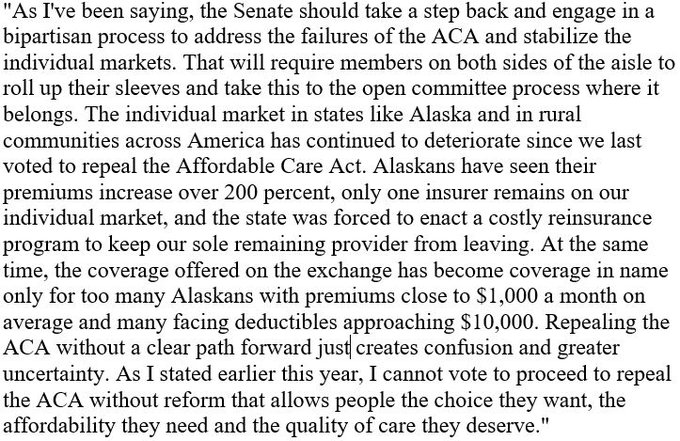
“I cannot vote to proceed to repeal the ACA without reform that allows people the choice they want, the affordability they need and the quality of care they deserve,” she said in a statement posted on Twitter. Instead, she called for the Senate to undertake a bipartisan effort to fix the ACA exchanges.

Sen. Shelley Moore Capito of West Virginia was the first to announce her opposition to a repeal-and-delay plan. “As I have said before, I did not come to Washington to hurt people,” she said in a statement.

Maine Sen. Susan Collins—who was one of the four “no” votes that led to the demise of the BCRA—also quickly came out against McConnell’s new strategy.

“I will vote no on the motion to proceed to repeal the Affordable Care Act without a replacement,” she said.

“We can’t just hope that we will pass a replacement within the next two years,” Collins added. “Repealing without a replacement would create great uncertainty for individuals who rely on the ACA and cause further turmoil in the insurance markets.”

As with the BCRA, McConnell could only afford to lose two votes on a repeal-and-delay bill tailored to pass the chamber through the fast-track budget reconciliation process, given that such a measure was not expected to attract any Democratic support.

The White House, meanwhile, said it is willing to back whichever strategy results in repealing the ACA—whether that’s a repeal-and-delay bill or a “return to the legislation carefully crafted in the House and Senate,” Vice President Mike Pence said at a National Retail Federation event Tuesday.

“Inaction is not an option,” he added. “Congress needs to step up, Congress needs to do their job and Congress need to do their job now.”

Amid tension with CHS, 3 more executives and advisory board member quit Lutheran Health Network

http://www.beckershospitalreview.com/hospital-management-administration/amid-tension-with-chs-3-more-executives-and-advisory-board-member-quit-lutheran-health-network.html

Image result for lutheran health networkImage result for lutheran health network

Three top executives of Fort Wayne, Ind.-Lutheran Health Network and a member of the system’s advisory board have resigned due to actions by LHN’s parent company, Franklin, Tenn.-based Community Health Systems.

LHN Medical Staff President James Cameron, MD, Lutheran Hospital President-elect Matt Carr, MD, and Lutheran Hospital Medical Staff Vice President Marlene Bultemeyer, MD, announced their resignations in a letter sent Friday to the system’s acting CEO Mike Poore, according to the News-Sentinel.

“Although we had the most sincere intentions of guiding the medical staff in the years to come, the events of the past days and weeks have shown that this process will take more than we could individually or collectively accomplish without compromising the quality of care we now provide our patients,” they wrote.

Tom Kelley, a member of the advisory boards for LHN and Lutheran Hospital also resigned Friday, according to The Journal Gazette. He resigned one day after Chuck Surack stepped down from the advisory boards.

The new resignations come after CHS rejected a buyout offer from a group of LHN physicians in May. After saying no to the deal, CHS fired Lutheran Health Network CEO Brian Bauer and CMO Geoff Randolph, MD. Lutheran Hospital CMO Matthew Sutter, MD, resigned in June and Steven Orlow, MD, the system’s CMIO, resigned earlier this month.

5 painfully ineffective leadership styles

http://www.beckershospitalreview.com/hospital-management-administration/5-painfully-ineffective-leadership-styles.html

Image result for negative leadership

Though there are many different leadership styles one can employ to inspire exceptional performance, poor leadership can have devastating effects on the morale and productivity of an organization, according to Entrepreneur.

Listed below are five ineffective leadership styles to avoid avoid if you hope to have a high-performing organization.

  1. Reactive leaders often wait to act until action has already occurred, in which case they are playing catch-up to leaders who had the confidence to plan ahead for expected outcomes.
  2. Overly optimistic leaders take the healthy virtue of optimism too far, thinking so positively that they fail to account for situations where their employees or organization may fall short. They may also trust their extreme optimism over the facts at hand, which contradict their gut assumptions.
  3. Controlling leaders don’t give their employees room to succeed on their own and insist on having a hand in every aspect of their organization. By not trusting people to do their jobs, all a controlling leader does is create more inefficiency and suffocate talent.
  4. Distant leaders do not connect with their employees, who like to feel as though their boss knows them and are often inspired to do better when they feel a leader is personally invested in their success.
  5. Narcissistic leaders inevitably alienate subordinates by taking credit for the success of the team, which makes employees feel less valued. This can make employees less motivated to work hard on the next project if they know their contributions will get swept under the rug.

Straight repeal of ACA back on the table after BCRA fails: 5 things to know

http://www.beckershospitalreview.com/hospital-management-administration/straight-repeal-of-aca-back-on-the-table-after-bcra-fails-5-things-to-know.html

Related image

Two more Republican senators defected from the revised Better Care Reconciliation Act Monday evening, effectively sinking the ACA repeal and replacement bill, according to The New York Times.

Here are five things to know about the bill’s collapse.

1. The two defectors were Republican Sens. Mike Lee of Utah and Jerry Moran of Kansas. Both are Tea Party senators who opposed the ACA, so their defections came as a surprise, according to Bloomberg. Mr. Moran said in a statement he opposed the BCRA because it “fails to repeal the ACA or address healthcare’s rising costs.” He added, “We should not put our stamp of approval on a bad policy.” Mr. Lee did not support the bill because it did not repeal all of the ACA’s taxes or lower premiums enough for the middle class, according to a statement.

2. Without the support of Mr. Lee and Mr. Moran, the bill is dead. Senate Republicans needed at least 50 votes to pass the bill via reconciliation. They hold 52 seats, but two Republicans already announced their opposition: Sens. Susan Collins of Maine and Rand Paul of Kentucky. “Regretfully, it is now apparent that the effort to repeal and immediately replace the failure of Obamacare will not be successful,” Senate Majority Leader Mitch McConnell, R-Ky., said in a statement.

3. Mr. McConnell now wants to return to the full ACA repeal strategy. To do this, the Senate would take up the House bill, the American Health Care Act, and tack on an amendment to repeal the 2010 healthcare law, according to Mr. McConnell’s statement. This would repeal the ACA after a two-year delay to allow for Congress to facilitate a transition and a potential replacement. A bill similar to this was passed in 2015, but was repealed by former President Barack Obama.

4. Despite support in 2015, the straight repeal strategy will be tough to pass now. The New York Times report said this strategy “has almost no chance to pass,” because it will destabilize insurance markets too much. An analysis from the Congressional Budget Office published in January found 32 million more people would be uninsured by 2026 under the 2015 repeal bill. This would set back insurance rates more than the BCRA or the AHCA, which were estimated to increase the number of uninsured by 22 millionand 23 million by 2026, respectively.

5. President Donald Trump is pushing Congress toward the full repeal. He tweeted Monday night, “Republicans should just REPEAL failing Obamacare now & work on a new healthcare plan that will start from a clean slate. Dems will join in!”

Poll: Americans see healthcare as most important issue

https://origin-nyi.thehill.com/policy/healthcare/342336-poll-americans-see-healthcare-as-most-important-issue

Image result for Healthcare Poll

Americans view healthcare as the most important issue facing the country but are doubtful Congress will pass legislation that will lower premiums and cover more people, according to a Bloomberg poll released Monday.

With the GOP push to repeal and replace ObamaCare serving as the poll’s backdrop, 35 percent of Americans surveyed indicated healthcare was their top issue, more than twice as many as any other option. The other leading issues included unemployment and jobs (13 percent), terrorism (11 percent), immigration (10 percent) and climate change (also 10 percent).

A majority, 64 percent, disapproves of how President Trump is handling healthcare, compared to 28 percent approving.

Senate Majority Leader Mitch McConnell (R-Ky.) has delayed a vote on healthcare legislation that leadership hoped would be this week, as Sen. John McCain (R-Ariz.) recovers from an unexpected surgery. Without McCain, Republican leadership didn’t have enough votes to begin debate on the bill because Sens. Rand Paul (R-Ky.) and Susan Collins (R-Maine) said they would vote against a motion to proceed.

About 60 percent of those surveyed believe it’s unrealistic legislation will pass in the next several years that both lowers premiums and leads to more people with health coverage.

Conservative lawmakers have consistently pushed for a bill lowering health insurance premiums. A provision from Sen. Ted Cruz (R-Texas) that was added to the revised version of the GOP plan lets insurers sell plans that don’t comply with ObamaCare’s coverage regulations as long as they also sell a plan that does.

But the measure has received pushback from healthcare experts and insurers. In a strongly worded letter sent Friday, America’s Health Insurance Plans — the major insurance trade group — and the Blue Cross Blue Shield Association warned that it is “simply unworkable in any form and would undermine protections for those with pre-existing medical conditions, increase premiums and lead to widespread terminations of coverage for people currently enrolled in the individual market.”

Bloomberg surveyed approximately 1,000 people over the phone from July 8 to July 12. The poll has a margin of error of plus or minus 3.1 percent.