Oracle’s chairman Larry Ellison outlined a bold vision Thursday for the database giant to use the combined tech power of Oracle and Cerner to make access to medical records more seamless.
Days after closing its $28.3 billion acquisition of electronic health record company Cerner, Ellison said Oracle plans to build a national health record database that would pull data from thousands of hospital-centric EHRs.
In a virtual briefing Thursday, Ellison highlighted many long-standing problems with interoperability in healthcare. “Your electronic health data is scattered across a dozen or separate databases. One for every provider you’ve ever visited. This patient data fragmentation and EHR fragmentation causes tremendous problems,” he said.
“We’re going to solve this problem by putting a unified national health records database on top of all of these thousands of separate hospital databases. So we’re building a system where the health records all American citizens’ health records not only exist at the hospital level but also are in a unified national health records database.”
The concept of the national health records database, which would hold anonymized data, Ellison said, is to help doctors and clinicians have faster access to patient records when providing care. Anonymized health data in that national database could also be used to build artificial intelligence models to help diagnose diseases such as cancer.
“Better information is the key to transforming healthcare,” he said. “Better information will allow doctors to deliver better patient outcomes. Better information will allow public health officials to develop much better public health policy and it will fundamentally lower healthcare costs overall.”
Oracle also plans to modernize Cerner’s Millennium EHR platform with updated features such as voice interface, more telehealth capabilities and disease-specific AI models, Ellison said.
He highlighted a partnership between health tech company Ronin, a clinical decision support solution, and MD Anderson to create a disease-specific AI model that monitors cancer patients as they work through their treatments.
“The people at Oracle are not going to be developing these AI models. But our platform, Cerner Millennium, is an open system and allows medical professionals at MD Anderson, who are experts in treating cancer, to add these AI modules to help other doctors treat cancer patients,” Ellison said.
The purchase of Cerner, which marks Oracle’s biggest acquisition, gives the database giant a stronger foothold in healthcare. Ellison said the company’s enterprise resource planning (ERP) and HR software already is widely used in healthcare.
But the company will face the same long-standing barriers to sharing health data that have stymied other interoperability efforts. There also could be pushback from the industry to any effort by a tech giant to build a nationalized health database.
In March 2020, the federal government released rules laying the groundwork to give patients easier access to their digital health records through their smartphones. The regulation, which went into effect in April 2021, requires health IT vendors, providers and health information exchanges to enable patients to access and download their health records with third-party apps. Under the rule, providers can’t inhibit the access, exchange or use of health information unless the data fall within eight exceptions.
Interoperability experts point out there are already efforts underway to create a more unified database of health records, such Cerner competitor Epic’s Cosmos, which is a de-identified patient database combining the company’s EHR data of over 122 million patients.
Former U.K. Prime Minister Tony Blair is backing Ellison’s vision for building a unified health database. Blair, who leads the nonprofit Tony Blair Institute for Global Change, partners with Oracle to use its cloud technology to tackle health issues.
Speaking at the virtual event, Blair said a unified health records system will “empower citizens and provide clinicians and other care providers with immediate access to their health history and treatment without chasing it down from disparate sources.”
David Feinberg, M.D., who took the reins as Cerner CEO just four months before the acquisition was announced in December, said he was excited about the potential for Oracle and Cerner to advance data sharing.
“We’re bringing world-class technology coupled with a deep and long history of understanding how healthcare works. I don’t think anyone’s ever done that,” said Feinberg, now president and CEO of Oracle Cerner.
We spend a lot of our time helping health system executives craft and communicate enterprise-level strategy: entering new markets or businesses, developing new services, responding to competitive threats, exploring partnership opportunities. Strategy is about the “what” and “when”—what moves are we going to make, and when is the right time to make them?Answering those questions requires an understanding of industry and market forces, organizational capabilities, and consumer needs. But there’s another important component that often goes missing in the rush to get to the “how” of strategy execution: the “why”.
Yet understanding why we’re pursuing one path and not another is critical for aligning stakeholders: physicians, operators, and (importantly) the board. Joan Didion famously wrote that “we tell ourselves stories in order to live”, and we’d agree; the “why” is about storytelling. What’s the strategic narrative, or story, that frames our intended actions? Making sure that everyone involved—including our patients and consumers—has a clear understanding of why we’re opening a new facility, or launching a new service, or entering into a new partnership, is a key to success.
It’s about sharing the vision of our desired role as a system, and the part we see ourselves playing in improving healthcare. We’re sometimes criticized for spending so much time on “framing” and drawing “pretty graphics”, but we’ve come to believe that the ability to succinctly and compellingly describe the “why” of strategy is as important as coming up with the vision in the first place.And then, of course, delivering on the “why”—a job made easier if all involved are clear on just what it is.
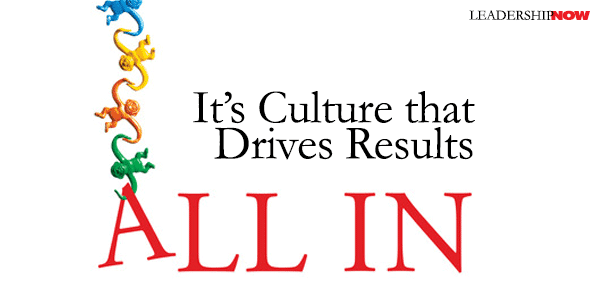
IN THE New York Times, Stephen I. Sadove, chairman and chief executive of Saks Inc., explains that it is culture that drives results:
It starts with leadership at the top, which drives a culture. Culture drives innovation and whatever else you’re trying to drive within a company — innovation, execution, whatever it’s going to be. And that then drives results.
When I talk to Wall Street, people really want to know your results, what are your strategies, what are the issues, what it is that you’re doing to drive your business. They’re focused on the bottom line. Never do you get people asking about the culture, about leadership, about the people in the organization. Yet, it’s the reverse, because it’s the people, the leadership, the culture and the ideas that are ultimately driving the numbers and the results.
While we know that our most important resource is our people, it’s not so easy to get people “all in”—convincing people to “truly buy into their ideas and the strategy they’ve put forward, to give that extra push that leads to outstanding results.”
All In by Adrian Gostick and Chester Elton explains why some managers are able to get their employees to commit wholeheartedly to their culture and give that extra push that leads to outstanding results and how managers at any level, can build and sustain a profitable, vibrant work-group culture of their own. All In takes the principles found in their previous books—The Orange Revolution and The Carrot Principle—and expands on them and places them in a wider context.
They begin by explaining that it all rests on the “belief factor.” People want to believe, but given the fact that “failure could cost them their future security why shouldn’t they be at least a little dubious about your initiatives?” But belief is key. “As leaders we must first allow people on our teams to feel like valuable individuals, respecting their views and opening up to their ideas and inputs, even while sharing a better way forward. It’s a balancing act that requires some wisdom.”
To have a culture of belief employees must feel not only engaged, but enabled and energized. What’s more, “each element of E+E+E can be held hostage by an imbalance in the other two.”
The authors have created a 7 step guide to develop a culture where people buy-in:
Define your burning platform. “Your ability to identify and define the key “burning” issue you face and separate it from the routine challenges of the day is the first step in galvanizing your employees to believe in you and in your vision and strategy.”
Create a customer focus. “Your organization must evolve into one that not only rewards employees who spot customer trends or problems, but one that finds such challenges invigorating, one that empowers people at all levels to respond with alacrity and creativity.”
Develop agility. “Employees are more insistent than ever that their managers see into the future and do a decent job of addressing the coming challenges and capitalizing on new opportunities.”
Share everything. “When we aren’t sure what’s happening around us, we become distrustful….In a dark work environment, where information is withheld or not communicated properly, employees tend to suspect the worst and rumors take the place of facts. It is openness that drives out the gray and helps employees regain trust in culture.”
Partner with your talent. “Your people have more energy and creativity to give. There are employees now in your organization walking around with brilliant ideas in their pocket. Some will never share them because they don’t have the platform to launch those ideas on their own. Most, however, will never reveal them because they don’t feel like a partner in the organization.”
Root for each other. “Our research shows incontrovertible evidence that employees respond best when they are recognized for things they are good at and for those actions where they had to stretch. It is this reinforcement that makes people want to grow to their full shape and stature.”
Establish clear accountability. “To grow a great culture, you need to cultivate a place where people have to do more than show up and fog a mirror; they have to fulfill promises—not only collectively but individually.” And this has to be a positive idea.
Gostick and Elton explain that the “modern leader provides the why, keeps an ear close to those they serve, is agile and open, treats their people with deference, and creates a place where every step forward is noted and applauded.”
The authors skillfully examine high-performing cultures and present the elements that produce them. A leader at any level can implement these ideas to drive results. A great learning tool.







 HENRY KOTULA