More Americans over 65 are working — here’s why

https://www.axios.com/2023/12/14/older-american-adults-working-wages-economy
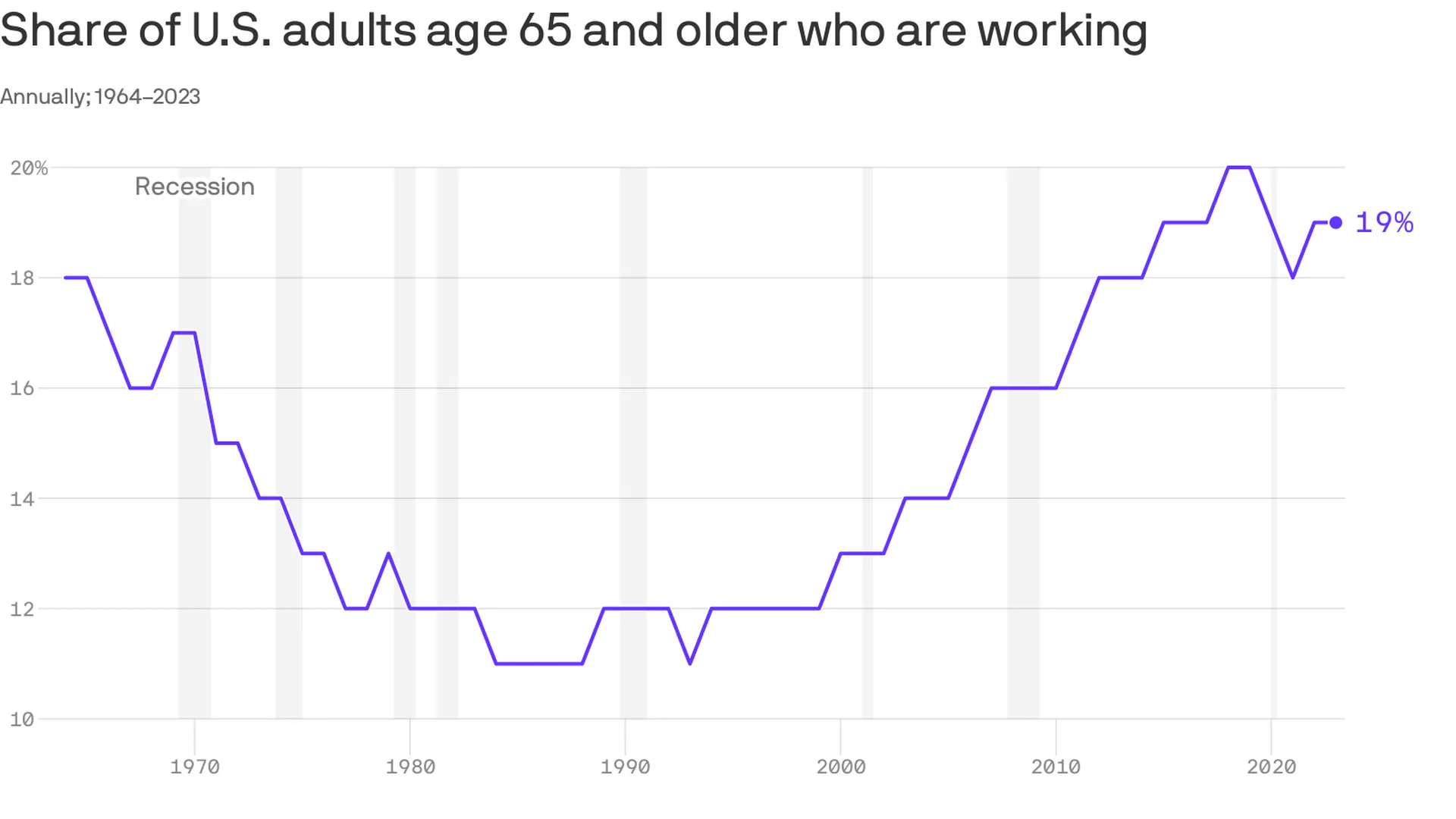
An increasing number of Americans age 65 and older are working — and earning higher wages, per a study from the Pew Research Center out Thursday.

Why it matters: 

This is good for the economy, especially as the U.S. population ages — but whether or not it’s good for older Americans is a bit more subjective.

Zoom in: 

The share of older adults working has been steadily increasing since the late 1980s, with a detour during the pandemic as older folks retired in greater numbers. Several forces are driving the shift:

  • Older workers are increasingly likely to have a four-year degree, and typically workers with more education are more likely to be employed.
  • Technology has made many jobs less physically taxing, so older workers are more likely to take them.
  • Meanwhile, changes in the Social Security law pushed many to continue working past 65 to get their full retirement benefits.
  • At the same time, there’s been a shift away from pension plans, which typically force people out of a job at a certain age, into 401(k) style plans that are less restrictive (and less generous, critics say).

By the numbers: 

Last year, the typical 65+ worker earned $22 an hour, up from $13 (in 2022 dollars) in 1987. That’s about $3 less than the average for those age 25-64, and the number includes wages of full- and part-time workers.

Be smart: 

Before Social Security existed, older people worked — a lot. In the 1880s, about three-fourths of older men were employed, said Richard Fry, senior researcher at Pew. They also didn’t live as long.

  • Meanwhile, the 65+ age group is a fast-growing one — by 2032 all the baby boomers will be in this category, per the BLS’s projections, and their increased workforce participation is good for an economy that is struggling with long-term labor shortages.

The big picture: 

“If people are working longer because they find purpose in their jobs and want to stay engaged, that’s good for them individually,” said Nick Bunker, head of economic research at Indeed Hiring Lab.

  • It’s also good for the productive capacity of the economy, and the firms where they work. “Older folks have lots of experience and knowledge to pass down,” he said.
  • Yes, but: If there are people who want to retire, but can’t because of financial constraints, “that’s bad,” he added.

What to watch: 

The share of older adults working peaked before the pandemic — will it surpass those levels?

  • The number hasn’t bounced back as much as anticipated partly because older Americans benefited hugely from the stock market surge and real estate gains of the past few years — and didn’t need to work anymore.

Thinking about AI’s impact on the healthcare workforce

https://mailchi.mp/e1b9f9c249d0/the-weekly-gist-september-15-2023?e=d1e747d2d8

We had an interesting exchange with a health system CEO this week, which started as a discussion about what to tell his board about the rapidly changing AI landscape, but drifted into a larger conversation about how human-dependent healthcare is. His system has invested heavily in virtual care and has begun to make strides in applying automation and artificial intelligence to both clinical care delivery and key operational processes. He’s glimpsed the potential for process automation—AI’s less sexy sibling, now that “generative AI” has burst onto the scene—to radically reduce staffing costs in areas like revenue cycle management.

And that’s making him wonder about the larger implications for workforce development—both inside his organization and in the economy as a whole. Like many health systems, his organization not only provides care to the community, but also employment opportunities and job growth. 

What happens when large swaths of healthcare delivery become more automated—how will the system look to retrain those workers for other roles? 

One clear area of workforce need over the coming decades will be hands-on caregiving for an older, sicker population that wants to age in place. Health aides, home health workers, community social workers and so forth—will those roles ultimately be filled by workers from other parts of healthcare (and the economy beyond) who find themselves displaced by AI and robotics? 

Will the Amazon warehouse worker of today become the home care worker of tomorrow? 

The conversation was fascinating and made us realize that we’ve paid too little attention to two key issues.

First, the tension between healthcare as a cost problem and healthcare as a source of job growth.

And second, the redistribution of workers into roles that will require hands-on, human presence (like caregiving) in the coming wave of AI and robotics. 

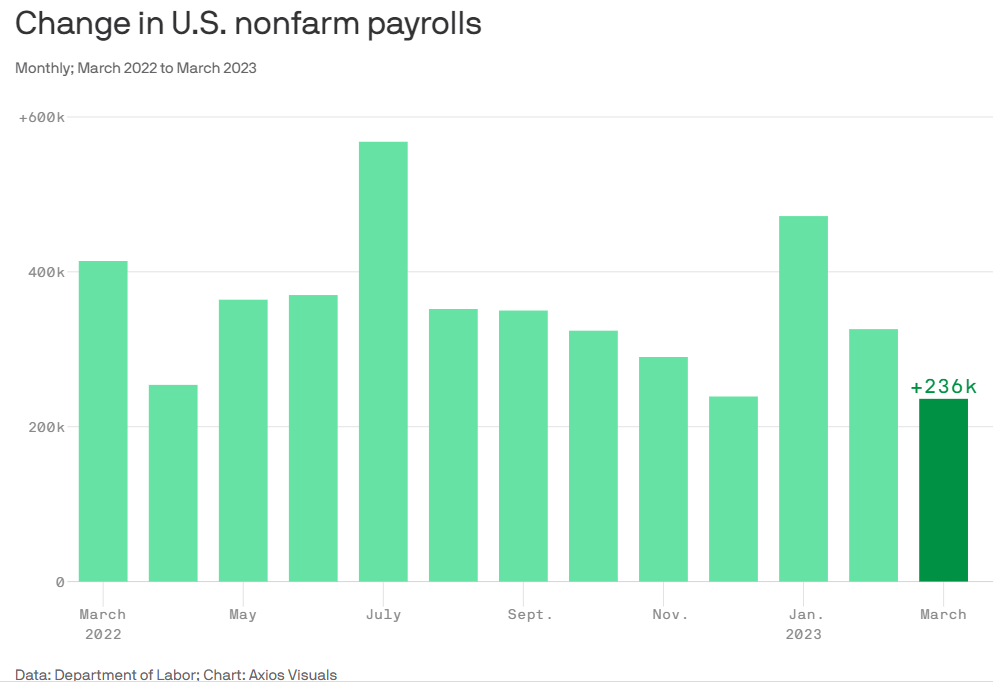
U.S. labor market booms in April, adding 253,000 jobs

The labor market added 253,000 payrolls in April, while the unemployment rate dipped to 3.4% — a historically low level.

Why it matters:

Job growth continued to boom last month, the latest sign that economy has strong momentum despite recent bank failures.

  • Economists expected a gain of 185,000 jobs last month.

Details:

The April job figures are a pickup from the 165,000 jobs added the previous month, which were revised down by 71,000, the Labor Department said on Friday.

  • The Labor Department said that jobs growth in the previous two months was lower than first estimated: jobs growth was revised down by a combined 149,000 for February and March.

The big picture:

In recent months, more Americans have joined the workforce, helping to ease labor force shortages.

  • The labor force participation rate — or the share of workers employed or looking for work — held at 62.6% in April.
  • Average hourly earnings, a measure of wage growth, rose to 0.5% in March. Wages rose 4.4% from the same time last year.

Where it stands:

The Federal Reserve has been concerned about an out-of-balance labor market that it fears could stoke inflation that’s already running high.

  • But Fed Chair Jerome Powell said this week that there were signs that the workforce was “coming back into better balance,” though it remained “very tight.”

National Hospital Flash Report: April 2023

https://www.kaufmanhall.com/insights/research-report/national-hospital-flash-report-april-2023

Hospital margins continued to stabilize in March with a slight improvement over February, according to data from Kaufman Hall’s National Hospital Flash Report. However, margins remain below pre-pandemic levels, leaving hospitals in a vulnerable position should a recession or a new public health emergency materialize.

For provider practices, physician productivity increased but the increased revenues could not keep pace expenses, according to the quarterly Physician Flash Report

While things appear relatively calm at the moment, there remain significant challenges—specifically labor shortages and diminished margins—that could quickly reach the surface if hospitals and health systems are faced with another crisis. 

Kaufman Hall experts are seeing increased reliance on advanced practice providers (APPs)—e.g. Nurse Practitioners and Physician Associates—and note that those that hire, retain and deploy this critical workforce most effectively will see more success in the long term.