


Quote of the Day – On Leadership Character




Joe Garagiola: “Yogi, we’re lost.”
Yogi Berra: “Yeah, I know it. But we’re making good time, ain’t we?”

Economists anticipated lackluster economic growth last quarter. Instead, growth surged, a sign of the still-resilient economy.
Why it matters:
The soft landing was very much intact this spring: Price pressures eased, but not at the expense of the strong economy and labor market.
What they’re saying:
“While these estimates will be revised a few times, they do point to the continued strength of the U.S. economy despite the high interest rate environment we’ve been in for over a year,” NerdWallet senior economist Elizabeth Renter wrote this morning.
The big picture:
The economy grew at an annualized 2.8% in the second quarter, up from the modest gain of 1.4% at the start of 2024.
Capital spending rose at a 5.2% annualized rate, reflecting a surge in spending on equipment (+11.6%) and continued investment in intellectual property (+4.5%).
Between the lines:
A narrower measure of growth affirms the economy’s resiliency in the second quarter.
The intrigue:
The second quarter saw strong growth alongside lower inflation — a reversal of dynamics observed in the January to March period, when inflation resurged and headline GDP moderated.
What to watch:
The Federal Reserve holds a policy meeting next week. No rate changes are expected, though officials look likely to lay the groundwork for a rate cut in the fall.

The U.S. economy grew at a 2.8% annualized rate in the second quarter—a faster rate than economists expected as consumer spending increased and businesses built up inventories, the Commerce Department said on Thursday.
Why it matters:
The new data raises confidence the economy has achieved a “soft landing” — healthy economic growth alongside cooling inflation.
Driving the news:
The accelerated growth stemmed from a jump in inventory investment and consumer spending.
The big picture:
Gloomy forecasts of a recession over the past year have not come to pass.
The bottom line:
The economy continues to defy expectations of a slowdown.

https://www.kaufmanhall.com/insights/blog/gist-weekly-july-12-2024

On Wednesday, the Centers for Medicare & Medicaid Services (CMS) issued its proposed annual changes to physician payments in its 2025 Medicare Physician Fee Schedule Proposed Rule. Required by statute to maintain budget neutrality, CMS is proposing to reduce the conversion factor—which translates the cost of providing medical services into physician payments—by 2.8%.
This is expected to lower physician payments by 2.93% on average. The proposed rule also includes new telehealth flexibilities, changes allowing eligible accountable care organizations access to a quarterly advance on their earned savings, and new payments for providers that help patients at high risk of overdose or suicide.
The Gist: With CMS proposing to reduce physician payments for the fifth straight year, the American Medical Association and other physician groups are once again calling on Congress to avert these cuts.
Congress has previously responded with “Band-Aid” solutions to temporarily reduce or eliminate reductions for the next calendar year, but physician groups are demanding a more comprehensive fix that ties Medicare payment updates to the Medicare Economic Index, a measure of practice cost inflation.
Medicare physician pay has declined 20% relative to practice costs from 2000 to 2021, and post-COVID inflation has only worsened the issue. Although lawmakers on Capitol Hill have explored various means of doing so, structural changes to Medicare budgetary policy face an uphill legislative battle in a presidential election year.
https://www.kaufmanhall.com/insights/blog/gist-weekly-july-12-2024
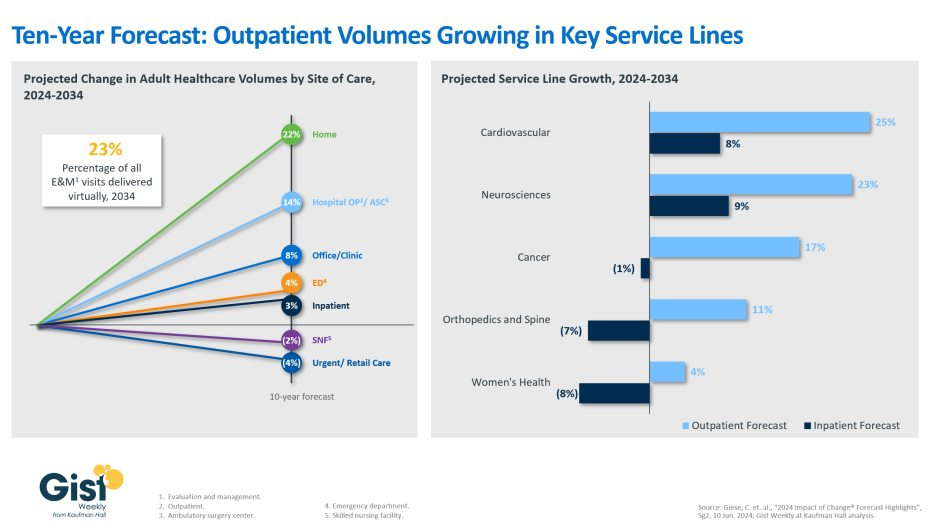
Using the latest data forecast from Sg2, a Vizient company, the graphic above illustrates how the outpatient shift will continue to accelerate through 2034.
Home-based care and outpatient services, including ambulatory surgery centers, are projected to be the fastest growing care sites over the next decade, with volumes increasing 22% and 14% respectively.
Sg2 forecasts that physician offices, emergency departments, and inpatient settings will experience more modest volumes increases, whereas skilled nursing facilities and retail care volumes are predicted to decline.
Additionally, although the initial outpatient procedural shift was largely focused on orthopedics, the next wave of outpatient volume growth will come from other service lines.
Driven by regulatory changes, as well as patient demand, outpatient cardiovascular volumes are expected to increase by 25% over the next decade, closely followed by neurosciences at 23%.
Continued health system investment into higher-acuity outpatient care remains crucial.
 HENRY KOTULA