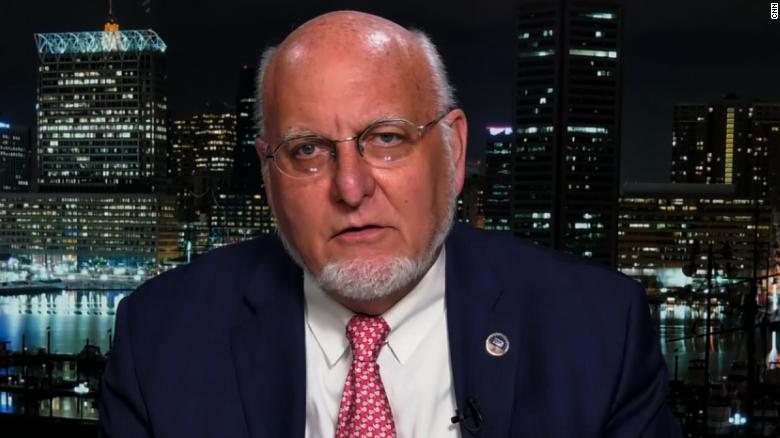
White House reverses position after blocking health officials from appearing on CNN

https://www.cnn.com/2020/04/09/media/pence-office-tv-bookings-coronavirus/index.html?utm_medium=social&utm_content=2020-04-09T18%3A50%3A06&utm_source=twCNN&utm_term=link&fbclid=IwAR3vThr8ecjeeG6VqkgR6s1blEbkkOK6ocqYTUof8cVVQKMByXoKMhBXfuw

White House reverses position after blocking health officials from ...

Vice President Mike Pence’s office reversed course on Thursday afternoon, after declining for days to allow the nation’s top health officials to appear on CNN and discuss the coronavirus pandemic, in what was an attempt to pressure the network into carrying the White House’s lengthy daily briefings in full.

After this story was published, Pence’s office allowed for the booking of Centers for Disease Control and Prevention Director Dr. Robert Redfield for CNN’s Thursday night coronavirus town hall. Dr. Anthony Fauci was also booked for Friday on “New Day.”
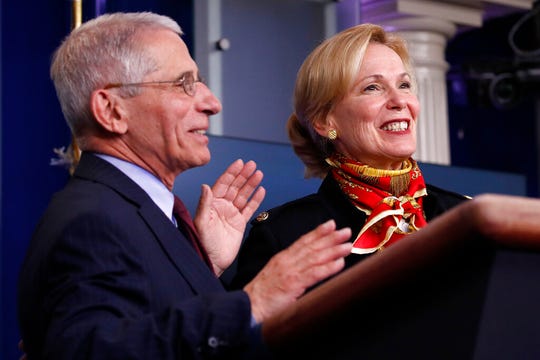
Previously, Pence’s office, which is responsible for booking the officials on networks during the pandemic, said it would only allow experts such as Fauci or Dr. Deborah Birx to appear on CNN if the network televised the portion of the White House briefings that includes the vice president and other coronavirus task force members.
CNN often only broadcasts President Donald Trump’s question and answer session, which sometimes includes the health care officials, live on-air.
After Trump leaves the podium, CNN frequently cuts out of the White House briefing to discuss and fact-check what the President has said. A CNN executive said that the network usually returns to such programming because of the extensive length of the full briefing that includes Pence, which can run in excess of two hours.
CNN did, however, air the vice president’s portion of the briefing Wednesday night.
Regardless, Pence’s office for several days declined to make the nation’s top health care officials available to CNN for the last seven days.
“When you guys cover the briefings with the health officials then you can expect them back on your air,” a Pence spokesperson told CNN Thursday morning.
Fauci, Birx, FDA Commissioner Stephen Hahn and Surgeon General Jerome Adams have all appeared on NBC, CBS, ABC and Fox during the last week, despite the fact that the broadcast networks have generally not covered the briefings that have included the vice president and health officials.
But the Vice President’s office had blocked all CNN appearances since last Thursday night.
Fauci appeared on the last five weekly CNN Town Halls, with Anderson Cooper and Dr. Sanjay Gupta. Until this story was published, Vice President’s office has refused to make him, or anyone, available for Thursday’s town hall.
The White House has made two non health care officials available to CNN in the last week. Secretary of Defense Mark Esper appeared on “State of the Union” on Sunday and Peter Navarro appeared on Anderson Cooper’s show on Friday and “New Day” on Monday.
Trump has declined CNN’s repeated requests for an interview, instead appearing only on Fox News for softball interviews multiple times during the national emergency.
A CNN spokesperson declined to comment for this story.



Labor Secretary Eugene Scalia faces blowback as he curtails scope of worker relief in unemployment crisis

https://www.washingtonpost.com/business/2020/04/10/labor-secretary-eugene-scalia-faces-blowback-he-curtails-scope-worker-relief-unemployment-crisis/?fbclid=IwAR3mYk7W0Jvxu0lJ9vo7FXufkVsy1OVsg-VqmUztG1hi5PJAneL7PzcKDtI

Eugene Scalia, rising in Trump orbit, becomes key force in ...

Labor Department comes under fire over handling of worker protection, unemployment program.

The Labor Department is facing growing criticism over its response to the coronavirus pandemic as the agency plays a central role in ensuring that the tens of millions of workers affected by the crisis get assistance.

The criticism ranges from direct actions that the agency has taken to limit the scope of worker assistance programs to concerns that it has not been aggressive enough about protecting workers from health risks or supporting states scrambling to deliver billions in new aid.

In recent days, Labor Secretary Eugene Scalia, who has expressed concerns about unemployment insurance being too generous, has used his department’s authority over new laws enacted by Congress to limit who qualifies for joblessness assistance and to make it easier for small businesses not to pay family leave benefits. The new rules make it more difficult for gig workers such as Uber and Lyft drivers to get benefits, while making it easier for some companies to avoid paying their workers coronavirus-related sick and family leave.

“The Labor Department chose the narrowest possible definition of who qualifies for pandemic unemployment assistance,” said Andrew Stettner, a senior fellow at the Century Foundation who has spent two decades working on unemployment programs.

At the same time, frustrations have built among career staff at the Labor Department that the agency hasn’t ordered employers to follow safeguards, including the wearing of masks, recommended by the Centers for Disease Control and Prevention to protect workers. Two draft guidance documents written by officials at the Occupational Safety and Health Administration, part of the Labor Department, to strengthen protections for health-care workers have also not been advanced, according to two people with knowledge of the regulations granted anonymity to discuss the internal deliberations.

Scalia, a longtime corporate lawyer who is the son of the late Supreme Court justice Antonin Scalia, has emerged as a critical player in the government’s economic response to the pandemic. Nearly 17 million Americans have applied for unemployment insurance since President Trump declared a national emergency on March 13, and states are struggling to get their systems working to deliver $260 billion in new aid approved by Congress.

Democrats and some Republicans argue that the Labor Department needs to be more aggressive about disbursing money and technical assistance to states to shore up the unemployment insurance system. The department has released only half of $1 billion in administrative support for states that Congress approved almost a month ago.

Sen. Lindsay O. Graham (R-S.C.) said Thursday in an interview that he has talked to Scalia about the need to speed things up.

“You could have massive civil unrest if these systems cannot get checks out the door. We’re talking about 20 percent unemployment, maybe even more,” Graham said. “The application process is a nightmare. The state systems are failing.”

Graham said that Scalia has been responsive, but, “I don’t see any action being taken.”

Labor Department officials said Scalia is moving rapidly to help U.S. workers in an unprecedented time. They pointed to a poster and guidebook that OSHA released with steps companies “can take” to reduce worker risk of coronavirus exposure.

“Under Secretary Scalia’s leadership, in the last two weeks, the department has quickly released new rules and guidance for states, businesses, and individual Americans to help those in need of relief,” said Patrick Pizzella, deputy labor secretary. “The department has already distributed nearly $500 million in additional administrative funding to 39 states.”

Still, Scalia has made clear he is wary of taking an excessively lax approach to disbursing aid, an argument that he used to help win GOP support for recent legislation. Writing on Fox Business Network’s website on Monday, he warned that he does not want unemployed people to become addicted to government aid.

“We want workers to work, not to become dependent on the unemployment system,” Scalia wrote with Small Business Administration chief Jovita Carranza. “Unemployment is not the preferred outcome when government stay-at-home orders force temporary business shutdowns.”

On the day the $2 trillion package passed the Senate, Scalia spoke with Sens. Rob Portman (R-Ohio), Ben Sasse (R-Neb.) and Tim Scott (R-S.C.), who had raised concerns the law’s new unemployment benefits were too large and would deter workers from returning to jobs.

Scalia told conservative senators that once enacted, his agency would ensure the provisions his agency oversees would not hurt U.S. companies, according to three congressional officials aware of the conversations and granted anonymity to discuss the call.

Narrowing rules

Two recent laws passed by Congress expanded paid and sick leave policies as well as the size and scope of unemployment benefits for Americans. But worker advocates argue that as Scalia begins to implement these measures, his department is being much less generous toward workers than toward companies.

New Labor Department guidance says unemployment benefits apply to gig workers only if they are “forced to suspend operations,” which could dramatically limit options for those workers if their apps are still operating. Other workers also face a high hurdle to qualify for benefits.

The guidance says a worker “may be able to return to his or her place of employment within two weeks” of quarantining, and parents forced to stop work to care for kids after schools closed are not eligible for unemployment after the school year is over. Workers who stay home because they are older or in another high-risk group are also ineligible unless they can prove a medical professional advised them to stop working.

Some states are also having a difficult time figuring out how to verify how much money self-employed workers typically earn. It might require looking at tax documents, which unemployment offices don’t usually have access to.

“Some of the requirements, the standards that we’re being held to, are going to be incredibly difficult to adhere to,” Maine Labor Commissioner Laura Fortman said.

A Labor Department spokesperson said the agency is “providing as much technical assistance and IT support as possible” to states, some of which are using computer systems that are several decades old.

Scalia’s agency is also in charge of overseeing the new paid sick and family leave regulations, which apply to companies with fewer than 500 employees during the pandemic. The law gave the Labor Department authority to exempt businesses with under 50 employees from providing 12 weeks of paid family leave to care for a child out of school if the leave policy threatens to bankrupt the company.

Businesses that deny workers paid leave don’t have to send the government any paperwork justifying why. The Labor Department’s guidance asks companies to “retain such records for its own files,” a contrast with the heavy documentation required from gig workers who must prove they were affected by the coronavirus outbreak to get aid.

A Labor Department spokesperson said its rules on paid sick and family leave follow Congress’ direction.

“The department’s new rule balances allowing workers to take paid leave to care for their children with keeping small businesses open — as instructed by Congress,” a spokesperson said.

Tension at OSHA

Some Labor Department staffers and outside critics have also faulted Scalia for his handling of OSHA, which falls under his jurisdiction.

The CDC has issued recommendations for the public and businesses to follow practices such as social distancing and sanitizing workstations. OSHA could make those guidelines mandatory for all employers or for all essential employees but has not done so.

“Some of the OSHA staff is frustrated they can’t do more to protect workers. They want an emergency standard that would require employers to follow CDC guidelines,” said David Michaels, a George Washington University School of Public Health professor who served as assistant secretary of labor for occupational safety and health in the Obama administration.

Under Scalia, OSHA has also decided against issuing safety requirements to protect hospital and health-care workers, including rules that would mandate nurses and other providers be given masks and protective gear recommended by the CDC when at risk of exposure.

The union National Nurses United petitioned Scalia to increase the requirements during the pandemic, but a union spokeswoman said the Labor Department has not even acknowledged receipt of the letter.

Hospitals have resisted these rules for years. Tom Nickels, the chief lobbyist for the American Hospital Association, said that he hadn’t spoken to Scalia but that his group has opposed these actions in conversations with OSHA staff because widening the use of N95 respirator masks would be impractical. “The equipment is in short supply,” he said. “We can’t get it.”

OSHA also has not taken significant action to protect workers from retaliation when they speak out about dangerous conditions that expose them to coronavirus, Michaels said.

When workers at a manufacturing plant in northern Illinois tried alerting government officials about their concerns about working shoulder to shoulder, the regional OSHA official responded that “all OSHA can do is contact an employer and send an advisory letter outlining the recommended protective measures,” according to an email reviewed by The Washington Post. “This isn’t very helpful for you or your labor group, but it is the best I have to offer,” the email said.

On Wednesday, OSHA sent out a news release reminding companies that it is “illegal to retaliate against workers because they report unsafe and unhealthful working conditions during the coronavirus pandemic.”

“OSHA has completely abandoned their responsibility to protect workers on the job,” said Debbie Berkowitz, who worked at OSHA in the Obama administration and is now director of the worker safety and health program at the National Employment Law Project. “I have never felt this way, that every worker is at the mercy at their boss of whether they get protected. People are going to get sick and die, and they don’t have to.”

This week, Scalia said OSHA would take all worker safety concerns seriously.

“We are fielding calls from workers worried about their health and from workers who believe they have been illegally disciplined by their employer for expressing health concerns,” he said. “We will not tolerate retaliation.”


South Korea is winning the fight against covid-19. The U.S. is failing.

https://www.washingtonpost.com/outlook/2020/04/10/south-korea-is-winning-fight-against-covid-19-us-is-failing/?fbclid=IwAR0Fizr7BiOZgPxJVjHpHcuetAnn_UcamZDfmY16V4_RG3xV52rOXryIepk&utm_campaign=wp_main&utm_medium=social&utm_source=facebook

Confucianism Isn't Helping South Korea Beat the Coronavirus

South Korea’s blueprint for victory.

As the coronavirus spreads rapidly around the world, killing thousands and leaving governments scrambling to deal with the fallout, one country has repeatedly drawn praise for its efficiency in dealing with it: South Korea. After the first cases appeared, the South Korean government ramped up testing at a speed almost unimaginable in the United States. Its swift response slowed the spread of the virus and saved thousands of lives. As of April 8, South Korea had suffered 200 deaths due to the virus (4 per 1 million of population) and the number of new cases has slowed, while the United States had suffered 13,000 deaths (39 per 1 million population) with new cases continuing to grow quickly.

How did this happen? For many it is baffling that a relatively small Asian country could succeed where much of the rest of the world tragically failed. Was it South Korea’s experience dealing with another respiratory epidemic illness, Middle East respiratory syndrome, in 2015? Its excellent and affordable health-care system? Its cultural values? Mask-wearing? Some of these factors doubtless accelerated South Korea’s rapid deployment of testing stations and its subsequent efforts to identify and treat patients.

But the efficient South Korean response also hinged on two historically rooted factors: the close cooperation between the state and the private sector, and the South Korean public’s willing and almost enthusiastic embrace of a large-scale medical intervention. The origins of both of these phenomena lie in the South Korean experience of rapid industrialization and nation-building during the Cold War.

After the first cases of covid-19 were reported in South Korea on Jan. 20, the government recognized the need for prompt and comprehensive action. According to Reuters, South Korean Health Ministry officials called a meeting with representatives from medical companies in January when only four cases of the virus had been confirmed. The health officials told the executives that the country needed to have tests ready in short order, and they promised rapid approval by the Korea Centers for Disease Control and Prevention. In scarcely one week, the government had approved a test kit developed by Kogene Biotech and would soon fast-track the approval of test kits developed by several other companies.

The endeavor was so successful that by March, 47 countries were seeking to import South Korean test kits. Compared with President Trump, who has squabbled with 3M and General Motors over the production of masks and ventilators, the government and private sector worked together seamlessly in South Korea. Companies responded quickly to the state’s demands while receiving strong government support.

The private companies’ swift response to an urgent government fiat followed a pattern of state-private sector partnership in the service of the nation that was pioneered by South Korea’s authoritarian ruler Park Chung Hee during the 1960s. When Park seized power in a military coup in 1961, South Korea was among the poorest countries in the world and, from the perspective of many U.S. officials who often called it a “rat hole,” it was hopeless. But Park was driven by an all-consuming determination to achieve double-digit economic growth rates and raise living standards in his impoverished country.

Although Park received much advice from the United States during his 19 years in power, the model of development he came up with did not emulate the American style of free-market capitalism at all. It bound South Korean conglomerates closely to the state, offering them special incentives if they followed state guidance and performed. During the 1960s, Park recognized that to achieve an economic takeoff, he needed to dramatically increase exports. His government made low-interest loans available to companies that were willing to test their mettle exporting textiles, wigs and other light-manufactured goods abroad. Those that succeeded were rewarded with even greater largesse from the state.

This development model had a dark side, of course. The cozy ties between the state and businesses facilitated corruption, strengthened Park’s grip on power and heightened repression. But from a purely economic standpoint, it worked. Exports increased, Korean firms captured a growing share of international markets, and per capita income rose.

Park never strayed far from his military roots. The managerial techniques and soldierly discipline he had learned in his years as an officer informed his approach to development. American aid officials were impressed by how his presentations seemed to come “straight out of the U.S. military briefing manuals.” South Korea’s rapid response to the coronavirus has contained echoes of this military ethos, although the country shifted to more democratic governance in the 1980s and 1990s. “We acted like an army,” one infectious-disease specialist in Korea told Reuters.

Cold War nation-building in South Korea brought not only state-led economic development, but also new kinds of government-led medical interventions. As historian John P. DiMoia has explained, during the 1950s, many South Koreans were still unfamiliar with Western medicine and did not initially welcome official health programs. This began to change under Park Chung Hee’s rule. The South Korean leader launched public health campaigns that fundamentally changed both the medical profession and the public’s attitude toward it. New professional standards were demanded of doctors and their support staff, while the public was encouraged — and at times coerced — to participate in family planning and other state-organized health interventions.

The swift rollout of coronavirus testing was not South Korea’s first large-scale effort to combat an infectious organism. During the 1960s, according to DiMoia, one of the biggest medical problems plaguing South Korea was parasite infestation. The Park government made a concerted effort to eradicate parasites through a national testing program that targeted elementary school students. For nearly two decades, collecting of stool samples for analysis was a routine part of life for South Korean children. The children that learned — at times grudgingly — to accept government testing for parasites during the 1970s and 1980s are now the adults who willingly line up to be tested for the coronavirus.

Today, the Moon Jae-in government’s response to the virus has not been without flaws and criticism. The South Korean media has blamed him for not moving quickly enough to ban Chinese tourists when the virus began spreading rapidly. Others have criticized the high degree of state surveillance that accompanied the rollout of testing. The government would have had far more difficulty carrying out contact tracing if it could not have closely followed the movement of its citizens through their smartphones and credit cards.

Here, too, there are faint echoes of South Korea’s authoritarian past, which was too often marked by the close monitoring of students, intellectuals and other dissidents by military regimes.

But Moon, who was imprisoned during the 1970s for protesting Park Chung Hee’s authoritarian rule, has been careful to keep his policies within the confines of democratic accountability. Conservative U.S. commentators who claim South Korea has succeeded because it is not a democracy have it wrong. In fact, South Korea has avoided the draconian lockdowns and travel restrictions imposed by the Communist Party of China. Through the use of technology and data, South Korean has been able to keep businesses open to a greater extent than most parts of the United States.

South Korea’s impressive management of the coronavirus only strengthens its rapidly growing cultural influence around the world, which is abundantly clear in the widespread popularity of K-pop and the unprecedented success of the Korean film “Parasite” at the Academy Awards.

The Moon government’s deft handling of a global pandemic that has taken on nightmarish proportions elsewhere has drawn praise from health experts and policymakers worldwide, with many citing it as a model. “Let’s not follow Italy, let’s follow South Korea,” Sen. Mitt Romney (R-Utah) said recently when talking about how the United States should deal with its own swiftly escalating crisis.

Unfortunately, it is too late for the United States to emulate South Korea and avert thousands of deaths. But we could learn from its example, by encouraging better public-private partnerships in manufacturing needed medical equipment and protective gear and by encouraging Americans to embrace public health initiatives, including widespread testing, to save lives.


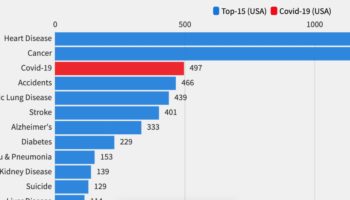
USA: COVID-19 daily deaths vs. Top 15 Causes of Death

A Chart Showing How Long It Took For Coronavirus To Become The ...

Still think the flu is a bigger overall health problem than COVID-19? Check out this animated graph showing daily deaths from various conditions over the past few weeks. (Maria Danilychev, MD @ Flourish Studio)


Pence Blocks Fauci, Birx from Appearing on CNN after Network Stops Airing Full White House Coronavirus Briefings

https://news.yahoo.com/pence-blocks-fauci-birx-appearing-163022678.html

Anthony Fauci and Deborah Birx are diving into social media to ...

Vice President Mike Pence has blocked Drs. Anthony Fauci and Deborah Birx, as well as other top U.S. health officials, from appearing on CNN following the network’s decision to not air the White House coronavirus press briefings in full.

“When you guys cover the briefings with the health officials then you can expect them back on your air,” a spokesman for the vice president told CNN.

Trump and the White House Coronavirus Task Force, led by Pence, have been giving daily briefings to the press for several weeks after rising numbers of Americans have been infected. A CNN executive said that the network has sometimes cut away from the briefings after Trump speaks, and turns to a panel to fact-check the president. However, the network usually broadcasts only the president’s question-and-answer session.

Fauci and Birx regularly appear at the briefings to give updates on the status of the coronavirus epidemic within the U.S. Fauci has also appeared on CNN virtual townhalls on the coronavirus for the past five weeks, but will not be present this Thursday.

The New York Times, another outlet that has been a target of the Trump administration’s ire, stopped airing the briefings on its website entirely.

“We stopped doing that because they were like campaign rallies,” Elisabeth Bumiller, the paper’s Washington bureau chief, told the Washington Post. “The health experts often have interesting information, so we’re very interested in that, but the president himself often does not.”