Behind the Debate Over ‘Medicare for All’

https://www.weeklystandard.com/chris-deaton/behind-the-debate-over-medicare-for-all
Image result for Behind the Debate Over ‘Medicare for All’

The federal price tag of Bernie Sanders’s proposal is not surprising. But the implications are kind of insane.

Bernie Sanders’s “Medicare for all” proposal is receiving new scrutiny because of an estimate released this week by economist Chuck Blahous of the right-leaning Mercatus Center. Blahous projects that the plan would cost the government $32.6 trillion over 10 years but also reduce the country’s overall level of health expenditures by $2 trillion. “M4A” advocates say that these numbers are two sides of the same coin: that because the program would redirect spending for health care to the government and lower aggregate expenses in the economy, the exorbitant cost to taxpayers would be, as multiple left-leaning analyses have put it, “a bargain.” But Blahous’s research of the Sanders plan, like that of his contemporaries, is loaded with assumptions and caveats that reduce conclusions about the idea’s cost-saving to speculation. If anything, it’s fair to say that the research shows how M4A is a risk of historic price.

For the average individual, the point of “Medicare for all” is to have federal tax revenue pay for health coverage that is comprehensive and basically free to use. Sanders’s proposal includes wide-ranging benefits applicable in “medically necessary or appropriate” circumstances and eliminates cost-sharing, meaning no copays, deductibles, or similar charges. The expense to households is less take-home pay: a new, de facto “premium” paid to Washington, maybe higher payroll taxes, and, depending on income level and economic behavior, higher income taxes from rate hikes.

Similar trade-offs would appear elsewhere: Businesses would not offer their employees coverage under an M4A scheme, for example. But they, too, would have to foot the cost, through a higher corporate tax rate, potential taxes on their own behavior (like on carbon), and perhaps an employer-specific premium like the one paid by individuals. Some of these ideas are incorporated into Sanders’s thinking; depending on the bill’s projected cost, more of them may be necessary to compensate for the government’s expense.

This is where Blahous’s work comes in. Whereas Sanders’s campaign forecast his M4A plan to cost $1.38 trillion per year, Blahous projected that number to be more than double, at $3.26 trillion, in the paper he published on Monday. “For perspective on these figures, consider that doubling all currently projected federal individual and corporate income tax collections would be insufficient to finance the added federal costs of the plan,” he wrote. His assessment met skepticism from some in the press, given Mercatus’s affiliation with the Koch brothers.

Notwithstanding the sloppiness of such a charge—Mercatus is directed by a world-class economist respected across the political spectrum, Tyler Cowen, and Blahous’s paper was peer-reviewed and reflected his own research, regardless—Blahous’s findings were similar to the Urban Institute’s, a well-regarded and left-leaning think tank that examined the Sanders proposal in 2016. Its 10-year federal cost estimate was $3.20 trillion a year.

The Urban Institute economists ran their numbers based on the Vermont senator’s framework for Medicare for all. But Sanders introduced his legislation in the Senate last year, which provided Blahous more specifics to analyze and alternative scenarios to consider. For example: Sanders’s plan caps reimbursements to physicians and hospitals for services at the Medicare reimbursement rate, which is significantly lower than reimbursements under private plans (but higher than those under Medicaid). “In 2014, Medicare hospital payment rates were 62 percent of private insurance payment rates and are currently projected to decline to below 60 percent by the time M4A would be implemented, and to decline further afterward. Medicare physician payment rates were 75 percent of private insurance rates in 2016 and … are projected to decline sharply in relative terms in future years, also falling below 60 percent within the first full decade of M4A,” Blahous writes.

The surprising finding in his study is that Sanders’s Medicare for all bill would decrease national health expenditures (NHEs) over the next decade by $2 trillion. Many M4A advocates celebrated this estimate, given the unlikely source of it. But there are two things to keep in mind. One, national health expenditures are different from government expenditures: They comprise aggregate spending on health care in the United States, in both the private and public sectors. (They have a specific definition, per the Centers for Medicare and Medicaid services, available on Page 6 here.) Two, while keeping reimbursement rates at the relatively low Medicare level would help contain the total dollar figure of NHEs, it also would jar the finances of medical providers.

“Perhaps some facilities and physicians would be able to generate heretofore unachieved cost savings that would enable their continued functioning without significant disruptions,” writes Blahous. “However, at least some undoubtedly would not, thereby reducing the supply of healthcare services at the same time M4A sharply increases healthcare demand.” Difficulty accessing care “almost certainly must arise”—which is not a controversial statement, but mere economic intuition.

“Setting provider payment rates for acute care services at levels consistent with the current law Medicare program may be too restrictive,” the Urban Institute study stated. “Payment rates may in fact have to be higher, at least initially and perhaps indefinitely, to be acceptable to providers.”

Anticipating this scenario, Blahous runs the numbers keeping reimbursements to providers and physicians on pace with current projections. This situation results in an annual cost to government of $3.80 trillion, not $3.26 trillion—and a net increase in NHEs of $3.25 trillion over a decade, instead of a decrease of $2.05 trillion. This represents a range of realistic outcomes, and given political and economic realities, something close to the alternative payment arrangement has to be considered a likelihood.

Of course, all this discussion pertains only to finances, not the pluses and minuses of access and quality of care: low-income individuals getting covered, but consumers demanding more care while suppliers shrink the availability of it, for instance. It also does not consider how the goalposts of whether the public scores a good deal with M4A could move. Jacobin magazine called the Sanders plan “a bargain” based on Blahous’s score, since “[w]e get to insure every single person in the country, virtually eliminate cost-sharing, and save everyone from the hell of constantly changing health insurance all while saving money.” But what if the public doesn’t save money, as in the alternative scenario Blahous evaluates? The same advocates could argue so what?—even if the public is paying more money on net, it’s doing so in the cause of insuring 30 million more people. They could frame those numbers as being worth it.

The thrust of the costs is that M4A is not some unassailable good and an easy system relative to the status quo, even for all the inefficiencies of the current, messy health insurance market. Again, this is not a critique confined to a right-of-center perspective. As the Center for American Progress’s Topher Spiro wrote on Monday (in a since-deleted tweet):

spiro-m4a.jpg

Medicare for all would represent an historically large cost shift between the American economy and federal government. Simply citing the budget impact of such a proposal—$32.6 trillion over a decade—to invalidate the merits of the idea cuts the debate unjustifiably short, as left-of-center critics have stated. But incorporating the other financial aspects of M4A does not cinch their case. It instead complicates it, undermines it, and brings the debate about American health care back to philosophical grounds.

Does the public believe Washington should have total financial control of the market, to the tune of more than $3 trillion in tax revenue a year? Does it trust Washington to allocate those taxes fairly? And given the range of outcomes for reducing health costs—to the point it may not reduce them at all—does it believe that such a transition merits the risk?


The Health 202: ‘Medicare for all’ is the dream. ‘Medicaid for more’ could be the reality.

https://www.washingtonpost.com/news/powerpost/paloma/the-health-202/2018/08/02/the-health-202-medicare-for-all-is-the-dream-medicaid-for-more-could-be-the-reality/5b61d4ed1b326b0207955ea2/?utm_term=.f54d337c2d74

Image result for incremental health reform

“Medicare for all” is the hottest position on the left these days, but there’s a quieter push afoot to create a public option using Medicaid. 

Chanting “Medicaid for more” may not sound as bold for progressives seeking to prove their bona fides before the midterm elections. Yet all the most-hyped 2020 Democratic presidential candidates are on board with the idea, including the Medicare expansion’s biggest champion, Sen. Bernie Sanders (I-Vt.).

The idea in concept is simple: Allow states to open up their Medicaid programs to anyone regardless of income. Those people could buy in to the social safety net and have access to Medicaid’s provider network and benefits. The groundwork for expanding the program for low-income Americans has already been laid to some extent as 34 states have expanded Medicaid under the Affordable Care Act.

Sen. Brian Schatz (D-Hawaii) has introduced the “State Public Option Act” to promote states to expand Medicaid — co-sponsored by some familiar Democratic faces: Sanders, Elizabeth Warren (Mass.), Cory Booker (N.J.), Kamala Harris (Calif.) and Kirsten Gillibrand (N.Y.). But the real efforts are happening at the state level where legislatures all over the country are seriously considering the idea.

Heather Howard, a lecturer at Princeton University who also helps states with their health-care systems, said many plans are in their infancy, but that 14 states across the country have made moves to, at minimum, weigh the benefits and challenges of shifting Medicaid to a publicly available health insurance option.

“There are a lot of policy considerations to think about, but while the federal policy debate is stalled, you have states thinking about what tools do we have. [Medicaid] is the immediate tool you have,” she told me.

That’s because Medicare is operated at the federal level so any major changes to it have to be decided in Washington. Medicaid, on the other hand, is run by the states, so they have more discretion over how the program is set up. 

There are real critiques of Medicaid as it now exists, such as low reimbursement rates for doctors and uniform access to care. To offer it to everyone would require responding to those criticisms as well as new questions such as the cost to states, whether states have to apply for federal waivers to alter the program and whether a public option lives on or off the ACA exchanges.

This week stakeholders across New Mexico met with President Obama’s former Centers for Medicare and Medicaid Services Administrator Andy Slavitt to begin some of those conversations. Earlier this year, New Mexico’s state legislature passed a bill to create a committee to study a Medicaid buy-in program. Medicaid is popular there; one-third of New Mexicans are enrolled. Yet 230,000 people remain uninsured in the state, according to Kaiser Family Foundation data, and proposed premium rates for 2019 for those who don’t qualify for ACA subsidies are increasing anywhere from 9.2 percent to 18.5 percent.

Slavitt is the board chair of a new group, United States of Care, which has an impressive roster of bold-faced names leading it from investor Mark Cuban to former Obama speechwriter Jon Favreau to former congresswoman Gabrielle Giffords (D-Ariz.) and her astronaut husband Mark Kelly. In the absence of Washington leadership, the group is working with states on ways to improve health care.

Allison O’Toole, the group’s director of state affairs, was also on the ground in New Mexico this week and told me there’s a “real hunger” and “momentum” around the idea of allowing states to expand Medicaid.

“Washington is in gridlock and not addressing people’s real concerns around the cost and affordability of health care,” O’Toole said. “This has created a greater sense of urgency and necessity by states to pick up that ball and run with it.”

With the Republicans’ failure to repeal the ACA and the public outcry when they tried, Democrats are feeling emboldened this year to talk ambitiously about their health-care goals. 

Health care is a leading issue heading into November, and polls show at least half of Americans are in favor of a “Medicare for all” program. But even if Democrats win the House majority and make gains in the Senate, President Trump has said Obamacare is unsustainable and his administration has worked persistently to chip away at it.

That’s why Michael Sparer, a public- health professor at Columbia University, believes “Medicaid for more” is not only good policy, but also good politics. It’s the type of proposal, he reasons, that could peel off moderate Republicans in a way that a national Medicare program never could. 

It’s true that Medicaid is a favorite GOP punching bag. The Trump administration is urging states to add work requirements to their programs and the GOP playbook has long included capping how much the federal government pays each state to administer Medicaid.

Yet 34 states, including many with Republican governors, expanded the ACA under Medicaid to include more low-income residents, and several more red states are on the precipice of following them. It’s a program that has endured and grown for 53 years.

“The Medicaid buy-in is more of a compromise program, it’s not viewed as a big national program. People who believe in states’ rights can view it as states having more flexibility,” Sparer said.

Sparer has written extensively on the topic and told me his support for expanding Medicaid is heavily influenced by the political viability of focusing on the program for low-income Americans versus the one covering seniors — meaning states don’t have to wait for a new president to do something meaningful. But that doesn’t mean he thinks national political figures like Sanders should stop talking about “Medicare for all.”

“The advantage is [Medicaid buy-in] is incremental, it adds populations here and there. But incremental isn’t a great political slogan. You put ‘let’s change the system’ on a bumper sticker and I get that,” he said. “But the more there’s momentum for ‘Medicare for all,’ then ‘Medicaid for more’ could be the back up plan.”

“Given the ever-present debate,” he added, “a more incremental path is a better path.”


How Would Individual Market Premiums Change in 2019 in a Stable Policy Environment?

Click to access Individual-Market-Premium-Outlook-20191.pdf

Image result for How Would Individual Market Premiums Change in 2019 in a Stable Policy Environment?

Introduction

In recent weeks, insurers in many areas of the country have unveiled the premiums they propose to
charge for individual market health insurance policies in 2019. In setting premiums for 2019, insurers
are taking account of several policy changes that will be newly in effect for the 2019 plan year, including
repeal of the individual mandate penalty and Trump Administration actions to expand the availability
of plans that are exempt from various Affordable Care Act (ACA) requirements. These policy changes
are generally expected to cause many healthier people to leave the individual market and thereby raise
individual market premiums (e.g., CBO 2018a; Blumberg, Buettgens, and Wang 2018).

This analysis examines how premiums might have changed in 2019 in a stable policy environment. To
do so, I first estimate insurers’ revenues and costs in the ACA-compliant individual market through
2018, drawing primarily on insurers’ reports to state and federal regulators. With these estimates as a
starting point, I then estimate how premiums would have changed in 2019 under various assumptions
about how insurers’ costs and margins would have evolved in 2019 without the major pending policy
changes. This analysis reaches two main conclusions:

 Insurers will earn large profits in the ACA-compliant individual market in 2018:
I project that insurers’ revenues in the ACA-compliant individual market will far exceed their
costs in 2018, generating a positive underwriting margin of 10.5 percent of premium revenue.
This is up from a modest positive margin of 1.2 percent of premium revenue in 2017 and
contrasts sharply with the substantial losses insurers incurred in the ACA-compliant market
in 2014, 2015, and 2016. The estimated 2018 margin also far exceeds insurers’ margins in the
pre-ACA individual market. These estimates for 2018 as a whole are broadly consistent with
estimates for the first quarter of 2018 derived from insurers’ first quarter financial filings by
researchers at the Kaiser Family Foundation (Semanskee, Cox, and Levitt 2018).

The estimated improvement in insurers’ margins for 2018 is driven by the substantial
premium increases insurers implemented for 2018, which will almost certainly be more than
sufficient to offset the loss of cost-sharing reduction (CSR) payments and what appears likely
to be another year of moderate growth in underlying claims spending. Prior analysis of
insurers’ 2018 rate filings suggests that many insurers expected policy changes that are now
scheduled to take effect in 2019, notably repeal of the individual mandate penalty, to take effect
in some form during 2018 (Kamal et al. 2017). This may have led insurers to incorporate those
policy changes into their premiums a year early.

 In a stable policy environment, average premiums for ACA-compliant plans
would likely fall in 2019: In this analysis, I define a stable policy environment as one in
which the federal policies toward the individual market in effect for 2018 remain in effect for
3
2019. Notably, this scenario assumes that the individual mandate remains in effect for 2019,
but also assumes that policies implemented prior to 2018, like the end of CSR payments,
remain in effect as well. Under those circumstances, insurers’ costs would rise only moderately
in 2019, primarily reflecting normal growth in medical costs. Meanwhile, for reasons I discuss
in detail in the main text, it is unlikely that insurers would set 2019 premiums with the goal of
keeping margins at their unusually high 2018 level. Downward pressure on premiums from
falling margins would likely more than offset upward pressure on premiums from underlying
cost pressures, so premiums would fall on net.

Indeed, under my base assumptions, I estimate that the nationwide average per member per
month premium in the individual market would fall by 4.3 percent in 2019 in a stable policy
environment. This estimate is subject to some uncertainty, primarily because of uncertainty
about underlying individual market claims trends and about the margins insurers are likely to
target for 2019. However, I estimate that average premiums would have declined in a stable
policy environment under a range of plausible alternative assumptions.

The remainder of this analysis proceeds as follows. The first section provides an overview of my
methodology for estimating insurers’ revenues and costs through 2018, and the second section
presents the resulting estimates. The final section examines what these estimates imply for premium
changes in 2019 in a stable policy environment. A pair of appendices provide additional detail.


Trump’s undermining of Obamacare violates the Constitution, new lawsuit charges

https://www.nbcnews.com/politics/donald-trump/trump-s-undermining-obamacare-violates-constitution-new-lawsuit-charges-n896626

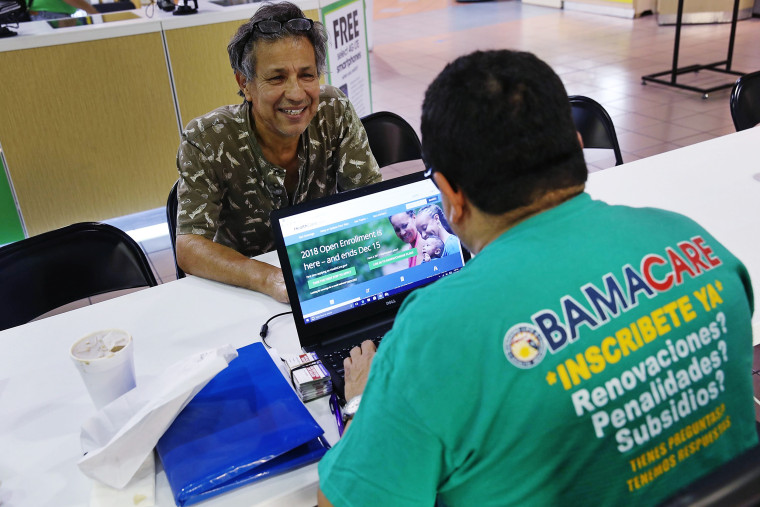
Image: People Sign Up For Health Care Coverage Under The Affordable Care Act During First Day Of Open Enrollment

ASHINGTON — After congressional Republicans repeatedly failed last year to repeal the Affordable Care Act, President Donald Trump promised to “let Obamacare implode” on its own.

A new lawsuit being filed Thursday argues that Trump’s efforts to make good on that promise violate the U.S. Constitution.

Trump has “waged a relentless effort to use executive action alone to undermine and, ultimately, eliminate the law,” the complaint charges, according to a draft obtained by NBC News. The lawsuit is being filed in Maryland federal court by the cities of Baltimore, Chicago, Cincinnati and Columbus, Ohio.

Since Trump’s first executive order directing federal agencies to claw back as much of the Affordable Care Act as possible, his directives have increased health coverage costs and depressed enrollment, the complainants say.

Specifically, the suit argues that Trump is violating Article II of the Constitution, requiring the president to “take care that the laws be faithfully executed.”

“There’s a clear case of premeditated destruction of the Affordable Care Act,” said Zach Klein, Columbus city attorney.

This includes making it easier for individuals and trade groups to purchase coverage outside the law’s insurance markets; threatening to eliminate cost-sharing reduction payments; cutting funding for “navigators,” or those who help individuals enroll in the program; and using federal funds Congress dedicated to implementing the law toward making videos criticizing it.

On Wednesday, Health and Human Services Secretary Alex Azar announced a plan for cheaper, short-term insurance plans, the latest example of actions that critics say will drive up costs on Obamacare exchanges.

During a call-in appearance on Rush Limbaugh’s radio show Wednesday, Trump took credit for all but ending the Affordable Care Act.

“I have just about ended Obamacare. We have great health care,” he said. “We have a lot of great things happening right now. New programs are coming out.”

The suit also relies on a list of Trump’s tweets indicating his intent to unravel the law, according to a lawyer involved in the case.

Constitutional scholars have long debated the extent to which the chief executive must “faithfully” execute U.S. laws under Article II — from Franklin Roosevelt’s objections to legislative veto provisions and Harry Truman’s seizure of steel mills.

Citing the same “take care” clause, Republicans took issue with President Barack Obama’s executive orders on immigration as well as his delayed implementation of the health law.

This case stands apart from all others, says Abbe Gluck, a Yale University law professor and expert on Article II, because it’s not about the extent to which Trump is “faithfully” implementing a law. Rather Trump has been frank that he is sabotaging the law, she said.

“That’s what makes this case novel, first of its kind and really important,” Gluck said. “No scholar or court has ever said the president can use his discretion to implement a statute to purposely destroy it.”

“If there’s ever going to be a violation of the ‘take care’ clause, this is it,” she said.

If successful, the suit would strike down aspects of a Trump rule designed to undercut insurance markets; render a judgment he’s violating his constitutional obligation to enforce the statute; and issue an injunction that he implement the law faithfully.

LOCAL IMPACT

The suit also cites Trump scaling back oversight of insurance issuers, cutting open enrollment in half, urging a federal court to throw out Obamacare’s protections for pre-existing conditions and undermining the individual mandate.

All of these actions, they say, undercut confidence in the program and enrollment, the keys to its success. The whole concept of insurance, whether it’s for cars, homes or people, is to minimize risk by creating a diverse pool — in this case of healthy and unhealthy, young and old participants.

John Yoo, a law professor at the University of California, Berkeley, and former Bush Justice Department official, said a president can’t refuse to enforce a law just because he disagrees with it.

Still, Obamacare was written in a way that gives great leeway to the executive, said Yoo.

“Is there something specific in the statute that he is refusing?” he said, adding that funding reductions don’t qualify. “That’s the constitutional standard,” said Yoo.

In 2017, there was a 37 percent average increase in premiums nationwide, and 3 million more people lacked health insurance than did in 2016. In Columbus, city-subsidized health centers saw almost 3,000 more uninsured patients in 2017. As the uninsured rate increases, Columbus must also pay more for ambulance transports, draining millions of dollars from localities.

“The accumulation of these (acts) has cost Americans thousands of dollars more, and it was done in a way that can be clearly traced” to Trump’s orders, said Andy Slavitt, former acting administrator of the Centers for Medicare and Medicaid under Obama.

The budget strain is also hampering efforts to address the opioid crisis. Ohio has the second-highest drug overdose death rate, according to the Centers for Disease Control and Prevention, with the city of Columbus averaging nine or 10 Naloxone administrations a day to prevent deaths.

“The time for criticism is over,” Klein said. “We have no ability to recoup that money. We just have to eat it due to the Trump administration’s efforts to sabotage the law.”

HEALTH CARE POLITICS

The plaintiffs deny politics play a role in the timing of the suit, which they say they have been building for the past year.

But it will likely serve as a reminder to voters of Trump’s hand in rising premiums just as they are set to skyrocket. Trump’s 2016 campaign platform was built in part on greater economic security for working-class Americans.

Insurance companies are hiking rates in the individual market, citing decisions being made in Washington. And premiums are set to surge in 2019, with a majority of states proposing increases over and above the previous year.

After several elections in which Republicans used Obamacare to attack Democrats, the party says it’s regained the advantage on the health care issue. In the past few years, the Republican-led Congress has voted dozens of times to try and repeal the law, failing each time. “People got to see they (the GOP) have no better alternative,” said Slavitt.

“Most Democrats are saying ‘look we never said the ACA is perfect, but the other person is trying to take away your coverage,” said Slavitt.

Trump’s former Health and Human Services Secretary Tom Price has also faulted Congress’s repeal of the individual mandate for coming premium increases. Further, Trump’s Justice Department is taking aim at Obamacare’s most popular provisions: a ban on insurance companies’ discriminating against individuals with pre-existing conditions.

CONSTITUTIONAL OBLIGATION

The suit seeks to force Trump to adopt policies intended to expand rather than shrink enrollment; reduce rather than increase premiums; and promote instead of attack the ACA.

Among the specific rules plaintiffs seek to reverse are allowing exchanges to strip individuals of tax credits without notification and reducing oversight of insurance agents and brokers, as well as oversight of the law in general.

“What’s insidious here is the administration is doing it knowing that confidence in the act is key to its success,” said Adam Grogg, senior counsel at Democracy Forward and the lead litigator on the case. The fewer Americans who enroll in the program, the more volatile the market, he said.

“The overall picture here is one of sabotage that drives up the rates of uninsured and underinsured and leaves cites and counties holding the bag,” Grogg said.

Four cities are charging that the president is failing to execute the law by actively undercutting the Affordable Care Act.


CMS Adminstrator dismisses Affordable Care Act

CMS Adminstrator dismisses Affordable Care Act

Image result for 2018 midterm elections


About 1.4 million Californians buy coverage through the state’s Obamacare exchange, Covered California, and nearly 4 million have joined Medicaid as a result of the program’s expansion under the law.

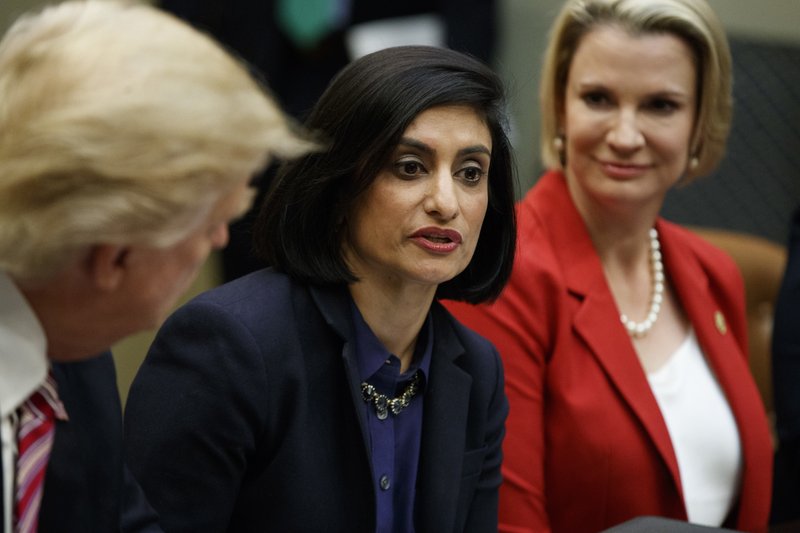
Stepping into the land of the Trump resistance, Seema Verma flatly rejected California’s pursuit of single-payer health care as unworkable and dismissed the Affordable Care Act as too flawed to ever succeed.

Speaking Wednesday at the Commonwealth Club here, the administrator of the Centers for Medicare & Medicaid Services said she supports granting states flexibility on health care but indicated she would not give California the leeway it would need to spend federal money on a single-payer system.

“I think a lot of the analysis has shown it’s unaffordable,” Verma said during a question-and-answer session following her speech. “It doesn’t make sense for us to waste time on something that’s not going to work.”

During her speech, Verma issued a broader warning to advocates pushing for a Medicare-for-all program nationally. She said that “socialized” approach to medicine would endanger the program and the health care it provides for millions of older Americans.

“We don’t want to divert the purpose and focus away from our seniors,” Verma said in the address before more than 200 people. “In essence, Medicare for all would become Medicare for none.”

Single-payer has emerged as a key issue in the California governor’s race this year. The current front-runner for governor, Gavin Newsom, a Democrat and the current lieutenant governor, has vowed to pursue a state-run, single-payer system for all Californians if elected in November. Many California lawmakers have endorsed that idea as the next step toward achieving universal coverage and to tackling rising costs.

California has enthusiastically embraced the Affordable Care Act, and state leaders have struggled with — and even bucked — the Trump administration on a variety of health-policy fronts. The state stands to lose more than any other if the Trump administration is successful in further dismantling the ACA.

About 1.4 million Californians buy coverage through the state’s Obamacare exchange, Covered California, and nearly 4 million have joined Medicaid as a result of the program’s expansion under the law.

Verma wields enormous power as head of CMS, overseeing a $1 trillion budget. The agency sets policy for Medicare, Medicaid and the federal insurance exchanges under the ACA.

The landmark health law, she said, was so flawed it could not work without further action from Congress.

“It wasn’t working when we came into office and it continues not to work,” Verma said, responding to a question from moderator Mark Zitter, founder of the Zetema Project, a nonprofit organization that promotes debate on health care across partisan lines. “The program is not designed to be successful.”
Zitter billed the event as a rare chance for Californians to hear directly from a top Trump administration official, although Verma’s remarks broke little new ground, he said.

Trump health care policies figure into many of California’s congressional races this fall in which incumbent Republicans are fending off Democratic challengers. And in court, California Attorney General Xavier Becerra is leading a coalition of attorneys general who are defending the constitutionality of the ACA in a Texas case with national implications.

The Trump administration has sided with the officials waging the lawsuit, choosing not to defend the health law’s protections for people with preexisting conditions. Separately, the administration has backed work requirements for many people on Medicaid.

Short
California’s state Senate passed a law in May banning such requirements as a condition for eligibility in Medi-Cal, the state’s Medicaid program. The bill is pending in the state Assembly.

“Making health insurance coverage contingent on work requirements goes against all we’ve worked for here in California,” state Sen. Ed Hernandez (D-West Covina), author of SB 1108, said in May.

State lawmakers also are considering bills that would limit the GOP-backed sale of short-term health policies and prevent people from joining association health plans that don’t have robust consumer protections.

In an interview after the speech, Verma criticized those legislative efforts in California because they would limit consumer choice.
“Any efforts to thwart choice and competition and letting Americans make decisions about their health care is bad health policy,” she said.

Peter Lee, executive director of Covered California, the state’s ACA marketplace, has criticized the Trump administration for promoting those cheaper, skimpier policies as an alternative to ACA-compliant plans. He said he fears consumers will be harmed by “bait-and-switch products” that don’t provide comprehensive benefits.

“There have been a series of policies from Washington that have the effect of raising costs, particularly for middle-class Americans, and pricing them out of coverage,” Lee said in an interview last week. “This is not a failure of the ACA. This is entirely happening since the new administration.”

Most of Verma’s speech in San Francisco focused on Medicare. She outlined a number of initiatives designed to strengthen the program and protect taxpayers from ballooning costs. After the speech, CMS announced proposed changes to Medicare payment policies for outpatient care that could yield savings for the government and patients.

In her remarks, Verma reiterated the Trump administration’s efforts to reduce prescription drug prices, improve patients’ access to their own medical records and eliminate burdensome regulations on doctors and other medical providers.

Verma received a polite round of applause at the beginning and end of her appearance.


CMS’ proposed outpatient payment rule for 2019: 10 things to know

https://www.beckershospitalreview.com/finance/cms-proposed-outpatient-payment-rule-for-2019-10-things-to-know.html

Related image


CMS released its 2019 Medicare Outpatient Prospective Payment System proposed rule July 25, which calls for site-neutral payments and would make changes to the 340B program.

Here are 10 things to know about the 2019 proposed rule:

Payment update

1. CMS proposed increasing the OPPS rates by 1.25 percent in 2019. The agency arrived at its proposed rate increase through the following updates: a positive 2.8 percent market basket update, a negative 0.8 percentage point update for a productivity adjustment and a negative 0.75 percentage point adjustment for cuts under the ACA.

Site-neutral payment proposal

2. Under the proposed rule, CMS would make payments for clinic visits site-neutral by reducing the payment rate for hospital outpatient clinic visits provided at off-campus provider-based departments to 40 percent of the OPPS rate. The clinic visit is the most common service billed under the OPPS, and CMS estimates the payment proposal would save the Medicare program and Medicare recipients a combined $760 million in 2019.

3. This change is projected to reduce OPPS payments by 1.2 percent, which would largely offset the 1.25 percent payment rate increase under the proposed rule.

Proposed 340B program changes

4. CMS scaled back the 340B drug discount program in 2018, and the agency proposed additional cuts for next year.

5. On Jan. 1, 2018, CMS began paying hospitals 22.5 percent less than the average sales price for drugs purchased through the 340B program. That’s compared to the previous payment rate of average sales price plus 6 percent.

6. Under the proposed rule, CMS would extend the average sales price minus 22.5 percent payment rate to 340B drugs provided at nonexcepted off-campus provider-based departments.

7. CMS also proposed to pay for separately payable biosimilars acquired under the 340B program at the average sales price minus 22.5 percent of the biosimilar’s own ASP, rather than ASP minus 22.5 percent of the reference product’s ASP.

Hospital Outpatient Quality Reporting Program changes

8. For 2019, CMS proposed removing one measure from the Hospital Quality Reporting Program beginning with the 2020 payment determination and removing nine other measures beginning with the 2021 payment determination.

9. “The proposals to remove these measures are consistent with the CMS’ commitment to using a smaller set of more meaningful measures and focusing on patient-centered outcomes measures, while taking into account opportunities to reduce paperwork and reporting burden on providers,” CMS said in the fact sheet for the proposed rule.

Comment period

10. CMS will accept comments on the proposed rule until 5 p.m. EST Sept. 24.


House passes bills to expand HSAs, delay health insurance tax

https://www.fiercehealthcare.com/payer/house-passes-bills-to-expand-hsas-delay-health-insurance-tax?mkt_tok=eyJpIjoiTldSak16YzRNMk16WkRReiIsInQiOiJxSDc3cTV3bUNJbkxxOW5yVlBob2FOcEhOUFlnZkxoRHVaSFgyZ1RHZWs5K0V1S2hWYVZtRFJqSnBXcURCeDhKVWU1OEYxTHZUQ2d4ajdUQU9pRlZmYzNmNmJmUzFPMGVtb21jT1wvbnl0clNHRERaTUh4U0dTNTVzQTY4SXJ3c2QifQ%3D%3D&mrkid=959610

congress

The House of Representatives passed a pair of bills on Wednesday that would loosen regulations around health savings accounts and delay the health insurance tax for two years.

The Restoring Access to Medication and Modernizing Health Savings Accounts Act (H.R. 6199) passed 277-142. The legislation would give plans additional flexibility to cover services before a deductible is met. It would also permit spouses to contribute to an HSA and allow members to purchase over-the-counter drugs.

The Increasing Access to Lower Premium Plans and Expanding Health Savings Accounts Act of 2018 (H.R. 6311), which passed 242-176, would increase the amount beneficiaries can contribute to an HSA. But it also includes provisions to add catastrophic or “copper” plans to the ACA exchanges.

Additional solutions to strengthen Health Savings Accounts will provide Americans with more choices, more control and better flexibility to invest their healthcare dollars in ways that best fit their personal needs,” AHIP president and CEO Matt Eyles said in a statement.

H.R. 6311 also includes a two-year delay on the health insurance tax, something insurers have pushed against for some time. In an earnings call last week, UnitedHealth Group CEO David Wichmann said the insurer was advocating for a “delay or outright repeal of the insurance tax” which he claimed would drive up premiums.

In 2015, the most recent year the tax was in effect, insurers lost about $11 billion.

“Providing another temporary reprieve, as work continues to fully repeal this harmful tax, will help reduce premiums for families, small business owners, seniors and states,” Eyles said.

HSAs have been largely supported by Republicans, although some bipartisan bills have sought to use high-deductible plans and HSAs to improve chronic disease treatment. HSAs combined with high-deductible plans have seen steady growth over the last several years, increasing more than 400% since 2007, according to AHIP.

Critics have pointed out that HSAs don’t work well for low-income individuals who don’t have the money to put into an HSA.
On Thursday, following a speech at the Heritage Foundation, Department of Health and Human Services Secretary Alex Azar lauded the use of HSAs as a way to involve consumers in their care.

“We are very supportive of efforts to strengthen HSAs to allow more money to be put in there, to enable the HSA money to be used for more preventive services, and to expand the reach of those,” he said. “I think it’s a critical counterpart to high-deductible plans and a critical element to how we bring that kind of consumerism to a third-party payer system.”


Poll reveals partisan divide among consumers on healthcare policy priorities

https://www.fiercehealthcare.com/regulatory/bipartisan-policy-center-health-reform-insurance-coverage-single-payer-markets?mkt_tok=eyJpIjoiTldSak16YzRNMk16WkRReiIsInQiOiJxSDc3cTV3bUNJbkxxOW5yVlBob2FOcEhOUFlnZkxoRHVaSFgyZ1RHZWs5K0V1S2hWYVZtRFJqSnBXcURCeDhKVWU1OEYxTHZUQ2d4ajdUQU9pRlZmYzNmNmJmUzFPMGVtb21jT1wvbnl0clNHRERaTUh4U0dTNTVzQTY4SXJ3c2QifQ%3D%3D&mrkid=959610

congress

Many healthcare consumers want the federal government to control costs.
But they also have serious reservations about the typical levers policymakers would need to pull to do so.

Morning Consult polled (PDF) more than 2,200 adults on behalf of the Bipartisan Policy Center (BPC) and found that 37% want the government to play a greater role in regulating the price of healthcare goods and services, while 21% believe the government should have more power to set healthcare prices.

However, just 13% were in favor of increased Medicare taxes, raising the Medicare eligibility age from 65 to 67 or reducing benefits required in Affordable Care Act plans—all key ways the government can achieve lower costs in that program.

The Bipartisan Policy Center’s Expert Panel on the Future of Health Care crafted a set of guiding principles for lawmakers to use in building future healthcare policy, including:

Everyone should have useful and affordable health insurance, whether through a public payer or a private insurer.
Reforms should be built so as to avoid major disruptions to consumer access.

Stable insurance markets are crucial. Policies must target “excessive and unnecessary” cost growth.
Reforms must have long-term stability, both politically and financially.

The split, experts said, reflects consumer frustration and misunderstanding of a complex, expensive and fragmented healthcare system, said Sheila Burke, a BPC fellow and strategic adviser at the law firm Baker, Donelson, Bearman, Caldwell & Berkowitz.

“I think what we see in the mix of systems reflects that confusion,” Burke said at an
event hosted by the center on Wednesday.

Burke was one of 10 people recruited by BCP for its Expert Panel on the Future of Health Care, which aims to build a bipartisan framework that legislators can use to build future healthcare policy. Other members include former Centers for Medicare & Medicaid Services Acting Administrator Andy Slavitt and former Senate majority leaders Tom Daschle and Bill Frist.

The poll results are another element the panel members said legislators can use when taking aim at healthcare reform.

The respondents were also divided by political party, and the survey found a notable split in what people on each side of the aisle view as healthcare reform priorities. Close to half (43%) of Democrats said that ensuring everyone has access to insurance is a main priority, compared to 14% of Republicans.

Meanwhile, 25% of Republicans said Congress should focus on lowering premiums, and 24% said it should look at ways to reduce the role of government in healthcare. Just 13% and 5% of Democrats, respectively, said the same.

Daschle said at the event that while the panel’s focus was on federal reform, the real energy to address healthcare reform may be at the state level. As the federal government flounders on healthcare, states are likely to step in and innovate, he said.
“The more dysfunctional Washington is, the more states pick up the slack,” he said.
The federal government should set guardrails and guidelines for that state innovation, though, Daschle said.


Trump’s top Medicare official slams ‘Medicare for All’

https://apnews.com/a69f5ada0db24ada9bc5bd8a44604f3b

The Trump administration’s Medicare chief on Wednesday slammed Sen. Bernie Sanders’ call for a national health plan, saying “Medicare for All” would undermine care for seniors and become “Medicare for None.”

The broadside from Medicare and Medicaid administrator Seema Verma came in a San Francisco speech that coincides with a focus on health care in contentious midterm congressional elections.

Sanders, a Vermont independent, fired back at Trump’s Medicare chief in a statement that chastised her for trying to “throw” millions of people off their health insurance during the administration’s failed effort to repeal the Affordable Care Act.

Verma’s made her comments toward the end of a lengthy speech before the Commonwealth Club of California, during which she delved into arcane details of Medicare payment policies.

Denouncing what she called the “drumbeat” for “government-run socialized health care,” Verma said “Medicare for All” would “only serve to hurt and divert focus from seniors.”

“You are giving the government complete control over decisions pertaining to your care, or whether you receive care at all,” she added.

“In essence, Medicare for All would become Medicare for None,” she said. Verma also said she disapproved of efforts in California to set up a state-run health care system, which would require her agency’s blessing.

In his response, Sanders said that “Medicare is, by far, the most cost-effective, efficient and popular health care program in America.

He added: “Medicare has worked extremely well for our nation’s seniors and will work equally well for all Americans.”

The Sanders proposal would add benefits for Medicare beneficiaries, coverage for eyeglasses, most dental care, and hearing aids. It would also eliminate deductibles and copayments that Medicare and private insurance plans currently require.

Independent analyses of the Sanders plan have focused on the enormous tax increases that would be needed to finance it, not on concern about any potential harm to seniors currently enrolled in Medicare.

But so-called “Mediscare” tactics have been an effective political tool for both parties in recent years, dating back to Republican Sarah Palin’s widely debunked “death panels” to fan opposition to President Barack Obama’s health care overhaul. Democrats returned the favor after Republicans won control of the House in 2010 and tried to promote a Medicare privatization plan.

Democrats clearly believe supporting “Medicare for All” will give them an edge in this year’s midterm elections.

More than 60 House Democrats recently launched a “Medicare for All” caucus, trying to tap activists’ fervor for universal health care that helped propel Sanders’ unexpectedly strong challenge to Hillary Clinton for the 2016 Democratic presidential nomination. Just a few years ago, Sanders could not find co-sponsors for his legislation.

A survey earlier this year by the Kaiser Family Foundation and The Washington Post found that 51 percent of Americans would support a national health plan, while 43 percent opposed it. Nearly 3 out of 4 Democrats backed the idea, as did 54 percent of independents. But only 16 percent of Republicans supported the Sanders approach.

Early in his career as a political figure, President Donald Trump spoke approvingly of Canada’s single-payer health care system, roughly analogous to Sanders’ approach. But by the 2016 presidential campaign Trump had long abandoned that view.


Medicare option is popular but vague among Democrats

https://www.axios.com/democrats-single-payer-public-option-health-care-1532047129-3b97bb26-f2ff-407a-af5b-6821981b6e45.html

A public health care plan — once deemed too liberal to make it into the Affordable Care Act — is now the more moderate position for many Democrats who are uncomfortable with the party’s rapid embrace of “Medicare for All.”

Yes, but: Democrats haven’t decided yet what a public option should look like.

Show less
“In some ways, a public option or buy in to Medicare or Medicaid has become a place for Democrats uncomfortable with single payer to land.”
— Larry Levitt, Kaiser Family Foundation

Driving the news: Members of Congress have now introduced as many as five bills expanding government involvement in health care, as Vox has reported. A public option is also coming up frequently on the campaign trail, either as a step toward “Medicare for All” or as a policy goal in and of itself.

  • In Iowa’s third district, which is rated as a toss-up, Democrat Cindy Axne is running on a public option “that allows Americans to choose between Medicare or Medicaid.”
  • In New Jersey’s third district, another toss-up, Democrat Tom Malinowski supports creating a universal Medicare option that people could buy into.
  • “I think the much more plausible path to a single payer health care system is through a public option. I just don’t know that the country is ready to support a bill that outlaws private insurance,” said Sen. Chris Murphy, a sponsor of one of the public option plans.

Flashback: A public option for the individual market was almost included in the Affordable Care Act, but former Sen. Joe Lieberman blocked it.

  • “It was too liberal for Joe Lieberman” — not for the entire party — back in 2009, Democratic Minority Whip Dick Durbin told me. “We had 60 votes and he said he wouldn’t vote for it. That was the end of that.”
  • “You may have more people today supporting single payer, Medicare for All than 10 years ago, but I’m not sure that the floor has moved as much as the ceiling has,” Murphy said.

The big question: Some Democrats want a public option to be offered in the employer market in addition to the individual market.

  • “Now, a public option for just the individual market would likely be unsatisfying to single payer supporters, providing no relief from health care costs for the much larger number of people with employer coverage,” Levitt said.

The details: A central tenet of adopting a public option is using the government’s purchasing power to bring down underlying health care prices.

  • “The common denominator of all Democrats is that they want more affordable options for people, and how broadly you apply to tool depends on how broadly you define the problem right now,” said Chris Jennings, a Democratic health care consultant.
  • “Lurking behind the public option discussion is really the issue of health care prices. A public option of any kind would use the leverage and regulatory power of the government to get lower prices for health care,” Levitt said.
  • But determining how far to go would be tricky and comes with risk.
  • “There is some room to put some downward pressure on provider prices without having significant adverse consequences on access to care or quality of care, but the big question is how much,” said Aviva Aron-Dine of the left-leaning Center on Budget and Policy Priorities.