Healthcare CEOs: Senate healthcare bill would have dire consequences

http://www.healthcarefinancenews.com/news/healthcare-ceos-senate-healthcare-bill-would-have-dire-consequences?mkt_tok=eyJpIjoiWkRZMVlqUTNZVE13WVRreCIsInQiOiJEOTJKXC9BRnluY1JjdkVVc0kwSlhFMGx5dmc4cnpDeW1GZGtsT25WOUFiSFdSeDdtYW1yNmRoQ2NQZk1vMnZheXJRUkQ3bW0xZzVNbkR4ZXBKNEFqR3ZOWCtYMFAwb3dlckZjVlFxc2tlWFJpYUY0SnIwc0doRVJYUFpSTkc4SEkifQ%3D%3D

Cleveland Clinic, Kaiser, NewYork-Presbyterian executives are all concerned over the Senate’s bill.

Healthcare CEOs made the rounds of news shows in this week to air their grievances with the Better Care Reconciliation Act, the Senate GOP bill intended to replace Obamacare.

The American Hospital AssociationAmerican Medical Association, AARP, and several other organizations have registered their opposition to the proposed bill.

But, it’s healthcare CEOs who are working to mitigate the anticipated changes who are anticipating how the proposed legislation would affect their organizations.

Among healthcare chief executives weighing in on the topic in recent days are Cleveland Clinic CEO Toby Cosgrove, MD, New York Presbyterian CEO Steven J. Corwin, MD, and Kaiser Permanente CEO Bernard Tyson.

Cleveland Clinic CEO Toby Cosgrove

With the anticipated greater numbers of uninsured patients coming into hospitals, “you’re going to have hospitals that are in very deep financial trouble,” Cosgrove told CNBC’s “Squawk Box” on Wednesday. “And this is particularly true of rural hospitals and safety net hospitals, which are very dependent on Medicare and Medicaid for their returns.”

As he sees it, legislators are not looking at the “root cause of the problem.” It’s not how you divide the money,” he said. “The problem really is the rising cost of healthcare.”

“I think if we came together and dealt with the root cause there’d be plenty of money to go around to look after people,” Cosgrove said. “But if we don’t deal with it now, we’re going to have the same problem going 10 years from now.”

“We’re really headed in the wrong direction,” Cosgrove said. We’re talking about payment reform; we’re not talking healthcare reform.”

Kaiser Permanente CEO Bernard J. Tyson

Bernard J. Tyson, chairman and CEO of Oakland, Calif.-based Kaiser Permanente, wrote in a LinkedIn post that although the ACA – also known as Obamacare – is an imperfect legislation, future healthcare reform must build on its progress, rather than undo it.

“We need to pause and ask policymakers to answer the most fundamental question: What does progress on healthcare look like for the people in America?”

In his view, it should cover more people, not fewer people; be affordable.

Without question, we must make healthcare more affordable; provide the best quality of care and best health outcomes.

Tyson points out that the U.S. has among the poorest health outcomes compared to the other developed nations. The healthcare industry can improve quality if “we commit to moving from a predominantly ‘sick care,’ episodic, fee-for-service model to a predominantly preventive model with incentives for value, integrated care and, most important, keeping people healthy.”

“The draft bill does not expand coverage; it does not do enough to protect people in need of care, nor does it provide enough assistance to those who need help in paying for health care and coverage,” he writes.

NewYork-Presbyterian CEO Steven J. Corwin

Speaking to Bloomberg on Tuesday, Steven J. Corwin, CEO of NewYork-Presbyterian said, “Just remember this: One in three children in this country is insured by Medicaid. One in three.”

Corbin noted that two-thirds of the expense of Medicaid are for people who are in nursing homes.

“So, you can work all your life, be a grandma, or ma, and then go through your assets, and then you have to be on Medicaid to go into a nursing home,” he said. “This is going to be devastating to so many people.”

Asked whether he would prefer having something concrete done in Congress or just see the proposed bill go away, Corbin said: “I’d like to see it go away. And, I’d like to see the Medicaid expansion remain, and I’d like to see the insurance market stabilized.”
 

What a Trump Presidency Means for Value-Based Care and the ACA

https://revcycleintelligence.com/features/what-a-trump-presidency-means-for-value-based-care-and-the-aca?elqTrackId=b434f9c1bb9342b9a07ae438e60e0219&elq=235b6caa09e94e4eb4db871c5d4f6292&elqaid=2897&elqat=1&elqCampaignId=2683


The future of the Affordable Care Act is up for debate after Donald Trump’s surprise victory, but value-based care is likely to remain a guiding force in the healthcare industry.

Love it or loathe it, the United States is headed for four years of drastic policy changes under a Donald Trump administration, giving lawmakers another good chance to repeal, replace, or revise the Affordable Care Act.

The landmark healthcare legislation was the centerpiece of one of the most contentious campaigns in American history.  Staring down anticipated premium hikes of up to 25 percent on the public health insurance exchanges, millions of concerned citizens voted for the candidate they felt was most likely to make positive changes to a system that has never quite managed to address their needs.

The impact of a Republican Congressional majority, a Republican President, and a vacant seat on a Supreme Court that already struck down one of the ACA’s major provisions is as of yet unknown, but a conservative twist to our national drama will certainly bring the future of the healthcare coverage framework into question.

For healthcare provider organizations, the plot will thicken even further.  Thanks to provisions that require payers to cover patients with preexisting conditions and adhere to premium caps that have reduced their profitability, the ACA has incentivized a quick shift towards value-based care.

Eager to trim costs, pay for fewer services, and attract as many patients as possible in a competitive and confusing marketplace, payers have incentivized providers to abandon the traditional fee-for-service reimbursement structure and look to population health management strategies as a way to stem the financial bleeding.

Will significant changes to the Affordable Care Act free up payers to return to more lucrative business practices, or will commercial insurers, Medicare, and Medicaid stay the course?

How can healthcare providers position themselves for success in what will undoubtedly be another turbulent episode in the healthcare saga, and what are the nation’s options for developing a new path forward while still delivering the best possible care to its patients?

Warren Buffett calls ObamaCare repeal bill ‘Relief for the Rich Act’

http://thehill.com/policy/healthcare/339799-warren-buffett-obamacare-repeal-bill-should-be-called-relief-for-the-rich?utm_content=buffer25d18&utm_medium=social&utm_source=facebook.com&utm_campaign=buffer

Warren Buffett calls ObamaCare repeal bill ‘Relief for the Rich Act’

Warren Buffett is attacking the Republican Party’s plans to repeal and replace ObamaCare, claiming bills in the House and Senate would provide tax cuts for the rich.

Legislation passed by the House, he said, should be called “Relief for the Rich Act.”

Buffett, one of the wealthiest men in the country, claimed his tax bill would have been reduced by $679,999, or 17 percent, from the House bill.

“There’s nothing ambiguous about that. I will be given a 17 percent tax cut. And the people it’s directed at are couples with $250,000 or more of income. You could entitle this, you know, Relief for the Rich Act or something,” he said in an interviewwith PBS.

Buffett made the comments are a question about the GOP plan to do away with an ObamaCare surcharge on people earning a higher income.

Buffett also suggested that the bill would give many lawmakers a tax cut.

The annual salaries for lawmakers are much lower, he noted, at around $174,000 a year.

“But most of them have — if you look at the disclosures, they have substantial other income,” he said.

“If they get to higher than $250,000, as a married couple, or $200,000 as a single person, they have given themselves a big, big tax cut, if they — if they voted for this.”

The Senate on Tuesday decided to delay action on their draft healthcare bill until after the July 4 recess following criticism from conservatives and centrists in the conference.

What we know about Senate health care bill 2.0

https://www.axios.com/what-we-know-about-the-senate-health-care-bill-2-0-2450356848.html

Image result for aca repeal

Majority Leader Mitch McConnell is trying to wrangle members from opposite ends of the Republican caucus together to support some revised version of the Senate health care bill, offering both moderates and conservatives new policies to shore up support for the bill.

On the table: More funding to fight the opioid epidemic, revised health savings account policies, potentially getting rid of the repeal of the net investment tax on the wealthy.

Off the table: Undermining pre-existing conditions protections, which could happen indirectly under a plan Sen. Ted Cruz is pushing,

What we’re hearing:

  • There’s a push to include as much as $45 billion in funding for the opioid crisis, up from $2 billion under last week’s bill. This would be a win for moderates like Sens. Rob Portman and Shelley Moore Capito.
  • There’s also an effort to add more funding to the state stabilization fund, and to make the funding available sooner to states.
  • There will likely be a provision allowing health savings accounts to be used for premiums. This is a win for conservatives, and could help middle-class people afford their premiums. One aide said the price tag could be around $60 billion, as it would result in lost tax revenue. (HSA contributions aren’t taxed.)
  • There’s chatter about removing a repeal of the Affordable Care Act’s 3.8 percent investment tax, which benefits wealthy people. This would free up some extra funding to help coverage levels, and would also help combat the narrative that the bill cuts coverage for the poor to give money to the wealthy.

What’s becoming a big problem: Cruz is pushing to allow insurers offering ACA-compliant plans to also offer non-compliant plans, which wouldn’t be required to meet the ACA’s pre-existing conditions protections or other insurance regulations. Cruz wants to include that in the revised bill to cut the cost of individual insurance, and says sick people could still get subsidies that would protect them from premium hikes.

But that’s off the table, senior GOP aides say, because most Republican senators have already decided they don’t want to undermine the ACA’s pre-existing condition protections in any way.

Hospitals Attack GOP Health Bill in $1 Million Ad Campaign

https://www.bloomberg.com/news/articles/2017-06-27/hospitals-attack-gop-health-bill-in-1-million-new-ad-campaign

Image result for american hospital association

Powerful hospital and medical school lobbying groups are spending at least $1 million on television ads opposing Senate Republicans’ plan to repeal and replace Obamacare.

The ads ask viewers to consider whether they’ll be among the millions of Americans projected to lose their health coverage under the Senate proposal, Rick Pollack, chief executive officer of the American Hospital Association, said Tuesday in a conference call with reporters.

The bill, which Republicans have put on hold until after the July 4 recess amid growing opposition within their own party, would leave an additional 22 million people in the U.S. without insurance, the non-partisan Congressional Budget Office estimated. Hospitals have a lot to lose under the current version of the bill, and the AHA, which represents about 5,000 institutions, last week told GOP senators to “go back to the drawing board.”

It’s the second time that the coalition will run ads opposing Republicans’ attempts to replace the Affordable Care Act, often called Obamacare. The group also ran ads opposing the House’s health bill, which passed in May. The House proposal would also increase the number of uninsured by more than 20 million, according to the CBO.

Samantha Dean, a spokeswoman for the AHA, said the campaign’s ads have already begun running and will cost seven figures. She wouldn’t give a precise amount.

The advertisements will continue to run “for as long as needed,” Dean said.

Analysis: Mitch McConnell Plans To Hide Trumpcare’s Pain Until After Midterms

http://www.healthleadersmedia.com/technology/analysis-mitch-mcconnell-plans-hide-trumpcare%E2%80%99s-pain-until-after-midterms?spMailingID=11361778&spUserID=MTY3ODg4NTg1MzQ4S0&spJobID=1182449350&spReportId=MTE4MjQ0OTM1MAS2

Image result for medicaid cuts

The Better Care Reconciliation Act bill may make the health insurance markets look better almost immediately by giving insurers a more predictable, more lucrative market.

Senate Majority Leader Mitch McConnell is well aware of the political peril of taking health benefits away from millions of voters. He also knows the danger of reneging on the pledge that helped make him the majority leader: to repeal Obamacare.

Caught between those competing realities, McConnell’s bill offers a solution: go ahead and repeal Obamacare, but hide the pain for as long as possible. Some of the messaging on the bill seems nonsensical (see: the contention that $772 billion squeezed out of Medicaid isn’t a cut). But McConnell’s timetable makes perfect sense — if you are looking at the electoral calendar.

Here are a few key dates in McConnell’s “Better Care Reconciliation Act” (BCRA) that seem aimed more at providing cover for lawmakers than coverage for Americans:

2019: First major changes and cuts to the Affordable Care Act exchanges happen after the 2018 midterm cycle, allowing congressional Republicans to campaign on a “fixed” health system, even though Obamacare is still largely in place next year.

2019: States share $2 billion in grants to apply for waivers under a much looser process through this fiscal year. These waivers could allow insurers to sell skimpy plans that have low price tags but don’t take adequate care of people with preexisting conditions. None of those waivers has to go into effect, however, until after 26 Republican governors face re-election in 2018.

2020: Stabilization cash that makes the markets more predictable and fair for insurers flows through the congressional midterm cycle and the 2020 presidential cycle. Then it disappears. Medicaid expansion funds hold steady through this crucial political window, too.

2024: States enjoy their last few sips of Medicaid expansion cash at the end of 2023 — just as, perhaps, a second Republican presidential term is ending.

2025: The bill changes the formula for the entire Medicaid budget (not just the Obamacare expansion), dramatically reducing federal funding over time. That starts eight years and two presidential election cycles from now.

McConnell insists everything about the bill has been aboveboard and transparent.

“Nobody’s hiding the ball here. You’re free to ask anybody anything,” McConnell said on June 13.

But he and his working group did literally hide the bill from Democrats and most Republicans, crafting it behind closed doors until there was just a week left before his goal to secure a vote on it. (That timing was thrown off Tuesday with the announcement the vote was delayed, but the dealmaking is just beginning.)

Meanwhile, at least two policy details in the bill may obscure the effects for several years and make the health insurance markets look better almost immediately by giving insurers a more predictable, more lucrative market.

One is a stipulation that compels the federal government, for two years, to pay the cost-sharing reduction payments to insurance companies that President Donald Trump has threatened to end. The payments are part of the Affordable Care Act, and they flow to insurers on behalf of low-income marketplace customers to cover their out-of-pocket health expenses. Republicans had sued to stop the payments, adding considerable instability to ACA marketplaces next year. McConnell ends that uncertainty for two years.

On top of that cash infusion, the BCRA proposes a “Short-Term Stabilization Fund” that would also aim to help lower premium costs and could attract a few more insurers into counties that are sparsely covered now. It would dish out $50 billion to insurers — $15 billion per year in 2018 and 2019 and $10 billion per year in 2020 and 2021.


Medicaid: Welfare or Health Insurance?

https://www.axios.com/the-great-medicaid-divide-2445011303.html

Image result for Republicans see Medicaid as welfare. Most Americans don't

Republicans want to roll back the Medicaid expansion, cap federal Medicaid spending increases, and add work requirements, drug testing, time limits, copays and premiums to some state Medicaid programs. But almost no one else wants to do these things. One poll finding goes a long way toward explaining why: Republicans view Medicaid as a form of welfare, and pretty much everyone else views it as a government insurance program.

Why it matters: Welfare remains unpopular in our country; it’s always popular to limit or cut “welfare”. Whether it should be, and what this says about us, is a different question.

What the poll found: As the chart shows, Democrats (73%) and independents (62%) view Medicaid as an insurance program similar to others that help people pay for health care. But a slight majority of Republicans (52%), see it as more similar to welfare programs like food stamps.

Between the lines: One reason Medicaid limits are no slam dunk for Republicans in the Senate may be that not all Republicans view it as welfare: 46% see it as insurance, just as most Democrats and Independents do. Republicans who are more moderate are worried about the practical effects on citizens and states of rolling back the expansion or cutting federal Medicaid spending. One assumes they wouldn’t worry as much unless they viewed Medicaid as valuable health insurance coverage.

Perceptions of Medicaid as welfare don’t seem bothered much by facts, such as, for example, that two thirds of Medicaid spending goes for the low income elderly and disabled who don’t fit the Ronald Reagan era image of the welfare king or queen. But it’s not the majority view in any case. A little less than a third of voters identify as Republicans today, and about half of them see Medicaid as welfare.

It’s this group and their perceptions of the program, and elected officials who share their views, that seem to be driving debate about Medicaid today.

Premiums and Tax Credits under the Affordable Care Act vs. the Senate Better Care Reconciliation Act: Interactive Maps

Premiums and Tax Credits under the Affordable Care Act vs. the Senate Better Care Reconciliation Act: Interactive Maps

Image result for Premiums and Tax Credits under the Affordable Care Act vs. the Senate Better Care Reconciliation Act: Interactive Maps

This map includes premium and tax credit estimates by county for current ACA marketplace enrollees at age 27, 40, or 60 with an annual income of $20,000, $30,000, $40,000, $50,000, $60,000, $75,000, $100,000, or 351% of the federal poverty level (which is just above the cutoff for tax credits under the BCRA). The map includes estimates for premiums, tax credits, and premiums after tax credits for bronze and silver plans in each county in 2020.

Most current Healthcare.gov enrollees have lower incomes:

  • About 66% of enrollees have incomes at or below 250% of poverty (approximately $31,250 for a single individual in 2020), with the bulk (44% of all enrollees) having incomes at or below 150% of poverty (approximately $18,750 in 2020).
  • About 36% of enrollees are under age 35, 37% are age 35 to 54, and 27% are 55 or older.

Both the ACA and the Better Care Reconciliation Act include tax credits that take into account family income, local cost of insurance, and age. Eligible enrollees are expected to pay a certain percentage of income towards the cost of a benchmark plan, with tax credits covering the remainder of the premium. The premium caps as a percentage of income grow over time.

Under the ACA, people with incomes from 100% to 400% of the poverty level are eligible for tax credits. Premium caps in 2020 will vary from 2.4% of income for a household at the poverty level to 10.2% at 400% of poverty ($50,000), according to Kaiser projections. The caps do not vary by age. The benchmark plan under the ACA is a silver plan with an actuarial value of 70%, meaning enrollees pay for an average of 30% of their health care expenses through cost-sharing.

Under the BCRA, people with incomes up to 350% of the poverty level are eligible for tax credits (including people with incomes below poverty). Under the BCRA, premium caps vary by age and will range in 2020 from 2.4% of income for a household below the poverty level (<$12,500 in 2020), to 17.4% of income for a 60 year old at 350% of poverty ($43,750). The benchmark plan under the Senate bill is a plan with an actuarial value of 58%, meaning enrollees pay for an average of 42% of their health care expenses through cost-sharing.

Note: the map does not include cost-sharing assistance under the ACA that lowers deductibles and copayments for low-income marketplace enrollees. For example, in 2017, people making between 100 – 150% of poverty enrolled in a silver plan on healthcare.gov had an average deductible of $255; those with incomes between 150 – 200% of poverty had an average deductible of $809; and those with incomes between 200 – 250% of poverty had deductibles averaging $2,904. In 2017, the average deductible for a silver plan was $3,609 and $6,105 for a bronze plan.

Our method of estimating premiums before tax credits under the BCRA is based on Congressional Budget Office (CBO) projections for the AHCA, which suggest that the premium for a 40-year-old under the American Health Care Act (AHCA) would be similar to the premium for a 40-year-old under the ACA, before accounting for tax credits and for the same level of coverage. We therefore assume that the premium before tax credits for the lowest cost bronze plan and the second-lowest cost silver plan under the ACA is equal to the premium for a similar plan (with 60% and 70% actuarial values) under the BCRA for a 40-year-old. To arrive at the 60-year-old and 27-year-old premium under the BCRA, we use a 5:1 age curve, since the BCRA would change age rating from 3:1 to 5:1. We assume that states that have set their own age curves with ratios smaller than 3:1 (i.e. New York, Vermont, Massachusetts, and the District of Columbia) would maintain their state-specific age curves under the BCRA. We use the projected premium for the lowest cost bronze plan in each county as an equivalent for the BCRA benchmark plan to calculate tax credits under the BCRA. The BCRA makes it easier for states to waive certain provisions of the law, including the essential benefits insurers are required to cover. Such waivers would tend to lower premiums but increase out-of-pocket costs for health care. Our analysis is based on states not seeking waivers.

Explaining Medicaid’s Starring Role in the U.S. Health Debate

https://www.bloomberg.com/news/articles/2017-06-27/medicaid-s-starring-role-in-u-s-health-care-flap-quicktake-q-a

Image result for medicaid

The biggest single change called for by the Republican health-care bill that may be voted on by the U.S. Senate this week is its reduction in federal spending on Medicaid, the program for poor and disabled Americans. The bill is being championed by Majority Leader Mitch McConnell and backed by U.S. President Donald Trump as a way to “repeal and replace” the Affordable Care Act, also known as Obamacare. The Senate bill, like one passed in May by the House of Representatives, would roll back Obamacare’s expansion of Medicaid and make other far-reaching changes to the program as well.

1. Who does Medicaid serve?

It’s the biggest health insurer in the U.S., providing benefits to about one in fourAmericans. It covers almost half of all births, almost two-thirds of people in nursing homes, almost 40 percent of all children and almost a third of adults with disabilities. Total Medicaid spending was $552 billion in the 2015 fiscal year, 17 percent of overall health spending. Along with education, Medicaid is one of the two largest components of spending by state governments, which administer the program and fund it in partnership with the federal government.

2. How did Obamacare change Medicaid?

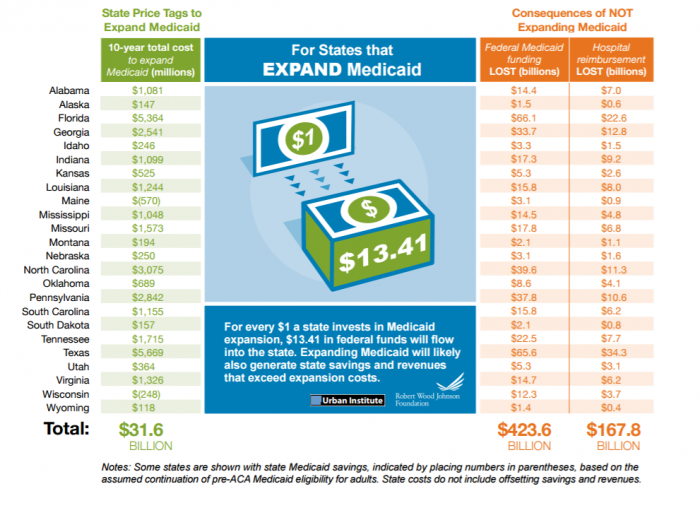
It expanded Medicaid to cover those who were unable to afford private insurance but didn’t have incomes low enough to qualify for Medicaid before. After a Supreme Court ruling made the expansion optional, 31 states and the District of Columbia used the financial incentives offered under the Obamacare law to add about 12 million people to the Medicaid rolls. To congressional Republicans’ ire, the expansion was funded in part by tax increases on higher-income people. The federal government pays more than 90 percent of the cost of the Medicaid expansion.

Reverse the expansion of Medicaid, at different paces. The House bill would wind down funding for the expansion starting in 2020. The Senate bill would phase out the expansion’s funding between 2021 and 2024.

4. How else would they change Medicaid?

Currently, the federal government generally reimburses states for a fixed percentage of Medicaid expenditures, regardless of total spending or number of people enrolled. The Republican bills would impose a per-person limit on Medicaid reimbursement that would increase over time at a rate linked to inflation. The Congressional Budget Office said that under the House bill, which uses the rate of medical inflation to set the pace of spending, federal Medicaid spending would decrease by $834 billion between 2017 and 2026. The Senate bill would set a lower growth rate starting in 2025 by using the general inflation rate as a benchmark for much of Medicaid’s spending, rather than the medical inflation rate.

5. What would the impact be?

The Congressional Budget Office estimates that between 2017 and 2026, 15 million fewer people would be covered by Medicaid under the Senate bill, and 14 million fewer under the House bill, than under Obamacare. In both cases, Medicaid would account for about two-thirds of the increase in the number of uninsured projected by the CBO.

6. How else could poor people get coverage?

The House and Senate bills would make them eligible for subsidies for individual insurance policies, meaning people who are dropped from Medicaid could use the subsidies to buy their own coverage. Critics say the bill would make those policies unaffordable to low-income people by increasing deductibles.

7. What’s the debate about the bills like?

8. What’s Trump’s position?

During the 2016 campaign, Trump said that unlike other Republican candidates he would not cut Medicaid, Medicare or Social Security. But he did support the House health-care bill. After McConnell introduced a draft version of his bill, Sean Spicer, the White House spokesman, said that Trump was “very supportive” of the bill but was “committed” to making sure that people currently on Medicaid didn’t lose their coverage.