Repealing Federal Health Reform: Economic and Employment Consequences for States

http://www.commonwealthfund.org/publications/issue-briefs/2017/jan/repealing-federal-health-reform?omnicid=EALERT1150318&mid=henrykotula@yahoo.com

The Commonwealth Fund

Abstract

Issue: The incoming Trump administration and Republicans in Congress are seeking to repeal the Affordable Care Act (ACA), likely beginning with the law’s insurance premium tax credits and expansion of Medicaid eligibility. Research shows that the loss of these two provisions would lead to a doubling of the number of uninsured, higher uncompensated care costs for providers, and higher taxes for low-income Americans.

Goal: To determine the state-by-state effect of repeal on employment and economic activity.

Methods: A multistate economic forecasting model (PI+ from Regional Economic Models, Inc.) was used to quantify for each state the effects of the federal spending cuts.

Findings and Conclusions: Repeal results in a $140 billion loss in federal funding for health care in 2019, leading to the loss of 2.6 million jobs (mostly in the private sector) that year across all states. A third of lost jobs are in health care, with the majority in other industries. If replacement policies are not in place, there will be a cumulative $1.5 trillion loss in gross state products and a $2.6 trillion reduction in business output from 2019 to 2023. States and health care providers will be particularly hard hit by the funding cuts.

http://www.commonwealthfund.org/interactives-and-data/maps-and-data/the-impact-of-aca-repeal-on-employment


GOP won’t promise ObamaCare fix will cover all

GOP won’t promise ObamaCare fix will cover all

Image result for uninsured

Republican leaders are refusing to commit to their ObamaCare replacement plan covering as many people as President Obama’s health law.

Congressional Republicans are quickly moving forward to pass a repeal of ObamaCare and say a replacement plan will come later this year.

But it’s unclear whether that eventual replacement will provide insurance options for at least 20 million people, the number who gained coverage under ObamaCare, amid worries that many could lose their health insurance.


Hospital Impact: Trump administration should stay the course on transition to value-based care

http://www.fiercehealthcare.com/hospitals/hospital-impact-it-s-vital-to-stay-course-value-based-care?utm_medium=nl&utm_source=internal&mrkid=959610&mkt_tok=eyJpIjoiTWpVM05HSm1PR0ZoTnpFMiIsInQiOiJUYjRHejhMZWNReUgrWjZDN1N6ZHhzU3NVSXlrZ2UrTk1lQWtiU1g2TFlBSHdXcHhwXC9sdFo4bFMwaklKaFRKSnZqMmNoV0I1dnNoT0czRDA4QWNoekNCeGZiV2JFYUZVdkdvWkY2UVVjYWFGTTRGOXhzSUlcL2xldkgzYzhoTWVOIn0%3D

Signs saying healthcare reform

As a practicing physician for more than 30 years, I have seen a number of changes occur in the healthcare industry. None of these changes have been as significant as the current transition from fee-for-service to value-based care.

It is no secret that with the price tag and inefficiencies, the current U.S. healthcare system is unsustainable. The traditional fee-for-service model, which focuses on treating acute conditions and rewards providers based on the number of services they provide, no longer works. Fortunately, the industry is shifting toward value-based care, which focuses on prevention and wellness and rewards providers for keeping people well and out of the hospital.

Major health systems like Greenville Health System (GHS), of which I am a part, are slowly but surely making the transition from volume- to value-based care. This type of transition is a huge undertaking and further complicated by the fact that the industry as a whole has not made the transition yet.

It’s as if we have one foot in the canoe and the other on shore. We are preparing for a future that has not fully arrived, but it is one that we are betting on because we believe it will have a tremendous impact on the health of our nation.


Doctors Group Warns Against Loss Of Coverage From ObamaCare Repeal

Doctors group warns against loss of coverage from ObamaCare repeal

Doctors group warns against loss of coverage from ObamaCare repeal

The country’s leading doctors group is urging Republicans to take steps to ensure that people do not lose their health insurance once ObamaCare is repealed.

The American Medical Association (AMA), wrote a letter to congressional leaders on Tuesday calling for the gains in coverage from ObamaCare, which has expanded insurance to 20 million people, to be preserved.

“In considering opportunities to make coverage more affordable and accessible to all Americans, it is essential that gains in the number of Americans with health insurance coverage be maintained,” AMA CEO Dr. James Madara wrote leaders in both parties.

“Consistent with this core principle, we believe that before any action is taken through reconciliation or other means that would potentially alter coverage, policymakers should lay out for the American people, in reasonable detail, what will replace current policies,” Madara continued.

“Patients and other stakeholders should be able to clearly compare current policy to new proposals so they can make informed decisions about whether it represents a step forward in the ongoing process of health reform.”

The AMA’s position is at odds with Republicans’ current plan. The GOP is moving forward this month with plans to repeal ObamaCare without a replacement, but delay repeal going into effect for a few years to buy time for drafting an alternative.

The American Hospital Association, meanwhile, warned in a report last month of an “unprecedented public health crisis” from people losing coverage under ObamaCare repeal.

The AMA added that ObamaCare is “imperfect” and said it would favor policies if they increased coverage, choices and affordability.

After Obama, Some Health Reforms May Prove Lasting

Image result for After Obama, Some Health Reforms May Prove Lasting

Fragments of bone and cartilage arced across the operating room as Dr. R. Michael Meneghini drilled into the knee of his first patient at a hospital here at dawn. Within an hour, the 66-year-old woman had a replacement joint made of titanium and cobalt chrome, and she was sent home the next day.

But the Obama administration was watching over her caregivers’ shoulders. If, over three months, her medical costs exceeded a target amount set by President Obama’s health regulators in Washington, Dr. Meneghini’s employer, Indiana University Health, stood to lose money.

Such efforts to squeeze spending out of the nation’s health system may well remain as Mr. Obama exits the West Wing and Donald J. Trump takes his seat in the Oval Office. The Affordable Care Act is in extreme peril, and Mr. Obama will meet with congressional Democrats at the Capitol on Wednesday to try to devise a strategy that can stave off the quick-strike repeal of the health law that Republicans plan for the opening months of the Trump administration.

But the transformation of American health care that has occurred over the last eight years — touching every aspect of the system, down to a knee replacement in the nation’s heartland — has a momentum that could prove impossible to stop.

Expanding insurance coverage to more than 20 million Americans is among Mr. Obama’s proudest accomplishments, but the changes he has pushed go deeper. They have had an impact on every level of care — from what happens during checkups and surgery to how doctors and hospitals are paid, how their results are measured and how they work together.

“From the moment I first set foot in the Oval Office in February 2009, the president told me that the law can’t be just about covering the uninsured, but that it also has to be about changing the way care is delivered,” said Nancy-Ann DeParle, who as a White House aide helped lead the effort to pass and carry out the health law. His message, she said: “I don’t want to cover everyone and just put them in the same creaky old delivery system.”

Changes in the delivery system already affect far more people than the law’s higher-profile coverage gains. To visit IU Health, the largest health care provider in Indiana, with 15 hospitals and 8,700 doctors, is to see those changes up close. Its leaders have started moving away from fee-for-service medicine, where every procedure, examination and prescription fetches a price. The emphasis now is on preventive care, on taking responsibility for the health of patients not only in the hospital, but also in the community.

Outlook for 2017: Healthcare re-reform

http://www.modernhealthcare.com/article/20161231/MAGAZINE/312319988/outlook-for-2017-healthcare-re-reform?utm_source=RealClearHealth%20Morning%20Scan&utm_campaign=be01ccd91c-EMAIL_CAMPAIGN_2017_01_03&utm_medium=email&utm_term=0_b4baf6b587-be01ccd91c-84752421

2017 had been shaping up as a year focused on fixing the Affordable Care Act’s insurance markets, slowing prescription drug price hikes, expanding Medicaid, improving mental healthcare and spreading value-based payment and delivery.

Suddenly there’s a new, more conservative agenda. And almost everything in healthcare is up in the air.


Insurers and providers were counting on continuing to add paying customers under the ACA’s premium subsidy framework, with more states expanding Medicaid to low-income adults. But after the surprise presidential victory of Republican Donald Trump, industry groups have no clear idea what the new framework will be if Trump and the Republican Congress make good on their pledge to repeal and replace Obamacare.

Beyond that, there’s great uncertainty whether and at what level Republicans will fund a wide range of health programs, including medical research, mental health and addiction services, public health, community health centers and the Children’s Health Insurance Program. Trump’s picks for cabinet-level posts, notably Rep. Mick Mulvaney (R-S.C.) at the Office of Management and Budget, are no fans of government social spending.

“It’s hard to plan a business with this many outstanding questions,” said Ceci Connolly, CEO of the Alliance for Community Health Plans, which represents not-for-profit insurers.

Republican experts say there’s no question Congress will push to repeal the ACA via a party-line, expedited budget bill. It’s likely they’ll also try to erase or roll back the law’s Medicaid expansion. But these observers acknowledge that congressional GOP leaders themselves don’t know what they’re going to put in the ACA’s place—or precisely how they’ll do it.

“They’re working through that,” said Dean Rosen, a Republican lobbyist who formerly served as a senior Republican Senate staffer. “Republicans will own the changes, and they have to be very careful they don’t find themselves in the same position as the Obama administration, defending an unpopular, partisan piece of legislation.”

More than 50 million adults with pre-existing conditions would lose coverage in wake of Obamacare repeal, Kaiser study says

http://www.healthcarefinancenews.com/news/more-50-million-adults-pre-existing-conditions-would-lose-coverage-wake-obamacare-repeal-kaiser

Image result for pre-existing conditions

Kaiser Family Foundation poll found the 53 percent of people reported that they or someone in their household has a pre-existing condition.

Crossing the Political Chasm

http://www.commonwealthfund.org/publications/blog/2016/dec/crossing-the-political-chasm

As a new chapter in the saga of U.S. health care reform is written in the coming year, it’s worth remembering that, behind the layers of jargon and obscure political maneuvers, the consequences of success—and of failure—will be shared by individuals and groups across our society…regardless of ideology, demography, or geography.

Uncertainty. Opportunity. It’ll all be there for healthcare in 2017, PwC says

http://www.healthcaredive.com/news/uncertainty-opportunity-itll-all-be-there-for-healthcare-in-2017-pwc-sa/432384/

You reap what you sow. The idea is the push behind countless movie plots and rock songs but it’s also a central theme to PricewaterhouseCooper’s (PwC) Health Research Institute’s (HRI) new report on healthcare trends to watch out for in 2017. The seeds for next year were planted in 2007, according to the new report.

There will be certain uncertainty over the fate of the Affordable Care Act next year. However, many of the trends that should be on top-of-mind for hospital administrators next year will relate to value-based care, Trine Tsouderos, PwC’s Health Research Institute director, told Healthcare Dive. “If you think about the political changes as the waves on the surface of the ocean, there’s a very strong current underneath that is the shift to value-based care,” she said. “We do not see that changing. We see the shift continuing industry-wide despite any changes in Washington, DC.”

For example, only 90 or so retail clinics were in operation and about one in 10 consumers have been to one in 2016. Today, more than 3,000 such clinics have been propped up across the U.S. with one in three consumers having visited one. This drift highlights the continued move to more convenience in healthcare access as well as price transparency for patients.

Sticking with the nautical theme, Tsouderos likened the healthcare industry to a battleship in explaining why ideas from 10 years ago are now coming to fruition. It takes a long time to change the course of such a large and complex ship. “You can’t turn [the industry] on a dime,” she said.

What emerging trends administrators should know for 2017

https://www.pwc.com/us/en/health-industries/top-health-industry-issues.html


After the Election, the Public Remains Sharply Divided on Future of the Affordable Care Act

http://connect.kff.org/after-the-election-the-public-remains-sharply-divided-on-future-of-the-affordable-care-act?ecid=ACsprvtkG7thn0KvqmasXGGSnW1I2ovnfcZhoigDXi-aw9Wa_OhWGcyqpjasxqgfF_XFOsbs0N1f&utm_campaign=KFF-2016-November-Tracking-Poll&utm_source=hs_email&utm_medium=email&utm_content=38490459&_hsenc=p2ANqtz–qXSbCJ4pmKneag47QgP5kargBeYht5Al3rljRS8wEAQj-n-71yE8rwo5xn_Bg9Nwp-C89R9o_HVKBqqv5G6aMyddn9g&_hsmi=38490459

november poll1.png

Among Those Who Favor Repeal, Arguments About Loss of Coverage for Those with Pre-Exiting Conditions Can Sway Some Opinions

Many Obamacare Provisions Remain Broadly Popular Across Party Lines, But Not its Mandate

The first Kaiser Health Tracking Poll since the 2016 election finds that Americans are largely divided on the future of the Affordable Care Act even though many of the law’s major provisions remain quite popular across party lines.

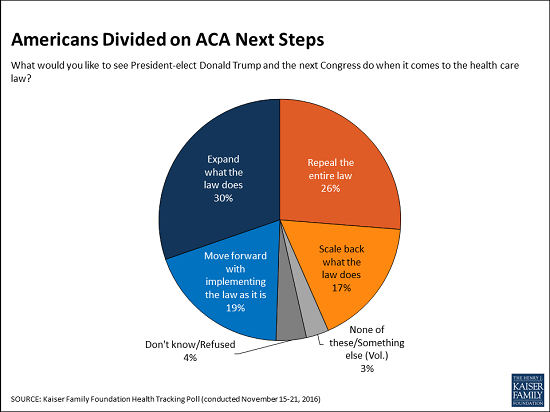
The new survey finds that one fourth (26%) of Americans want to see President-elect Donald Trump and the next Congress repeal the entire law, and an additional 17 percent want them to scale back what the law does. This compares to 30 percent of the public who want to see the law expanded and 19 percent who want to see lawmakers move forward with implementing the law as it is.

The poll captures a slight uptick in the share of Americans who want lawmakers to scale back the law as well as a decrease in the share who want lawmakers to repeal the entire law.  This is largely driven by Republicans: About half (52%) of Republicans now say they want to see the Affordable Care Act repealed, down from 69 percent in October. At the same time, a quarter (24%) of Republicans now want to see the law scaled back, up from 11 percent in October.

Among the quarter (26%) of Americans that want to see the Affordable Care Act repealed, 31 percent want to see the health care law just repealed and not replaced. About two-thirds wants lawmakers to repeal the health care law and replace it with a Republican-sponsored alternative, with 42 percent wanting lawmakers to wait to repeal it until the details of a replacement plan have been figured out and 21 percent wanting lawmakers to repeal it immediately and figure out a replacement plan later.

Among those who want the law repealed, 38 percent (or 10% of the public overall) change their opinion after hearing the argument that repealing the ACA would mean that insurance companies could deny coverage to people with pre-existing conditions. A slightly smaller share change their opinion after hearing that more than 20 million Americans could lose their coverage.