


I.R.S. Ruling Is Obstacle to Health Care Networks Promoted by ACA
Health reform (aka Obamacare) is entering a new stage. The recent announcement by United Health Care that it will stop selling insurance to individuals and families through most health insurance exchanges marks the transition. In the next stage, federal and state policy makers must decide how to use broad regulatory powers they have under the Affordable Care Act (ACA) to stabilize, expand, and diversify risk pools, improve local market competition, encourage insurers to compete on product quality rather than premium alone, and promote effective risk management. In addition, insurance companies must master rate setting, plan design, and network management and effectively manage the health risk of their enrollees in order to stay profitable, and consumers must learn how to choose and use the best plan for their circumstances.
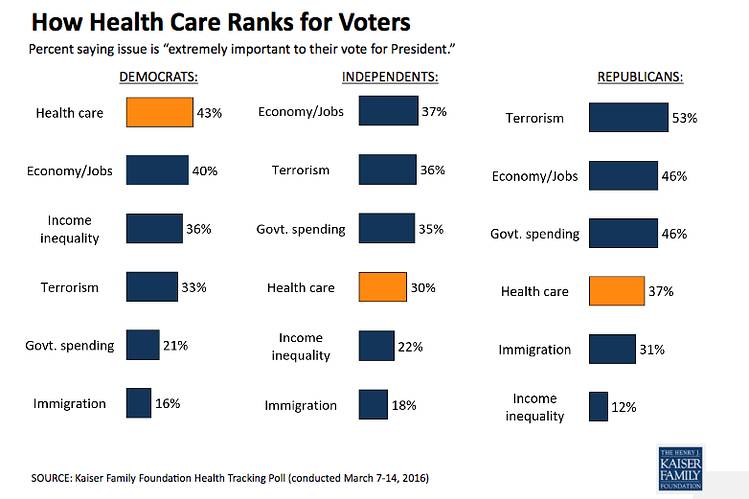
Health care has faded into the background of the election campaign as Donald Trump himself has become the issue on the Republican side and the debate between Hillary Clinton and Bernie Sanders over health care has shifted to other topics. This doesn’t mean that health will be the No. 1 or No. 4 factor when Democrats and Republicans vote in November. As the chart also shows, issue priorities are closely bunched, and my experience has been that voters cast ballots in presidential elections on the basis of their overall views of the candidates rather than candidates’ specific positions on issues.
When people say health care is an extremely important voting issue, they aren’t always thinking of the ACA. Among Republicans who say health is “extremely important” to their vote, about equal shares are thinking about the ACA as are thinking about issues such as access to care and health-care costs. Nor are Democrats always intending to support the ACA when they cite health as a voting issue. They are more likely to cite improving access or addressing costs generally as their reason for naming health a top voting issue.
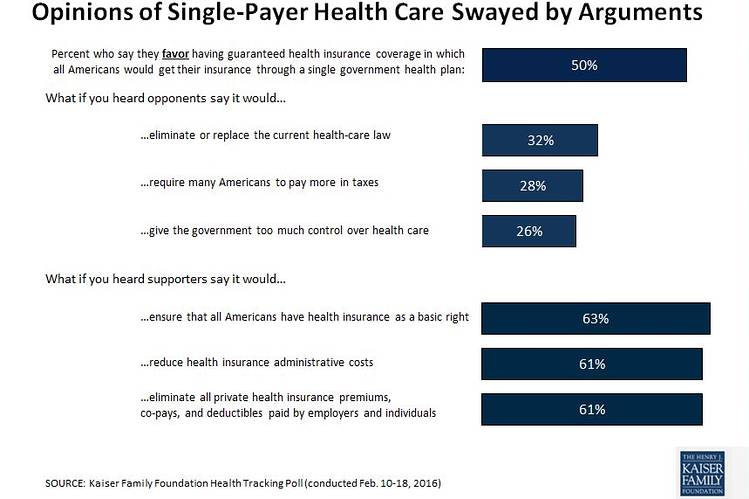
Gallup polling released last week showed majority support–58%–for replacing the Affordable Care Act with a federally funded health system. The same poll found 51% support for repealing the ACA. There is a basic point that often gets lost in reaction to poll findings like these: They measure the public’s initial response to ideas and words, and proposals such as single payer or ACA repeal that people associate with candidates–but they don’t tell us much about the likely level of support for a policy if there is a real debate about legislation before Congress, with winners and losers laid bare.
It’s always a fair bet that support would decline for big changes that come with big trade-offs–whether it is single-payer health care or ACA repeal or something else–but there is no way to know those levels in advance, and support could rise or fall depending on how a legislative debate plays out. Consider single-payer health care as an example. In February, the Kaiser Family Foundation monthly tracking poll simulated some of the arguments the public might hear in a debate about single payer.

An Obama administration proposal to reduce Medicare payments for many prescription drugs has run into sharp bipartisan criticism, suggesting that it is easier to diagnose the problem of high prices than to solve it.

Judges have largely dismissed the argument that hospitals need to merge to meet the demands of the Affordable Care Act, but a Pennsylvania judge recently accepted the “Obamacare-made-me-do-it” defense, according to the National Law Review. In defense to an antitrust challenge by the FTC, plenty of hospitals have argued mergers are necessary to meet ACA goals, such as moving away from the fee-for-service model and providing high quality care more efficiently.

The American College of Emergency Physicians has filed suit against HHS over a provision in the Affordable Care Act health law they say lets insurers get away with underpayments for out-of-network emergency care, Modern Healthcare reported.
http://www.healthcaredive.com/news/will-medicaid-expansion-holdouts-finally-give-in/419439/

Legislators in some non-expansion states are currently under fire from state hospital associations, and in some cases state governors, to finally expand their Medicaid programs. Will the holdouts cave under the pressure? As of March 14, there were 19 non-expansion states, according to a Kaiser Family Foundation report. Hospitals in those states are not faring as well as their counterparts in states that have expanded their Medicaid programs.
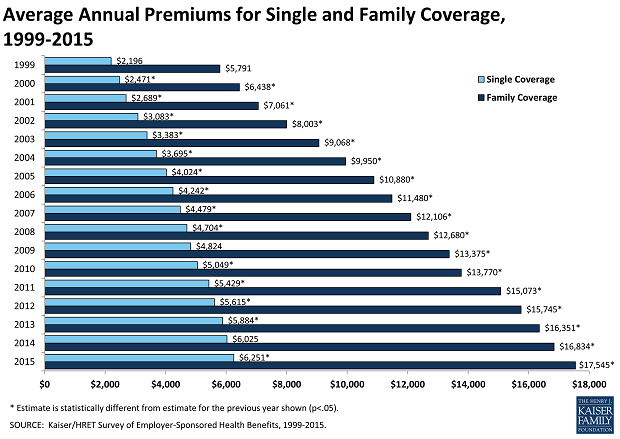
A new report from the American Academy of Actuaries outlines the trends that will impact health insurance premiums next year. “There are both upward and downward pressures on premiums for 2017, but for the individual and small group markets as a whole, the factors driving premium increases up dominate,” senior academy health fellow Cori Uccello said in a statement.
 HENRY KOTULA