Repealing the individual mandate would do substantial harm

https://www.brookings.edu/blog/up-front/2017/11/21/repealing-the-individual-mandate-would-do-substantial-harm/?utm_campaign=Brookings%20Brief&utm_source=hs_email&utm_medium=email&utm_content=58686618

Related image

he tax legislation reported by the Senate Finance Committee last week included repeal of the individual mandate, which was created by the Affordable Care Act (ACA) and requires individuals to obtain health insurance coverage or pay a penalty. The Congressional Budget Office (CBO) has estimated that this proposal would cause large reductions in insurance coverage, reaching 13 million people in the long run.

Supporters of repealing the individual mandate have argued that the resulting reductions in insurance coverage are not a cause for concern because they would be voluntary. Rigorous versions of this argument acknowledge that individuals who drop coverage would lose protection against high medical costs, find it harder to access care, and likely experience worse health outcomes, but assert that the very fact that these individuals would choose to drop insurance coverage shows that they will be better off on net. On that basis, advocates of repealing the mandate claim that its repeal would do no harm. However, this argument suffers from two serious flaws.

The first flaw in this argument is that it assumes individuals bear the full cost of their decisions about whether to obtain insurance coverage; in fact, one person’s decision to go without health insurance coverage shifts costs onto other people. Notably, CBO has estimated that the departure of healthy enrollees from the individual market spurred by repeal of the individual mandate will increase individual market premiums by 10 percent, causing some in that market to involuntarily lose coverage and causing those who remain to bear higher costs. In addition, many of those who become uninsured will end up needing health care but not be able to pay for it, imposing costs on other participants in the health care system. Because individuals who choose to become uninsured do not bear the full cost of that decision, they may choose to do so even in circumstances where the benefits of coverage—accounting for its effects on both the covered individual and the rest of society—exceed its costs.

The second flaw in this argument is that it assumes individual decisions about whether to purchase health insurance coverage reflect a fully informed, fully rational weighing of the cost and benefits. In fact, there is strong reason to believe that many individuals, particularly the healthier individuals most affected by the mandate, are likely to undervalue insurance coverage. This likely reflects a variety of well-documented psychological biases, including a tendency to place too much weight on upfront costs of obtaining coverage (including the “hassle costs” of enrolling) relative to the benefits insurance coverage would provide if the individual got sick and needed care at some point in the future. It is therefore likely that many people who would drop insurance coverage due to repeal of the individual mandate would end up worse off, even solely considering the costs and benefits to the individuals themselves.

The considerations described above mean that, in the absence of subsidies, an individual mandate, or some combination of the two, many people will decline to obtain insurance coverage despite that coverage being well worth society’s cost of providing it. Furthermore, unless the current subsidies and individual mandate penalty provide too strong an incentive to obtain coverage that results in too many people being insured—a view that appears inconsistent with the available evidence—then reductions in insurance coverage due to repealing the individual mandate would do substantial harm.

The remainder of this analysis takes a closer look at the two flaws in the argument that reductions in insurance coverage caused by repeal of the individual mandate would do no harm. The analysis then discusses why these considerations create a strong case for maintaining an individual mandate.

INDIVIDUAL DECISIONS TO DROP INSURANCE COVERAGE IMPOSE SUBSTANTIAL COSTS ON OTHER PEOPLE

As noted above, supporters of repealing the individual mandate have often argued that the resulting reductions in insurance coverage would do no harm because they are the outcome of voluntary choices. One major flaw in this argument is that one person’s decision to drop insurance coverage imposes costs on other people through a pair of mechanisms: increases in individual market premiums and increases in uncompensated care. I discuss each of these mechanisms in greater detail below.

Increases in individual market premium reduce coverage and increase others’ costs

Repealing the individual mandate would reduce the cost of being uninsured and, equivalently, increase the effective cost of purchasing insurance coverage. That increase in the effective cost of insurance coverage would, in turn, cause many people to drop coverage. Because individuals with the most significant health care needs are likely to place the highest value on maintaining insurance coverage, the people dropping insurance coverage would likely be relatively healthy, on average. In the individual market, those enrollees’ departure would raise average claims costs, requiring insurers to charge higher premiums to the people remaining in the individual market.[1]

CBO estimates that, because of this dynamic, repealing the individual mandate would increase individual market premiums by around 10 percent. Those higher premiums would push some enrollees who are not eligible for subsidies out of the individual market. Higher premiums would impose large costs on unsubsidized enrollees who remained in the ACA-compliant individual market—around 6 million people—while increasing federal costs for subsidized enrollees who remain insured.[2]

CBO’s estimates are at least qualitatively consistent with empirical evidence on the effects of the individual mandate. Perhaps the best evidence on this point comes from Massachusetts health reform. Research examining the unsubsidized portion of Massachusetts’ individual market estimated that Massachusetts’ individual mandate increased enrollment in the unsubsidized portion of its individual market by 38 percent, reducing average claims costs by 8 percent and premiums by 21 percent. Similarly, research focused on the subsidized portion of Massachusetts’ market found that the mandate appears to have been an important motivator of enrollment, particularly among healthier enrollees.

Direct evidence on the effects of the ACA’s mandate is relatively scant because it is challenging to disentangle the effect of the mandate from the effect of other policy changes implemented by the ACA. However, it is notable that the uninsured rate among people with incomes above 400 percent of the federal poverty level fell by almost one-third from 2013 to 2015. This trend is consistent with the view that the ACA’s individual mandate has increased insurance coverage since these individuals are not eligible for the ACA’s subsidies, and implementation of the ACA’s bar on varying premiums or denying coverage based on health status, taken on its own, would have been expected to actually reduce insurance coverage in this group. Because this estimate applies to only a relatively small slice of the population, it cannot easily be used to determine the total effect of the individual mandate on insurance coverage, but it does suggest that the mandate has had meaningful effects.

Repealing the individual mandate could also cause broader disruptions in the individual market for some period of time. Insurers would find it challenging to predict exactly what the individual market risk pool would look like after repeal of the mandate. Some insurers might elect to limit their individual market exposure until that uncertainty is resolved, particularly since the Trump Administration has signaled an intent to pursue other significant policy changes affecting the individual market. That uncertainty could cause some insurers to withdraw from the market, potentially leaving some enrollees without any coverage options. Alternatively, insurers could elect to raise premiums by even more than they expect to be necessary (e.g., by more than the CBO 10 percent estimate cited above) to ensure that they are protected in all scenarios, with significant costs to both individuals and the federal government. It is uncertain how widespread these types of broader disruptions would be in practice, but they are possible.

It is important to note that one person’s decision about whether to purchase individual market coverage affects the premiums faced by others because of a conscious policy choice: the decision to bar insurers from varying premiums or denying coverage based on health status. Without those regulations, individual coverage decisions would have little or no effect on the premiums charged to others. But policymakers and the public have, appropriately in my view, concluded that these regulations perform a valuable social function by ensuring that health care cost burdens are shared equitably between the healthy and the sick. Having made that decision, other aspects of public policy must take account of the fact that one person’s decision to go uninsured has consequences for the market as a whole.

Some newly uninsured individuals would need care, but be unable to pay for it

Dropping insurance coverage also allows individuals to shift a portion of the cost of the care they receive onto others in the form of uncompensated care. Even in the group of comparatively healthy individuals who elect to drop their coverage, some will get sick and need health care. Some of these individuals might be able to pay for that care out of pocket, but others—particularly those who get seriously ill—would likely be unable to pay for it. In some cases, that would cause these individuals to forgo needed care, but in other cases they would receive care without paying for it, either due to the legal requirement that hospitals provide care in emergency situations or through various other formal and informal mechanisms. (Although individuals would often still be able to access care without paying for it, they would frequently still be billed for that care, with potential downstream consequences for their ability to access credit.)

Uninsured individuals receive large quantities of uncompensated care in practice. Estimates based on the Medical Expenditure Panel Survey indicate that a non-elderly individual uninsured for the entire year received $1,700 in uncompensated care, on average, during 2013. Consistent with that fact, increases in the number of uninsured individuals increase the amount of uncompensated care. In the context of the Oregon Health Insurance Experiment, a randomized controlled trial of the effects of expanded Medicaid coverage, having Medicaid coverage was estimated to reduce the amount of uncompensated care an individual receives by almost $2,200 per year, on average. Quasi-experimental research has similarly found that increases in the number of uninsured individuals in a hospital’s local area increase the amount of uncompensated care a hospital delivers and that the expansion in insurance coverage achieved by the ACA substantially reduced hospitals’ uncompensated care burdens.

Precisely who bears the cost of uncompensated care, particularly in the long run, is not entirely clear. A portion of uncompensated care costs are borne by federal, state, and local government programs and, therefore, are ultimately borne by taxpayers. In 2013, around three-fifths of uncompensated care was financed by federal, state, and local government programs explicitly or implicitly aimed at this purpose. Increases in uncompensated care burdens are likely to lead to increases in spending on these programs. In some cases, those increases will happen automatically. For example, CBO finds that repealing the individual mandate will increase federal spending on the Medicare Disproportionate Share Hospital (DSH) program, which is intended to defray uncompensated care costs, by $44 billion over the next ten years because the formula for determining DSH payments depends on the uninsured rate. In other cases, changes may occur more indirectly, perhaps because higher uncompensated care burdens create political pressure to expand these programs (or make it harder to cut them).

The impact of uncompensated care therefore depends to a significant degree on how non-profit hospitals cope with reduced operating margins. Evidence on this point is relatively limited. However, in instances where increases in uncompensated care burdens cause providers to incur outright losses, they are likely to ultimately force facilities to close, which could reduce access to care or increase prices charged to those enrolled in private insurance by reducing competition. In instances where increases in uncompensated care burdens merely trim positive operating margins, lower margins presumably force hospitals to reduce capital investments or to reduce cross-subsidies to other activities such as medical education or research.Recent research focused on the hospital sector, which accounts around three-fifths of all uncompensated care, suggests that providers also bear a significant portion of uncompensated care costs in the form of lower operating margins. However, this does not imply that uncompensated care costs are ultimately borne by hospitals’ owners. Indeed, this research finds that reductions in operating margins in response to increases in uncompensated care occur almost exclusively among non-profit hospitals, plausibly because for-profit hospitals are adept at locating in geographic areas where the demand for uncompensated care is relatively low. (Greater distortions where providers choose to locate and what services they choose to offer may be an important cost of increased uncompensated care.)

INDIVIDUAL DECISIONS TO DROP INSURANCE COVERAGE MAY HARM THE INDIVIDUALS THEMSELVES

The argument that reductions in insurance coverage due to repeal of the individual mandate do no harm because they are voluntary has a second important flaw; specifically, this argument assumes that individual decisions about whether to obtain health insurance coverage reflect a fully informed, fully rational weighing of the costs and benefits. There is strong reason to doubt that assumption.

Economists commonly note that many people decline to take-up health even in settings where that coverage is free or nearly so. For example, analysts at the Kaiser Family Foundation (KFF) have estimated that, in 2016, there were 6.8 million people who were eligible for Medicaid or the Children’s Health Insurance Program, but not enrolled in those programs, despite the fact that these programs had negligible premiums. Similarly, for this year’s Marketplace open enrollment period, analysts at KFF estimated that among uninsured individuals eligible to purchase Marketplace coverage, around two-fifths could obtain a bronze plan for a premium of zero, but few expect all of these individuals to enroll.

This type of behavior is very challenging to explain as the outcome of a fully informed, fully rational decision-making process. The fact that individuals who do not purchase insurance coverage can shift significant costs to others, as discussed above, can help explain why some individuals value insurance at less than the cost of providing it. But these factors cannot explain why enrollees would decline to obtain coverage that is literally free to them. In principle, “hassle costs” of enrolling in coverage could explain decisions to forgo coverage in these instances, but those hassle costs would need to be implausibly large to explain a decision to forgo an offer of free insurance coverage.

Precisely why individuals decline to take up insurance coverage even in settings where it seems clearly in their interest to do so is not fully understood. This review article catalogues a wide variety of psychological biases that may play a role, but three seem particularly important in this context:

  • Present bias: Economists have documented that individuals generally exhibit “present bias,” meaning that they place a large weight on current costs and benefits relative to similar costs and benefits in the future. In the context of insurance coverage, this type of bias is likely to cause individuals, particularly those who are currently healthy, to place too much weight on the upfront premium and hassle costs required to enroll in health insurance relative to the benefit of having insurance coverage if they get sick at some point in the future. This may cause individuals to decline to obtain insurance coverage even when it is in their economic interest, including in instances where the premium required to enroll is literally zero.

Overweighting of small up front hassle costs appears to lead suboptimal decisions in many economic settings, but the retirement saving literature provides a particularly striking example. Simply being required to return a form to enroll in an employer’s retirement plan has been documented to sharply reduce take-up of that plan, even in circumstances where employees forgo hundreds or thousands of dollars per year in employer matching contributions by declining to participate.

  • Overoptimistic perceptions of risk: One core function of health insurance is to provide protection against relatively rare, but very costly, illnesses. Indeed, a large fraction of the total value of a health insurance contract is delivered in those states of the world. In 2014, around 5 percent of the population accounted for around half of total health care spending.[3] But because these events are comparatively rare, many individuals, particularly healthier individuals, may have difficulty forming accurate perceptions of the risks they face. Research on Medicare Part D has found that individuals tend to place too much weight on premiums relative to expected out-of-pocket costs when choosing plans, providing some evidence that individuals do indeed underestimate risk (although research focused on insurance products other than health insurance has concluded that individuals may sometimes overestimate risk). Like present bias, misperceptions of risk can cause hassle or premium costs to receive too much weight relative to the actual benefits of coverage.
  • Inaccurate beliefs about affordability: Enrollees could also have inaccurate information about the availability of coverage. Survey evidence has suggested that, as of early 2016, almost 40 percent of uninsured adults were unaware of the existence of the ACA’s Health Insurance Marketplaces. Additionally, approximately two-thirds of those who were aware of the Marketplaces had not investigated their coverage options, with most saying that they had not done so because they did not believe that they could afford coverage. Individuals’ beliefs about whether coverage is affordable may be accurate in some instances, but it is likely that they are not accurate in many other cases. Inaccurate beliefs may cause many individuals to fail to investigate their coverage options, including some who are eligible for free or very-low-cost coverage.

REDUCTIONS IN INSURANCE COVERAGE FROM REPEALING THE INDIVIDUAL MANDATE WOULD DO SUBSTANTIAL HARM

The factors identified above provide strong economic rationale for implementing some combination of subsidies and penalties to strengthen the financial incentive to obtain health insurance coverage. These policy tools can compensate for the fact that individual decisions to go without coverage do not account for the ways in which those decisions increase costs for others. Similarly, in many (though not all) instances, financial incentives can help counteract psychological biases that cause individuals to go without insurance coverage even when it is against their own economic interest.

This discussion does not, of course, speak directly to how large subsidies and penalties should be. At least in theory, it is possible to overcompensate for the factors catalogued in the preceding section by creating too large an incentive to obtain coverage and thereby causing too many people to become insured. This occurs if the cost of the additional health care individuals receive when they become insured plus the administrative costs of providing that coverage exceeds the health benefits of the additional health care and the improved protection against financial risk.

Estimating the optimal size of subsidies and penalties is beyond the scope of this analysis. However, it is notable that virtually no one in the current policy debate is arguing that the United States insures too many individuals. Furthermore, there is reason to doubt that this is an empirically relevant concern. For example, the research on Massachusetts health reform by Hackmann, Kolstad, and Kowalski that was discussed earlier used their estimates to calculate the “optimal” mandate penalty to apply to unsubsidized enrollees. They conclude that just offsetting adverse selection justifies a mandate penalty similar in size to the one included in the ACA; also accounting for either uncompensated care or imperfections in consumer decision making could justify a considerably larger penalty.

It therefore seems difficult to justify repealing the individual mandate on the grounds that current policies provide an excessive overall incentive to obtain insurance coverage. Of course, policymakers might believe that it would be preferable to swap the mandate for larger subsidies, perhaps because they believe that it is inappropriate to penalize individuals for not obtaining coverage. In principle, sufficiently large increases in subsidies could offset the reduction in insurance coverage that repealing the individual mandate would cause. But such an approach would require large increases in federal spending since it would keep insurance enrollment at its current level by providing larger subsidies to each enrolled individual. In any case, the Senate Finance Committee bill does not take this approach. Rather than increasing spending on insurance coverage programs to mitigate coverage losses, the bill uses the reduction in spending on coverage programs caused by repealing the mandate (which results from lower enrollment in those programs) to finance tax cuts.




Medicaid Expansion Has Improved the Financial Outlook for Safety-Net Hospitals

http://www.commonwealthfund.org/publications/issue-briefs/2017/nov/financial-impact-state-medicaid-expansion-safety-net-hospitals

Abstract

  • Issue: Safety-net hospitals play a vital role in delivering health care to Medicaid enrollees, the uninsured, and other vulnerable patients. By reducing the number of uninsured Americans, the Affordable Care Act (ACA) was also expected to lower these hospitals’ significant uncompensated care costs and shore up their financial stability.
  • Goal: To examine how the ACA’s Medicaid expansion affected the financial status of safety-net hospitals in states that expanded Medicaid and in states that did not.
  • Methods: Using Medicare hospital cost reports for federal fiscal years 2012 and 2015, the authors compared changes in Medicaid inpatient days as a percentage of total inpatient days, Medicaid revenues as a percentage of total net patient revenues, uncompensated care costs as a percentage of total operating costs, and hospital operating margins.
  • Findings and Conclusions: Medicaid expansion had a significant, favorable financial impact on safety-net hospitals. From 2012 to 2015, safety-net hospitals in expansion states, compared to those in nonexpansion states, experienced larger increases in Medicaid inpatient days and Medicaid revenues as well as reduced uncompensated care costs. These changes improved operating margins for safety-net hospitals in expansion states. Margins for safety-net hospitals in nonexpansion states, meanwhile, declined.

Background

Through their missions or legal mandate, safety-net hospitals provide care to all patients, regardless of their ability to pay.1 They include public hospitals, which are often providers of last resort in their communities; academic medical centers, which combine their teaching function with a mission to serve vulnerable populations; and certain private hospitals.

Safety-net hospitals deliver a significant level of care to low-income patients, including Medicaid enrollees and the uninsured, typically providing services that other hospitals in the community do not offer — trauma, burn care, neonatal intensive care, and inpatient behavioral health, as well as education for future physicians and other health care professionals. They are also an important source of care to uninsured individuals who are ineligible for Medicaid or subsidized marketplace coverage because of their citizenship status.2

Several studies have suggested major reductions in uncompensated care and improved financial status at safety-net institutions in states that expanded Medicaid compared to those in states that did not expand.3,4 However, these results were based on interviews with a limited number of safety-net health system executives and staff. Our analysis expands on this research by examining changes in key financial metrics — that is, uncompensated care, Medicaid costs and revenues, and total hospital margins–across safety-net hospitals nationally using standardized data.

When compared to other short-term acute care hospitals, hospitals that met our safety-net hospital criteria had substantially higher Medicaid revenue and uncompensated care levels than non-safety-net hospitals. Safety-net hospitals, however, had lower operating margins (Exhibit 1).

Below we discuss findings on the impact of the Affordable Care Act’s (ACA) Medicaid expansion on safety-net hospitals’ financial status. The ACA allowed states to expand Medicaid eligibility to nonelderly adults with incomes up to 138 percent of the federal poverty level. The reduction in the number of uninsured under the ACA coverage expansions was expected to reduce the uncompensated care that hospitals provide, thus improving their financial status. As of 2015, 31 states and the District of Columbia had expanded Medicaid, while 19 states had not.5

We measure changes in the financial status of safety-net hospitals in states that expanded Medicaid prior to 2015 (326 hospitals) versus safety-net hospitals in states that did not expand or expanded in 2015 or after (268 hospitals). (See “How We Conducted This Study” for complete methods.)

Key Findings

Our analysis of Medicare cost report data for federal fiscal years 2012 and 2015 shows a sizable contrast in financial performance between safety-net hospitals in states that expanded Medicaid under the ACA and those in states that did not. Performance metrics included the following:

    • Hospital operating margins.6 Operating margins improved for safety-net hospitals located in Medicaid expansion states compared with declines for those in states that did not expand. From 2012 to 2015, operating margins for safety-net hospitals in Medicaid expansion states increased from –3.2 percent to –2.1 percent in 2015 (Exhibit 2, Appendix A). In contrast during the same period, operating margins for safety-net hospitals in nonexpansion states declined from 2.3 percent to 2.0 percent. Largely accounting for this difference were increased Medicaid revenues and reduced uncompensated care costs. Even after expansion, safety-net hospitals’ operating margins in Medicaid expansion states were lower than those in nonexpansion states.
    • Medicaid inpatient days. From 2012 to 2015, safety-net hospitals in Medicaid expansion states experienced larger growth in Medicaid utilization than those in nonexpansion states (Exhibit 3). During the study period, Medicaid inpatient days in expansion states rose 13.5 percent. In comparison, Medicaid inpatient days in nonexpansion states fell slightly, by 0.9 percent.
    • Medicaid revenues and costs.7 The rise in use of safety-net hospitals in Medicaid expansion states resulted in these hospitals’ increased Medicaid revenue and costs compared to a slight decline in nonexpansion states (Exhibit 4). From 2012 to 2015, safety-net hospitals’ Medicaid revenues as a share of net patient revenues rose 12.7 percent in Medicaid expansion states. In contrast, during the same period, safety-net hospitals’ Medicaid revenues as a share of net patient revenues declined 1.8 percent in nonexpansion states. However, safety-net hospitals’ profit margins on Medicaid patients fell from 6.8 percent to 0.7 percent in expansion states, suggesting that the revenues received for newly eligible patients did not keep pace with the higher cost of treating these patients.
    • Uncompensated care costs.8 In 2012, safety-net hospitals’ uncompensated care costs as a percent of total hospital operating costs equaled 6.7 percent in expansion states compared to 5.7 percent in nonexpansion states (Exhibit 5). By 2015, however, the safety-net hospitals’ share of uncompensated care declined to 3.5 percent in expansion states, or a reduction of 47.4 percent. By comparison, in nonexpansion states that year, uncompensated care costs as a share of total hospital operating costs fell to 5.3 percent, a 7.8 percent reduction.

Discussion

These data suggest that the Medicaid expansion created by the ACA had a significant positive financial impact on safety-net hospitals in states that expanded Medicaid eligibility relative to those in states that did not expand. Safety-net hospitals in expansion states saw larger increases in Medicaid patient volume and revenue, reduced uncompensated care, and improved financial margins compared to safety-net hospitals in nonexpansion states. Although our study’s results are specific to safety-net hospitals, other studies have found similar trends across all hospitals in expansion and nonexpansion states.9

The improved financial stability of safety-net hospitals could allow these hospitals to continue expanding outpatient capacity, invest in strategies to improve care coordination, hire new staff, and develop better infrastructure to monitor costs.10 Such investments can also help prepare hospitals for new payment arrangements that may require them to assume more financial risk for patient care and outcomes. Improvements not only benefit the institutions and Medicaid patients but the communities these hospitals serve.

Current attempts to repeal the ACA aim to eliminate the Medicaid expansions over time and curtail Medicaid spending by more than $800 billion over 10 years. The Congressional Budget Office estimates that about 14 million people could lose their Medicaid coverage by 2026, which would have an adverse effect on safety-net hospitals in those states. Specifically, safety-net hospitals’ gains in reduced uncompensated care and improved overall financial margins could be lost in the future.


​The ACA is the ultimate survivor

​https://newsatjama.jama.com/2017/11/20/jama-forum-the-health-care-law-that-continues-to-escape-death/

The Affordable Care Act has survived more assassination attempts than Fidel Castro — and it’s still kicking. The Kaiser Family Foundation’s Larry Levitt has a piece in the JAMA Forum laying out the argument that the ACA “continues to escape death.”

  • Levitt’s piece is mostly focused on the Senate’s repeal-and-replace efforts and the Trump administration’s implementation decisions — cutting off payments for cost-sharing subsidies and dramatically scaling back enrollment outreach.
  • “If these efforts were intended to make the marketplace implode, they may, in fact, be backfiring,” Levitt says, citing the weird abundance of plans with $0 monthly premiums and enrollment totals that are beating some experts’ expectations.

This is just the latest chapter. The ACA has been a fixture of public debate since 2009, and it has never veered far from death’s door. In that time, it has survived:

  • Any number of make-or-break moments during the legislative debate
  • Two potentially disastrous Supreme Court challenges
  • The Republican waves of 2010 and 2014, and the countless repeal votes that followed
  • A slew of self-inflicted wounds, from provisions that proved unworkable to the hot mess that was the HealthCare.gov launch.

Between the lines: The ACA has definitely taken some hits — it’s not as strong its drafters might have hoped on the day it passed. But congressional Republicans’ failure to repeal it, and President Trump backing into a massive increase in its subsidies, are just the latest signs of the law’s surprising durability.

Until Congress repeals the individual mandate, anyway…


Health Care Price Growth Plummets To Lowest Rate In Almost Two Years

https://altarum.org/about/news-and-events/health-care-price-growth-plummets-to-lowest-rate-in-almost-two-years

Image result for Health Care Price Growth Plummets To Lowest Rate In Almost Two Years

Fueled by health policy uncertainty and structural health sector changes, health care price growth in August rose by only 1.2% compared to a year earlier. This is the lowest health price growth rate recorded in almost 2 years, and just slightly above the all-time low, according to Altarum’s latest Health Sector Economic Indicators Briefs. Contributing to overall slow price growth is a historically low Medical Consumer Price Index growth rate, a possible signal of relief for health care consumers with substantial out-of-pocket expenditures.

Despite an upward revision to recent estimates, health spending growth in August 2017 was only a modest 4.3% higher than a year earlier. Per Charles Roehrig, founding director of Altarum’s Center for Sustainable Health Spending, this moderation in spending growth is in response to a leveling-off in insurance coverage.

Health care job growth also remained modest, with 22,500 new jobs added in September 2017, slightly less than the 2017 average of 25,000. “Slower growth in health care utilization is reflected in slower growth in health jobs, particularly in the hospital sector,” said Roehrig. “This relatively good news should be tempered by a serious look at whether even this moderate growth is sustainable in the longer term.”

Health Care Spending

In August, the health share of gross domestic project (GDP) fell to 18.0%, but spending at an annual rate was 4.3% higher than August 2016, exceeding $3.5 trillion. Spending growth in August 2017 increased in all major categories, led by home health care at 6.5%. Hospital spending continues to grow slowly, at a 2.3% rate.

Health Care Employment

Hospitals added 4,500 jobs and ambulatory care settings added an above-average 24,700 jobs in August, but these gains were offset by the loss of 6,700 jobs in nursing and residential care. Slow hospital job growth in 2017 is a primary force behind the health sector growing at about three-quarters the pace of 2015 and 2016.

Health Care Prices

The 12-month moving average of the Health Care Price Index (HCPI) fell to 1.8% growth after being at 1.9% for 6 straight months, dousing any expectations of a return to a 2.0% growth rate range in the near term. Year-over-year hospital price growth fell to from 1.5% to 1.3%, and physician and clinical services price growth fell one-tenth to 0.5%. Annual drug price growth fell to a 2.7% rate, its lowest reading since growing by 2.4% in December 2015.

Podcast: ‘What The Health?’ Tax Bill Or Health Bill?

https://khn.org/news/podcast-what-the-health-tax-bill-or-health-bill/?utm_campaign=KFF-2017-The-Latest&utm_source=hs_email&utm_medium=email&utm_content=58570997&_hsenc=p2ANqtz-90FnDooDrGIdtTTHP8VfZovw1vS_Y_js4RdDwCCIwslKGDgrqu1yZ6bbcLJ5AbWfyJaM2B3HhQ9fR9txLD5dY-TnO3HA&_hsmi=58570997

Image result for kaiser podcast what the health?


Republican efforts to alter the health law, left for dead in September, came roaring back to life this week as the Senate Finance Committee added a repeal of the “individual mandate” fines for not maintaining health insurance to their tax bill.

In this episode of “What the Health?” Julie Rovner of Kaiser Health News, Sarah Kliff of Vox.com, Joanne Kenen of Politico and Alice Ollstein of Talking Points Memo discuss the other health implications of the tax bill, as well as the current state of the Affordable Care Act.

Among the takeaways from this week’s podcast:

  • The tax bill debate proves that Republicans’ zeal to repeal the Affordable Care Act is never dead. The new congressional efforts to kill the penalties for the health law’s individual mandate could seriously wound the ACA since the mandate helps drive healthy people to buy insurance.
  • One of the most overlooked consequences of the tax debate is that it could trigger a substantial cut in federal spending on Medicare.
  • A $25,000 MRI? That’s what one family paid to go out of their plan’s network to get the hospital they wanted for the procedure for their 3-year-old. Such choices are again drawing complaints about narrow networks of doctors and hospitals available in some health plans.
  • Although they don’t likely say it in front of cameras, many Democrats are relieved at President Donald Trump’s choice to head the Department of Health and Human Services, former HHS official Alex Azar.
  • Federal officials have given 10 states and four territories extra money to keep their Children’s Health Insurance Programs running but it’s not clear what couch they found the money hidden in.
  • And in remembrance of Uwe Reinhardt, a reminder that he always stressed that a health care debate was about more than money — it was about real people.

Plus, for “extra credit,” the panelists recommend their favorite health stories of the week they think you should read, too.

Health Care for Millions at Risk as Tax Writers Look for Revenue

https://www.bloomberg.com/news/articles/2017-11-16/health-care-for-millions-at-risk-as-tax-writers-look-for-revenue

Image result for individual mandate

The Republican tax plans are suddenly looking a lot more like health-care bills, with provisions that may affect coverage and increase medical expenses for millions of families.

The House version of the tax bill, which President Donald Trump endorsed on Tuesday, would end a deduction that allows families of disabled children and elderly people to write off large medical expenses. The Senate plan would repeal the Obamacare requirement that most Americans carry insurance, a move that insurers promise would raise premiums in the nationwide individual insurance market.

The provisions would help offset the cost of large tax cuts for corporations and individuals. But the move has sparked a new wave of opposition from the health-care industry and others who are concerned about its impact — the same political headwinds that tanked Republican efforts to repeal the Affordable Care Act earlier this year.

Either proposal, if signed into law, “could be devastating for some families with disabilities,” said Kim Musheno, vice president of public policy at the Autism Society, a Bethesda, Maryland, organization that advocates for people with autism. “Families depend on that deduction. And if they deal with the individual mandate, that’s going to cut 13 million people from their health care,” she said, citing a Congressional Budget Office estimate.

Republicans and some conservative groups, though, argue that removing the penalty for uninsured individuals would represent a tax cut for many low-income people who pay it now. Americans for Tax Reform, the group led by anti-tax crusader Grover Norquist, said that Internal Revenue Service data from tax year 2015 show that 79 percent of households that paid the penalty earned less than $50,000 a year.

Most Americans already think the tax legislation is designed to benefit the rich and oppose the bill by a two-to-one margin, according to a Quinnipiac University poll released on Wednesday. The survey was conducted between Nov. 7 and Nov. 13 — before the repeal of the Obamacare mandate was introduced — and has a margin of error of 3 percentage points. Some of the details in both tax plans have changed since the survey, and the Senate tax-writing committee is still working on its draft.

Republican Concerns

Few Republicans have spoken out about the House bill’s repeal of the medical-expense break. The bill faces a vote on the House floor Thursday. But some criticism has begun to surface as advocacy groups including the AARP and the American Cancer Society have highlighted the harm the House bill could have on families battling diseases and on the elderly. People with tens of thousands of dollars in annual medical expenses often rely on the tax deduction to make ends meet.

Representative Walter Jones, a North Carolina Republican, said Wednesday he’ll vote against the House bill in part because it eliminates the deduction for out-of-pocket medical expenses.

“There are a lot of seniors in my district and this is life and death for them,” he said.

The deduction is allowed under current law if medical expenses exceed 10 percent of a taxpayer’s adjusted gross income. Almost 9 million taxpayers deducted about $87 billion in medical expenses for the 2015 tax year, according to the IRS.

Representative Greg Walden, an Oregon Republican who chairs the Energy and Commerce Committee, said some of his constituents who live in expensive elder-care facilities could be harmed if the deduction is scrapped.

“I think it’s one we have to continue to massage a bit,” he said. “There’s a lot of things out there and there’s maybe going to be an opportunity to adjust some of them.”

He declined to elaborate.

Obamacare Repeal

On the other side of the Capitol, Senate Republican leaders’ sudden decision to add a partial Obamacare repeal to their bill has energized Democratic opposition.

“You don’t fix the health insurance system by throwing it into a tax bill and causing premiums to go up 10 percent,” Senator Sherrod Brown, an Ohio Democrat, told reporters Wednesday.

Were the ACA’s insurance mandate repealed absent a new policy to compel the purchase of coverage, the CBO projects that premiums would rise 10 percent for people who buy insurance on their own and more than 13 million Americans would lose or drop their coverage.

But a reduction in the number of people with insurance also translates to less taxpayer money spent to provide subsidies for premiums under the ACA. Ending the requirement as of 2019 would save the government an estimated $318 billion, helping to offset the cost of lowering the corporate tax rate.

In addition, the Senate’s tax plan could trigger sharp cuts to Medicare and other programs in order to meet budget deficit rules, according to CBO.

Easy Ads

The move to target Obamacare comes after Republicans lost elections in Virginia and other states earlier this month. Health care was a significant factor in those races and Republicans will face punishing campaign ads if they try to chip away at Obamacare or end the medical-expense deduction while cutting taxes, said political analyst David Axelrod, a former top adviser to President Barack Obama.

“The thing that makes it more of a potent issue is that it’s all being done to facilitate what essentially is a massive corporate tax cut and an individual tax cut that’s skewed to wealthy Americans,” he said in an interview. “You don’t have to work very hard to make those ads.”

The White House argues that the ACA’s insurance mandate isn’t popular and disproportionately affects low- and middle-income Americans who are forced to buy insurance that may be more expensive than they can afford.

“The President’s priorities for tax reform have been clear from the beginning: make our businesses globally competitive, and deliver tax cuts to the middle class,” White House spokesman Raj Shah said in a statement. “He is glad to see the Senate is considering including the repeal of the onerous mandates of Obamacare in its tax reform legislation and hopes that those savings will be used to further reduce the burden it has placed on middle-class families.”

‘Cut Top Rate’

Trump, though, has said proceeds from repealing the insurance mandate should be used to cut taxes even further for wealthy people.

“How about ending the unfair & highly unpopular Indiv Mandate in OCare & reducing taxes even further?” Trump said Monday in a tweet. “Cut top rate to 35% w/all of the rest going to middle income cuts?”

Like Republicans’ failed attempts to repeal the ACA, the tax plan is amassing a growing list of opponents from the world of medicine.

Insurers, hospital groups and disability advocates have spoken out forcefully against the health-care proposals in the bill. Hospitals and insurance groups wrote a letter to Congressional leaders on Tuesday warning of dire health-care outcomes if the tax measure becomes law.

“Repealing the individual mandate without a workable alternative will reduce enrollment, further destabilizing an already fragile individual and small group health insurance market on which more than 10 million Americans rely,” said the letter, signed by six health-care groups, including the American Hospital Association and America’s Health Insurance Plans.


Poll: Ahead of House Tax Reform Vote, Americans are More Likely to Rank Children’s Health Care, Hurricane Relief and Other Issues as Top Priorities for Washington

http://connect.kff.org/poll-ahead-of-house-tax-reform-vote-americans-are-more-likely-to-rank-childrens-health-care-hurricane-relief-and-other-issues-as-top-priorities-for-washington?ecid=ACsprvumAORaSTpZGqmqhYQaXpeqtZoXjMxf6lbzmdUaIsV8vQ82Gwn_2PBBsI5zIiSuUzZ5w8-C&utm_campaign=KFF-2017-November-Poll-Tax-Reform-Vote&utm_source=hs_email&utm_medium=email&utm_content=58466081&_hsenc=p2ANqtz-8Cag0QgNSRgFKsxX_UJAz_sPw8ZG2hIH2l7nv8vGW9Dn5a8w_Mcy5njs5Hwf79zPT3e9Z8cecPnIWqwTXGvfb_qKXqRg&_hsmi=58466081

tax reform poll chart 2.png

Controlling Immigration Tops Republicans’ Priority List, With Tax Reform among a Number of Second-Tier Issues Including Hurricane Relief and ACA Repeal

Most of the Public Initially Favors Getting Rid of the ACA’s Individual Mandate As Part of Tax Reform, But Some Become Opponents When Presented with Facts and Arguments for Keeping the Mandate

As the House prepares to vote Thursday on its tax reform bill, a new Kaiser Family Foundation poll finds almost three in 10 Americans (28%) view tax reform as a top priority for President Trump and Congress.

That’s significantly fewer than the share that say the same about reauthorizing funding for the Children’s Health Insurance Program (62%), hurricane recovery funding (61%), stabilizing the Affordable Care Act’s insurance marketplaces (48%) and addressing the prescription painkiller epidemic (43%).  Two immigration-related issues – strengthening controls to limit who enters the country (35%) and passing legislation to allow the Dreamers to legally stay (34%) – also rank higher, while a similar share (29%) say repealing the Affordable Care Act is a top priority.

Among Republicans, half (51%) say reforming the tax code is a top Washington priority, behind strengthening immigration controls (69%) but similar to the share who consider hurricane recovery funding (52%), repealing the Affordable Care Act (50%), stabilizing the insurance marketplaces (46%) and reauthorizing CHIP funding (46%) to be top priorities.

In a tweet Monday, President Trump called on Congress to end the Affordable Care Act’s individual mandate, which requires most Americans to have health insurance or pay a tax penalty and has long been the least popular provision in the law. While the House tax reform bill does not currently address the mandate, key Republican senators said Tuesday that they will include such a provision in their version of the bill.

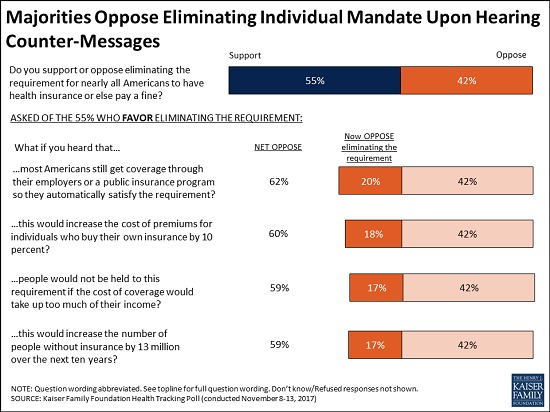
The new poll finds that most Americans (55%) initially support eliminating the mandate as part of tax reform, while four in 10 (42%) oppose it. Most Republicans (73%) and independents (58%) support ending the mandate, while most Democrats (59%) oppose it.

These views are malleable, with about a third of supporters (representing a fifth of the public overall) switching to oppose the mandate’s repeal when presented with facts and arguments about who is impacted and potential consequences of its repeal.

For example, the share who oppose eliminating the mandate can rise as high as 62 percent when initial supporters hear that most Americans get coverage through their employers or government programs that meets the mandate’s requirements. Similar majorities ultimately oppose eliminating the mandate when presented with other arguments against it, including that premiums for people who buy their own health insurance would go up, that people are exempted from the mandate if the cost of coverage takes up too much of their income and that getting rid of the mandate would result in 13 million more people being uninsured over the next 10 years, as the Congressional Budget Office has estimated.

One provision in the House bill would eliminate a tax deduction that allows people with high medical costs to deduct any medical and dental expenses that exceed 10 percent of their income.  A majority (68%) of the public – including majorities of Democrats (77%), independents (66%), and Republicans (61%) oppose eliminating the tax deduction for individuals who have high health care costs.

More than four in 10 (44%) of the public think eliminating the deduction for high medical costs will affect them and their families, though in reality a much smaller share of the public uses that deduction in any given tax year. According to the Internal Revenue Service, about 17 percent of taxpayers who file itemized deductions use this deduction (approximately 6% of all taxpayers and 3% of the public).

Looking ahead to the 2018 midterm elections, the public is divided over whether not passing a tax reform plan or not repealing the ACA would be a bigger deal for President Trump and Republicans. Nearly half of the public say it will be a bigger problem if the president and Republicans are unable to pass their tax reform plan (47%), similar to the share who say it will be a bigger problem if they are unable to revive a repeal of the ACA (44%). Republicans are also divided, with similar shares saying   it would be a bigger deal if President Trump and Republicans are unable to repeal the ACA (50%) and if they are unable to pass tax reform (45%).

Designed and analyzed by public opinion researchers at the Kaiser Family Foundation, the poll was conducted from November 8 – 13, 2017 among a nationally representative random digit dial telephone sample of 1,201 adults. Interviews were conducted in English and Spanish by landline (415) and cell phone (786). The margin of sampling error is plus or minus 3 percentage points for the full sample. For results based on subgroups, the margin of sampling error may be higher.

Senate Tax Plan Aims to Repeal Obamacare Mandate

The Obamacare repeal debate is on again. Senate Republicans decided on Tuesday to include the elimination of the Affordable Care Act’s individual mandate in their tax plan, a risky move that would raise hundreds of billions of dollars to help pay for their desired tax cuts but is also sure to reignite intense clashes over health care coverage. Here’s a quick look at this latest twist in the tax reform effort:

Why They’re Doing It: Repealing the mandate, which requires individuals to buy health insurance or pay a penalty, helps solve the difficult math problems Senate tax-writers faced. The Senate tax bill can add up to $1.5 trillion to the debt over 10 years, and it can’t add to the deficit after that period. President Trump and some Senate Republicans had urged that the mandate repeal be included in the tax plan since it saves a projected $338 billion over 10 years, according to the Congressional Budget Office.

“Repealing the mandate pays for more tax cuts for working families and protects them from being fined by the IRS for not being able to afford insurance that Obamacare made unaffordable in the first place,” Sen. Tom Cotton (R-AR), who had proposed the move, said after the decision was announced. And if the repeal passes as part of a tax cut package, Trump and congressional Republicans would deliver on two promises to voters in one bill.

What It Means: Repealing the mandate may help Republicans chalk up a big win on taxes, but it also comes at a cost. The move raises revenue because it would lead to 13 million fewer people having health insurance, according to the CBO, and thus reduces the amount the government must shell out for insurance subsidies and care. Analysts also warn that, without the mandate, premiums will rise and some insurers might not participate in Obamacare markets that require them to cover pre-existing conditions. “Eliminating the individual mandate by itself likely will result in a significant increase in premiums, which would in turn substantially increase the number of uninsured Americans,” a coalition of insurers, hospitals and doctors wrote in a letter to congressional leaders on Tuesday.

Those expected effects carry significant political risk. For one thing, it could reawaken the liberal base that mobilized so effectively against Obamacare repeal and turn their focus to the tax bill. Michael Linden, a liberal policy expert, tweeted that “Reducing the corporate tax rate to 23% instead of 20% generates the SAME savings as repealing the ACA mandate. They could cut taxes for corporates just a little less, but instead they’re cutting health care.” Democratic leaders are already slamming the decision. “Republicans just can’t help themselves,” Sen. Chuck Schumer said. “They’re so determined to provide tax giveaways to the rich that they’re willing to raise premiums on millions of middle-class Americans and kick 13 million people off their health care.”

Will It Pass? A “skinny” Obamacare repeal bill that would have eliminated the individual mandate failed in the Senate in July when Republican Sens. John McCain, Lisa Murkowski and Susan Collins voted against it. But Senate Majority Leader Mitch McConnell told reporters that including the repeal provision would make it easier for the tax bill to pass. As part of the deal, the Senate would also reportedly vote on another bill to restore federal payments to insurers that the president had halted last month. Sen. John Thune (R-SD) said that a whip count had been done and expressed confidence that Republicans had the 50 votes they need.

How the elections could put the brakes on anti-ACA plans

https://www.axios.com/how-the-elections-could-put-the-brakes-on-anti-aca-plans-2508099820.html

Image result for How the elections could put the brakes on anti-ACA plans


The most important issue in an election is sometimes, but seldom, the factor that actually determines the outcome of the election. That’s what we saw happen in Virginia this week. Health was the top issue in the Virginia race, according to exit polls, but it was only one of many factors that drove the election.

The bottom line: The election may have been more of a referendum on President Trump than health care — but the results in Virginia and in the Maine referendum on Medicaid expansion will still have a practical impact on what happens next, including the appetite for Affordable Care Act repeal and for cutting Medicaid to pay for tax cuts.

The details: Voters in Virginia named health care as far and away their top issue in the election in the network exit poll. It’s not surprising that the issue was at the top of their minds; they have been hearing all about the ACA in the news for months and about Medicaid expansion in their state.

Yes, but: Notably, the exit poll did not include the economy on the list of issues voters could choose. Fox News did ask about the economy and, as the chart shows, it and health were statistically tied in their poll.

Between the lines: When voters rank health care as a top issue in an election, it does not necessarily mean health care drove their vote. Voters’ views of the candidates themselves are generally a bigger factor. The candidates were also proxies for voters’ feelings about President Trump, and many more voters in Virginia said they were voting to express opposition to Trump than their support for him (34% vs. 17%).

Most voters who chose health care as their top issue in Virginia voted for Northam, possibly signaling that Democrats may be able to campaign on health care and the ACA in upcoming elections.

What to watch: The Maine vote on Medicaid expansion was a different story. Maine voters cast their ballots on a specific referendum to expand the Medicaid program, and it won resoundingly. The result speaks to a lesson learned in the repeal and replace debate: Medicaid and Medicaid expansion are far more popular than Republicans seem to think they are, largely because Medicaid now covers 74 million Americans and matters to a broad cross section of the American people.

The impact: The immediate political implication is that it will be much tougher to cut Medicaid to help pay for tax cuts. Another lesson is that expanding Medicaid could be a winner in other states, especially with the federal government picking up 90 percent of the costs and the Trump administration ready to let red states put a conservative stamp on their programs. Medicaid is not Social Security or Medicare yet, but politically it is a lot closer than Republicans may realize.

A lot can and probably will happen between now and 2018. But for now, the prominence of health care in the Virginia election could throw a scare into moderate Republicans about continuing to pursue ACA repeal. And the Maine referendum on Medicaid expansion could make them more cautious about cutting Medicaid.

Medicaid Is Great, but Rural Maine Needs Hospitals, Too

Image result for rural hospital

This week Maine voted to become the 32nd state to expand Medicaid despite opposition by Gov. Paul LePage, who had vetoed five previous expansion bills passed by the state legislature and has now threatened to block the results of the ballot initiative. Unless Mr. LePage succeeds, about 80,000 more Mainers will be eligible for coverage, a victory in an unsettling year for health care in America.

With the Affordable Care Act under constant threat from the Trump administration and out-of-pocket costs rising faster than wages, health care topped the list of the most important issues facing Americans this year.

However, Maine and other rural states face a health care crisis that Medicaid expansion can’t fix on its own. It’s not about affordable coverage; it’s about access: For too many rural areas, doctors and hospitals are scarce.

In the postwar era, America made hospital construction and modernization a priority. On Aug. 13, 1946, Harry Truman signed the Hill-Burton Act,giving communities grants and loans for hospital construction. By 1975, almost one-third of American hospitals owed their creation to the law. Financing for Hill-Burton health care construction ended in 1997, but one rule from the original bill still applied: These hospitals had to give free or reduced care to people who couldn’t afford services. As rural areas aged and the population shrank because of manufacturing’s decline and the rise of a technology-driven economy centered on urban areas, hospitals struggled to stay in operation.

Under the Affordable Care Act, hospitals started shutting down at worrisome rates because of an increase in financial penalties for noncompliance with A.C.A. mandates, the cost of tighter reporting standards and smaller reimbursements for certain procedures. Since the A.C.A. became law in 2010, over 80 rural hospitals have closed nationwide. Maine alone has lost three hospitals in that time, about 10 percent of its rural total.

If closings continue at this rate, 25 percent of America’s rural hospitals will have disappeared in the decade after Obamacare’s passage. This does not take into account facility deterioration, doctor departures or department closures.

This is a big problem for Maine, which has the highest percentage of rural residents in the country, according to the most recent census data. Calais Regional Hospital in Down East Maine recently oversaw its last childbirth. The obstetrics department closed in late summer, forcing women in labor to drive 50 minutes to deliver their babies. Despite an opioid crisis that increases the chance of high-risk pregnancies, this same privately owned hospital shut down its pediatrics wing and intensive care unit in recent years, because of financial pressure from the management company halfway across the country in Tennessee.

This was hardly an isolated example in Maine. The town of Jackman closed its 24-hour emergency room in September, and Boothbay lost its only hospital in 2013. Rangeley, where my wife’s family lives, is an hour away from the nearest hospital and has no doctor in town.

Meanwhile, Maine Med in Portland, Maine’s largest city, is about to break ground for a $512 million addition just a few years after it finished a $40 million renovation. While rural Maine’s hospitals and departments are closing because of large losses, Maine Med had, for 2016, a $61 million surplus.

Medicaid expansion is a welcome source of new revenue to rural hospitals in Maine because more insured patients mean fewer uncompensated treatments. Still, it comes nowhere close to fixing the problem or, politically, putting any meaningful points on the Democratic scoreboard.

In 2016, Donald Trump won Maine’s rural congressional district by a 10-point margin and rural counties in America at large by a 26-point marginon a message of repealing and replacing Obamacare. As Maggie Elehwany of the National Rural Health Association said in an NPR interview this year, rural Americans voted for Mr. Trump in part because of health care. “They see their hospitals closing,” she noted. “And one hospital C.E.O. described it as a three-pronged stool. It’s the churches, the hospitals and the schools. If you lose one of those legs of that stool, the whole community collapses.”

Since President Trump hasn’t been able to deliver on any meaningful legislation to support rural voters, it is the Democrats’ time to deliver. One good step is a bill sponsored by the Democratic senators Tim Kaine of Virginia and Michael Bennet of Colorado called Medicare-X. It would give a public option to Americans in rural counties where limited competition has yielded higher-priced health insurance options.

It still doesn’t solve the heart of the rural problem. Democrats can’t just lower premiums and expand Medicaid. We must strengthen rural communities by making access to high-quality health care services a priority of any proposal. In any future legislation, we should demand grants for new hospitals, funds to modernize crumbling ones and financial incentives for top doctors to work in these areas. This will not only make rural communities healthier, but also more welcoming for growth and new business.

No person suffering from a heart attack should die because a hospital is too far. No pregnant mother should have to risk the health of her baby because she can’t make it to a delivery room in time. As Democrats, we believe that health care is a right. It would be a big mistake to expand health care insurance but offer no place to use it.