Trump Acting Solo: What You Need To Know About Changes To The Health Law

https://khn.org/news/trump-acting-solo-what-you-need-to-know-about-changes-to-the-health-law/

Apparently frustrated by Congress’ inability to “repeal and replace” the Affordable Care Act, President Donald Trump this week decided to take matters into his own hands.

Late Thursday evening, the White House announced it would cease key payments to insurers. Earlier on Thursday, Trump signed an executive order aimed at giving people who buy their own insurance easier access to different types of health plans that were limited under the ACA rules set by the Obama administration.

“This is promoting health care choice and competition all across the United States,” Trump said at the signing ceremony. “This is going to be something that millions and millions of people will be signing up for, and they’re going to be very happy.”

The subsidy payments, known as “cost-sharing reductions,” are payments to insurers to reimburse them for discounts they give policyholders with incomes under 250 percent of the federal poverty line, or about $30,000 in income a year for an individual. Those discounts shield these lower-income customers from out-of-pocket expenses, such as deductibles or copayments. These subsidies have been the subject of a lawsuit that is ongoing.

The cost-sharing reductions are separate from the tax credit subsidies that help millions of people pay their premiums. Those are not affected by Trump’s decision.

Some of Trump’s actions could have an immediate effect on the enrollment for 2018 ACA coverage that starts Nov. 1. Here are five things you should know.

1. The executive order does not make any immediate changes.

Technically, Trump ordered the departments of Labor, Health and Human Services and Treasury within 60 days to “consider proposing regulations or revising guidance, to the extent permitted by law,” on several different options for expanding the types of plans individuals and small businesses could purchase. Among his suggestions to the department are broadening rules to allow more small employers and other groups to form what are known as “association health plans” and to sell low-cost, short-term insurance. There is no guarantee, however, that any of these plans will be forthcoming. In any case, the process to make them available could take months.

2. The cost-sharing reduction changes ARE immediate but might not affect the people you expect.

Cutting off payments to insurers for the out-of-pocket discounts they provide to moderate-income policyholders does not mean those people will no longer get help. The law, and insurance company contracts with the federal government, require those discounts be granted.

That means insurance companies will have to figure out how to recover the money they were promised. They could raise premiums (and many are raising them already). For the majority of people who get the separate subsidies to help pay their premiums, those increases will be borne by the federal government. Those who will be hit hardest are the roughly 7.5 million people who buy their own individual insurance but earn too much to get federal premium help.

Insurers could also simply drop out of the ACA entirely. That would affect everyone in the individual market and could leave some counties with no insurer for next year. Insurers could also sue the government, and most experts think they would eventually win.

3. This could affect your insurance choices for next year. But it’s complicated.

The impact on your plan choices and premiums for next year will vary by state and insurer. For one thing, insurers have a loophole that allows them to get out of the contracts for 2018, given the change in federal payments. So, some might decide to bail. That could leave areas with fewer — or no — insurers. The Congressional Budget Office in August estimated that stopping the payments would leave about 5 percent of people who purchase their own coverage through the ACA marketplaces with no insurers in 2018.

For everyone else, the move would result in higher premiums, the CBO said, adding an average of about 20 percent. In some states, regulators have already allowed insurers to price those increases into their 2018 rates in anticipation that the payments would be halted by the Trump administration.

But how those increases are applied varies. In California, Idaho, Louisiana, Pennsylvania and South Carolina, for example, regulators had insurers load the costs only onto one type of plan: silver-level coverage. That’s because most people who buy silver plans also get a subsidy from the federal government to help pay their premium, and those subsidies rise along with the cost of a silver plan.

Consumers getting a premium subsidy, however, won’t see much increase in their out-of-pocket payments for the coverage. Consumers without premium subsidies will bear the additional costs if they stay in a silver plan. In those states, consumers may find a better deal in a different metal-band of insurance, including higher-level gold plans. Many states, however, allowed insurers to spread the expected increase across all levels of plans.

4. Congress could act.

Bipartisan negotiations have been renewed between Sens. Lamar Alexander (R-Tenn.) and Patty Murray (D-Wash.) to create legislation that would continue the cost-sharing subsidies and give states more flexibility to develop and sell less generous health care plans than those currently offered on the exchanges. Trump’s move to end the cost-sharing subsidies may bolster those discussions.

In a statement, Murray called Trump’s action to withdraw cost-sharing subsidies “reckless” but said she continues “to be optimistic about our negotiations and believe we can reach a deal quickly — and I urge Republican leaders in Congress to do the right thing for families this time by supporting our work.”

Trump on Friday urged Democrats to work with him to “make a deal” on health care. “Now, if the Democrats were smart, what they’d do is come and negotiate something where people could really get the kind of healthcare that they deserve, being citizens of our great country,” he said Friday afternoon.

Earlier Friday, Senate Minority Leader Chuck Schumer (D-N.Y.) did not sound as if he was in the mood to cut a deal.

“Republicans have been doing everything they can for the last ten months to inject instability into our health care system and to force collapse through sabotage,” he said in a statement. “Republicans in the House and Senate now own the health care system in this country from top to bottom, and their destructive actions, and the actions of the president, are going to fall on their backs. The American people see it, and they know full well which party is doing it.”

poll released Friday by the Kaiser Family Foundation shows that 71 percent of the public said they preferred that the Trump administration try to make the law work rather than to hasten replacement by encouraging its failure. The poll was conducted before Trump made his announcement about the subsidies. (Kaiser Health News is an editorially independent program of the foundation.)

5. Some states are suing, but the outcome is hard to guess.

Even though all states regulate their own insurance markets, states have limited options for dealing with Trump’s latest move. Eighteen states and the District of Columbia, led by New York and California, are suing the Trump administration to defend the cost-sharing subsidies. But it is unclear whether a federal court could say that the Trump administration is obligated to continue making the payments while that case is pending.

 

No rush to stabilize ACA markets


President Trump’s decision to cut off the Affordable Care Act’s cost-sharing reduction subsidies doesn’t seem to have added much new urgency to the push to stabilize states’ insurance markets — which would likely include a guarantee to keep the subsidy payments flowing.

  • Bad sign: GOP Senate leadership didn’t talk about the CSR issue at all last night in their weekly meeting, at least while staff was in the room, a senior aide told Axios’ Caitlin Owens. To them, it’s still all about tax reform.
  • “They’re focused on tax reform,” Alexander, who’s been spearheading the stabilization effort, said of GOP leaders. “What I’ve asked the Republican leadership to do is to give us a chance to see if we can develop consensus among Republicans as well as Democrats.”
  • “The sooner the better,” Alexander said. “We want whatever agreement we have to benefit people in 2018 by holding down increasing premiums and to lower them in 2019.”

Yes, but: Affecting 2018 premiums will be a tough task — the window to begin signing up for 2018 coverage begins in two weeks.

  • Pennsylvania regulators announced yesterday that they’ve approved new premium hikes, more than 20% higher than the increases that were already on the books, because of the loss of CSR subsidies.
  • If Congress reaches a deal in time, one senior GOP aide told Caitlin, states and insurers could look to options such as rate re-filings and rebates to help consumers next year.
  • But the Kaiser Family Foundation’s Larry Levitt said turbulence for 2018 will likely be minimal. Most insurers had already planned for the payments to end, and therefore don’t need to make any changes.
  • The Trump administration appears to be allowing new increases by insurers that didn’t plan for CSR payments to disappear, Levitt said.
  • “Terminating the CSR payments is producing a lot of confusion, but the market will operate reasonably fine and the effect on consumers will be modest,” Levitt said. “If this was intended to end Obamacare, it’s probably not going to work. The real question at this point is the longer term effect of the administration’s overall strategy to undermine the marketplaces.”
One more problem: Even if a deal is struck, and it could muster 60 votes in the Senate, there’s a very real question of how it passes. Voting on the bill by itself, without being part of a larger package, would be difficult for Republicans. Most legislation that needs to get passed before the end of the year is expected to be clumped into one big bill in early December.

Tough decisions loom for Dems on ObamaCare

Tough decisions loom for Dems on ObamaCare

Image result for Deal No Deal


Congressional Democrats have to decide how badly they want an ObamaCare deal.

Senate Republicans are open to renewing the insurer payments that President Trump canceled last week, but, in return, they want to expand a program that allows states to waive Affordable Care Act regulations.

That asking price could be hard for Democrats to swallow.

While Democrats want to protect ObamaCare, they fear that expanding the waivers would allow states to chip away at the bedrock protections of the law, including the rules on what an insurance plan must cover.

The politics of the health-care debate are also shifting.

While ObamaCare used to be a liability for Democrats, a Kaiser Family Foundation poll in August found that 60 percent of respondents think Republicans are responsible for problems in the Affordable Care Act going forward. Only 28 percent said the responsibility rests with Democrats.

Polls like that make some Republicans nervous about an ObamaCare backlash in the 2018 elections. And Democrats, hopeful of winning back the House and potentially even the Senate next year, are eager to hang ObamaCare’s problems around the GOP’s neck.

“Republicans in the House and Senate now own the health-care system in this country from top to bottom, and their destructive actions, and the actions of the president, are going to fall on their backs,” Senate Minority Leader Charles Schumer (D-N.Y.) said on Friday.

Negotiations over an ObamaCare bill have been going on for weeks, with Sens. Lamar Alexander (R-Tenn.) and Patty Murray (D-Wash.) seeking an agreement to stabilize the markets and protect people’s coverage options.

Democrats say they are pushing for a deal, and Murray said Friday she was “optimistic” that one could be reached.

Trump’s decision to cancel the payments to insurers added fresh urgency to the talks. Health-care experts warn the loss of the payments — meant to offset the cost of insuring some lower-income people — could cause insurers to flee the system before open enrollment begins Nov. 1.

Several Republicans have said they are worried their constituents will be hurt by a collapse of the marketplaces, seemingly bolstering the talks.

But it’s far from clear that any ObamaCare deal reached by the Senate can become law.

Speaker Paul Ryan (R-Wis.) said last month that an Alexander-Murray deal is “not viable” for the House GOP.

And Trump on Monday sent mixed signals about whether he’d be willing to sign a bill reviving the ObamaCare payments.

The president declared that ObamaCare is “dead” and boasted that he had ended the “gravy train” of payments to insurers, causing their stock prices to drop.

“Hundreds of millions of dollars a month handed to the insurance companies for very little reason, believe me. I want the money to go to the people. … I want the money to go to people that need proper health care, not to insurance companies, which is where it’s going as of last week. I ended that,” he said.

Yet Trump also seemed to endorse the Alexander-Murray talks, stating that the two parties are “meeting right now and right now they’re working on something very special.”

“I do believe we’ll have a short-term fix because I think the Democrats will be blamed for the mess. This is an ObamaCare mess,” he said.

Sen. Lindsey Graham (R-S.C.), who golfed with Trump over the weekend, said on CBS on Sunday that Trump had spoken with Alexander and that Trump is open to a deal to continue the cost-sharing reduction payments if there is enough flexibility for the states.

“We are willing to work with Congress  to reach a legislative solution,” a White House aide said. “We will not provide bailouts to insurance companies until we provide the American people with relief from the ObamaCare disaster.”

Schumer said  on Monday in a written statement that he welcomes Trump’s support for a deal.

“I’m hopeful that we are nearing an agreement that makes clear that we have no intention of supporting the president’s efforts at sabotage,” he said. “If he’s now supportive of an agreement that stabilizes and improves the existing system under the Affordable Care Act, we certainly welcome that change of heart.”

The negotiations have been hung up on the question of how far to go in waiving ObamaCare’s regulations.

Republicans say it is not enough to speed up the process for a state to get a waiver; instead, the scope of the waivers must be broadened.

Alexander says he has agreed to fund two years of the ObamaCare payments, known as cost-sharing reductions, which is more than his original offer of one year. He says Democrats need to give up something in return.

Democrats argue that they have already made significant concessions, including agreeing to expand low-cost “copper” health insurance plans, streamlining the waiver process by letting states choose from a “menu” of options and allowing insurers to charge higher out-of-pocket costs for some services.

Asked Monday if he wanted more flexibility for states than Democrats are willing to give, Alexander replied, “I want as much as we can get.”

“I mean, I would like to repeal and replace ObamaCare, and Sen. Murray would like to keep it intact, but that’s not how you make a compromise,” he said.

Alexander said Trump has encouraged him to make a deal, as has Schumer.

“I find that very encouraging, that both the president and Sen. Schumer encouraged me to do something,” Alexander said.

Still, he declined to put any timetable on when an agreement could be reached.

States have already tried Trump’s health care order. It went badly.

https://www.brookings.edu/blog/up-front/2017/10/13/states-have-already-tried-trumps-health-care-order-it-went-badly/?utm_campaign=Brookings%20Brief&utm_source=hs_email&utm_medium=email&utm_content=57417795

Image result for Cherry Picking

Even after Republicans in Congress failed three times to rid themselves of the Affordable Care Act, President Trump has proved that there is no shortage of ideas for how to disrupt the health-care system.

Like many appealing ideas, this one, proposed by Sen. Rand Paul (R-Ky.), has hidden land mines that are already well-mapped out based on previous failed attempts to enact them, even in Paul’s home state of Kentucky.The president signed an executive order Thursday that will allow small employers to join associations of small business — such as farm bureaus or chambers of commerce — that provide health coverage to their members. If such associations self-insure, existing law might enable them to avoid both state insurance regulations and the core of the ACA. Thus, a simple turn of the regulatory dials could free up a large portion of the most heavily regulated parts of the health-insurance market.

A version of these self-insured association health plans first became widespread in the 1980s, but they failed in droves because many were undercapitalized. More troubling, these earlier association plans had a history of becoming what the Labor Department termed “scam artists” and the Government Accountability Office reported were “bogus entities [that] have exploited employers and individuals seeking affordable coverage.” More than two dozen states reported in 1992 that these early association plans had committed “fraud, embezzlement or other criminal law” violations.

We might avoid such a fate by requiring groups to register and meet adequate solvency and consumer-protection standards. But that doesn’t solve the more ominous aspect of association health plans: market destabilization.

Because less-regulated association health plans compete with fully regulated markets, actuaries and regulators have long warned that association plans create an uneven playing field that can disrupt markets. People who don’t need to cover preexisting conditions or don’t want to pay community rates gravitate to the better deals offered by associations, leaving sicker people in the regulated markets. Naturally, regulated insurance prices increase as a result, sometimes causing a death spiral that crashes the market.

We could avoid such market disruption by making association health plans abide by the same regulations that govern individuals and small groups, but the whole point of Trump’s executive order is to sidestep existing regulations. The only other option for avoiding market disruption is to keep association plans separate from the regular market by ensuring that people cannot simply choose between association plans and regulated insurance based solely on their health status.That’s just what happened in Kentucky in the 1990s when it reformed its individual market but exempted association plans from the reforms. Enrollment with associations shot up, and most insurers selling in the regulated market pulled out. Within two years, the state repealed its reforms. Association health plans were only one part of Kentucky’s failed market reforms, but they are still a major reason why the so-called Kentucky disaster now serves as a lesson for other states to avoid similar measures.

Employer groups avoid this kind of adverse selection because people can’t just pick an employer simply to get the health insurance they want. But many association health plans allow just that. You don’t need to be a farmer to join the Farm Bureau, and business associations can be open to any person that files a Schedule C tax form. Some groups have such skimpy fig leaves for membership qualification that they are criticized as “air breather” associations — that is, the only commonality among their members is their dependency on oxygen.

Federal and state law attempts to avoid this by exempting associations from insurance regulations only if they are “bona fide,” meaning that obtaining insurance is not the reason people join them. But as regulators will tell you, that criterion is not easy to enforce, which is why the hot potato of association “bona fides” is regularly tossed back and forth among states, insurers and the Labor Department .

Despite this troubled history, association health plans have an important place in, and alongside, regulated health-insurance markets. Still, their history counsels caution in freely expanding that role. These plans should succeed based on delivering superior value rather than serving as a vehicle to cherry-pick regulations they do and don’t want to follow. For that to happen, association health plans need a set of carefully considered rules based on lessons from the past, rather than naive belief in a quick fix.

Trump healthcare order could run afoul of retirement plan law

http://www.reuters.com/article/us-usa-healthcare-lawsuits-analysis/trump-healthcare-order-could-run-afoul-of-retirement-plan-law-idUSKBN1CH0DR

Image result for Retirement Savings

President Donald Trump’s plan to make it easier for small businesses to band together and buy stripped-down health insurance plans could violate a federal law governing employee benefit plans and will almost certainly be challenged in court, legal experts said.

U.S. President Donald Trump speaks about tax reform in Harrisburg, Pennsylvania, U.S., October 11, 2017. REUTERS/Joshua Roberts

Trump signed an executive order on Thursday aimed at letting small businesses join nationwide associations for the purpose of buying large-group health plans that are not subject to coverage requirements of the Affordable Care Act, commonly known as Obamacare.

Industry experts said Trump’s order could ultimately enable such associations to purchase insurance from states with the fewest regulations. That would undermine Obamacare, former Democratic President Barack Obama’s signature healthcare law, which Republicans have failed to repeal.

Several healthcare and employment law experts said if Trump’s plan moves forward, states could argue the federal government had overstepped its authority in violation of the U.S. Employee Retirement Income Security Act (ERISA), a law that governs large-group plans.

In Thursday’s order, Trump asked the Department of Labor to propose rules that would allow more employers to participate in association health plans. Legal experts said lawsuits might not be brought until such regulations are issued.

Dania Palanker, an assistant research professor at Georgetown University’s Center on Health Insurance Reforms, said ERISA granted states the right to regulate association health plans.

Attorneys general could argue the federal government had overreached if the Trump administration winds up allowing associations to buy health coverage across borders that only complies with a single state’s regulations.

”Any attempt to allow the sale of association plans to small groups across state lines will be open to legal scrutiny as to whether it is violating ERISA and undermining state authority,” said Palanker.

‘PREPARED TO FIGHT’

A White House official said that “departments will be drafting rules in a way that minimizes litigation risk.”

The Department of Labor “will be reviewing ERISA in the course of following the President’s direction” in the order, the official said.

A number of state attorneys general from Democratic-leaning states said on Thursday they would fight any efforts to weaken Obamacare, which extended health insurance to 20 million Americans, but which Republicans call intrusive and ineffective.

“It should come as no surprise that California is prepared to fight in court to protect affordable healthcare for its people,” said Xavier Becerra, the state’s Democratic attorney general.

Legal experts said states may argue the associations formed for the purpose of buying insurance are not employers under ERISA.

Although ERISA allows associations to qualify as employers and manage large-group plans, federal regulators have generally required that members of such associations have a high degree of common interest beyond buying insurance, said Allison Hoffman, a professor at the University of Pennsylvania School of Law.

Trump’s order asks the secretary of labor, who enforces ERISA, to consider expanding the common-interest requirements to permit broader participation in association health plans.

SHORT-TERM PLANS

The idea of expanding association health plans across state lines has long been championed by Republican U.S. Senator Rand Paul, who made it a key plank of his own proposal to repeal and replace Obamacare. The Kentucky Republican was at Trump’s side when the president signed the executive order.

Paul’s proposal said ERISA was too restrictive in its definition of associations and that the law needed to be amended.

Thursday’s order also asked the Labor, Treasury and Health and Human Services Departments to look into expanding participation in cheaper, bare-bones, short-term limited-duration insurance plans, which are not subject to the ACA.

Timothy Jost, a professor at the Washington and Lee University School of Law, said such a move would face fewer legal hurdles than the expansion of association health plans.

The current three-month limitation on the use of such plans was a rule adopted by the Obama administration last year, so the Trump administration could roll it back through the normal rulemaking process.

Such plans are typically marketed to individuals who are between jobs or have a gap in coverage. They are much cheaper than ACA plans, but cover less and can exclude those with pre-existing conditions.

In New Test for Obamacare, Iowa Seeks to Abandon Marketplace

Image result for In New Test for Obamacare, Iowa Seeks to Abandon Marketplace

With efforts to repeal the Affordable Care Act dead in Congress for now, a critical test for the law’s future is playing out in one small, conservative-leaning state.

Iowa is anxiously waiting for the Trump administration to rule on a request that is loaded with implications for the law’s survival. If approved by the federal Centers for Medicare and Medicaid Services, it would allow the state to jettison some of Obamacare’s main features next year — its federally run insurance marketplace, its system for providing subsidies, its focus on helping poorer people afford insurance and medical care — and could open the door for other states to do the same.

Iowa’s Republican leaders think their plan would save the state’s individual insurance market by making premiums cheaper for everyone. But critics say the lower prices come at the expense of much higher deductibles for many with modest incomes, and that approval of the plan would amount to another way of undermining the law. Already the administration has slashed funding for advertising and outreach to help people sign up for insurance, and President Trump is preparing to issue an executive order allowing more access to plans that don’t meet the law’s standards.

Adding to the uncertainty, the Washington Post reported last week that Mr. Trump in August asked Seema Verma, the federal official in charge of reviewing Iowa’s plan, to reject it. Some supporters of the law saw that as a deliberate effort to keep premiums high; Mr. Trump frequently cites sharply rising premiums as proof that the health law is failing.

Neither C.M.S. nor the White House would comment on whether Mr. Trump had pushed for the application to be denied. A spokeswoman for C.M.S. said only that the plan remains under review.

In Des Moines on Tuesday, Gov. Kim Reynolds told reporters that her team was in constant contact with the White House and C.M.S. about the plan, including a call with Ms. Verma this week, trying “to get to yes.” She said the administration has been “very receptive” to the plan as a solution to the “unaffordable,” “unworkable” health law until it can be repealed.

Iowa calls its request a stopgap plan that would allow the state to opt out of the federal health insurance marketplace, HealthCare.gov, for 2018 and create a state-run system that its insurance commissioner says would lower premiums for the 72,000 Iowans who currently have Obamacare health plans, including 28,000 who earn too much to get subsidies to help with the cost.

But the cheaper premiums would come with a big trade-off: higher out-of-pocket costs. The only option for customers would be a plan with deductibles of $7,350 for a single person and $14,700 for a family. The proposal would also reallocate millions of federal dollars that the health law dedicates to lowering costs for people with modest incomes and use the money for premium assistance to those with higher incomes, no matter how much money they make.

The individual insurance market is particularly fragile in Iowa, partly because the state has allowed tens of thousands of people to keep old plans that do not meet the health law’s standards. Aetna and Wellmark Blue Cross & Blue Shield, the state’s most popular insurer, are both withdrawing at the end of the year. The only insurer planning to remain, Medica, is seeking premium increases that average 56 percent, blaming Mr. Trump’s ongoing threats to stop paying subsidies known as cost-sharing reductions that lower many people’s deductibles and other out-of-pocket costs. Wellmark has said it will stay if the stopgap plan is approved.

“What we are trying to address is a really large number of people being priced out,” said Doug Ommen, the state’s Republican insurance commissioner.

Two other states, Alaska and Minnesota, have already won permission to shore up their Obamacare markets with waivers allowed under the law; they will use federal money to help insurers cover the claims of their most expensive customers next year. But Oklahoma abruptly withdrew a similar request in late September — one that state officials said would have reduced premiums by an average of 30 percent — saying that the Trump administration had reneged on a promise to approve it by Sept. 25 and they were out of time. (A C.M.S. spokeswoman said, “At no time was an approval package or an approval date ever agreed upon.”)

Iowa’s waiver request is more far-reaching, providing what Timothy S. Jost, an emeritus professor of health law at Washington and Lee University, has called a “watershed moment” for Obamacare.

“It’s a decision to abandon a number of key principles of the Affordable Care Act,” he said.

Under the law, people who don’t get insurance through work can buy it through the online marketplace. They get federal subsidies to help with the cost if their income is below 400 percent of the poverty level, or about $65,000 a year for a couple. Those whose incomes are below 250 percent of the poverty level — $40,600 a year for a couple — also get cost-sharing reductions.

Iowa’s plan would reallocate much of that federal assistance, using it to provide premium subsidies based on age and income for even the wealthiest individual market customers. It would also be used to create a “reinsurance” program, like Alaska’s and Minnesota’s, to help insurers cover their sickest customers. The law’s essential health benefits and protections for people with pre-existing conditions would remain in place, but every individual market customer would get the same standardized high-deductible plan.

Mr. Jost and other supporters of the law say Iowa’s proposal does not meet the requirements for so-called innovation waivers, including that the coverage they provide must be at least as comprehensive and affordable as Obamacare plans, because poorer people would face higher deductibles and other out-of-pocket costs. That, they say, leaves the plan open to almost-certain legal challenges.

Seemingly acknowledging that problem, Mr. Ommen has tweaked Iowa’s proposal — including with a supplemental filing to the Trump administration on Thursday — to preserve subsidies that reduce out-of-pocket costs for roughly 21,000 low-income Iowans.

But those at slightly higher income levels would lose cost-sharing assistance completely, facing the $7,350 deductible and other out-of-pocket expenses.

“You still have some real problems from the perspective of making sure low-income people can afford coverage,” said Joel Ario, a managing director at Manatt Health who worked on the Affordable Care Act at the Department of Health and Human Services during the Obama administration.

But for the roughly 28,000 Iowans who have Obamacare coverage but earn too much to get subsidies, the need for a shake-up is urgent. And with open enrollment starting in about three weeks, time is of the essence.

Dozens of them, including many farmers, submitted comments to Mr. Ommen or testified at public hearings in favor of the stopgap plan, with many saying they would be forced to drop their insurance next year if it were not approved.

“Fortunately both my husband and I have already prepaid our funeral expenses,” write a woman identified as Nancy K., of Bellevue, who said she could no longer afford her coverage. “Every single item, even our cemetery marker, is paid for or covered for my death in the event that we cannot afford insurance to pay for any so-called catastrophic health care.”

Landi Livingston, whose family raises beef cattle in rural southern Iowa, said she was paying almost $500 a month for a Wellmark plan and dreaded having to switch to Medica next year, with what she assumed would be significantly higher prices.

If the Trump administration approves the state’s request, Ms. Livingston’s premium would likely drop to around $350 a month, according to estimates from the state, saving her $1,800 next year. But her $3,000 deductible would more than double, meaning that if she had high medical expenses she could end up paying more toward those bills.

“I still think it’s the best thing on the table right now,” she said of the stopgap plan. “It’s high time the people in power get this figured out.”

For Tony Ross, a retired paralegal in Des Moines who has a subsidized marketplace plan from Aetna, the stopgap plan would lower his premiums to about $85 a month, from $220, according to the state estimates. But his deductible – currently $750 because his low income qualifies him for cost-sharing reductions – would balloon by almost tenfold. That would mean paying thousands more each year for his expensive blood pressure medication, he said.

“Obviously I need a way lower deductible than $7,350,” said Mr. Ross, 63. “This doesn’t seem like a fair way of fixing things.”


How Trump set up Obamacare to fail

https://www.vox.com/policy-and-politics/2017/10/11/16447504/obamacare-open-enrollment-trump-sabotage

All the ways the Trump administration has made it harder to sign up for health insurance this year.

President Trump hasn’t succeeded in repealing Obamacare yet. But his administration is doing its best to force the law to fail.

The most critical time of the year for the health care law is almost here: open enrollment, when millions of people log on to online marketplaces, check whether they qualify for federal subsidies to help them pay their premiums, and shop for plans. For the past three years, at least 10 million people have gotten insurance that way each year.

But this year, open enrollment is in the hands of a White House that’s openly hostile to the Affordable Care Act — and the Trump administration is taking advantage of the best opportunity it has to undercut the law.

President Trump has said that he wants Obamacare to implode, which he hopes would reignite the stalled congressional effort to repeal it. He isn’t just sitting around waiting for that to happen. His administration halved the length of open enrollment. They slashed spending on advertising and assistance programs. They pulled out of outreach events at the last minute.

The entire health care law could be at stake. Advertising and outreach are primarily targeted to younger and healthier people, who are essential to the law’s goal of affordable insurance coverage for all Americans. If their enrollment drops while older, sicker people keep signing up, premiums are going to increase even more next year.

It’s the start of a death spiral, a self-perpetuating cycle of price hikes and falling enrollment — which is exactly what Trump has said he wants.

“I think what this cumulative activity can do is start that death spiral,” Kathleen Sebelius, President Obama’s health and human services secretary during the ACA’s first open enrollment, told me.

Obamacare supporters are already conceding that as a result of these cuts, they likely won’t be able to match last year’s 12 million sign-ups. “I don’t actually think that’s possible anymore,” Lori Lodes, who worked on Obamacare enrollment in the Obama administration, told me.

We will know by December 15, the end of this year’s open enrollment period, how much the White House has succeeded in gutting Obamacare. By embracing this strategy, the Trump administration has put its political goals ahead of the millions of people who depend on the ACA for insurance.

“I really do think what they want to be able to do is come out on December 16 and say, ‘See, we told you Obamacare is imploding; it’s failing,’” Lodes said. “When the reality is they are going to be responsible because of the decisions they’ve made to undermine open enrollment.”

Open enrollment and outreach, explained

Every fall, the Obamacare insurance marketplaces open for business. People have a few weeks to log on, check out their options, and sign up for coverage. This year, sign-ups start on November 1 and close on December 15.

An entire apparatus exists to support open enrollment. Most states use the federal Healthcare.gov, while a few run their own marketplaces. The feds and some states run call centers, where people can talk to a real person to walk through enrollment. The federal government funds navigator and in-person assistance programs, which set up places where people can get help navigating the sign-up process.

Open enrollment hasn’t technically changed much this year, except it’s been shortened from 12 weeks to six. Otherwise, it’s pretty much the same. Healthcare.gov will still be open. People can still get tax subsidies and shop for coverage. All of the ACA’s regulations, such as protections for people with preexisting conditions and the requirement that insurers cover essential health benefits, remain in place.

But the mere need to clarify that, yes, Obamacare is still around is a big problem for open enrollment. After eight months of Republicans fighting to repeal it while claiming it’s failing, people like Lodes worry that many Americans think the law either is already gone or won’t be around for much longer.

Which is why outreach is so important.

The Obama administration went all out every year to promote open enrollment. President Obama appeared on late-night TV and viral online shows. The administration recruited celebrities to star in ads or highlight open enrollment on social media. Senior officials scrounged for as much money for the navigator program as they could find.

While things didn’t always go smoothly — the launch of Healthcare.gov was a disaster — the efforts helped 12 million people sign up for coverage in 2016. The uninsured rate has dropped to historic lows, and insurers have started to see improved business on the law’s marketplaces.

The key, Lodes said, was blanketing people with information — from television ads and email and text message reminders to working with community-based groups and churches. The biggest barrier was convincing people they could actually afford insurance, once the law’s financial assistance was accounted for.

Outreach works: The Huffington Post reportedrecently that an internal Health and Human Services Department report concluded that 37 percent of sign-ups in the last few months of 2016 could be attributed to outreach.

Trump administration officials have defended their outreach cuts in part by arguing that people are already familiar with Obamacare after three years. “I don’t think we can force people to sign up for a program,” a senior administration official told reporters in August.

But that runs counter to the available evidence. Nearly 40 percent of the US uninsured were still unaware of the marketplaces last year, and almost half did not know they might be eligible for financial assistance, according to surveys by the Commonwealth Fund.

“There is a difference knowing Obamacare is the law and knowing what you should do with that information,” Lodes said, “between knowing you need to sign up in this finite period of time or you do not get health coverage.”

The Obama administration had assumed that older people or people with preexisting conditions who struggled to get insurance before the ACA would be eager to sign up. So they focused their efforts on reaching younger people or people who hadn’t had insurance before. Every year, people turn 26 and roll off their parents’ health insurance, or maybe they get a new job with a higher salary and need to move from Medicaid to private insurance.

Every year, in other words, there are brand new customers for the ACA marketplaces.

“They’re either the least familiar or they are the healthiest. Either way, they either don’t know or don’t believe they need or want health insurance,” Sebelius said. “For somebody to suggest that there is no persuasion needed is just nuts.”

How Trump is sabotaging Obamacare enrollment

Because open enrollment is such a sprawling undertaking, the Trump administration has many tools at its disposal to undermine it and, by extension, the ACA. It seems to be using all of them.

The White House has some minimal requirements under federal law. It must perform outreach and education, it must run a call center, it must have a website where people can enroll, and it must operate a navigator program.

On paper, the Trump administration will do each of those things. But each is facing significant cuts. Together, they add up to a clear picture of an administration using every means available to drop support for ACA enrollment:

  1. Just a few weeks into the Trump administration, HHS announced it would reduce open enrollment from 12 weeks to six weeks.
  2. Trump has threatened since the spring to cut off federal payments to health insurers, driving up premiums and leaving some counties at risk of having no insurance options.
  3. Over the summer, Trump administration officials hinted they might not enforce the individual mandate.
  4. In August, HHS said it would cut funding for Obamacare advertising by 90 percent, from $100 million to $10 million.
  5. HHS also said it would cut funding for in-person assistance by 40 percent.
  6. A few weeks later, the department let the in-person assistance budget run out entirely without awarding more money.
  7. Late last month, the administration abruptly pulled out of state-level open enrollment events.
  8. HHS has cut off relationships with Latino groups that had worked with the Obama administration to enroll that population in coverage, Talking Points Memo has reported.

In other words, the Trump administration is cutting funding for outreach, cutting funding for enrollment assistance, and dropping out of partnerships to support enrollment, while shrinking the window for people to sign up for coverage, sowing doubts about whether people will be required to have insurance, and making threats that drive up premiums.

So as Trump claims Obamacare is failing, his administration is setting up a self-fulfilling prophecy.

Obamacare supporters are trying to fill the gaps with grassroots programs like the Get Covered campaign, run by former Obama administration officials. But they do not have the same resources as the federal government.

The ideal TV advertising campaign, for example, would cost about $15 million, said Lodes, who is helping to oversee Get Covered. They already know, with mere weeks left until open enrollment starts, that they will not be able to raise that kind of money, which means the hole left by the Trump administration cutting $90 million from the ACA’s advertising budget will go largely unfilled.

“There is no way that anything we do or anyone else does can fill the footprint of what the admin should be doing,” she said. “They were unable to get repeal passed through the Congress, so they really seem intent to do everything they can do to make sure open enrollment is not successful.”

Weak enrollment is a huge threat to Obamacare’s future

The inevitable result of the Trump administration’s actions will be fewer Americans with health insurance. Last year, 12 million people signed up for coverage through the Obamacare marketplaces. Nobody expects to match that number this year, after open enrollment has been so severely undermined.

“There is no doubt that the actions by the administration will mean that fewer people get covered,” Lodes said.

The number of uninsured Americans will likely tick up from its current historic lows. Hundreds of thousands or even millions will not be financially protected against a medical emergency, and it will be harder for them to afford the routine health care that prevents bigger problems later on. That will have a real effort on people’s lives and financial security.

But falling enrollment also threatens Obamacare’s future.

The law works when younger, healthier people and older, sicker people all sign up for coverage. Insurers need the low-cost patients to help cover the costs of the sicker ones, who are more likely to rack up big medical bills. The ACA has both sticks (the individual mandate) and carrots (cheaper premiums for young people and generous subsidies) to get everybody into the market.

But getting younger and healthier people takes a little more effort. They have been the focus of the outreach that Trump is now cutting.

People who have medical conditions already or who are older and know they may soon need insurance are going to find a way to enroll regardless. But young and healthy people are less likely to think they need insurance. They need some persuading that the ACA’s coverage will help them in an unlikely medical event and that they will be able to afford it, Sebelius and Lodes said.

“The last person to sign up is probably the healthiest person to sign up,” David Anderson, a former insurance industry official who now researches at Duke University, told me.

With a sicker pool left behind, health insurers are likely to either increase premiums even more next year or leave the market altogether. Plans have already cited the marketing cuts as one reason for increased premiums in 2018. And the higher premiums get, the more difficult it is to persuade young and healthy people to pay the price.

If sign-ups plummet — which even Obamacare supporters expect after the Trump administration has done so much to undermine open enrollment — the law’s future will be in serious peril.

“What that means over the long term is the health of the marketplace is at risk,” Lodes said.

No matter what the president says, Obamacare isn’t failing yet. But his administration is trying as hard as it can to make those words a reality.

Who will pay more without CSR subsidies

https://www.axios.com/vitals-2497054515.html

Good morning … Last week gave us an executive order and an end to cost-sharing payments. Can’t wait to find out what the health policy universe has in store for us this week.

Who will pay more without CSR subsidies

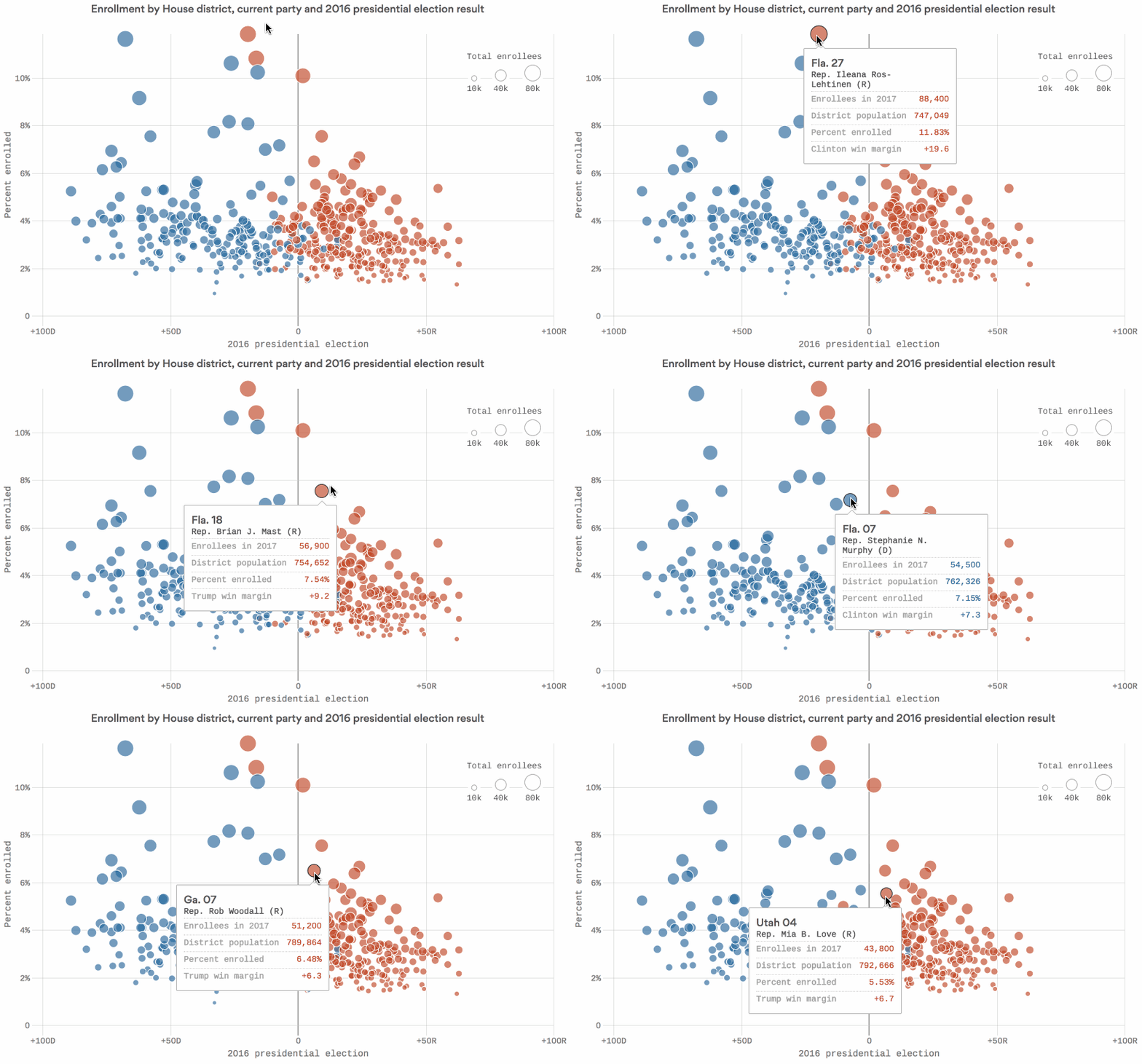
Data: Kaiser Family Foundation; Daily Kos Elections; Census Bureau; Chart: Chris Canipe / Axios

The Trump administration’s decision to stop paying the Affordable Care Act’s cost-sharing reduction subsidies will affect ACA customers in Republican-leaning congressional districts as well as Democratic ones. Here’s a look at how many people could feel the impact in districts that voted for President Trump, compared with those in districts that voted for Hillary Clinton.

The details: This year, 11.1 million people were enrolled in ACA marketplace plans or in a Basic Health Plan created by the law. Of those, 5.9 million live in Republican-held congressional districts and 5.2 million live in districts held by Democrats, per the Kaiser Family Foundation.

The impact: The CSR subsidies are going to 58% of the people who are enrolled in ACA marketplace plans. In all, about 7 million people don’t receive any financial assistance with their premiums, so they’d pay the full cost when health insurance companies raise their rates. But others could be affected if health insurers decided to pull out of the markets rather than deal with the instability.

The flaws in Trump’s legal rationale

There are broader implications of the Trump administration’s decision to lean so heavily on a legal rationale for cutting off the CSR subsidies: institutional divisions between the executive and legislative branches.

Between the lines: The White House said it was ending the payments in part because of a ruling last spring that said it was unconstitutional to make the payments without an explicit appropriation from Congress. As part of that process, Attorney General Jeff Sessions wrote a memo saying, in effect, there was no point appealing that ruling.

  • “Opening the door to lawsuits initiated by Congress over the specifics of how the executive branch spends tax dollars would be a marked change and a potential threat to the White House,” the New York Times’ Carl Hulse noted over the weekend.
  • Trump might particularly wish he hadn’t conceded that point if Democrats retake control of the House and/or Senate while he’s still president. Divided government is how this lawsuit started, after all.

Real talk: Former White House strategist Steve Bannon, speaking at the Values Voters Summit over the weekend, cut to the heart of Trump’s decision: “Not going to make the CSR payments, going to blow that thing up; going to blow those exchanges up, right?”

Administration’s Ending Of Cost-Sharing Reduction Payments Likely To Roil Individual Markets

http://healthaffairs.org/blog/2017/10/13/administrations-ending-of-cost-sharing-reduction-payments-likely-to-roil-individual-markets/

Yesterday, October 12, 2017, the White House press office announced that the administration will no longer be reimbursing insurers for the cost-sharing reductions they are legally required to make for low-income individuals. The Affordable Care Act requires insurers to reduce cost sharing for individuals who enroll in silver plans and have household incomes not exceeding 250 percent of the federal poverty level. These provisions reduce the out-of-pocket limit for these enrollees—particularly for those with incomes below 200 percent of poverty—and sharply reduce deductibles, coinsurance, and copayments. The reductions cost insurers around $7 billion a year currently.

The press secretary’s statement said:

Based on guidance from the Department of Justice, the Department of Health and Human Services has concluded that there is no appropriation for cost-sharing reduction payments to insurance companies under Obamacare. In light of this analysis, the Government cannot lawfully make the cost-sharing reduction payments. The United States House of Representatives sued the previous administration in Federal court for making these payments without such an appropriation, and the court agreed that the payments were not lawful. The bailout of insurance companies through these unlawful payments is yet another example of how the previous administration abused taxpayer dollars and skirted the law to prop up a broken system. Congress needs to repeal and replace the disastrous Obamacare law and provide real relief to the American people.

Acting HHS Secretary Hargan and CMS Administrator Verma issued a similar statement:

It has been clear for many years that Obamacare is bad policy. It is also bad law. The Obama Administration unfortunately went ahead and made CSR payments to insurance companies after requesting—but never ultimately receiving—an appropriation from Congress as required by law. In 2014, the House of Representatives was forced to sue the previous Administration to stop this unconstitutional executive action. In 2016, a federal court ruled that the Administration had circumvented the appropriations process, and was unlawfully using unappropriated money to fund reimbursements due to insurers. After a thorough legal review by HHS, Treasury, OMB, and an opinion from the Attorney General, we believe that the last Administration overstepped the legal boundaries drawn by our Constitution. Congress has not appropriated money for CSRs, and we will discontinue these payments immediately.

The Legal Background

In fact, the ACA requires the federal government to reimburse insurers for these reductions. This is not a bailout. It is rather a statutory obligation of the federal government to pay insurers for services they have provided as required by law. In 2014, the House of Representatives sued the Obama administration in House v. Burwell (now House v. Price) claiming that the cost-sharing reduction (CSR) payments to insurers had never been appropriated by Congress and were thus illegal. A district court judge accepted this argument in the spring of 2016 and enjoined their payment, as President Trump’s statement says, but stayed her order pending appeal. The Obama administration appealed, arguing that there was in fact an appropriation. Until yesterday, the Trump administration had not taken a position on whether there was an appropriation or not.

The appeal is still pending, with the House and the Trump administration having agreed to stay the appeal several times. At the end of August, the D.C. Circuit Court of Appeals allowed 19 state attorneys general to intervene to protect their citizens. For more on the CSR backstory see here and here; for more on the intervention, see here; and for Health Affairs Blog posts on cost-sharing reduction payments, see here.

The Consequences Of Ending The CSR Payments

The effect of terminating the payments has been well analyzed, including a report from the Congressional Budget Office. It will drive up premiums as insurers attempt to cover the cost of the reductions. As premiums go up, so will premium tax credits. Indeed, the government will probably pay more in premium tax credits than it saves in cost-sharing reduction payments. Individuals who earn too much to receive tax credits will be particularly hard hit by the premium increases. Some of these could decide to pursue new forms of coverage that might be made available under the measures announced in President Trump’s October 12 executive order.

Ending the CSR payments could also drive some insurers out of the exchanges. Under their contract with the federal exchange, insurers may terminate participation if cost sharing reduction payments are terminated, but they are still subject to state laws on market withdrawal, which limit their ability to do so. They may not terminate their exchange enrollees unless they fail to pay their premiums, which many likely would do once an insurer left the exchange and premium tax credits were no longer available.

The effect of CSR payment termination, however, will depend heavily on how insurers deal with the change. In several states, including California, insurers have anticipated the termination and have already loaded the lost payments into their on-exchange silver plansIn other states, however, insurers have to date been instructed to assume that the payments will be made, or have been given no instructions whatsoever. In these states, the change is likely to cause considerable confusion. Insurers will have to refile their rates and will likely not be able to do so before open enrollment begins in three weeks. For more on the different responses insurers may have take, see here.

What Might Happen Now

It is possible that the states that have intervened in the House v. Price appeal will seek to block the withdrawal of the funds. It is also very possible that the state attorneys general or a consumer or insurer will sue to block the CSR withdrawal. New York Attorney General Eric Schneiderman issued a press release yesterday threatening legal action if President Trump withdraws the payments, and the California Attorney General has also threatened suit.

It is also possible that Congress will adopt a specific appropriation to fund the CSRs, putting to rest the question of whether such an appropriation exists. The Senate Health, Education, Labor, and Pension Committee held hearings on bipartisan solutions to health reform problems in September and virtually every witness, including insurance commissioners and governors supported removing the uncertainty around the payments and making it clear that they would continue. Support for continuing CSR funding has come from insurers, consumers, the National Association of Insurance Commissioners, and virtually all other stakeholders. The President’s statement, and the likely consequent chaos in the individual marketplaces, may be enough to finally prompt action.

In any event, ending the CSR payments is another sign that President Trump is doing what he can to undermine the stability of the individual market under the ACA. This action will have a much more immediate impact than the measures Trump announced in yesterday’s executive order.

18 states sue over Trump-halted ObamaCare payments

http://thehill.com/policy/healthcare/355360-15-states-sue-over-trump-halted-obamacare-payments

Image result for lawsuits

A new multi-state lawsuit has been announced to stop President Trump from halting key ObamaCare payments to insurers.

Eighteen states and Washington, D.C., signed onto the lawsuit filed Friday in federal court in California, according to Sarah Lovenheim, a spokeswoman for California Attorney General Xavier Becerra (D).

On Thursday night, Trump announced he would stop making the payments, which led to an outcry from critics saying he was sabotaging the health-care law.

The complaint will seek a temporary restraining order, preliminary injunction and permanent injunction requiring the cost-sharing reduction payments be made.

The administration, on a monthly basis, had been funding cost-sharing reduction subsidies, which compensate insurers for lowering the out-of-pocket costs of certain ObamaCare enrollees.

Trump has repeatedly signaled he might cut them off, while insurers have been pleading for long-term certainty that they would continue.

“Without the Affordable Care Act [ACA] and its subsidies for these families, millions more would be left in the cold without coverage. California isn’t about to turn its back on hardworking families who are fighting to hold onto their ACA health insurance. We’ve taken the Trump administration to court before and won, and we’re ready to do it again if necessary,” Becerra said in a statement Thursday night, before the lawsuit was officially announced.

Additionally, New York Attorney General Eric Schneiderman (D) said he anticipates proceeding with litigation on a case that’s currently been on hold.

The House sued the Obama administration, arguing the White House was illegally funding cost-sharing reduction subsidies payments to insurers.

Earlier this summer, the U.S. Court of Appeals for the District of Columbia Circuit ruled that a coalition of attorneys general — including Schneiderman and Becerra — can defend the payments.

“The fast track for initial relief will be in the case we’re filing in California,” Schneiderman said, referring to the new lawsuit.