200 health, business groups endorse bipartisan ObamaCare bill

200 health, business groups endorse bipartisan ObamaCare bill

Image result for aca business group support

More than 200 health and business groups have endorsed a bipartisan bill to shore up ObamaCare’s insurance markets.

Senate Health Committee Chairman Lamar Alexander (R-Tenn.) and ranking member Patty Murray (D-Wash.) announced the support Wednesday as part of their latest push to get the bill passed.

Those in support include influential groups such as the American Medical Association and the American Hospital Association.

But the bill still faces an uphill battle to becoming law. While it appears to have the support needed to pass the Senate, Majority Leader Mitch McConnell (R-Ky.) has said he won’t call it for a vote without approval from President Trump.

The bill would fund ObamaCare’s insurer subsidy payments for two years and give states additional flexibility to change their ObamaCare requirements.

Trump has called the bill a bailout for insurance companies and is pushing for more conservative changes.

But Murray said Tuesday she hasn’t had any discussions with the White House about making changes to the legislation, calling for it to be brought up as is.

The bill thus appears to be at a standstill. Many observers think its only real chance is to be included in a larger deal on spending in December.

CBO: Alexander-Murray Bill Would Trim Deficit, Keep Americans Insured

http://www.healthleadersmedia.com/health-plans/cbo-alexander-murray-bill-would-trim-deficit-keep-americans-insured?spMailingID=12228675&spUserID=MTY3ODg4NTg1MzQ4S0&spJobID=1262308916&spReportId=MTI2MjMwODkxNgS2#

Image result for congressional budget office

Is the Senate’s bipartisan compromise a workable fix or a ‘futile’ stopgap?

The bipartisan Alexander-Murray bill aimed at propping up the Affordable Care Act long enough for more substantial changes to be made is receiving a mixed response from lobbying groups and legislators, with some saying the bill only extends the life of a system that should be allowed to die.

Supporters say the bill would stabilize a volatile healthcare insurance market and preserve coverage for millions of Americans by continuing the cost sharing reduction (CSR) payments that health plans say are essential to helping them survive the ACA.

The Congressional Budget Office (CBO) and Joint Committee on Taxation (JCT) released an assessment Wednesday of the measure, finding that the deal would reduce the deficit by $3.8 billion over the next decade “without substantially changing the number of people with health insurance coverage, on net.” By contrast, earlier proposals to overhaul the ACA lost steam this year after CBO scores indicated that they would likely drive down the number of insured Americans by tens of millions.

“This nonpartisan analysis shows that our bill provides savings and ensures that funding two years of cost-sharing payments will benefit taxpayers and low-income Americans, not insurance companies,” Sen. Lamar Alexander (R-TN) and Sen. Patty Murray (D-WA) said Wednesday in a joint statement.

The CSR payments are intended to compensate insurers for providing coverage to lower-income consumers at below cost, and many say losing those payments will drive premiums higher and force some insurers to leave certain markets.

The compromise

Alexander and Murray developed the compromise bill in a bid to maintain the CSR subsidies that the Trump administration announced October 12 it would halt. The White House argues the CSRs were never authorized by Congress.

California is leading the charge in a legal challenge of President Trump’s stated intention to stop the payments, and the American Hospital Association, along with several other groups representing hospitals and other healthcare organizations, has filed a brief in support of the CSRs. But a federal judge in California sided Wednesday with the White House, ruling that the government doesn’t have to continue making the payments while states challenge the move in court, Reuters reported.

A bipartisan coalition of 24 senators—12 Republicans and 12 Democrats—have signed on to the healthcare legislation as cosponsors. Preserving the CSRs was a major priority of the Democrats, who compromised by agreeing to the Republican push to allow states to seek waivers of ACA requirements in their own states.

Ending the subsidies is expected to result in healthcare plans raising premiums even higher than otherwise planned. But the Alexander-Murray bill would authorize the CSR payments for two years and tie them to the changes in the ACA that give states more flexibility to seek waivers from the law’s requirements.

The proposed legislation also would allow insurance companies to sell less comprehensive plans to all consumers. Republican leaders say the allowance would make more affordable plans available, which, in turn, would encourage more people to buy coverage and help the insurers remain profitable.

“This is a first step: Improve it, and pass it sooner rather than later. Our purpose is to stabilize and then lower the cost of premiums in the individual insurance market for the year 2018 and 2019,” Alexander said.

Bill opposition

The Association of American Physicians and Surgeons (AAPS) opposes the bill, saying it seeks to stabilize the insurance marketplace by forcing taxpayers to pay insurers to lower out-of-pocket costs for certain plan members.

Jane M. Orient, MD, executive director of AAPS, says the ACA actually makes insurance unaffordable.

“The deceitfully named Affordable Care Act did not just destabilize the individual insurance market; it destroyed it by outlawing genuine, voluntary insurance,” Orient says. “ACA-compliant plans are not true insurance, but coercive prepayment schemes for a federally dictated package that might be rejected by most subscribers.”

Orient says the bill being considered should be seen as an inappropriate form of legislative life support.

“Resuscitating Obamacare with Alexander-Murray would only prolong its dying process, but at great expense,” Orient says.

“Instead of running a futile Code Blue on Obamacare, we should be attending to American medicine and the American economy,” she adds.

Bill ‘provides critical stability’

American College of Emergency Physicians (ACEP) President Becky Parker, MD, FACEP, disagrees.

She says ACEP supports the Alexander-Murray legislation because it will provide critical stability for the individual health insurance marketplace, ensuring that millions of Americans have continued access to the health coverage they need and deserve.

“This legislation is a good-faith bipartisan effort that will help limit increases in health insurance premiums and preserve important consumer protections, such as the Essential Health Benefits package that includes emergency services, while also providing additional flexibility for states to implement innovative approaches to coverage,” Parker says.

Bipartisan ACA bill gets a challenge from the right

https://www.axios.com/bipartisan-aca-bill-gets-a-challenge-from-the-right-2500833570.html?stream=health-care&utm_source=alert&utm_medium=email&utm_term=alerts_healthcare

Image result for Bipartisan ACA bill

Two prominent Republicans have come up with a more conservative alternative to the Senate’s bipartisan Affordable Care Act bill. The new proposal, from Sen. Orrin Hatch and Rep. Kevin Brady, would waive the ACA’s individual and employer mandates in exchange for temporarily funding its cost-sharing subsidies.

Why it matters: This proposal would be harder to pass than the one that’s already on the table. But it’s a sign that conservatives aren’t willing to sit on the sidelines on a process that, so far, has not given them much of what they want.

The details: Hatch and Brady’s proposal, which hasn’t yet been translated into legislative text, is largely in line with what the White House has said it wants. Their proposal would:

  • Fund the ACA’s cost-sharing subsidies for two years
  • Attach new abortion-related conditions on those funds
  • Waive the individual mandate for five years
  • Retroactively waive the employer mandate for two years
  • Expand health savings accounts

The alternative: The bill sponsored by Sens. Lamar Alexander and Patty Murray, by contrast, would fund the cost-sharing subsidies for two years; allow more people to buy cheaper, less comprehensive coverage; and make it easier for states to seek waivers from some of the ACA’s regulatory requirements.

The bottom line: Few, if any, Democrats could support Hatch-Brady — and that gives it much longer odds than Alexander-Murray, which already has the 60 votes it would need to pass the Senate. The question is whether GOP leaders will try to find a middle ground — and whether the presence of an alternative will stop Alexander-Murray from gaining more GOP support, especially in the House.

Keeping the Alexander-Murray health care bill in context

https://www.axios.com/keeping-the-alexander-murray-health-care-bill-in-context-2498670199.html

Image result for Keeping the Alexander-Murray health care bill in context


As debate continues about a bipartisan fix for the Affordable Care Act marketplaces, Drew Altman’s latest Axios column describes the scale of the problems in the ACA marketplaces and the public’s confusion about whether they are impacted. He says that the news media, experts and policy makers can do more to put the marketplace problems and fixes in context as debate evolves.

As the debate unfolds about the bipartisan bill by Senators Lamar Alexander and Patty Murray to repair the Affordable Care Act marketplaces, the public could be just as confused as they have been about the ACA’s marketplaces. That’s why it’s important to debate it in the right context: It’s aimed at an urgent problem affecting a relatively small sliver of the health insurance system, not all of the ACA and not the entire health system.

The bottom line: It’s a limited measure that will never give conservatives or liberals everything they want.

Reality check: Many people will think it affects their insurance when, in actuality, it will have no impact on the vast majority of Americans who get their coverage outside of the relatively small ACA marketplaces.

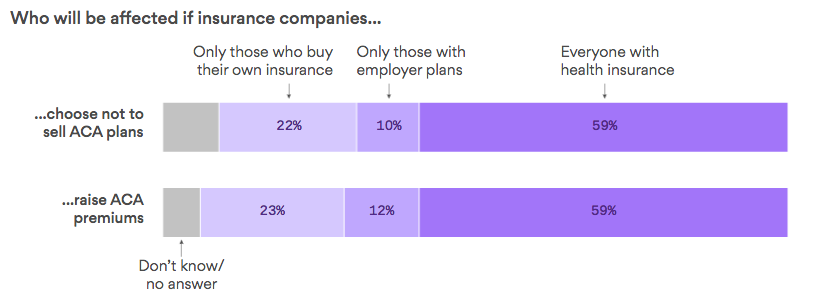
The chart based on our new Kaiser Tracking Poll shows the confusion. Just 23% of the American people know that rising premiums in the ACA marketplaces affect only people who buy their own insurance. More than seven out of 10 wrongly believe rising premiums in the marketplaces affect everyone or people who get coverage through their employer.

The public will be susceptible to spin and misrepresentation of the limited goals of Alexander-Murray: a bipartisan effort to stabilize the marketplaces by funding the cost-sharing reduction subsidies, providing more resources for open enrollment outreach, and expediting state waivers.

President Trump has added to the confusion. He recently pronounced the ACA “dead”, adding, “there is no such thing as Obamacare anymore.” Possibly that’s because he wishes it was dead. More likely, he was referring to the problems in the ACA marketplaces, which he has exaggerated.

Like thinking your whole house is falling down when just a part of the foundation needs shoring up, both he and the American people have an inaccurate picture of where the marketplaces fit in the ACA and where the ACA fits in the health system.

A few facts:

  • There are just 10 million people enrolled in the ACA marketplaces.
  • The law’s larger Medicaid expansion and consumer protections are popular and working well.
  • The far larger Medicare and Medicaid programs and employer based health system combined cover more than 250 million people, and are largely unaffected by developments in the ACA marketplaces.
  • Premiums for the 155 million people who get coverage through their employers rose a very modest 3% in 2017.

Some conservatives in Congress will hold out for repeal, and they’ll resist any legislation that they view as propping up Obamacare. But for everyone else, it’s important to understand the problem and get the facts.


The only option left to the Senate is to make health care reform someone else’s problem

The only option left to the Senate is to make health care reform someone else’s problem

Image result for pass the buck dilbert

I wish I had more time to blog. I really do. But I’m consumed with grant submissions, mentoring researchers, and writing columns about health policy because it’s clear that someone’s got to do it.

That said, I’m taking ten minutes out of my day here to rant. Read it or don’t.

If it hasn’t become abundantly clear, the only thing left for Republican Senators to try is to kick the can down the road. Again. They’re going to try and pass a bill which gives less money overall to states, a lot less money to some states, and then tells them to “figure it out”. Later, they can claim that they gave the states all the tools they needed to fix the health care system, so now it’s THEIR fault things don’t work.

This is ridiculous.

There is no magic. There is no innovation. If there was a way to make the health care system broader, cheaper, and better, we would do it right now. We would have done it years ago. No matter what you may think of Democrats in 2009, they didn’t choose the ACA because they wanted to keep states from fixing the health care system. The ACA was the best they could get.

There are no governors, of red or blue states, who have a magic plan for health care innovation. There are no state legislators (who likely work part-time) who have a secret plan to unleash the power of federalism. The Republicans in Congress have had seven years, all the money in the world, the phone numbers of every conservative wonk in the country, the CBO, experts eager to offer their help… If they couldn’t figure this out, do they think that Montana will? Oklahoma? Indiana? In less than two years?

THERE IS NO WAY TO SPEND LESS, COVER MORE, AND MAKE IT BETTER.

Pretty much every health care organization is against this bill. The organization of Medicaid directors is against this bill. Most governors are against this bill. Nearly every wonk I can think of is against this bill.

There are legitimate ways to reform the health care system according to conservative principles. They all involve tradeoffs. The people defending this bill refuse to acknowledge that. Many are – at this point – seemingly just making stuff up and promising the moon. And – I’ll bet all the money in my pocket on this – when they can’t deliver, it’s going to be someone else’s fault.

Centrist Democrats Turn to Pragmatism, Seek Bipartisan ACA Fixes

https://morningconsult.com/2017/09/15/centrist-dems-seek-bipartisan-aca-fixes-not-single-payer-plan/

Click to access attachment-1.pdf

Image result for healthcare policy

While some progressives campaigned this week for “Medicare for all,” a group of moderate House Democrats aligned themselves with a more modest push to stabilize the Affordable Care Act, arguing that it could spur broader health care reforms in the future.

Thirty-eight of the 61 members of the New Democrat Coalition sent a letterFriday urging the leaders of the Senate Health, Education, Labor and Pensions Committee to agree on a bipartisan bill to keep premiums from rising further for Obamacare enrollees next year.

The letter outlines five short-term proposals agreed to by the group — several of which are likely to be included in the Senate bill, such as the extension of key insurer payments known as cost-sharing reductions.

New Democrat Coalition Chair Rep. Jim Himes (D-Conn.) said that while some Democrats and Republicans continue to push polarizing health care plans after the July collapse of Senate Republicans’ Obamacare repeal push, some lawmakers of both parties are ready to try bipartisanship.

“There’s a pretty substantial group of Democrats and Republicans who are ready to work together and get some things done on this most politically charged of topics,” Himes said in an interview Thursday.

Only three of the 38 Democrats who signed the letter are co-sponsors of a single-payer health care bill introduced by Rep. John Conyers (D-Mich.) that has been endorsed by approximately 60 percent of the House Democratic caucus; Sen. Bernie Sanders (I-Vt.) introduced similar legislation in the Senate on Wednesday.

But the progressive single-payer legislation has almost no chance of passing the Republican-led Congress, and members of the New Democrat Coalition are taking a more pragmatic approach: While “Medicare for all” proponents support placing nearly all Americans on a government plan, the New Democrat Coalition is backing reforms to improve private health insurance coverage and reduce health care costs.

“We believe these ideas provide a framework to reduce health care costs for families and seniors, increase choices for consumers, and encourage participation by the young and healthy,” the Democrats wrote in the letter.

Some members of the New Democrat Coalition are also in the House Problem Solvers Caucus, which consists of centrist GOP and Democratic lawmakers and sent its own letter Wednesday urging the Senate HELP and Finance committees to move toward a bill as a crucial Sept. 27 deadline for insurers approaches.

HELP Committee Chairman Lamar Alexander hopes to reach an agreement on the legislation by early next week, the Tennessee Republican said at a hearing on Thursday.


Senate bargainers say deal reached on children’s health

http://abcnews.go.com/Health/wireStory/senate-bargainers-deal-reached-childrens-health-49809048

Image result for children's health insurance program (chip)

Senate Republican and Democratic bargainers reached agreement late Tuesday to extend financing for the children’s health insurance program for five years, a pact that if approved would avert an end-of-month cash crunch for the popular program.

In a concession to Republicans, the agreement would phase out extra federal funds that have gone to states for the program since the additional money was mandated as part of President Barack Obama’s 2010 health care law.

Money for the federal-state program is due to expire at the end of September. The program provides health coverage to around 8 million low-income children and pregnant women.

It was initially unclear how the agreement would fare in the Senate and the House.

But the two negotiators — Senate Finance Committee Chairman Orrin Hatch, R-Utah, and that panel’s top Democrat, Ron Wyden of Oregon — work closely with party leaders. In addition, having embarrassingly failed in this year’s attempt to repeal Obama’s health care statute, Republicans and President Donald Trump are eager for an accomplishment and would be unlikely to stymie the continuation of such a widely supported initiative.

It was also unclear if the pact would move quickly and by itself through Congress, or become a vehicle for other, less widely backed legislation.

In a written statement, Hatch said “Congress needs to act quickly” to extend the program.

Without providing detail, Hatch said the agreement would give states “increased flexibility” to run the program. He also said lawmakers will “continue to advance this agreement in a way that does not add to the deficit,” suggesting that a compromise on how to pay for the extra funds may have not yet been found.

Wyden called the agreement “a great deal for America’s kids.”

The federal government pays around $7 billion annually for the program. States by law pay a small share — until recently, an amount ranging from 15 percent to 35 percent of costs.

But under Obama’s law, states each received an additional 23 percent share from Washington. Many Republicans, particularly conservatives, have chafed at that added amount.

Under the agreement, the full 23 percent share would continue for two more years. It would phase down to 11.5 percent in 2020 and the extra money would disappear completely the following year. The details were provided by a Senate aide who spoke on condition of anonymity because full details weren’t released.

The Real Reason the U.S. Has Employer-Sponsored Health Insurance

Image result for The Real Reason the U.S. Has Employer-Sponsored Health Insurance

The basic structure of the American health care system, in which most people have private insurance through their jobs, might seem historically inevitable, consistent with the capitalistic, individualist ethos of the nation.

In truth, it was hardly preordained. In fact, the system is largely a result of one event, World War II, and the wage freezes and tax policy that emerged because of it. Unfortunately, what made sense then may not make as much right now.

Well into the 20th century, there just wasn’t much need for health insurance. There wasn’t much health care to buy. But as doctors and hospitals learned how to do more, there was real money to be made. In 1929, a bunch of hospitals in Texas joined up and formed an insurance plan called Blue Cross to help people buy their services. Doctors didn’t like the idea of hospitals being in charge, so some in California created their own plan in 1939, which they called Blue Shield. As the plans spread, many would purchase Blue Cross for hospital services, and Blue Shield for physician services, until they merged to form Blue Cross and Blue Shield in 1982.

Most insurance in the first half of the 20th century was bought privately, but few people wanted it. Things changed during World War II.

In 1942, with so many eligible workers diverted to military service, the nation was facing a severe labor shortage. Economists feared that businesses would keep raising salaries to compete for workers, and that inflation would spiral out of control as the country came out of the Depression. To prevent this, President Roosevelt signed Executive Order 9250, establishing the Office of Economic Stabilization.

This froze wages. Businesses were not allowed to raise pay to attract workers.

Businesses were smart, though, and instead they began to use benefits to compete. Specifically, to offer more, and more generous, health care insurance.

Then, in 1943, the Internal Revenue Service decided that employer-based health insurance should be exempt from taxation. This made it cheaper to get health insurance through a job than by other means.

After World War II, Europe was devastated. As countries began to regroup and decide how they might provide health care to their citizens, often government was the only entity capable of doing so, with businesses and economies in ruin. The United States was in a completely different situation. Its economy was booming, and industry was more than happy to provide health care.

This didn’t stop President Truman from considering and promoting a national health care system in 1945. This idea had a fair amount of public support, but business, in the form of the Chamber of Commerce, opposed it. So did the American Hospital Association and American Medical Association. Even many unions did, having spent so much political capital fighting for insurance benefits for their members. Confronted by such opposition from all sides, national health insurance failed — for not the first or last time.

In 1940, about 9 percent of Americans had some form of health insurance. By 1950, more than 50 percent did. By 1960, more than two-thirds did.

One effect of this system is job lock. People become dependent on their employment for their health insurance, and they are loath to leave their jobs, even when doing so might make their lives better. They are afraid that market exchange coverage might not be as good as what they have (and they’re most likely right). They’re afraid if they retire, Medicare won’t be as good (they’re right, too). They’re afraid that if the Affordable Care Act is repealed, they might not be able to find affordable insurance at all.

This system is expensive. The single largest tax expenditure in the United States is for employer-based health insurance. It’s even more than the mortgage interest deduction. In 2017, this exclusion cost the federal government about $260 billion in lost income and payroll taxes. This is significantly more than the cost of the Affordable Care Act each year.

This system is regressive. The tax break for employer-sponsored health insurance is worth more to people making a lot of money than people making little. Let’s take a hypothetical married pediatrician with a couple of children living in Indiana who makes $125,000 (which is below average). Let’s also assume his family insurance plan costs $15,000 (which is below average as well).

The tax break the family would get for insurance is worth over $6,200. That’s far more than a similar-earning family would get in terms of a subsidy on the exchanges. The tax break alone could fund about two people on Medicaid. Moreover, the more one makes, the more one saves at the expense of more spending by the government. The less one makes, the less of a benefit one receives.

The system also induces people to spend more money on health insurance than other things, most likely increasing overall health care spending. This includes less employer spending on wages, and as health insurance premiums have increased sharply in the last 15 years or so, wages have been rather flat. Many economists believe that employer-sponsored health insurance is hurting Americans’ paychecks.

There are other countries with private insurance systems, but none that rely so heavily on employer-sponsored insurance. There are almost no economists I can think of who wouldn’t favor decoupling insurance from employment. There are any number of ways to do so. One, beloved by wonks, was a bipartisan plan proposed by Senators Ron Wyden, a Democrat, and Robert Bennett, a Republican, in 2007. Known as the Healthy Americans Act, it would have transitioned everyone from employer-sponsored health insurance to insurance exchanges modeled on the Federal Employees Health Benefits Program.

Employers would not have provided insurance. They would have collected taxes from employees and passed these onto the government to pay for plans. Everyone, regardless of employment, would have qualified for standard deductions to help pay for insurance. Employers would have been required to increases wages over two years equal to what had been shunted into insurance. Those at the low end of the socio-economic spectrum would have qualified for further premium help.

This isn’t too different from the insurance exchanges we see now, writ large, for everyone. One can imagine that such a program could have also eventually replaced Medicaid and Medicare.

There was a time when such a plan, being universal, would have pleased progressives. Because it could potentially phase out government programs like Medicaid and Medicare, it would have pleased conservatives. When first introduced in 2007, it had the sponsorship of nine Republican senators, seven Democrats and one independent. Such bipartisan efforts seem a thing of the past.

We could also shift away from an employer-sponsored system by allowing people to buy into our single-payer system, Medicare. That comes with its own problems, as The Upshot’s Margot Sanger-Katz has written. She also has covered the issues of shifting to a single-payer system more quickly.

It’s important to point out that neither of these options has anything even close to bipartisan support.

Without much pressure for change, it’s likely the American employer-based system is here to stay. Even the Affordable Care Act did its best not to disrupt that market. While the system is far from ideal, Americans seem to prefer the devil they know to pretty much anything else.

State officials plead for bipartisan ObamaCare fix

State officials plead for bipartisan ObamaCare fix

State officials plead for bipartisan ObamaCare fix

State insurance officials pleaded with senators on Wednesday to quickly act to stabilize the ObamaCare marketscalling for a multiyear extension of key payments to help fund premiums for low-income customers.

Congress must pass a fix by the end of September to shore up the wobbly individual markets, several officials said, in particular funding for key ObamaCare insurer payments known as cost-sharing reductions (CSR).

“The CSR funding issue is the single most critical issue that you can address to help stabilize insurance markets for 2018 and potentially bring down costs,” Tennessee’s insurance commissioner Julie Mix McPeak told the Senate Health Committee.

The panel kicked off a series of hearings Wednesday on stabilizing the markets. If Congress can pass a bill, it would represent the biggest bipartisan update since President Obama signed the law in 2010.

Health committee Chairman Lamar Alexander (R-Tenn.) wants to find consensus by the end of next week. To sell the fix, he and ranking member Patty Murray (D-Wash.) held a private meeting with senators not on the committee and the witnesses who testified as Wednesday’s hearing.

“If we can do two things, that would be two more things that we have agreed on in a bipartisan way in the last seven years in health insurance,” Alexander told reporters.

“And then let the leaders see if we can pass it, and hope the House does and that the president signs it.”

Despite some pushback that could still come from conservatives calling the payments an “insurer bailout,” Alexander and Murray hope to cobble together a bipartisan group that agree some continuation of the payments is necessary.

The cost sharing subsidies, which reimburse insurers for giving discounted deductibles and co-pays to low-income customers, have been made by the Trump administration on a month-to-month basis.

Republicans had sued the Obama administration over the payments, calling them unconstitutional, but many have since acknowledged they need to continue at least in the near term to prevent steep premium hikes.

Insurers have asked for long-term certainty on the payments, threatening to hike premiums and leave the ObamaCare markets altogether if they don’t get it.

Democrats, and some Republicans like Alexander, agree Congress should fund the payments, but there’s disagreement on the time frame.

Alexander wants to fund the payments through 2018 while Murray has pushed for multiple years.

“It is critical that we work toward a multiyear solution in order to provide the kind of certainty that will have the most impact on families’ premiums and choices in the marketplaces,” Murray said.

America’s Health Insurance Plans, the nation’s largest insurer trade association, and other stakeholder groups urged Congress to fund the payments through at least 2019.

“Without two years of CSR funding, uncertainty will persist and the Congress will need to address these same issues early next year,” the groups wrote in a letter to the committee Tuesday.

Meanwhile, Republicans say a bipartisan health bill must include changes to ObamaCare’s state waivers so states have more control over what their insurance plans look like.

Alexander said ObamaCare’s waivers should be amended so “states can have more flexibility to devise ways to provide more coverage with more choices and lower costs.”

“It just hasn’t been very appealing to states because it is a difficult tool to use,” he said.

This point was echoed by Pennsylvania’s insurance commissioner Theresa Miller, who called the process to get approved cumbersome.

“Baseline coverage requirements should be kept intact as much as possible … but make it easier for states to respond to market issues,” she said.

For example, it takes at least six months to get a waiver approved with the federal government, which the commissioners said made it difficult to quickly respond to market issues.

But Democrats have been wary of anything they say could result in coverage losses and the availability of less comprehensive insurance plans.

The Senate GOP’s ObamaCare repeal plan, which failed in a dramatic vote with Sen. John McCain (R-Ariz.) joining two other Republicans in opposition, contained language intended to make it easier for states to approve less comprehensive plans.

However, Democrats say that is going in the wrong direction.

We should be “moving forward not backward on affordability, coverage and quality of care,” Murray said.

“We’re all well aware threading this needle won’t be easy,” she said, “but I do believe an agreement that protects patients and families from higher costs and uncertainty, and maintains the guardrails in our current health care system, is possible.”

Several commissioners also recommended setting up a temporary reinsurance program to help insurers with high cost patients with the intent of lowering premiums for healthier ones.

“Congress should enact a federal reinsurance program with a minimum duration of three years,” said Washington state insurance commissioner Mike Kreidler, adding that it would “significantly help stabilize the individual health insurance market.”

But Alexander indicated it’s unlikely for the bill to include reinsurance funding, noting that the U.S. is already trillions in debt.

“If a reinsurance program is such a good idea … why don’t states do it?” he asked, suggesting states impose small fees on every insurance plan sold to help fund it.

Democrats are also pushing for a bill to restore ObamaCare outreach funding after the Trump administration announced drastic cuts to the program.

Alaska’s insurance director Lori Wing-Heier said the cuts concern her because “these programs reduce the number of uninsured citizens and maximize public participation.”