


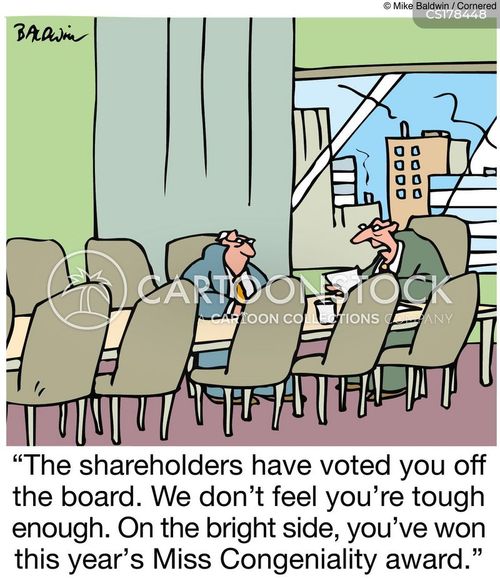
Cartoon – New Company Motto

In the fall of 2014, the hedge fund activist and Allergan shareholder Bill Ackman became increasingly frustrated with Allergan’s board of directors. In a letter to the board, he took the directors to task for their failure to do (in his words) “what you are paid $400,000 per year to do on behalf of the Company’s owners.” The board’s alleged failure: refusing to negotiate with Valeant Pharmaceuticals about its unsolicited bid to take over Allergan— a bid that Ackman himself had helped engineer in a novel alliance between a hedge fund and a would-be acquirer. In presentations promoting the deal, Ackman praised Valeant for its shareholder-friendly capital allocation, its shareholder-aligned executive compensation, and its avoidance of risky early-stage research. Using the same approach at Allergan, he told analysts, would create significant value for its shareholders. He cited Valeant’s plan to cut Allergan’s research budget by 90% as “really the opportunity.” Valeant CEO Mike Pearson assured analysts that “all we care about is shareholder value.”
These events illustrate a way of thinking about the governance and management of companies that is now pervasive in the financial community and much of the business world. It centers on the idea that management’s objective is, or should be, maximizing value for shareholders, but it addresses a wide range of topics—from performance measurement and executive compensation to shareholder rights, the role of directors, and corporate responsibility. This thought system has been embraced not only by hedge fund activists like Ackman but also by institutional investors more generally, along with many boards, managers, lawyers, academics, and even some regulators and lawmakers. Indeed, its precepts have come to be widely regarded as a model for “good governance” and for the brand of investor activism illustrated by the Allergan story.
Yet the idea that corporate managers should make maximizing shareholder value their goal—and that boards should ensure that they do—is relatively recent. It is rooted in what’s known as agency theory, which was put forth by academic economists in the 1970s. At the theory’s core is the assertion that shareholders own the corporation and, by virtue of their status as owners, have ultimate authority over its business and may legitimately demand that its activities be conducted in accordance with their wishes.
Attributing ownership of the corporation to shareholders sounds natural enough, but a closer look reveals that it is legally confused and, perhaps more important, involves a challenging problem of accountability. Keep in mind that shareholders have no legal duty to protect or serve the companies whose shares they own and are shielded by the doctrine of limited liability from legal responsibility for those companies’ debts and misdeeds. Moreover, they may generally buy and sell shares without restriction and are required to disclose their identities only in certain circumstances. In addition, they tend to be physically and psychologically distant from the activities of the companies they invest in. That is to say, public company shareholders have few incentives to consider, and are not generally viewed as responsible for, the effects of the actions they favor on the corporation, other parties, or society more broadly. Agency theory has yet to grapple with the implications of the accountability vacuum that results from accepting its central—and in our view, faulty—premise that shareholders own the corporation.
The effects of this omission are troubling. We are concerned that the agency-based model of governance and management is being practiced in ways that are weakening companies and—if applied even more widely, as experts predict—could be damaging to the broader economy. In particular we are concerned about the effects on corporate strategy and resource allocation. Over the past few decades the agency model has provided the rationale for a variety of changes in governance and management practices that, taken together, have increased the power and influence of certain types of shareholders over other types and further elevated the claims of shareholders over those of other important constituencies—without establishing any corresponding responsibility or accountability on the part of shareholders who exercise that power. As a result, managers are under increasing pressure to deliver ever faster and more predictable returns and to curtail riskier investments aimed at meeting future needs and finding creative solutions to the problems facing people around the world.
Don’t misunderstand: We are capitalists to the core. We believe that widespread participation in the economy through the ownership of stock in publicly traded companies is important to the social fabric, and that strong protections for shareholders are essential. But the health of the economic system depends on getting the role of shareholders right. The agency model’s extreme version of shareholder centricity is flawed in its assumptions, confused as a matter of law, and damaging in practice. A better model would recognize the critical role of shareholders but also take seriously the idea that corporations are independent entities serving multiple purposes and endowed by law with the potential to endure over time. And it would acknowledge accepted legal principles holding that directors and managers have duties to the corporation as well as to shareholders. In other words, a better model would be more company centered.
Before considering an alternative, let’s take a closer look at the agency-based model.


Anand Krishnaswamy, vice president of Kaufman Hall’s strategic and financial planning practice, makes the case that MACRA readiness should be a priority not only for physicians, but also for hospital boards and executives.
The first performance year of the Medicare Access and CHIP Reauthorization Act is now underway, which will determine Medicare Part B payments in 2019. Although 2017 is designed to be a transition year, providers who dive in now have the opportunity to maximize financial rewards and set themselves up for success down the line.
“The biggest underlying issue is the lack of awareness and engagement by health systems and physician groups,” Mr. Krishnaswamy tells Becker’s. Though many providers are distracted by the uncertainty on Capitol Hill, MACRA and value-based care are likely here to stay — and it’s time for hospitals to craft a strategy.
Mr. Krishnaswamy suggested providers take the following five steps to prepare for MACRA.

Political biases aside, the transition process for the new administration—both as to President Donald Trump and his Cabinet nominees and White House advisers—does a great service for nonprofit health systems by highlighting critical conflict-of-interest concerns. The last several weeks’ headlines provide health system general counsel with a rare opportunity to offer practical board education based on current events.
The president’s personal asset divestiture plan, announced on Jan. 11, along with the broader public scrutiny of key administration members’ business interests, present an important teaching moment on identifying, resolving and managing conflict-of-interest issues. And that’s a subject on which many health system boards could use continuing guidance, given the strictures of the duty of loyalty.
Neither the particulars of the administration’s potential conflict issues nor the details or adequacy of the president’s divestiture plan needs to be addressed here. Instead, the issues themselves provide something of a checklist that can help health system boards ensure their internal conflict-of-interest policies and processes are as fulsome as possible. Strong conflict-of-interest inquiries are critical to protect the reputation of the organization and its board members, and to sustain key business arrangements.
It is important to note that the rapid growth of health systems, the equally rapid diversification of their businesses and investment portfolios, and the expanding diversity of board members’ backgrounds in board membership significantly complicate the conflict-of-interest review process.
The “Trump Transition” conflicts checklist logically could include the following:
CONCLUSION
The landscape that encompasses the totality of the president’s family business interests and those of his Cabinet appointees—and their relationship to the ethics of government—is many layered. It nevertheless offers certain valuable analogies for the health system board—for which the duty of loyalty is sacrosanct. It isn’t all that great a leap to go from Trump’s transition issues to the conflict-of-interest policies of a nonprofit health system board. And it should be noted that the breadth of scrutiny of transition-related conflicts of interest likely hasn’t gone unnoticed by health-care industry regulators, including but not limited to state charity officials. Regulators may be far more likely than before to apply greater sensitivity to issues and relationships that may present conflict issues and their broader legal implications.

Dr. Thomas Malone on Thursday announced his resignation as president and CEO of Summa Health, 21 days after more than 240 physicians signed a no-confidence letter calling for his departure.
Malone, 60, a Northeast Ohio native who began leading the health system two years ago, will continue to serve as CEO for up to 60 days while Summa’s board of directors conducts a search for his successor, the board said.
In a statement released Thursday, Malone said he had detracted from the health system’s mission.
“I care deeply about the future of Summa Health and am incredibly proud of all that we have accomplished together over the past two years,” Malone wrote. “However, as I thought about what would be best for our organization moving forward, it became clear to me that my presence may be a distraction from our goals. And that is unacceptable to me.”


 HENRY KOTULA