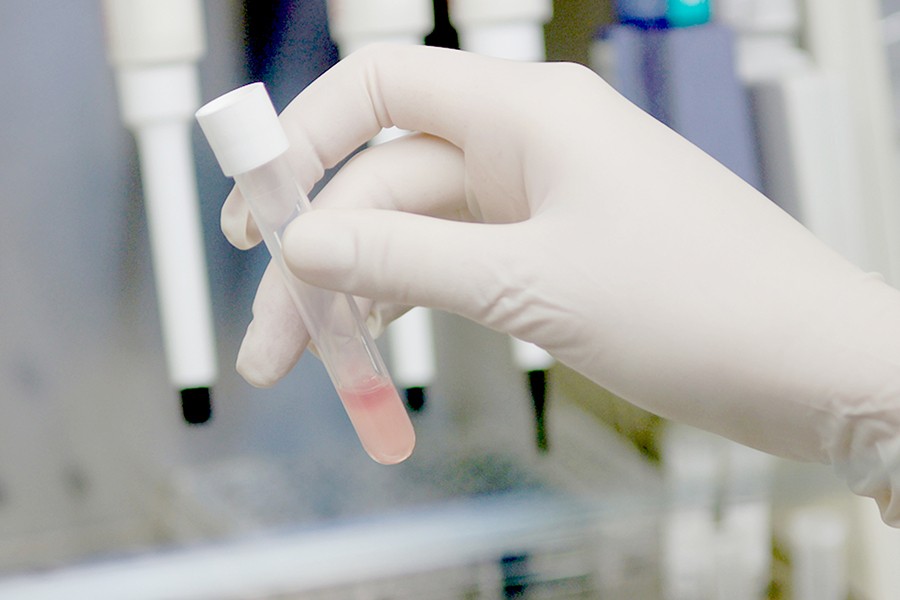
Scientists develop blood test that spots tumor-derived DNA in people with early stage cancers

https://hub.jhu.edu/2017/08/16/cancer-tumor-dna-blood-test/?utm_source=Hub+subscribers&utm_campaign=7a294dde15-EMAIL_CAMPAIGN_2017_08_17&utm_medium=email&utm_term=0_d8bf41c16e-7a294dde15-63587717


Promising screening test could cut down on over-testing for populations most at risk for certain cancers.

In a bid to detect cancers early and in a noninvasive way, scientists at the Johns Hopkins Kimmel Cancer Center report they have developed a test that spots tiny amounts of cancer-specific DNA in blood and have used it to accurately identify more than half of 138 people with relatively early stage colorectal, breast, lung, and ovarian cancers.

The test, the scientists say, is novel in that it can distinguish between DNA shed from tumors and other altered DNA that can be mistaken for cancer biomarkers.

OVERALL, THE SCIENTISTS WERE ABLE TO DETECT 62 PERCENT OF STAGE I AND II CANCERS.

A report on the research, performed on blood and tumor tissue samples from 200 people with all stages of cancer in the United States, Denmark, and the Netherlands, appears today in the journal Science Translational Medicine.

“This study shows that identifying cancer early using DNA changes in the blood is feasible and that our high accuracy sequencing method is a promising approach to achieve this goal,” says Victor Velculescu, professor of oncology at the Kimmel Cancer Center.

Blood tests for cancer are a growing part of clinical oncology, but they remain in the early stages of development. To find small bits of cancer-derived DNA in the blood of cancer patients, scientists have frequently relied on DNA alterations found in patients’ biopsied tumor samples as guideposts for the genetic mistakes they should be looking for among the masses of DNA circulating in those patients’ blood samples. To develop a cancer screening test that could be used to screen seemingly healthy people, scientists had to find novel ways to spot DNA alterations that could be lurking in a person’s blood but had not been previously identified.

“The challenge was to develop a blood test that could predict the probable presence of cancer without knowing the genetic mutations present in a person’s tumor,” says Velculescu.

The goal, adds Jillian Phallen, a graduate student at the Johns Hopkins Kimmel Cancer Center who was involved in the research, was to develop a screening test that is highly specific for cancer and accurate enough to detect the cancer when present, while reducing the risk of “false positive” results that often lead to unnecessary over-testing and over-treatment.

To develop the new test, Velculescu, Phallen and their colleagues obtained blood samples from 200 patients with breast, lung, ovarian, and colorectal cancer. The scientists’ blood test screened the patients’ blood samples for mutations within 58 genes widely linked to various cancers.

Among 42 people with colorectal cancer, the test correctly predicted cancer in 50 percent of patients with stage I, 89 percent of patients with stage II, 90 percent of patients with stage III, and 93 percent of patients with stage IV disease. For patients with lung cancer, the test correctly identified cancer among 45 percent of patients with stage I disease, 72 percent with stage II disease, 75 percent with stage III, and 83 percent with stage IV cancer. For 42 patients with ovarian cancer, the test identified 67 percent with stage I, 75 percent with stage II, 75 percent with stage III, and 83 percent with stage IV disease. Among 45 breast cancer patients, the test spotted cancer-derived mutations in 67 percent of patients with stage I disease, 59 percent with stage II, and 46 percent with stage III cancers.

Overall, the scientists were able to detect 86 of 138—62 percent—stage I and II cancers, and found none of the cancer-derived mutations among blood samples of 44 healthy individuals.

Despite these initial promising results for early detection, the blood test needs to be validated in studies of much larger numbers of people, say the scientists.

Velculescu and his team also performed independent genomic sequencing on available tumors removed from 100 of the 200 patients with cancer and found that 82 percent had mutations in their tumors that correlated with the genetic alterations found in the blood.

He says the populations that could benefit most from such a DNA-based blood test include those at high risk for cancer, including smokers, for whom standard computed tomography scans for identifying lung cancer often lead to false positives, and women with hereditary mutations for breast and ovarian cancer within BRCA1 and BRCA2 genes.

Can Patrick Soon-Shiong silence his many critics?

Can Patrick Soon-Shiong silence his many critics?

LOS ANGELES, CA - MARCH 22: CEO of Abraxis Health Institute Patrick Soon-Shiong during a Urban Economic Forum co-hosted by White House Business Council and U.S. Small Business Administration at Loyola Marymount University on March 22, 2012 in Los Angeles, California. Topics discussed at the forum included the Obama administration's support for policies that create private sector-jobs and future entrepreneurs. (Photo by Kevork Djansezian/Getty Images)

On the phone, Patrick Soon-Shiong speaks slowly and deliberately. He clearly trusts himself, but he doesn’t trust journalists anymore.

A series of scathing articles by STAT News and Politico sent stocks in his publicly-traded companies tumbling earlier this year. On Monday, he has an opportunity to change that narrative somewhat, with the unveiling of data from human trials of his cancer vaccine at a major oncology conference.

The stories allege that despite his bold claims, Soon-Shiong’s NantWorks subsidiaries are underperforming and reliant on contracts from other companies in the group. Reporters have also claimed that one of his companies, NantHealth, has received contracts from institutions that had received donations from his nonprofit foundation — a major conflict of interest. This was not adequately disclosed prior to the massive initial public offering of NantHealth, they argue, which may violate SEC laws.

For his part, Soon-Shiong, dismisses the allegations noting that part of the motivation behind those stories was political: “They had never written about me until they saw this picture of me with Trump.”

Speaking to MedCity on Wednesday after his recent appointment to a national health IT advisory committee, Soon-Shiong detailed how the various threads of his career are converging toward a pivotal moment. A solution for healthcare is almost within reach and he’s poised to unveil what he believes is a disruptive cancer therapy – the Nant vaccine – at the annual meeting of the American Society of Clinical Oncology (ASCO) in Chicago on Monday.

This story clearly clashes with many other viewpoints in the industry.

Trump budget would force tough choices in disease research

http://abcnews.go.com/Technology/wireStory/trump-budget-force-tough-choices-disease-research-46183046

Image result for disease research

What goes on the chopping block: Research into cancer or Alzheimer’s? A Zika vaccine or a treatment for superbugs?

Health groups say President Donald Trump’s proposal to slash funds for the nation’s engine of biomedical research would be devastating for patients with all kinds of diseases — and for jobs.

“It is possible that the next cure for some cancer is sitting there waiting to be discovered, and it won’t get to the table,” said Dr. Georges Benjamin, executive director of the American Public Health Association.

In his budget blueprint Thursday, Trump called for a cut of $5.8 billion from the National Institutes of Health. That’s a staggering 18 percent drop for the $32 billion agency that funds much of the nation’s research into what causes different diseases and what it will take to treat them.

It comes despite Trump recently telling Congress about the need to find “cures to the illnesses that have always plagued us.”

“All of us woke up this morning in a state of shock about this number,” said Dr. Blase Polite, a cancer specialist at the University of Chicago who chairs the American Society for Clinical Oncology’s government relations committee.

Trump’s proposal would roll back NIH’s 2018 budget to about what it was in 2003. The president called for a “major reorganization” of NIH to stress the “highest priority research,” but only specifically targeted for elimination the $69 million Fogarty International Center that focuses on global health and has played a big role in HIV research abroad.

Drops in deaths from cancer and heart disease, breakthroughs in genetics, and new ways to treat and prevent HIV and other infectious diseases all are credited to decades of NIH-funded basic research.


15 things for healthcare leaders to know about Obama’s 2017 budget

http://www.beckershospitalreview.com/finance/15-things-for-healthcare-leaders-to-know-about-obama-s-2017-budget.html


Leading researchers recommend major change in prostate cancer treatment

https://www.washingtonpost.com/news/to-your-health/wp/2016/07/06/leading-researchers-recommend-major-change-in-prostate-cancer-treatment/

Leading American and British cancer researchers are urging that all men with advanced prostate cancer strongly consider being tested for inherited gene mutations — both to help steer their treatment and to alert family members who themselves might be at increased risk for a range of cancers.

This new recommendation, which represents a major change in approach, was prompted by a study published Wednesday in the New England Journal of Medicine. The researchers found that almost 12 percent of men with advanced cancer had defects in genes that are designed to fix damage to DNA, compared to 4.6 percent of patients with disease that hadn’t spread.

New York Genome Center scores $100 million from James Simons, Russell Carson

http://www.healthcarefinancenews.com/news/new-york-genome-center-scores-100-million-james-simons-russell-carson?mkt_tok=3RkMMJWWfF9wsRonuqrIce%2FhmjTEU5z16ukvX6%2B%2Fh4kz2EFye%2BLIHETpodcMTcBmMr%2FYDBceEJhqyQJxPr3MLtINwNlqRhPrCg%3D%3D

Image via <a href="https://www.google.com/maps/@40.7233136,-74.0049415,3a,75y,285.25h,96.9t/data=!3m6!1e1!3m4!1sVUiQRcuDJbvnL7bI5vxDSg!2e0!7i13312!8i6656!6m1!1e1">Google Maps</a>.

Center says money will go towards building new labs, bolstering technology and treatment options for patients.