Debt Sickened a Hospital Giant. Now the Doctors Are Revolting

https://www.bloomberg.com/news/articles/2017-09-21/debt-sickened-a-hospital-giant-now-the-doctors-are-revolting?


The standoff over Lutheran shows how for-profit chain CHS, once the nation’s largest, allowed its facilities to decay, compromising care and destroying investor value.

Four doctors from Lutheran Hospital in Fort Wayne, Ind., showed up at parent company Community Health Systems Inc. in May with a message for Chief Executive Officer Wayne Smith and his board. Physicians were in widespread revolt, they said. Facilities were cash-strapped and crumbling. Powerful locals wanted CHS to reinvest or leave.

The doctors urged Smith to sell the eight-hospital Lutheran Health Network to their physician group, which already owned a 20 percent stake, and an investor partner, for $2.4 billion—triple CHS’s current market value. The combative 71-year-old CEO denied authorizing cost cuts in Fort Wayne and demanded the names of those who did, say people in the meeting. The board refused the offer, and rather than pursue the budget-cutters, Smith fired Lutheran’s CEO, who’d sided with the doctors.

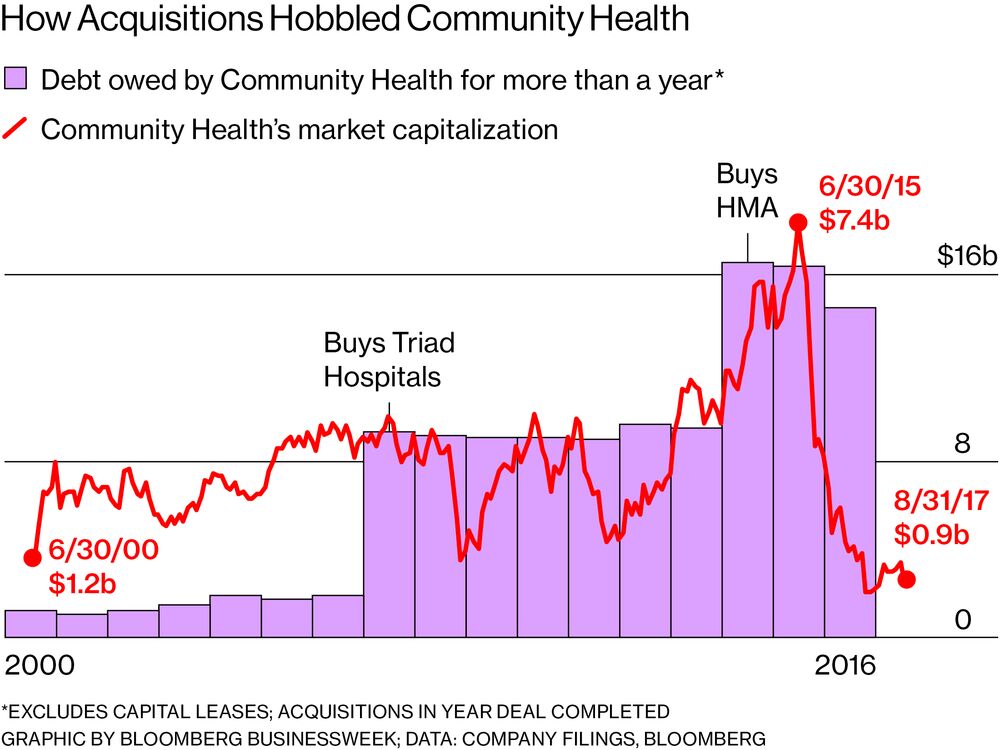
The standoff over Lutheran provides a window into how CHS, once the largest for-profit hospital chain in the U.S., has allowed facilities to languish, possibly compromising care and destroying investor value in the process. Smith presided over a decade-long acquisition binge that saddled CHS with total debt of almost eight times its earnings and a network of underperforming facilities. The company lost $2 billion in the past six quarters, during which doctors from Key West to Spokane have accused the chain of pinching pennies and regulators have fined it for overcharging Medicare. Says Indiana Republican Representative Jim Banks, who’s sided with the Fort Wayne doctors: “It’s buy, squeeze, and repeat.”

“At some point you reach a dead end, and you can’t cut the expenses anymore”

Smith took CHS public in 2001, just four years after coming to the company from Humana Inc., where he’d been head of hospital operations. The big acquisitions began in 2007, when the chain bought Texas-based Triad Hospitals Inc. for $6.4 billion, more than quadrupling its debt. Smaller deals followed. By the end of 2014, CHS had nearly doubled its debt again to finance its buyout of Health Management Associates LLC (HMA), a Florida-based group of mostly rural facilities that required costly upgrades.

Smith’s plan was to try to increase doctor productivity and slash costs, often replacing experienced doctors with loyal patients for younger ones who were willing to work longer hours. Like most for-profit operators, “they focused on cost control,” says Joshua Nemzoff of Nemzoff & Co., who advises hospitals on sale transactions. “At some point you reach a dead end, and you can’t cut the expenses anymore.”

Along with the rest of the hospital industry, CHS expected the Affordable Care Act to provide a windfall of insurance money from the newly covered. Investor enthusiasm soured when 19 states—including Florida and Texas, two key CHS markets—declined to expand Medicaid eligibility, leaving many low-income people without coverage. At the same time, insurers and other government programs began working to divert patients from hospitals into doctors’ offices, outpatient clinics, and other less expensive venues. The combined effect was particularly hard on rural hospitals, a large share of CHS’s network.

Raising prices while slashing costs has been a hallmark of CHS under Smith. In Fort Wayne, Lutheran charges more than rival Parkview Medical Center Inc. for 8 of 10 common medical procedures. During the first half of this year, patients were placed in beds in Lutheran’s emergency room hallways because the wards they should have been moved to were understaffed, and a leaking air conditioner in the neonatal care unit was dripping water on infants’ beds, according to people familiar with the conditions. While Parkview invested in its cancer and cardiac units, Lutheran doctors said at the board meeting that the CHS hospital was using lower-priced monitors they feared would miss potentially fatal heart rhythms.

Company spokeswoman Tomi Galin said in an email that many other hospitals use the same monitors. Nevertheless, CHS plans to spend $500 million on improvements and will recruit new doctors at Lutheran, she wrote, adding that employee retention there is rising.

Other critics of Smith have taken their complaints to court. After Gregg Becker quit his job as chief financial officer of CHS’s Rockwood Clinic in Spokane, Wash., in 2012, he filed a whistleblower claim with the U.S. Department of Labor, saying his superiors told him to reduce the facility’s forecast loss from $12.8 million to $4 million and threatened to fire him if he didn’t. Becker was awarded a settlement of almost $1.9 million by an administrative law judge, according to court documents. CHS has appealed the case to the Washington Supreme Court and the federal Arbitration and Review Board. (CHS sold Rockwood earlier this year.)

In 2014, CHS agreed to pay $98.15 million to the Department of Justice to settle lawsuits in five different districts accusing the company of charging for higher-cost inpatient services at hospitals, including Lutheran, when less expensive outpatient services would have been sufficient. CHS didn’t admit wrongdoing. But the DOJ in a statement said the company had “engaged in a deliberate corporate-driven scheme to increase inpatient admissions of Medicare, Medicaid, and the Department of Defense’s Tricare program.”

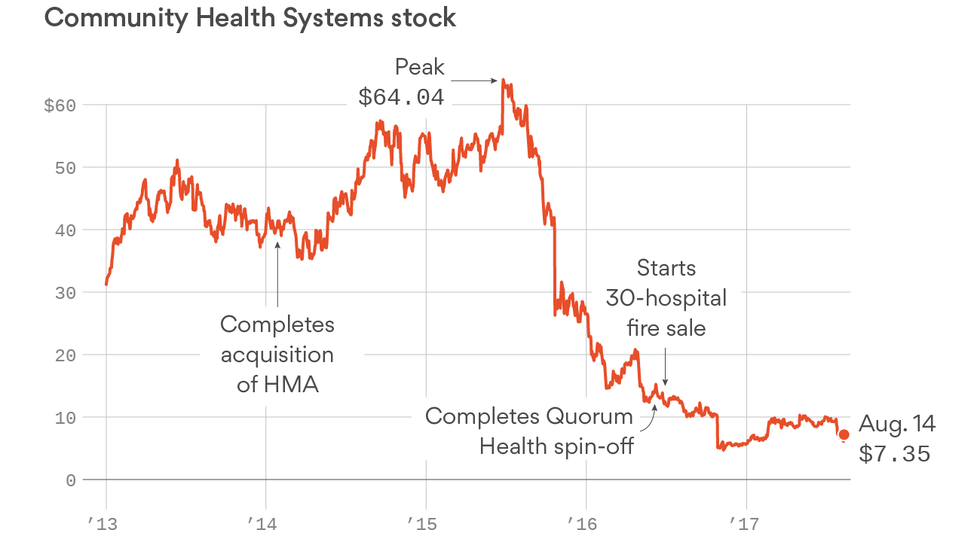
With losses mounting and the stock down more than 80 percent from its peak in June 2015, Smith has resorted to selling hospitals to pay off debt. One result: CHS will soon be about the same size it was before it attempted to digest HMA. Hedge fund ASL Strategic Value, a CHS shareholder, sent a letter to the board on Aug. 8 asking directors to replace Smith. Tom Kelley, a Fort Wayne car dealer whose employees rely on Lutheran for care, quit the Lutheran board in July and says he’s reviewing his employee medical plan. He tried and failed to broker a peace deal between the doctors and Smith.

“He’s a street fighter,” Kelley says of Smith. “He has survived government actions against him. He has survived lawsuits. He has survived all of this by being a tough SOB.”

BOTTOM LINE – Community Health Systems used acquisitions to become a major for-profit hospital operator. But the added heft wasn’t matched by profitability gains.


Chinese billionaire Tianqiao Chen makes big stock buy in CHS, brings stake to 22.1%

http://www.healthcarefinancenews.com/news/chinese-billionaire-tianquo-chen-makes-big-stock-buy-chs-brings-stake-221?mkt_tok=eyJpIjoiWlRsaE56QTFZMk00WVdVdyIsInQiOiJPV2NZVXpmSXoxY2s2blNFdG9DYmt0UHh1bnkzc0NcL0R3YnpCcEhqdm5lWVwvNlJrN2xDVlwvUFZ5ZFBzOElGY253OGFMZWVKVnh5a3dTSDM1RFwvdFN3cklQTGd0NmN0YzFrQjIrK21WUW5UTWhaUXVUdUhZZU41dGNwcUtvYmZUaEMifQ%3D%3D

Image result for Chinese billionaire Tianqiao Chen

The purchases were made through Chen’s various Shanda affiliates, documents showed.

Chinese billionaire Tianqiao Chen is once again raising eyebrows in the healthcare sector, after significantly increasing his stake in struggling healthcare organization Community Health Systems, which is based in Franklin, Tennessee.

According to a filing with the Securities and Exchange Commission, now owns 22.1 percent of CHS‘ outstanding shares of common stock after buying up roughly 9.8 million additional shares over the last week. The price per share varied from $6.1 to $8 per share.

The purchases were made through Chen’s various Shanda affiliates, documents showed.

The big stock buy will inevitably be viewed by at least some as a move to take a bigger interest in the struggling company, something that has been speculated about in the past when Chen first came on the scene and bought a large block of stock in the company last year.

A spokesperson for Shanda Group issued the following statement. “Shanda maintains a good relationship with the CYH management team and intends to engage with them regarding business and operations, and the status of CYH’s ongoing turnaround strategy.”

CHS has been in the news lately as it forges ahead with its ambitious divestiture plan to offload 30 hospitals in hopes of alleviating its billions-large debt load and tightening up its operations. So far the company has sold 20 of those hospitals and has plans in the works to unload the remaining ten. It has also said in a recent earnings call that they are entertaining plans to sell even more, but no definitive details have been released.

The collapse of Community Health Systems

https://www.axios.com/the-collapse-of-community-health-systems-2471839258.html

Image result for The collapse of Community Health Systems


Just three years ago, Community Health Systems was the largest for-profit operator of hospitals with more than 200 facilities scattered in rural and suburban areas with growing populations. Now, the company is hemorrhaging money, sitting atop a mountain of debt and teetering on the edge of bankruptcy — all major reasons why CHS has lost almost 90% of its market value.

“I think the company has a nontrivial chance of defaulting,” said one CHS investor who asked to be unnamed because of the sensitivity of the issue. Tomi Galin, a CHS spokeswoman, did not make any company officials available for an interview, but said the company is confident it will have “a stronger core group of hospitals that are better positioned for long-term growth.”

Why it matters: CHS sits in a massive hole after a string of missteps, according to industry insiders. And it’s not likely to get better for CHS, or the local communities that rely on a CHS facility, as more people get treated in lower-cost outpatient centers instead of the hospital.

The collapse: It began in 2013 and continued into January 2014. That’s when CHS completed its acquisition of Health Management Associates, a for-profit hospital chain that had a slew of financial and legal problems. The deal was worth $7.6 billion, including debt, and made CHS the largest for-profit hospital company by number of facilities.

“That was the death knell,” a health care investment banker said. “HMA was a troubled company, and (CHS) thought bigger would be better.”

Here’s what has happened at CHS since then:

  • A market cap that crumbled from roughly $7.5 billion in 2015 to less than $800 million today.
  • Net losses of almost $1.9 billion from the start of 2016 through the second quarter of this year.
  • A ballooning debt load totaling $14.7 billion as of June 30.
  • Larry Robbins, a prominent hedge fund manager, dumped his entire portfolio of CHS stock. Paul Singer of Elliott Management did the same earlier this year.
  • A fire sale of 30 hospitals to get cash to pay down debt.
  • Some of those sold hospitals were HMA remnants, while others were considered CHS’ better, more profitable hospitals. “It’s almost like they’re burning the furniture,” the banker said. An investor said CHS was “selling off the fine china” to meet debt payments.
  • A completed spin-off of Quorum Health that, in essence, threw many struggling rural hospitals off CHS’ books. Quorum isn’t faring well either.
  • High amounts of uncompensated care. CHS owns many hospitals in the South, and most of those states did not expand Medicaid under the Affordable Care Act. That means CHS has absorbed more uncompensated care than hospitals in Medicaid expansion states.

Looking ahead: CHS plans on divesting even more hospitals, executives said during their latest earnings call. They likely will be profitable hospitals, as buyers won’t touch money-losing inpatient facilities with dwindling admissions.

But large debt payments are due in 2019 through 2022. Short-term cash from transactions appears to be a bandage, and a subsequently smaller profit base won’t solve the big debt picture, making bankruptcy a real possibility, an investor said.

Galin, the CHS spokeswoman, said the money from the hospital sales “are being used to reduce our debt” and that “cash flow generation remains strong.”

Leadership questions: Many CHS executives have retired or left in the past two years, including longtime CFO Larry Cash. Wayne Smith, the CEO of the hospital chain since 1997, remains in his position. Smith is one of the highest earners among hospital executives and reaped more than $1 million in bonuses alone the past two years even though CHS’ stock price tanked.

Numerous sources would not go on the record to talk about CHS. One hospital industry analyst said this when asked how Smith still had his job despite the company’s problems: “Your question is very valid.”

CHS announces hospital sales worth $1.5B in revenue amidst ‘disappointing’ 2nd quarter losses

http://www.healthcarefinancenews.com/news/chs-announces-more-hospital-sales-amidst-disappointing-2nd-quarter-losses?mkt_tok=eyJpIjoiTXpOa01qUXhaVGd5TnpkaiIsInQiOiJudFozOHVLS1VVNXZZRE42Y0RmTWdIZHpkOU0yNERUSmlXU0VCMlJDMEFyMmVTUUc4aVwvcXRVc0gzXC9ndUdJVjhHT1drZkkzdDhBVFhHZ3BHVjI1NmhIVHY1RmNXSENVdWtwb3RVVnVtaFNWbXNFdnBzb0JVenRcL1ZuR1p0MW0zRyJ9

System is already knee deep in the planned divestitures of 30 hospitals; additional sales are part of shift to “smaller stronger” portfolio.

In addition to the planned divestitures of 30 hospitals,  struggling Franklin, Tennessee-based Community Health Systems announced during an earnings call Wednesday that they are looking at the additional sale of a group of hospitals that carries a combined $1.5 billion in annual net operating revenue.

CHS has already completed 20 of the 30 other planned sales, with 11 being sold in May and another nine deals having closed as of July 1st. The remaining 10 hospital sales are expected to close by September 30th, CHS said.

CHS’ financial health continued its downward slope, with a net loss of $137 million or $1.22 per diluted share in the second quarter of 2017. Their net operating revenue was down 9.7 percent to $4.1 billion. The company’s operating results for the second quarter reflected a 10.8 percent decrease in total admissions. On a same-store basis, both admission and adjusted admission dropped 2.5 percent year over year from 2016, financial documents showed.

Wayne T. Smith, chairman and chief executive officer of Community Health Systems said their focus is now on shifting to a “smaller, stronger portfolio of assets.”

“Obviously, we are disappointed with our performance during the second quarter. Our financial results reflect weaker than expected volumes, which negatively affected our net revenue and Adjusted EBITDA performance. We are seeing better results in certain areas, and we continue to work on a number of initiatives to drive operational and financial improvements.”

Hospital stocks sink after HCA’s earnings stumble

http://www.beckershospitalreview.com/finance/hospital-stocks-sink-after-hca-s-earnings-stumble.html

Image result for hca

Major for-profit hospital operators saw their share prices fall Tuesday after Nashville, Tenn.-based HCA Healthcare released its earnings for the second quarter, which fell below analysts’ estimates, according to Bloomberg.

HCA’s revenues increased 4 percent year over year to $10.73 billion in the second quarter of 2017, which fell below analysts’ estimate of $10.85 billion. The company ended the second quarter of this year with net income of $657 million, which was down slightly from $658 million in the same period of 2016.

After releasing its earnings, HCA shares fell 2.5 percent to $83.93. Dallas-based Tenet Healthcare shares dropped 7.3 percent to $19.57 and Franklin, Tenn.-based Community Health Systems shares fell 7.4 percent to $8.96, according to Bloomberg.

CHS divests 9 hospitals

http://www.beckershospitalreview.com/hospital-transactions-and-valuation/chs-divests-9-hospitals.html

Franklin, Tenn.-based Community Health Systems has completed its sale of nine hospitals.
CHS divested four hospitals to Harrisburg, Pa.-based PinnacleHealth System. The following hospitals are included in the transaction:

100-bed Memorial Hospital of York (Pa.)
214-bed Lancaster (Pa.) Regional Medical Center
148-bed Heart of Lancaster Regional Medical Center in Lititz, Pa.
165-bed Carlisle (Pa.) Regional Medical Center

CHS also divested hospitals in Louisiana, Texas and Washington. The company sold Spokane, Wash.-based Rockwood Health System, which includes two hospitals and a multi-specialty clinic, to Tacoma, Wash.-based MultiCare Health System. CHS divested 88-bed Lake Area Medical Center in Lake Charles, La., to Irving, Texas-based Christus Health and sold two Texas hospitals — 350-bed Tomball (Texas) Regional Medical Center and 67-bed South Texas Regional Medical Center in Jourdanton — to Nashville, Tenn.-based HCA Healthcare.

With the transactions completed, CHS operates 11 hospitals in Pennsylvania, two in Washington, two in Louisiana and 13 in Texas.
CHS divested the hospitals as part of a turnaround plan it put into place last year, which involves the company selling 30 hospitals to trim its debt load.