DOJ supports striking entire ACA: 5 things to know

https://www.beckershospitalreview.com/legal-regulatory-issues/doj-supports-striking-entire-aca-5-things-to-know.html

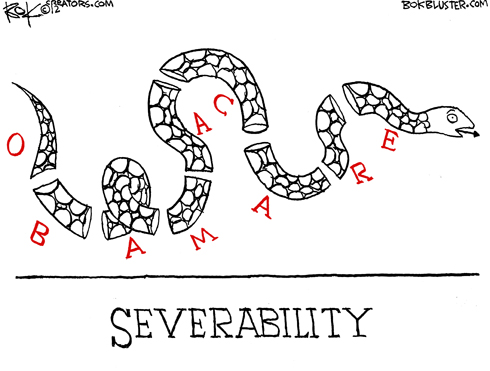
Image result for severability

In a March 25 court filing, the Department of Justice said it supports a judge’s ruling that the entire Affordable Care Act should be invalidated, according to CNN.

Five things to know:

1. In December, a federal judge in Texas held that the ACA is unconstitutional. He sided with the Republican-led states that brought the lawsuit, Texas v. United States, calling for the entire ACA to be struck down because Congress eliminated the healthcare law’s individual insurance mandate penalty.

2. The case is now pending in the 5th Circuit Court of Appeals. In a filing with the appellate court on March 25, the Justice Department said it supports the federal judge’s ruling that invalidated the ACA.

3. “The Department of Justice has determined that the district court’s judgment should be affirmed,” lawyers for the Justice Department wrote to the 5th Circuit Court of Appeals, according to Politico. “[T]he United States is not urging that any portion of the district court’s judgment be reversed.”

4. The filing signals a major shift in the Justice Department’s position. When Jeff Sessions was attorney general, the administration argued only certain parts of the ACA, like protections for people with pre-existing conditions, should be struck down, but the rest of the law could stand, according to CNN.

5. A coalition of Democratic-led states is challenging the Texas ruling. Regardless of the outcome, the 5th Circuit’s ruling is likely to be appealed to the Supreme Court, according to Politico.

Access the full CNN article here.

Access the full Politico article here.


Trump admin now backs elimination of ACA in court

https://www.healthcaredive.com/news/trump-admin-now-backs-elimination-of-aca-in-court/551319/

UPDATED: AHA blasted the decision, calling it “unprecedented and unsupported” by law or facts and warned it would lead to repeal of Medicaid expansion and gut protections for those with pre-existing conditions.

Dive Brief:

  • The Trump administration has reversed its stance on the Affordable Care Act, arguing in a court filing Monday that the entire law should be eliminated instead of just removing provisions protecting people with preexisting conditions.
  • The move came hours after Democratic attorneys general defending the ACA filed their brief arguing that the landmark law is still constitutional even without an effective individual mandate penalty. Both filings are in the Fifth Circuit following an appeal of a Texas judge’s decision from December declaring the law unconstitutional after Congress set the mandate penalty to zero in tax overhaul legislation. That decision was stayed pending appeal.
  • Industry groups lambasted the administration’s about-face. America’s Health Insurance Plans CEO Matt Eyles said in a statement the decision was, like the Texas ruling, “misguided and wrong.” He added the payer lobby “will continue to engage on this issue as it continues through the appeals process so we can support and strengthen affordable coverage for every American.” Federation of American Hospitals CEO Chip Kahn said in a statement the decision is “unfortunate but not unexpected considering [the administration’s] long-held views on the health law.”

Dive Insight:

Elimination of the ACA would be a particular blow for some payers that have found increasing profitability in the individual market. Centene and Molina have found success with the exchanges and have expanded their footprints.

It would also put major hospital chains in a bad spot. Companies like HCA, Tenet and Community Health Systems have exposure that could subject them to reduced patient volumes and more bad debt, Leerink analyst Ana Gupte said when the Texas ruling first came down.

Public support for the ACA has gradually increased over the years, and the latest polling from the Kaiser Family Foundation shows about 53% of respondents giving a favorable view and 40% unfavorable. Individual components of the law are even more popular.

The ACA, which just days ago marked its ninth anniversary, brought forth massive change in American healthcare. A repeal of the law would do the same, stripping insurance coverage for as many as 17 million people.

The Trump administration’s new stance presents an intensely stark contrast with the growing field of Democratic presidential contenders, who have shifted the healthcare conversation to the left as the 2020 field shapes up. Candidates have proposed various forms of Medicare for all as well as scaled back versions that still greatly expand government coverage.

It moves the DOJ away from even some Republicans. During last year’s midterms a few GOP candidates said they approved of the ACA’s most popular element — protection for people with preexisting conditions (although voting records didn’t necessarily back them up).

Most Democrats in Congress aren’t fully backing any single-payer model at the moment, but their support for the ACA is strong. Democrats in the House of Representatives are expected to announce a legislative package Tuesday that would strengthen the ACA by eliminating short-term health plans that don’t comply with the law and increasing subsidies for exchange plans.

Since the GOP’s quite public failure to repeal the law two years ago, efforts to do so through Congress have sputtered to nearly a halt. Instead, the Trump administration started chipping away at the law’s provisions. It cut the open enrollment period for ACA plans, as well as the advertising budget for promoting sign-ups, and stopped cost-sharing reduction payments to insurers.

More recently, HHS has bolstered short-term and association health plans that offer cheap but skimpy coverage not in line with ACA requirements. Analysts fear proliferation of these plans could draw young and healthy people away from the exchanges, jeopardizing the stability of the risk pool.

A Democratic-led House panel launched an investigation into short-term plans and is requesting documents from Anthem and UnitedHealth Group, among other companies.

The legal issue at hand is known as severability — the question of whether a single provision of the law, in this case the individual mandate, becoming unenforceable invalidates the entire statute. The mandate was also the key question in the original U.S. Supreme Court ruling allowing the ACA to move forward.

The high court has since lurched to the right, which is notable if the appeal on the Texas ruling reaches that stage, although that would likely be far down the road.


Judge rules Trump AHP expansion unlawful ‘end-run’ around ACA

https://www.healthcaredive.com/news/judge-rules-trump-ahp-expansion-unlawful-end-run-around-aca/551601/

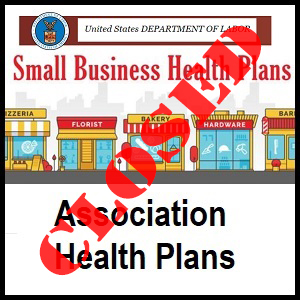
Image result for association health plans

Dive Brief:

  • A federal judge on Thursday struck down a Trump administration expansion of association health plans, which aren’t bound by the requirements of the Affordable Care Act. U.S. District Judge John Bates said the June rule from the Department of Labor that loosened restrictions on what groups could band together to offer AHPs “is clearly an end-run around the ACA.”
  • The ruling stems from a lawsuit 11 states and the District of Columbia filed to challenge the DOL rule. It comes the same week the Trump administration stepped up its attacks against the ACA, arguing in a court filing Monday the law should be eliminated in its entirety following a Texas judge’s decision the act is unconstitutional without the individual mandate penalty.
  • The judge had strong language condemning the administration’s attempt to allow for easier creation and use of AHPs, calling the regulatory change a “magic trick” that allowed for “absurd results” undermining the intent of Congress.

Dive Insight:

The ruling is a blow to the Trump administration’s efforts to circumvent the ACA, which ramped up significantly with the administration’s filing this week seeking complete repeal of the law. Another hit to those efforts came down Wednesday when a different federal judge struck down Medicaid work requirements in Arkansas and Kentucky.

The renewed fight comes as Democrats lining up for a 2020 presidential run are pushing for more progressive policies than have previously gained public traction. Some Democratic contenders are making Medicare for all and other single-payer models a central part of their platforms as healthcare shapes up to be a major issue for the next presidential election.

Experts have argued extended use of AHPs could siphon away young and healthy people looking for minimum coverage at a lower cost. If they choose AHPs they upset the balance on risk pools for more comprehensive coverage. Also, many consumers don’t understand the tradeoff and could be surprised by what isn’t covered when they are in need.

But even though the plans aren’t required to meet ACA standards, some that have formed have been adamant they provide adequate coverage, including the 10 essential ACA benefits. The plans are less obstructive to the regulatory environment than short-term health plans, which have also been granted more leeway under the Trump administration.

Land O’Lakes, for example, which said it was the first to offer an AHP under the more relaxed rules, said its plan covered essential benefits and pre-existing conditions, as well as “broad network coverage.”

The Society of Actuaries has said as many as 10% of people in ACA plans could leave for AHPs, which would also drive up premiums for plans in the individual market. Avalere predicted about 3.2 million people would shift and premiums would rise by 3.5%.

Supporters of AHPs decried the judge’s decision Thursday. Kev Coleman, founder of AssocationHealthPlans.com, said in a statement the ruling will hurt small businesses throughout the country.

“Thousands of employees and family members within the small business community have already enrolled in association health plans — which help lower health care costs — since they first became available last fall,” he said. “They have provided a means by which broad benefits may be accessed at more economical prices. While I do not believe today’s ruling will survive appeal, I believe Judge Bates’ decision is an unnecessary detour on small businesses’ path toward more affordable health coverage.”


Trump’s all-or-nothing gamble

https://www.axios.com/newsletters/axios-vitals-2bc1069a-f66e-4a33-8406-763284c3a0e1.html?utm_source=newsletter&utm_medium=email&utm_campaign=newsletter_axiosvitals&stream=top

The Trump administration’s new legal argument against the Affordable Care Act is a political risk. It may also be a liability in court.

How it works: The legal issue here is “severability” — if the ACA’s individual mandate is unconstitutional, can it be struck down in isolation? Or is it too intertwined with other parts of the law?

Flashback: We’ve seen this movie before — in 2012, at the Supreme Court.

  • According to behind-the-scenes reporting from the 2012 ACA case, four conservative justices wanted to strike down the entire law. Chief Justice John Roberts reportedly wanted to strike down the mandate and protections for pre-existing conditions while leaving the rest intact.
  • But the other conservatives wouldn’t budge, and faced with a choice between upholding or striking down the whole thing, Roberts chose the former.

The Justice Department has now forced that same all-or-nothing decision into the case now pending before the 5th Circuit Court of Appeals.

“There’s no way they were getting Roberts’ vote anyway … but this won’t help,” said Jonathan Adler, a law professor at Case Western Reserve University who helped spearhead a different challenge to the ACA.

  • “It’s contrary to everything he’s ever said and done on severability,” Adler argues.

It may not get that far. “I think the states ultimately lose,” Adler said. “I think the most likely outcome is they lose in the 5th Circuit. If they don’t lose at the 5th Circuit, they will lose at the Supreme Court.”

If that’s what happens, adopting this riskier legal strategy may ultimately be the only thing that saves Republicans from the political nightmare of wiping out 20 million people’s health care coverage with no strategy on how to replace it.

  • I’ll spare you a long list of quotes from President Trump’s trip to Capitol Hill yesterday. Suffice it to say that no, Republicans still do not have a plan for what happens next if they finally succeed in killing the ACA. Some things never change.


Justice Dept. now wants the entire ACA struck down

https://www.axios.com/newsletters/axios-vitals-badd31d3-c5eb-4423-9cfa-b5d6ea8e7daa.html?utm_source=newsletter&utm_medium=email&utm_campaign=newsletter_axiosvitals&stream=top

The Justice Department now wants the courts to strike down the entire Affordable Care Act — not just its protections for people with pre-existing conditions.

This is a stunning escalation, raising both the real-world and political stakes in a lawsuit where both the real-world and political stakes were already very high.

Where it stands: Judge Reed O’Connor ruled in December that the ACA’s individual mandate has become unconstitutional, and that the whole law must fall along with it.

  • At the time, the Trump administration argued that the courts should only throw out the mandate and protections for pre-existing conditions — not the whole law.
  • But in a one-page filing last night, DOJ said the 5th Circuit Court of Appeals should affirm O’Connor’s entire ruling.

Why it matters: If DOJ ultimately gets its way here, the ripple effects would be cataclysmic. The ACA’s insurance exchanges would go away. So would its Medicaid expansion. Millions would lose their coverage.

  • The FDA would lose have the authority to approve an entire class of drugs.
  • The federal government would lose a lot of its power to test new payment models — in fact, the administration is relying on some of those ACA powers as it explores conservative changes to Medicaid.

Politically, this makes no sense. Chuck Schumer and Nancy Pelosi must be dancing in the streets.

  • Health care — specifically pre-existing conditions — was overwhelmingly a winning issue for Democrats in 2018.
  • This lawsuit already had Republicans in an unpleasant bind.
  • Now the administration is doubling down, putting even more people’s coverage on the chopping block.

What they’re saying:

  • “The bad faith on display here is jaw-dropping,” pro-ACA legal expert Nick Bagley writes.
  • “I was among those who cheered the selection of William Barr as Attorney General and hoped his confirmation would herald the elevation of law over politics within the Justice Department. I am still hopeful, but this latest filing is not a good sign,” said Jonathan Adler, a conservative law professor who helped spearhead the last big ACA lawsuit.


The Trump Administration Now Thinks the Entire ACA Should Fall

The Trump Administration Now Thinks the Entire ACA Should Fall

Image result for aca court ruling

In a stunning, two-sentence letter submitted to the Fifth Circuit today, the Justice Department announced that it now thinks the entire Affordable Care Act should be enjoined. That’s an even more extreme position than the one it advanced at the district court in Texas v. Azar, when it argued that the court should “only” zero out the protections for people with preexisting conditions.

The bad faith on display here is jaw-dropping. Does the administration really think that the very position it advanced just month ago is so untenable that it must now adopt an even crazier view?

Much as it may dislike the fact, the Trump administration has an obligation to defend acts of Congress. Absent that obligation, the sitting administration could pick and choose which laws it wants to defend, and which it wants to throw under the bus. Indeed, the decision not to defend is close cousin to a decision not to enforce the law. If the ACA really is unconstitutional, wouldn’t continuing to apply the law would violate the very Constitution that empowers the President to act?

Even apart from that, the sheer reckless irresponsibility is hard to overstate. The notion that you could gut the entire ACA and not wreak havoc on the lives of millions of people is insane. The Act  is now part of the plumbing of the health-care system. Which means the Trump administration has now committed itself to a legal position that would inflict untold damage on the American public.

And for what? Every reputable commentator — on both the left and the right — thinks that Judge O’Connor’s decision invalidating the entire ACA is a joke. To my knowledge, not one has defended it. This is not a “reasonable minds can differ” sort of case. It is insanity in print.

Yet here we are. An administration that claims to support protections for people with preexisting conditions has now called for undoing not only the parts of the ACA that protect such conditions, but also the entire Medicaid expansion and parts of the law that shield those with employer-sponsored insurance from punitive annual or lifetime caps. Not to mention hundreds of rules having nothing to do with health insurance, including a raft of new taxes, mandatory labeling of calorie counts at chain restaurants, and rules governing biosimilars.

Maybe you think this level of disdain for an Act of Congress is to be expected from the Trump administration. Maybe it’s too much to process because of Russia and immigration and North Korea. But this is not business as usual. This is far beyond the pale. And it is a serious threat to the rule of law.


Segment 10 – What Can I Do to Fix Healthcare?

Segment 10 – What Can I Do to Fix Healthcare?


Slide11

This segment reviews steps that viewers can take locally as well as civic actions that can support healthcare restraint and reform at a national level.

In the last Segment we looked at what I call the Big Fix. It is based on the idea of setting limits fairly. I highlighted the Oregon Health Plan that was successfully implemented from 1994 to 2002.

In this final Segment, I hope to motivate you to action: Think National, and Act Local.

Here are some ideas for acting locally.

Slide06

Healthcare is a big topic to talk about. Tell friends about the need to set limits. Send out links to this You Tube on your social media. Also ask questions of your doctors to let them know that cost is an issue for you, such as those suggested by Elisabeth Rosenthal on NPR News Hour.

Slide07

Slide08

  1. How much will this test/surgery/ exam cost?

An “I don’t know” or “It depends on your insurance” from the doctor is not an answer. The doc­tor should give you a ballpark range or the cash price at the center where he or she refers.


  1. How will this test/surgery/exam change my treatment?

If the answer is “It won’t, but it might be good to know,” take a pass.


  1. Which blood test are you ordering? What X-ray? Why?

When doctors order blood work, they are frequently just ticking off boxes on a long electronic check­list, with no awareness of how much any might cost. Your questions alone will make them more dis­criminating.

  1. Are there cheaper alternatives that are equally good, or nearly so?

If you go to a pharmacy or a lab and encounter a high price, call your doctor’s office and tell him or her about it. Force your doctor to learn. He or she likely didn’t know.

  1. Where will this test/surgery/exam be performed — at the hospital, at a surgery center or in the office — and how does the place impact the price?

Doctors often practice and do procedures in different places on different days of the week. If you go on a Thursday and that happens to be your doctor’s day at the hospital, it could double the price of your biopsy or colonoscopy. If he or she refers you to an ambulatory surgery center, ask, “Are you an owner?” A little shaming might encourage better behavior.

  1. Who else will be involved in my treatment? Will I be getting a separate bill from another provider? Can you recommend someone in my insurance network?

Avoid a lot of unexpected charges up front by making sure that whoever is involved in your care — doctor, physician assistant, pathologist, anesthesiologist — is in your insurer’s network.

Slide09

Here are some ideas for thinking national. Write your congressmen. Join small groups — or form them — to meet with congressmen. Write letters to the newspaper editor.

Slide10

The key talking point is: Ask them to support fair limits on Essential Benefits using the combination of cost-benefit research and public input, modeled after the Oregon Health Plan of 1994. It may surprise you that this research is already authorized in the Affordable Care Act at Section 6301. Tell Congress to retain or expand this provision.

Thank you for your interest in reforming the US healthcare system for ourselves and for future generations.

Stay involved. A lot is riding on it.


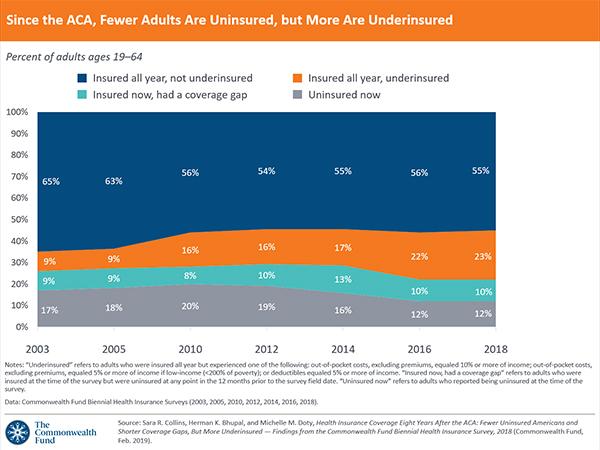
Since the ACA, Fewer Adults Are Uninsured, but More Are Underinsured

https://www.commonwealthfund.org/chart/2019/aca-fewer-adults-are-uninsured-more-are-underinsured

Image result for Since the ACA, Fewer Adults Are Uninsured, but More Are Underinsured


Ads for short-term plans may be confusing

https://www.rwjf.org/content/dam/farm/reports/issue_briefs/2019/rwjf451339?utm_source=newsletter&utm_medium=email&utm_campaign=newsletter_axiosvitals&stream=top

Image result for short term health insurance

People Googling for ACA coverage often found results that were actually trying to sell them skimpier short-term health plans, according to a report from Robert Wood Johnson Foundation and the Urban Institute.

Why it matters: Consumer confusion is one of the things regulators worried about most when the Trump administration expanded access to “short-term” coverage.

  • For some people, especially those who do only need coverage for a short time, one of these more bare-bones options might be a better choice than the comprehensive policies sold under the ACA.
  • But if you don’t realize you’re signing up for a plan with incredibly limited coverage and the right to drop you once you get sick, you could be in for a catastrophic surprise.
  • That’s why HHS mandated a disclosure statement about the plans’ limited benefits.

Details: Researchers Googled terms including “cheap health insurance” and “Obamacare plans” and looked at the first 4 results — which are usually ads.

  • Sites that included short-term plans “dominated the results,” though some of those sites also sell ACA-compliant plans. Sites varied in how much information they provided about the differences between the two types of plans.


Pre-existing conditions at House Ways and Means panel’s first policy hearing

Dems hit GOP on pre-existing conditions at panel’s first policy hearing

Dems hit GOP on pre-existing conditions at panel's first policy hearing

The powerful House Ways and Means Committee used its first policy hearing of the new Congress to hammer Republicans on pre-existing conditions, an issue that helped propel Democrats into the majority during the 2018 midterm elections.

Democratic panel members highlighted actions by the Trump administration that they argue have hurt people with pre-existing conditions, like the expansion of non-ObamaCare plans that could draw healthy people from the markets, raising premiums for those left behind.

The administration has expanded access to association and short-term health plans, which cost less than ObamaCare plans but cover fewer services. Republicans say they provide an off-ramp for consumers who can’t afford ObamaCare plans.

The witness invited by Republicans, Rob Robertson with the Nebraska Farm Bureau, said its newly developed association health plan “meets the needs of our members,” who can’t afford ObamaCare plans.

“We’re in this for the long term,” he told lawmakers. “We want to reduce costs, and the costs in the individual market are very, very high.”

ObamaCare’s popular consumer protections became the centerpiece of the November midterms after 20 Republican-led states sued to overturn the 2010 health care law, known as the Affordable Care Act (ACA).

Democrats tied congressional Republicans to the lawsuit after the Trump administration declined to defend ObamaCare and argued that those protections are unconstitutional.

Republicans say there are different ways to cover people with pre-existing conditions, like high-risk pools, which were banned after ObamaCare was implemented. Some pools had caps on coverage and long-waiting lists.

GOP committee members called Tuesday’s hearing political theatre, arguing they also support pre-existing protections but want to lower ObamaCare’s costs.

“Everyone up here wants protections for people with pre-existing conditions. Always have, always will,” said Rep. Devin Nunes (R-Calif.), ranking member of the health subcommittee. “We should be careful that we’re not stoking fear that someone is going to lose their health insurance. We have a responsibility to come up with a better health care system because ObamaCare is not the solution.”

Democrats on Tuesday said the GOP proposals aren’t serious.

Republicans have “political amnesia” and have “forgotten what it was like before the ACA,” said Rep. Lloyd Doggett (D-Texas), chairman of the health subcommittee. “Those with a diagnosis of a serious disease would also get a diagnosis of financial ruin. There were no protections for them before the ACA.”

Some Democratic panel members appealed to the emotional side of the health care debate, with one lawmaker announcing her cancer diagnosis at the hearing.

“This is a cancer I will live with for the rest of my life, but, because of my high-quality healthcare and insurance coverage, it is not a cancer I will die from,” said Rep. Gwen Moore (D-Wis.), 67.

Tensions ran high at times during Tuesday’s hearing, with members re-litigating the 2010 passage of ObamaCare and repeated GOP efforts to repeal it.

“Not one Republican up here supports pre-existing protections for the American people,” said Rep. Brian Higgins (D-N.Y.), who at times pounded his fist on the dais.

That drew a testy response from Rep. Tom Reed (R-Pa.), who said Republicans “heard the voices and the fear” from voters in the 2018 midterms when “this issue became the centerpiece.”

“We listened to this American people, as Republicans,” he said.