21 statistics on high-deductible health plans

http://www.beckershospitalreview.com/finance/21-statistics-on-high-deductible-health-plans.html

Image result for 21 statistics on high-deductible health plans

Hospital and health system executives are well aware of the affects high-deductible health plans have had on hospital finances, from patient collections to bad debt. To help quantify the impact of increasing patient financial obligations on the business of healthcare, here are 21 statistics to know about high-deductible health plans.

POLITICO-Harvard poll: Americans blame drug companies for rising health costs

http://www.politico.com/story/2016/09/americans-blame-drug-companies-for-rising-health-cost-poll-228866?utm_campaign=KHN%3A+Daily+Health+Policy+Report&utm_source=hs_email&utm_medium=email&utm_content=35091656&_hsenc=p2ANqtz-8PbV9cRcxweGuejnRZArmy5BpOsVlplZlnpP5Tlh3Bb4D0hvTxsoCG-nghADRTV3uBXXBbgZHO8RPcxFGbLEAOLxGfVw&_hsmi=35091656

A pharmacist is pictured. | Getty

The poll found 43 percent of Americans are “very or somewhat” worried about medical costs in the coming year, and the top concern (31 percent) is their out-of-pocket costs.

On Medicare But At Risk: A State-Level Analysis of Beneficiaries Who Are Underinsured or Facing High Total Cost Burdens

http://www.commonwealthfund.org/publications/issue-briefs/2016/may/on-medicare-but-at-risk

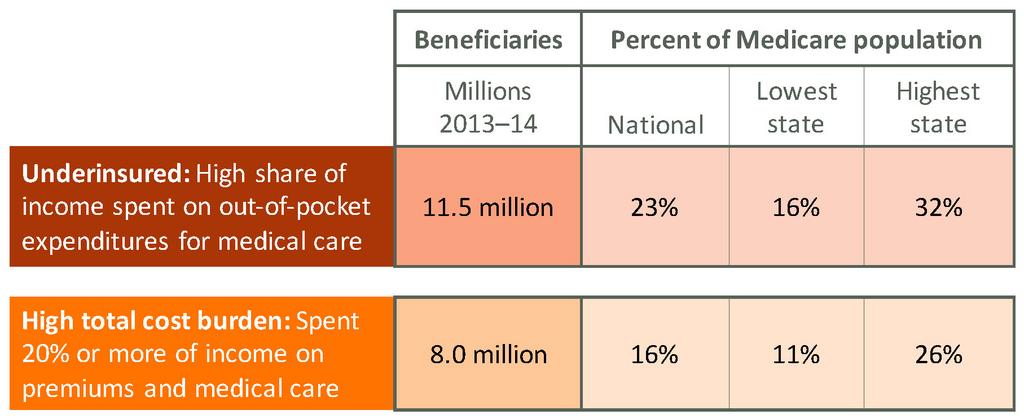
Medicare provides essential health coverage for older and disabled adults, yet it does not limit out-of-pocket costs for covered benefits and excludes dental, hearing, and longer-term care. The resulting out-of-pocket costs can add up to a substantial share of income. Based on U.S. Census surveys, nearly a quarter of Medicare beneficiaries (11.5 million) were underinsured in 2013–14, meaning they spent a high share of their income on health care. Adding premiums to medical care expenses, we find that 16 percent of beneficiaries (8 million) spent 20 percent or more of their income on insurance plus care. At the state level, the proportion of beneficiaries underinsured ranged from 16 percent to 32 percent, while the proportion with a high total cost burden ranged from 11 percent to 26 percent. Low-income beneficiaries were most at risk. The findings underscore the need to assess beneficiary impacts of any proposal to redesign Medicare.

21 statistics on high-deductible health plans

http://www.beckershospitalreview.com/finance/21-statistics-on-high-deductible-health-plans.html

Image result for high deductible health plan


Would You Like Some Insurance With Your Insurance?

http://khn.org/news/would-you-like-some-insurance-with-your-insurance/?utm_campaign=KHN%3A+Daily+Health+Policy+Report&utm_source=hs_email&utm_medium=email&utm_content=34662261&_hsenc=p2ANqtz-8_T7tLMkCX6Y6LfTReNo75vKpK1maHvHwggi_b0HJdFjSYivQggGeQ_9T7c_uhl0BRZml0KAXMIdJg7jjXJNAXcqcdiA&_hsmi=34662261

A screenshot from a video touting a gap plan called "Premium Saver." (Courtesy of Crema Design Studio)

Gap plans, used to cover out-of-pocket expenses like high deductibles, are becoming increasingly popular among consumers and businesses.

The rising price of insurance is driving the trend, explained insurance broker Ryan Hillenbrand, president of the Missouri Association of Health Underwriters.

“People see the prices of individual insurance and they say, ‘Boy, a $6,000 deductible seems really high. I don’t want something that gives me that much risk,’ ” Hillenbrand said. “That’s why [the gap insurance] market is heating up a little bit more.”

Gap insurance is in a category of insurance known as “limited benefit.” No matter how bad a person’s situation, the plan will pay out only a certain amount of money. “Mini-med” policies, now illegal under the Affordable Care Act, are another example of a limited benefit plan

Now, there’s renewed interest in gap plans. With monthly premiums on health insurance going up, more people are choosing cheaper, high-deductible options. In 2016, more than90 percent of people buying insurance under the ACA chose plans with an average deductible of $3,000 or higher.

Next year, the cost of one of the most popular plans available under the Affordable Care Act could increase by 10 percent on average across the country. That comes on top of a 5 percent jump the year before.

When consumers see those prices, Hillenbrand said, “they get sticker shock.”

“If you don’t qualify for a subsidy, you’re bearing the brunt of all that cost,” Hillenbrand said. “And here come the gap plans.”

The Missing Debate Over Rising Health-Care Deductibles

http://blogs.wsj.com/washwire/2016/09/18/the-missing-debate-over-rising-health-care-deductibles/?utm_campaign=KHN%3A+Daily+Health+Policy+Report&utm_source=hs_email&utm_medium=email&utm_content=34504530&_hsenc=p2ANqtz–cbQhbJAJ2j-K8I_jQv3kzC6RJuMdvGplQjAJSD–Kc6wYpIZ2CPkYbSLYxHgIpMaHkl9CnoCCH3BO8Sf-cUroX2PTig&_hsmi=34504530


Studies: Employer Costs Slow As Consumers Use Less Care, Deductibles Soar

http://khn.org/news/studies-employer-costs-slow-as-consumers-use-less-care-deductibles-soar/?utm_campaign=CHL%3A+Daily+Edition&utm_source=hs_email&utm_medium=email&utm_content=34365867&_hsenc=p2ANqtz-8KEto_GP9_uQqUz3i-mPzdbfQDEppu8jP4OnWeCEXc0J1QCOvNd0hi84YGIhj1horx7qHfq8_4658aqWRUhtoQ9n9XQQ&_hsmi=34365867

Pocketbook pain: Workers’ contributions to health-plan premiums have been rising faster than their pay. Deductibles have risen even more. (Courtesy of Kaiser Family Foundation)

Employer health insurance expenses continued to rise by relatively low amounts this year, aided by moderate increases in total medical spending but also by workers taking a greater share of the costs, new research shows.

Average premiums for employer-sponsored family coverage rose 3.4 percent for 2016, down from annual increases of nearly twice that much before 2011 and double digits in the early 2000s, according to a survey by the Kaiser Family Foundation. (Kaiser Health News is an editorially independent program of the foundation.)

But 3.4 percent is still faster than recent economic growth, which determines the country’s long-run ability to afford health care.

And the tame premium increases obscure out-of-pocket costs that are being loaded on employees in the form of higher deductibles and copayments. Another new study suggests those shifts have prompted workers and their families to use substantially fewer medical services.

For the first time in Kaiser’s annual survey, more than half the workers in plans covering a single person face a deductible of at least $1,000. Deductibles for family plans are typically even higher.

How companies are quietly changing your health plan to make you pay more

https://www.washingtonpost.com/news/wonk/wp/2016/09/14/the-quiet-change-to-insurance-plans-thats-making-health-care-more-expensive-for-patients/?_hsenc=p2ANqtz–a1tLHuuWbLDRr3vfl_vZWfJIr1163X7jwzsY9F5bjKZH9j8pjJ07N0ZJpCrTMnoGIXnIr7TqG7dAsJwyjClgznOWyIg&_hsmi=34365867&utm_campaign=CHL%3A%20Daily%20Edition&utm_content=34365867&utm_medium=email&utm_source=hs_email

Failure to Improve Is Still Being Used, Wrongly, to Deny Medicare Coverage

For months, physical therapists worked with Mrs. Kirby, a retired civil servant who is now 75, trying to help her regain enough mobility to go home. Then her daughter received an email from one of the therapists saying, “Edwina has reached her highest practical level of independence.”

Translation: Mrs. Kirby wouldn’t receive Medicare coverage for further physical therapy or for the nursing home. If she wanted to stay and continue therapy, she’d have to pay the tab herself.

Medicare beneficiaries often hear such rationales for denying coverage of skilled nursing, home health care or outpatient therapy: They’re not improving. They’ve “reached a plateau.” They’re “stable and chronic,” or have achieved “maximum functional capacity.”

Deanna Kirby wasn’t buying it. “I knew they couldn’t refuse you, even if you’re not improving,” she said.

She’s right. A federal judge last month ordered the federal Centers for Medicare and Medicaid Services to do a better job of informing health care providers and Medicare adjudicators that the so-called improvement standard was no longer in effect.


How the ACA’s Health Insurance Expansions Have Affected Out-of-Pocket Cost-Sharing and Spending on Premiums

http://www.commonwealthfund.org/publications/issue-briefs/2016/sep/aca-expansions-and-out-of-pocket-spending?omnicid=EALERT1098015&mid=henrykotula@yahoo.com

Abstract

Issue: One important benefit gained by the millions of Americans with health insurance through the Affordable Care Act (ACA) is protection from high out-of-pocket health spending. While Medicaid unambiguously reduces out-of-pocket premium and medical costs for low-income people, it is less certain that marketplace coverage and other types of insurance purchased to comply with the law’s individual mandate also protect from high health spending.

Goal: To compare out-of-pocket spending in 2014 to spending in 2013; assess how this spending changed in states where many people enrolled in the marketplaces relative to states where few people enrolled; and project the decline in the percentage of people paying high amounts out-of-pocket.

Methods: Linear regression models were used to estimate whether people under age 65 spent above certain thresholds.

Key findings and conclusions: The probability of incurring high out-of-pocket costs and premium expenses declined as marketplace enrollment increased. The percentage reductions were greatest among those with incomes between 250 percent and 399 percent of poverty, those who were eligible for premium subsidies, and those who previously were uninsured or had very limited nongroup coverage. These effects appear largely attributable to marketplace enrollment rather than to other ACA provisions or to economic trends.