Your Health Insurance Will Cost More Next Year: Here’s What’s Driving Prices Higher

http://www.thefiscaltimes.com/2016/08/10/Your-Health-Insurance-Will-Cost-More-Next-Year-Here-s-What-s-Driving-Prices-Higher

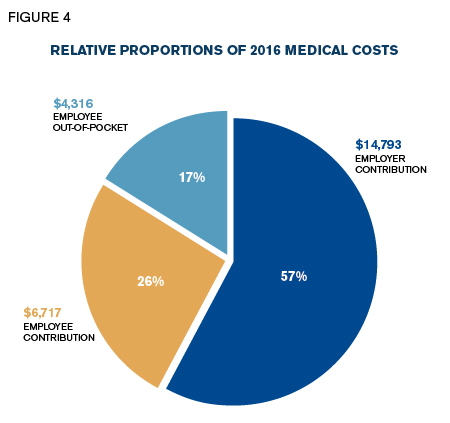
The cost of getting your health insurance through work will go up an average of 5 percent next year, according to a new survey of large employers by the National Business Group on Health.

The cost for employers will go up 6 percent. This is the third consecutive year that employers’ health costs have risen by 6 percent. While that’s still more six times the current rate of inflation, it’s likely a smaller increase than will be experienced by consumers who purchase insurance through the public exchanges.

While those plans vary widely by state, the average plan is expected to cost 10 percent more in 2017, according to Kaiser. Last year, the price of the average silver level plan on public exchanges increased 12 percent.

For employers, the biggest driver of the cost increases is the price of specialty drugs. Other factors included high-cost claims and long-term conditions, according to the NGBH survey.

Struggling to Stabilize the Exchanges

Struggling to Stabilize the Exchanges

Six years after passage of the Affordable Care Act (ACA), the individual and small-group insurance markets—the markets that the ACA remade—are still having growing pains. Health insurers have endured large losses and a number of ACA-created co-ops and other small insurers have failed. Consolidation among providers and insurers is an increasing and concerning trend. And many insurers are poised to raise premiums substantially for 2017, further stoking frustration with the insurance industry.

Even as the press vilifies insurers, however, the ACA’s supporters can’t afford to be indifferent to their struggles. Private insurers sell the managed care plans that are the central vehicle for expanding access to middle- and lower-income Americans. One day, those plans may cover many of the 11 percent of Americans who remain uninsured.

Part of insurers’ difficulty is that the risk pool in the individual and small-group markets, particularly on the exchanges, is sicker and smaller than originally projected. But the three programs—reinsurance, risk corridors, and risk adjustment—that the ACA’s drafters would hope stabilize premiums in the revamped markets have also not performed as expected. Dashed expectations have led to market instability and to a flurry of lawsuits around the “3Rs.” What does this unpredictable and difficult situation mean for 2017 and for the ACA more generally?

Payments for cost sharing increasing rapidly over time

http://www.healthsystemtracker.org/insight/payments-for-cost-sharing-increasing-rapidly-over-time/

Money Roll

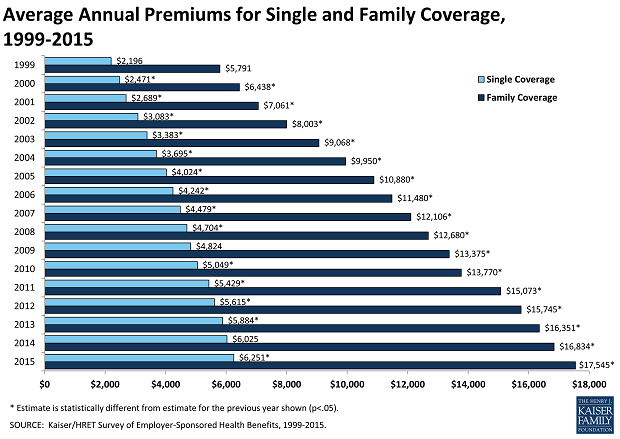
Rising cost-sharing for people with health insurance has drawn a good deal of public attention in recent years.  For example, the average deductible for people with employer-provided health coverage rose from $303 to $1,077 between 2006 and 2015.

While we can get a sense of employees’ potential exposure to out-of-pocket costs by looking at trends in deductibles, many employees will never reach their deductibles and other employees may have costs that far exceed their deductibles.  In addition to deductible payments, some employees also have copayments (set dollar amounts for a given service) or coinsurance payments (a percentage of the allowed amount for the service).  To look at what workers and their families actually spend out-of-pocket for services covered by their employer-sponsored plan, we analyzed a sample of health benefit claims from the Truven MarketScan Commercial Claims and Encounters Database to calculate the average amounts paid toward deductibles, copayments and coinsurance.

We find that, between 2004 and 2014, average payments for deductibles and coinsurance rose considerably faster than the overall cost for covered benefits, while the average payments for copayments fell.

Americans’ Experiences with ACA Marketplace Coverage: Affordability and Provider Network Satisfaction

http://www.commonwealthfund.org/publications/issue-briefs/2016/jul/affordability-and-network-satisfaction

For people with low and moderate incomes, the Affordable Care Act’s tax credits have made premium costs roughly comparable to those paid by people with job-based health insurance. For those with higher incomes, the tax credits phase out, meaning that adults in marketplace plans on average have higher premium costs than those in employer plans. The law’s cost-sharing reductions are reducing deductibles. Lower-income adults in marketplace plans were less likely than higher-income adults to report having deductibles of $1,000 or more. Majorities of new marketplace enrollees and those who have changed plans since they initially obtained marketplace coverage are satisfied with the doctors participating in their plans. Overall, the majority of marketplace enrollees expressed confidence in their ability to afford care if they were to become seriously ill. This issue brief explores these and other findings from the Commonwealth Fund Affordable Care Act Tracking Survey, February–April 2016.

How health care creates wage inequality

https://www.washingtonpost.com/opinions/how-health-care-creates-wage-inequality/2016/06/22/7d6974ae-3885-11e6-9ccd-d6005beac8b3_story.html?_hsenc=p2ANqtz-8vYCgTydHwYstwKLMGcojFFxInfu511ZO2gKjiviG0olgNel-V8f5RkeIaELQ94TQxWBT8n2D5uYJiMYrJhUVtizdVPQ&_hsmi=30930741&utm_campaign=KHN%3A%20Daily%20Health%20Policy%20Report&utm_content=30930741&utm_medium=email&utm_source=hs_email

You can add health care to the causes of growing wage inequality in America. There’s a largely unknown paradox at work. Companies that try to provide roughly equal health insurance plans for their workers — as many do — end up making wage and salary inequality worse. A new economic study shows how this perverse bargain works.

It’s simple arithmetic, writes Mark Warshawsky of the Mercatus Center at George Mason University, author of the study. Paying for expensive health insurance squeezes what’s left for wage and salary raises. Economic inequality increases, because health insurance typically represents a larger share of total compensation for lower-paid than higher-paid workers. Their wages are squeezed the most.

Health Care Costs for Average American Family Now Exceed $25,000 a Year

http://www.thefiscaltimes.com/2016/05/24/Cost-Health-Care-Average-American-Family-Now-Exceed-25000-Year?utm_campaign=541c47950e351dbe08037e5f&utm_source=boomtrain&utm_medium=email&bt_alias=eyJ1c2VySWQiOiJkYzYxNmI4YS03YTE4LTYyZjAtZWI5Ni02Mzk3ZDdkNDM4YWMifQ%3D%3D

What to Look for in 2017 ACA Marketplace Premium Changes

What to Look for in 2017 ACA Marketplace Premium Changes

Health Insurance Exchanges2

Here’s Why Your Health Insurance Premiums Are Going Up Again

http://www.thefiscaltimes.com/2016/05/09/Here-s-Why-Your-Health-Insurance-Premiums-Are-Going-Again?utm_campaign=541c47950e351dbe08037e5f&utm_source=boomtrain&utm_medium=email&bt_alias=eyJ1c2VySWQiOiJiODQwZDVjNy05MjczLWRiOTUtOTVmMi01OGI0MTc4NzFkYjIifQ%3D%3D

A new report from the American Academy of Actuaries outlines the trends that will impact health insurance premiums next year. “There are both upward and downward pressures on premiums for 2017, but for the individual and small group markets as a whole, the factors driving premium increases up dominate,” senior academy health fellow Cori Uccello said in a statement.

Click to access IB.Drivers5.15.pdf