‘Skinny Repeal’ of ACA Likely to Leave Everyone Wanting More

https://www.thefiscaltimes.com/2017/07/25/Skinny-Repeal-ACA-Likely-Make-Everyone-Wanting-More

The Senate’s Republican leadership has added yet another option to the complicated menu of Affordable Care Act repeal and replacement measures that may be considered as alternatives to the House-passed American Health Care Act.

Faced with the very real possibility that they will be unable to pass any of the current versions of their own health care legislation, which ranges from a standalone repeal of the ACA to a complicated restructuring of the law, Senate leadership is now considering the possibility of a measure being referred to as a “skinny repeal” of the ACA.

This represents a sort of fall-back position if the GOP is unable to muster the votes for any of the larger repeal and replace bills. The skinny repeal bill would eliminate the employer and individual mandates, which impose penalties on some businesses that don’t offer their employees insurance and on individuals not otherwise covered who do not buy themselves insurance. It would also repeal the controversial tax on medical devices.

The skinny repeal would fall far short of the goal of complete elimination of the ACA, but it would give Republicans the ability to claim at least a small victory. However, according to the Committee for a Responsible Federal Budget, it would also result in at least 15 million fewer Americans with insurance within a year, and 20 percent increases in health insurance premiums, while saving the federal government a relatively modest $225 billion over 10 years.

The skinny repeal would likely set up Senate Republicans for brutal criticism from both sides of the aisle.

It would also be viewed by large segments of the Republican voter base as a placeholder at best, or a betrayal at worst. By leaving in place many of the ACA’s mandates on health insurance providers and its taxes, the skinny repeal would leave many GOP voters clamoring for further action against Obamacare.

On the left, critics would point out that the elimination of the coverage mandates will inject huge and perhaps fatal uncertainty into the individual insurance market, potentially causing many more people to lose insurance, either because of insurers withdrawing from the system, or premiums becoming unaffordable.

First GOP health care bill fails, with many more votes to come

https://www.axios.com/first-gop-health-care-bill-fails-with-many-more-votes-to-come-2465490343.html

Image result for aca repeal

The Senate GOP’s Affordable Care Act replacement plan did a face plant on Tuesday night, with nine Republicans and all Democrats voting against it. But it was only the first vote of what’s sure to be a long process, and its failure wasn’t a surprise.

Why this matters: This was the Senate’s best attempt at an ACA replacement, after about two and a half months of closed-door meetings attempting to find something that could bridge the caucus’ deep divides. Its failure suggests Senate Republicans won’t be able to come together on a replacement plan without Democrats in the future, no matter what happens next.

What’s next: A vote on a bill that repeals the Affordable Care Act’s subsidies, taxes and Medicaid expansion but leaves in place its regulations. It’s expected to be tomorrow at noon.

The version of the bill, the Better Care Reconciliation Act, that the Senate voted down tonight included an agreement by Sens. Ted Cruz and Rob Portman that added $100 billion to help low-income people transitioning off of Medicaid, as well as Cruz’s proposal to let insurers sell health plans that don’t meet ACA requirements as long as they also sell plans that do.

Since neither of these were scored by the Congressional Budget Office, the BCRA amendment needed 60 votes to pass, meaning it was doomed from the start as Democrats were never going to support it.

Republicans who voted against the bill: Mike Lee, Susan Collins, Bob Corker, Lindsey Graham, Rand Paul, Dean Heller, Jerry Moran, Lisa Murkowski, Tom Cotton.


Senate rejects ObamaCare repeal, replacement amendment

Senate rejects ObamaCare repeal, replacement amendment

Image result for aca repeal

The Senate rejected a key proposal repealing and replacing ObamaCare on Tuesday night, as senators start a days-long debate on healthcare.

Senators voted 43-57 on a procedural hurdle for the measure that included the GOP repeal and a replace bill, the Better Care Reconciliation Act, as well as proposals from GOP Sens. Ted Cruz (Texas) and Rob Portman (Ohio).
GOP Sens. Susan Collins (Maine), Bob Corker (Tenn.), Tom Cotton(Ark.), Lindsey Graham (S.C.), Dean Heller (Nev.), Mike Lee (Utah), Jerry Moran (Kan.), Lisa Murkowski(Alaska) and Rand Paul (Ky.) voted against the repeal-replace proposal on the procedural hurdle. No Democrats voted for it.
The proposal was the first amendment to get a vote after senators took up the House-passed healthcare bill, which is being used as a vehicle for any Senate action, earlier Tuesday.
But it was widely expected to fail because it needed 60 votes because the Congressional Budget Office (CBO) didn’t analyze either the Cruz or Portman proposal that was packaged in with BCRA.
Tuesday night’s vote doesn’t prevent GOP leadership from offering another repeal and replace amendment, or another version of BCRA.
It could also help GOP leadership get rank-and-file senators on the record, as they try to figure out a path forward.
A vote on an amendment that would repeal much of ObamaCare is expected on Wednesday.
Cruz acknowledged ahead of the late night vote that the amendment wasn’t likely to be approved, but appeared optimistic that Republicans would be able to get to an agreement before a final vote this week.
“I will say the bill before the Senate … is not likely to pass tonight but I believe at the end of the process the contours within it are likely to be what we enact, at least the general outlines,” Cruz said from the Senate floor ahead of the vote.
Cruz said he expects his amendment to end up in the final version of the healthcare bill.
“I believe we will see the consumer freedom amendment in the legislation that is ultimately enacted,” he said.
Sen. Lisa Murkowski (R-Ala.) was greeted by protestors outside the Capitol who chanted “stay strong Lisa.”
Asked whether she would support a “skinny repeal” bill, she said it’s not clear what it would entail.
“I don’t know that any of us have defined what that might be.”
The Texas Republican’s provision would give insurance companies more flexibility on what kind of health insurance plans they provided, as long as they sold some plans that met the ObamaCare requirements.
Portman’s, meanwhile, would aim to lower insurance costs for individuals in Medicaid expansion states, like the Ohio Republicans, but could also apply to other low-income Americans.

The provision would add $100 billion to the bill’s state stability fund to help people who might lose the coverage they got under ObamaCare’s Medicaid expansion. These funds could help cover out-of-pocket costs like deductibles and copays.

Portman said he “worked with the president, vice president and administrative officials” to “improve this bill further to help out low-income Ohioans.”

Would your plan cover John McCain’s treatment?

https://www.healthinsurance.org/blog/2017/07/25/would-your-plan-cover-john-mccains-treatment/

Image result for adequate health insurance coverage

The Arizona Senator’s health plan will ensure top-notch glioblastoma treatment, but how would Americans with other health coverage fare?

Last week, we heard the sad news that Senator John McCain has been diagnosed with glioblastoma. McCain had surgery at Phoenix’s Mayo Clinic in mid-July, and it’s expected that he’ll also receive chemotherapy and radiation, along with other potential treatments. Senator McCain has proven time and again that he’s tough as nails, and appears to be facing this latest battle head-on. One thing that he likely has on his side is top-notch health insurance.

McCain is 80, which means he’s presumably been on Medicare for 15 years. Currently serving federal lawmakers are able to obtain employer-subsidized coverage in the Washington DC small-business exchange, and they can have this coverage in addition to Medicare.

How good is McCain’s coverage?

McCain hasn’t said publicly exactly what insurance he has, and his office has not responded to my inquiry. But the most likely scenario is that he has Medicare plus employer-sponsored coverage through the DC exchange – a very comprehensive benefits package.

There are certainly lots of other people who have similar coverage arrangements – either because they’re still working after turning 65, like McCain, or because they receive generous retiree health benefits that supplement their Medicare coverage. For those who don’t, there are private Medicare supplements available that cover virtually all of the out-of-pocket costs associated with Medicare.

But health coverage in the United States is a bit of a mixed bag, with some people having much better coverage than others. A serious illness tends to shine a spotlight on the flaws that exist in some health plans, so let’s take a look at how the average American facing a glioblastoma diagnosis would fare under various health plans.

Employer-sponsored health insurance

Most employer-sponsored health insurance plans provide pretty solid health coverage. According to a 2016 Kaiser Family Foundation analysis, the average deductible for covered workers was about $1,500, and that doesn’t count the 17 percent of covered workers whose plans had no deductible at all.

In addition, the average employer paid more than two-thirds of the total premiums. And the tax exclusion of employer-sponsored insurance premiums amounts to a subsidy that cost the federal government $250 billion in fiscal year 2016.

However, employer-sponsored health insurance is, by definition, linked to employment. A person going through a serious illness like glioblastoma might not be able to continue working, depending on the specifics of the treatment.

As long as the employer has at least 20 employees, the employee will be able to continue the coverage under COBRA for 18 months, even if he or she is unable to work. But COBRA is expensive, as the employer contribution to the premiums and the tax exclusion of the premiums are eliminated. (COBRA premiums are counted as a medical expense for the purpose of itemized medical deductions, but only expenses that exceed 10 percent of your income can be deducted this way.)

Although most employer-sponsored plans provide good coverage, that’s due in part to the ACA. It was not uncommon – particularly in low-wage, high turnover industries – for employers to offer “mini-meds” before the ACA, with exceedingly low benefit caps. (The ACA’s ban on lifetime and annual benefit limits means that these plans are no longer offered to employees.)

A mini-med with a $2,000 or $5,000 annual benefit maximum would not have done much in the face of glioblastoma. Vox reported that just the initial craniotomy to remove a blood clot above Senator McCain’s eye would likely have been billed at more than $76,000. And that was before the cancer diagnosis.

ACA-compliant individual market coverage

The pre-ACA individual market included plenty of solid plans. But dubious coverage also abounded, and regulations varied considerably from one state to another.

The ACA imposed a bevy of regulations on the individual health insurance market, bringing all new (as of 2014) plans up at least a basic minimum standard. Individual major medical coverage can no longer be sold without the ACA’s essential health benefits.

And for those benefits, insurers cannot limit how much they’ll pay during a year or over the course of an insured’s lifetime. (Sadly, another Arizona resident with cancer, Arijit Guha, died in 2013 at age 32. Guha’s health insurance plan had a $300,000 lifetime cap – which is no longer allowed, thanks to the ACA – and his treatment, including chemotherapy that cost $11,000 per session, quickly exceeded that limit.)

Individual-market plans also cannot discriminate against people with pre-existing conditions, either by charging them higher prices or declining their applications (both of those were standard practice in nearly every state prior to 2014). Notably, Senator McCain has a history of melanoma, which would have virtually guaranteed a declined application in the individual market pre-ACA if he had been in need of non-group coverage for some reason.

A person with ACA-compliant individual market coverage would have solid coverage for glioblastoma. The maximum out-of-pocket costs during 2017 would be $7,150, although most plans have out-of-pocket maximums below that threshold. And 57 percent of people who enrolled through the exchanges in 2017 have cost-sharing subsidies, which further reduce the out-of-pocket costs.

The American Cancer Society explains in more detail how the ACA improves access to care for people with cancer. But the short story is that a person facing glioblastoma with a 2017 individual health insurance policy has a much more secure financial safety net than someone with the same diagnosis a decade ago.

Medicaid

Medicaid provides comprehensive coverage. Although the benefits available under traditional Medicaid vary from one state to another, Medicaid expansion coverage is required to include the ACA’s essential health benefits. (The Senate’s Better Care Reconciliation Act – BCRA – would eliminate this requirement after 2019.)

Medicaid has minimal cost-sharing, limited to no more than 5 percent of a family’s annual income.

It’s true that compared with private health insurance and Medicare, fewer medical providers accept Medicaid. But the majority do work with Medicaid. (According to a Kaiser Family Foundation analysis, about 69 percent of office-based physicians accept new Medicaid patients, while about 85 percent accept new privately-insured patients.)

Short-term health insurance

The ACA implemented regulations that apply to virtually all types of health insurance. But some plans are not regulated by the law, including short-term health insurance.

As evidenced by the name, short-term plans are limited in their duration. As of 2017, a short-term plan can last no more than three months, although people who remain healthy can purchase a second short-term plan after the first one ends.

Short-term plans do not cover pre-existing conditions. So if you were to be diagnosed with glioblastoma while covered under a short-term plan, the first thing the insurer would do is go back through your medical records to make sure that you didn’t have any symptoms prior to enrolling in the plan.

Assuming you were healthy before you enrolled, your short-term plan would start to cover your treatments. But you would be facing a looming and inflexible coverage termination date, along with annual and lifetime benefit maximums. Short-term plans vary considerably in quality – some have lifetime benefit maximums of $250,000 or less, while others provide benefits well in excess of a million dollars. In the case of a glioblastoma diagnosis, coverage would end when the policy reached its predetermined end date, or when you hit your benefit maximum – whichever happened first.

Either way, you’d want to hope that you had other coverage already lined up and ready to go at that point. The cancer diagnosis would make it impossible to obtain another short-term policy.

And since a short-term plan is not considered minimum essential coverage, the termination of the short-term policy would not trigger a special enrollment period for individual or employer-sponsored insurance. You would still be able to enroll in a regular individual-market plan, or an employer plan if you’re eligible for one, during regular annual open enrollment. But you might experience a significant gap in coverage, which can be disastrous in the middle of cancer treatment.

A limited-benefit plan

Limited-benefit plans are another category of coverage that’s not regulated by the ACA (despite attempts by the Obama Administration to place some regulations on certain types of fixed indemnity coverage).

Fixed indemnity means that the plan pays a specific dollar amount if the insured has a covered claim. For example, the plan might pay $1,000 per day for hospitalization, or $50 for a doctor visit. There’s no cap on how much the patient has to pay, and these plans often have very low annual and lifetime benefit limits.

So imagine a plan that will pay $2,000 per day for hospitalization, for up to 25 days. It will also pay $2,500 for an outpatient surgical procedure and $2,500 for an inpatient surgical procedure. And it will pay $625 for anesthesia, but it does not cover prescriptions (these numbers are from a real plan currently available in the limited benefit market).

Remember that McCain’s craniotomy – before the glioblastoma was even diagnosed – likely cost $70,000. He was home very soon after the surgery, so if he was hospitalized at all, it wasn’t more than a day or two. A limited benefit plan like the one described above would have paid $2,000 for each day in the hospital (which amounts to zero dollars if the procedure didn’t result in an inpatient stay), $2,500 for the surgery, and $625 for the anesthesia. That would leave a sizeable chunk of the $70,000 bill as the patient’s responsibility.

And all of that is before the treatment for the glioblastoma even begins.

A Cruz Amendment plan

In mid-July, Senator Ted Cruz introduced an amendment to the BCRA aimed at reducing regulations on health insurance plans. The Cruz Amendment, if included in the BCRA, would allow insurers to offer non-ACA-compliant plans as long as they also offered at least one Silver plan, one Gold plan, and one plan that complies with the BCRA’s benchmark standards (58 percent actuarial value).

The non-compliant plans would likely range from decent to terrible, since they would have wide latitude in terms of the consumer protections they’d be able to waive. Essentially, it would be a return to the pre-ACA days when there was more of an “anything goes” approach to health insurance. Plans would be available without essential health benefits, would not have to cover pre-existing conditions, and could be offered with higher out-of-pocket limits than ACA compliant plans.

These plans would likely appeal to healthy people, as they would be less expensive than ACA compliant plans. But a person who seems perfectly healthy can be diagnosed with glioblastoma, at which point the holes in the coverage become glaringly apparent.

What about those who lack McCain’s coverage

In glioblastoma, Senator McCain is facing a fierce battle, and our hearts go out to him and his family. But thanks to McCain’s health coverage, he won’t have to worry about how to pay for his treatment. I’m glad he has that health coverage.

Senator McCain is not alone in his battle. There are more than 12,000 Americans who will be diagnosed with glioblastoma this year. Unfortunately, many of them do not have the level of health coverage that McCain has. Even with the best health insurance, the diagnosis plunges each family into an immensely challenging situation. With lesser – or no – coverage, the challenge becomes even more insurmountable.

Nobody deserves cancer. And nobody deserves to have to fight cancer with less-than-adequate health insurance. With our current medical know-how, we can’t keep everyone from getting cancer. But we can make sure that as many people as possible are covered by high-quality health insurance. We owe it to all the lesser-known John McCains out there to work towards that goal.

That means pushing back against any sort of “reform” that would result in fewer people with insurance. It also means rejecting proposals that would allow junk insurance plans to flood the market, lulling consumers into a false sense of security – until they’re diagnosed with brain cancer.


Senate GOP floats scaled-down healthcare bill

Senate GOP floats scaled-down healthcare bill

Image result for skinny bill

Senate Republicans are considering passing a dramatically scaled-down version of their ObamaCare repeal bill as a way to pass something and set up negotiations with the House, according to GOP aides.

The measure, known as a “skinny bill,” is intended to be something all Republicans can agree on, allowing something to pass and setting up a conference committee with the House.

Aides say the scaled-down bill would likely just repeal ObamaCare’s individual and employer mandates and the medical device tax.

That would be a far narrower measure than the most recent Senate replacement bill, which also scaled down ObamaCare’s subsidies and cut Medicaid.

The consideration of the scaled-down measure is a sign of how much trouble Senate Republicans are having coming to agreement on any more significant bill.

A Senate GOP aide said leadership pitched their office on the scaled-down bill on Monday.

The scaled-down bill is expected to come after votes, which are expected to fail, on both a repeal-only measure and the latest replacement bill.

Republicans would also need to gather enough votes to start debate, and it is still unclear if they have those votes.

Sen. John Cornyn (R-Texas), the No. 2 Senate Republican, floated a conference committee with the House on Monday evening.

“I think if you want to get a result that may be a selling point,” Cornyn said.

The Medicaid Fund: Beware of Gifts

http://thenews.pl/1/11/Artykul/317380,Poland-to-open-new-museum-at-German-Nazi-Treblinka-death-camp

Image result for medicaid

Press reports have suggested that to get the Affordable Care Act repeal-and-replace effort back on track, Senate leaders are now offering, as part of their Better Care Reconciliation Act (BCRA), a $200 billion fund to help states partially offset the nearly $800 billion dollars in lost federal Medicaid funding they would face over the next decade if BCRA became law. This fund, to be administered by the U.S. Secretary of Health and Human Services (HHS), would apparently be used to help low-income people transition from Medicaid to private insurance.

The offer, if accurate, still amounts to a 75 percent reduction in funding. So the fund does little to address the human and financial consequences of BCRA’s original Medicaid cuts. It’s also unclear how it would work or affect the private insurance market. Furthermore, it’s uncertain whether the Senate parliamentarian would allow a new program. Even if permitted under the strict rules governing the Senate reconciliation process, the program would encounter major legal and operational hurdles in implementation, as well as questions about the lack of public accountability for drawing on the money. It is also worth noting that this type of strategy, in which the HHS secretary is given vast powers over how to allocate funds under the loose rubric of “transition,” may itself raise questions about whether Congress simply has thrown a handful of dollars at the problem, and coupled these dollars with an extraordinary delegation of its constitutional legislative powers to the executive branch.

Today, if a state chooses to insure a Medicaid-eligible population, the federal government will pay a percentage of actual costs. Like insurance generally, these costs can vary by the type of population insured (healthy people versus those who are sick), the amount and intensity of services furnished, and the prices paid. In any year, and in any state, costs vary enormously, a fact driven home by the economic fallout from the opioid epidemic or the Zika virus. The federal Medicaid contribution to state programs ranges from 50 percent to about 75 percent, with higher contributions for low-income adults covered under the ACA’s Medicaid expansion. Equally importantly, there is real accountability in federal Medicaid payments spent to insure people — we know how many people are covered and what services are paid for.

Over the past several weeks, a blizzard of analyses and reports has made clear just how essential Medicaid is to states, their populations, their economies, and their ability to maintain operational health care systems for everyone. Receiving 25 cents on the dollar in lieu of guaranteed Medicaid financing would be little consolation; this is particularly true since presumably, like other special payments to states under the bill, the fund can be expected to be time-limited, after which more action from Congress would be needed to extend its life.

Let’s imagine that this fund becomes law, with details to be hashed out later. A host of questions would arise, all of which would need to be translated into complex and contentious regulations, issued following a lengthy rulemaking process. For example, will normal federal matching rules apply when states draw on this fund, or will states have to put up more funding or perhaps none at all? What types of costs will be recognized as eligible for fund payments? Will all states be able to participate or just those losing expansion funding? Will states be permitted to help only selected Medicaid expansion beneficiaries losing coverage? Although the fund is billed as transitional assistance for beneficiaries, would this include direct payments to providers to allow for continuity of care? Under laws that govern agency policymaking and spending decisions such as when, where, and how to spend $200 billion, these questions and many more would need to move a formal policy development process. The HHS secretary cannot simply dole out unstructured funding that could be used for purposes only tangentially related to transitions.

No vague promises or pennies-on-the-dollar slush fund can take the place of what Medicaid does for people and for states. Nor can it compensate for the consequences of ending the compact on which Medicaid has rested for over 50 years.

Parliamentarian deals setback to GOP repeal bill

http://thehill.com/policy/healthcare/343234-parliamentarian-deals-setback-to-gop-healthcare-bill?utm_content=buffer1343d&utm_medium=social&utm_source=facebook.com&utm_campaign=buffer

Image result for senate parliamentarian

Major portions of the Republican bill to repeal and replace ObamaCare will require 60 votes, according to the Senate parliamentarian, meaning they are unlikely to survive on the floor.

The parliamentarian has advised senators that several parts of the bill could be stripped out, according to a document released Friday by Sen. Bernie Sanders (I-Vt.), ranking member of the Senate Budget Committee. (Read the guidance here.)

The provisions that would likely be removed include policies important to conservatives, such as restrictions on tax credits being used for insurance plans that cover abortion.

Language in the bill defunding Planned Parenthood for a year also violates budget rules, according to the parliamentarian. That guidance is sure to anger anti-abortion groups who backed the bill specifically because of those provisions.

In a statement, Planned Parenthood said it was “obvious” that the defunding provision would be a violation of the reconciliation rules.

“No amount of legislative sleight of hand will change the fact that the primary motivation here is to pursue a social agenda by targeting Planned Parenthood,” the group said.

The parliamentarian has also not yet ruled on a controversial amendment from Sen. Ted Cruz (R-Texas) that would allow insurers to sell plans that do not meet ObamaCare regulations. If that provision were struck, conservative support for the bill would be in doubt.

Republicans are trying to use the budget reconciliation process to pass their healthcare bill with only a simple majority. The provisions deemed impermissible under that process can be stripped if a senator on the floor raises an objection.

Democrats would be virtually certain to deny Republicans the 60 votes they would need to keep portions of the bill intact.

The result is that the arcane rules of the Senate could end up making the bill harder for Senate Majority Leader Mitch McConnell (R-Ky.) to pass.

A spokesman for McConnell was quick to point out that the parliamentarian only provides guidance on the legislation to help inform subsequent drafts. The bill will have to change before it gets to the floor if Republicans want to salvage any of provisions in question.

GOP leaders have said they want to vote on a procedural motion to begin debate on ObamaCare repeal legislation early next week. However, it’s still not clear if they have the votes or which legislation they will be voting on: the replacement bill or repeal-only legislation.

Some conservatives were already questioning Friday why the Senate parliamentarian, Elizabeth MacDonough, would rule against Planned Parenthood defunding, when that provision was allowed under reconciliation in 2015.

A spokesman for Sanders said the guidance has changed because it is now clear that Planned Parenthood would be the only organization affected by the defunding language.

“It passed last time because there was at least a question that other entities could be affected by the language,” the spokesman said. “In the interim, Republicans have not been able to show that any entity other than Planned Parenthood is affected, and the new [Congressional Budget Office] score confirms that.”

In a blow to the insurance industry, the parliamentarian has advised that two key market stabilization provisions in the bill would be against the rules. First, the legislation can’t appropriate the cost-sharing reduction subsidies insurers rely on to keep premiums and deductibles low; it can only repeal them.

Additionally, a “lockout” provision requiring consumers with a break in coverage to wait six months before buying insurance also violates the rules, according to the guidance.

The provision was added to the bill to address concerns that people would only sign up for health insurance when they’re sick, if insurers are still prevented from denying coverage for pre-existing conditions.

The parliamentarian also advised that a specific provision dealing with New York state’s Medicaid program would be a violation of the rules. Senate Minority Leader Charles Schumer (D-N.Y.) seized on that decision.

“The parliamentarian made clear that state-specific provisions” violate the rules, Schumer said. “This will greatly tie the majority leader’s hands as he tries to win over reluctant Republicans with state-specific provisions. We will challenge every one of them.”

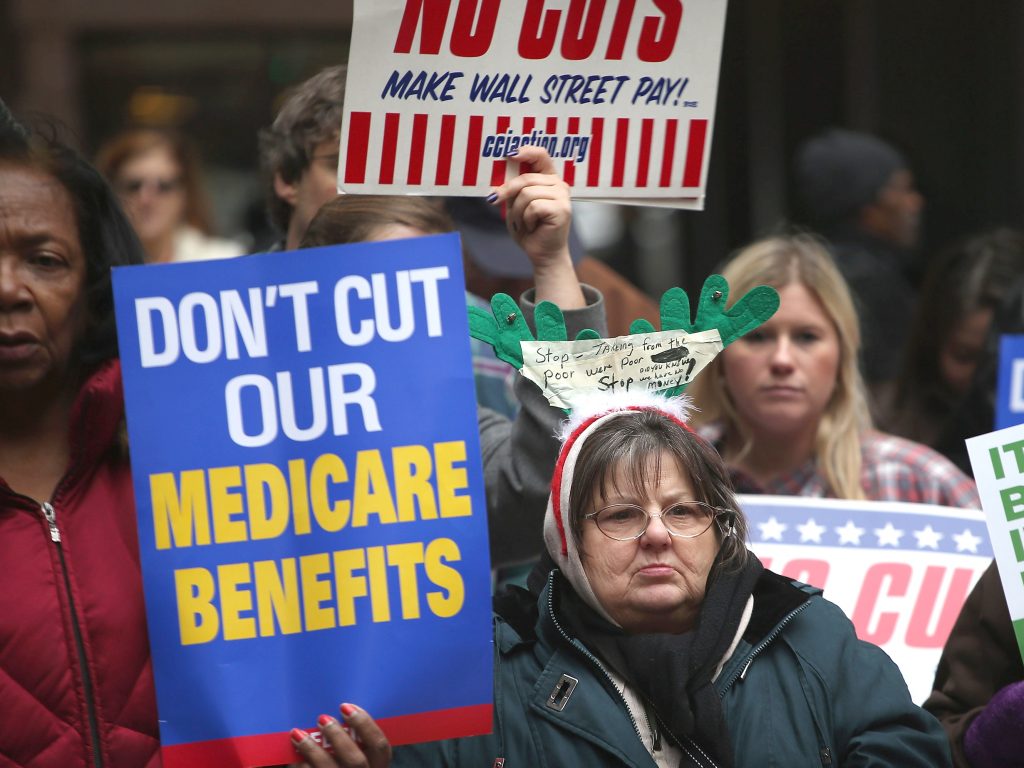
How GOP Will Still Carve Up Medicare

https://www.forbes.com/sites/johnwasik/2017/07/19/how-gop-will-still-carve-up-medicare/#48a9aa5943f1

Image result for assault on medicare

Now that the GOP’s plan for repealing and replacing Obamacare seems to be in a coma, the party has turned its attention to the 2018 federal budget.

Although specific spending details in the House committee mark-ups are still being hammered out, the GOP is back to its old script.

The GOP has a working blueprint to cut billions out of federal programs and balance the budget without tax increases. And, among other items, it still wants to privatize Medicare.

Speaker of the House Paul Ryan (R-WI). (Photo by Win McNamee/Getty Images)

Medicare covers more than 55 million Americans. Most of them are 65 or older and millions are permanently disabled. It’s the nation’s second-largest government-managed single-payer plan after Medicaid, which covers some 70 million.


While Medicare provides coverage for doctors and hospitals, it also covers prescription drugs if you pay an additional premium. You also have the option to buy into private policies through Medicare Advantage — if you don’t want the fee-for-service part of basic Medicare.

The rehashed House GOP budget blueprint wants to reshape Medicare into more of a Medicare Advantage model, which now covers some 19 million Americans.

What does that mean? Funding for the guaranteed part of Medicare would be shifted into the privatized scheme. You’d receive a fixed stipend or “premium support” to buy a private policy on an exchange.

Buying private plans on an exchange? Where have we heard that before? Oh yes, that was the model for the Affordable Care Act, or Obamacare, which the GOP has spent the last seven yearstrying to repeal. It’s been a staple of House Speaker Paul Ryan’s policy platform for years.

According to the House Budget Committee blueprint:

“The Medicare improvements envisioned in this budget resolution would adopt the popular simplified coverage structure of Medicare Advantage, and allow seniors greater plan choices while reducing costs.

It would resemble the private insurance market, in which the majority of Americans select a single health care plan to cover all their medical needs.”

In theory, having private insurers compete with the government to provide more coverage at a lower cost sounds like a good idea. But is it possible, given the government’s massive economies of scale?

Without generous subsidies, the prospect of insurers offering a better Medicare deal is like the corner grocer trying to compete with Wal-Mart. Moreover, using Medicare Advantage as a model is a horrible idea.

Medicare Advantage insurers have been embroiled in numerous billing scams, according to the non-partisan Center for Public Integrity. The Center, an independent watchdog, has published more than two dozen pieces on this ongoing morass. Here’s a summary of their findings:

“Congress created private Medicare Advantage health plans 11 years ago to help control health care spending on the elderly. But a Center for Public Integrity investigation found that billions of tax dollars are wasted every year through manipulation of a Medicare payment tool called a “risk score.”

The formula is supposed to pay health plans more for sicker patients and less for healthy people, but often it pays too much. The government has for years missed opportunities to corral tens of billions of dollars in overcharges and other billing errors tied to abuse of risk scores.

Meanwhile, the growing power of the Medicare Advantage industry has muzzled many critics in Congress, and turned others into cheerleaders for the program.”

Back to the main story: What House Speaker Paul Ryan and GOP congressional leaders are proposing is to tear down and remold basic Medicare into the troubled Medicare Advantage program, which would be like throwing kerosene on a house fire.

There’s even more of a muddle on how the GOP would calculate how much to give seniors for their yearly stipend to cover private premiums. What if policy costs go up double digits and the stipend doesn’t keep pace with the private market?

Would private insurers offer lower rates to healthier seniors and price less-healthy Americans out of the market? Although basic Medicare would still be available, wouldn’t the money diverted to premium support undermine funding for the traditional Medicare Hospital Trust Fund, which may be insolvent by 2029?

I think there’s a reason why there’s a billboard in Kenosha, Wisconsin — in the heart of Ryan’s Congressional District — that shows Ryan in a robber’s mask. There’s an attempted theft in progress, but older Americans and the disabled will be the victims.

State-by-State Estimates of Reductions in Federal Medicaid Funding

Better Care Reconciliation Act (BCRA): State-by-State Estimates of Reductions in Federal Medicaid Funding – Issue Brief

Medicaid Changes under the BCRA and Possible State Responses

Our analysis examines the changes in the BCRA that would phase out the enhanced matching rate for the ACA Medicaid expansion and limit federal Medicaid spending to a capped amount per enrollee for five eligibility groups (expansion adults, other adults, children, the elderly and people with disabilities). First, under the BCRA, for states that adopted the expansion as of March 1, 2017, the enhanced federal match would phase out from 90% in 2020 to 85% in 2021, 80% in 2022, 75% in 2023 and then to the regular state match rate in 2024 and beyond. This phase out lowers federal Medicaid spending relative to current law, under which federal financing for the expansion population would remain at 90% in 2020 and in subsequent years.

Second, under the BCRA, federal Medicaid spending for most enrollees would be limited to a set amount per enrollee. To establish these limits, states would use data from FY 2014-2016 to develop base year per enrollee spending that would be inflated to 2019 based on the medical component of the consumer price index (CPI-M). Beginning in 2020, federal spending would be limited to the federal share of spending based on per enrollee amounts calculated by inflating the base year spending by CPI-M for children and adults and CPI-M plus one percentage point for the elderly and disabled. Beginning in 2025, all per enrollee limits would be increased by general inflation (CPI-U). Certain spending and populations would be excluded from the per enrollee caps, including enrollees who do not receive the full scope of Medicaid benefits.

States could respond to these changes in federal policy in several ways. We examine changes in federal Medicaid spending under two possible scenarios of state responses: (1) All states, both expansion states and non-expansion states, fill gaps in the loss of federal funding and maintain coverage, including the ACA Medicaid expansion coverage, and (2) states that expanded Medicaid under the ACA fully drop their expansions but maintain spending and coverage for other groups, resulting in declines in both federal and state spending. In the second scenario, we model the loss of federal dollars that the state would have received had it fully maintained its expansion.

Wondering Which Health Bill the Senate Will Vote On? Here’s Your Scorecard

https://www.thefiscaltimes.com/2017/07/21/Wondering-Which-Health-Bill-Senate-Will-Vote-Here-s-Your-Scorecard


There hImage result for health bill scorecardave been times when congressional leaders decided to roll the dice and send major legislation to the floor with no certainty of the outcome because the odds of passage were a toss-up. Former House Speaker John Boehner (R-OH) did that more than once in trying to break a deadlock between far-right Freedom Caucus members and more moderate members of his party.

But rarely has a leader from either party asked his members to vote on a controversial bill – one with huge political implications for them — with no advanced warning of what was in the legislation.

Senate Majority Leader Mitch McConnell, a 32-year veteran lawmaker who some consider a “Master of the Senate” because of his wily ability to overcome legislative log-jams, is about to do just that next Tuesday, when he seeks to bring up health care reform legislation that for now remains a mystery to most of his own members, let alone the Democrats and the public.

McConnell spent months in secret backroom negotiations with a select group of Republican senators and Trump administration officials devising an alternative to a House-passed version of the legislation. But when the emerging plan was met with hostility from senators who thought it didn’t go far enough in gutting Obamacare or went too far in cutting Medicaid funding, McConnell engaged in an intense round of deal making to try to buy off opponents. But that didn’t work either.

Now, seemingly baffled by how to proceed, McConnell appears determined to seek closure on his party’s seven-year crusade to repeal and replace the Affordable Care Act. Unable to muster a minimum 50-vote Republican majority around any of a half-dozen competing plans to scrap and replace Obamacare, McConnell is considering a smorgasbord of choices next week to see which – if any—can win approval on the Senate floor in a wide-open showdown.

The options would range from an outright repeal of the ACA while delaying the effective date for two years to give Congress more time to devise a replacement, to simultaneously repealing and replacing Obamacare, to essentially punting on the issue by allowing states to decide for themselves whether to stick with the increasingly popular Obamacare program.

McConnell’s tactic is nearly unprecedented and would mark an extraordinary abdication of leadership responsibility in the drafting of historic health care reform legislation affecting one sixth of the economy, the health and well-being of 20 to 30 million Americans, and the long-term debt.

President Trump vowed throughout the 2016 presidential campaign that he and Republican lawmakers would repeal and replace the national health insurance program practically overnight once he took office. But for months, Trump was largely AWOL from the early talks and lobbying efforts that led to the narrow passage of a plan in the House in early May to the current deadlock in the Senate. Now Trump is making eleventh-hour demands that the Senate stay in town and pass some version of a GOP health bill, leaving McConnell caught between a rock and a hard place.

Steve Bell, a senior official at the Bipartisan Policy Center who spent 32 years on Capitol Hill as a Republican budget and economic adviser, said in an interview Friday, “I have never seen anything like this on an issue of this magnitude.”

Bell, who took part in past congressional deliberations over Social Security reform, deficit reduction deals and nuclear disarmament, added that “In all my years I’ve never seen a major issue that has been as mishandled as this.”

When Senate Majority Whip John Cornyn (R-TX) was asked by reporters whether senators would know in advance precisely what they would be voting on next week, he replied: “That’s a luxury we don’t have.”

There are several possible scenarios for how this political melodrama will play out on Tuesday, provided McConnell can persuade the majority to even proceed with a debate, which is far from a given. Here are the likely choices:

Repeal and Delay

Called the Obamacare Repeal and Reconciliation Act, this version of the bill is perhaps the simplest, if only because it does the least. Over the course of two years, the ORRA would eliminate many elements of the ACA entirely. The mandates would disappear, as would the tax increases, the new regulations regarding what insurance policies must cover, the subsidy payments to keep insurance affordable, and much more. What ORRA would not do is replace the ACA with a different structure meant to prevent the insurance markets from imploding.

The idea behind the ORRA is that, by giving lawmakers two years before the full impact of the law will be felt, there will be ample opportunity to craft a replacement. And because the alternative is so terrible, the argument goes, it follows that lawmakers will do just that.

This is not, to be clear, a sure thing at all. Congressional leaders used the same logic in 2011, putting the prospect of budget sequestration in place to force themselves to craft an alternative. They failed, and the country has been dealing with a policy that even its authors believed was terrible ever since.

CBO reviewed the ORRA earlier this week and determined that it would reduce federal deficits by $473 billion over a decade. But that reduction would come at the cost of 32 million fewer Americans with health care and premium costs for those who remain increasing 100 percent.

Repeal and Replace (I)

The Better Care Reconciliation Act is a sort of half-measure when it comes to doing away with the ACA. It would eliminate much of the law, including the hated individual mandate and many of the related taxes and regulations. However, it would leave much of the law’s structure in place, including subsidies paid to low- and -middle-income Americans. It would also leave many of the requirements related to what insurance policies must cover in place.

Those subsidies, however, would be smaller, and the policies they would buy would generally be worse in terms of coverage. The law changes the benchmark insurance policy from one that covers 70 percent of the expected costs of an individual’s average health care expenses to one that covers about 58 percent. While premiums would come down, the law would also cause deductibles to increase, in some cases by very large amounts. The CBO on Thursday found that the bill would result in Americans living near the poverty line being obligated to spend nearly their entire annual income in deductibles before full coverage kicked in.

CBO found that this version of the GOP repeal effort would save the Treasury $20 billion over a decade. That would come at the cost of about 22 million more Americans without insurance than would have it under current law.

Repeal and Replace (II)

This is an alternative version of the BCRA, restructured to make conservatives who felt the first draft of the bill left too much of the ACA intact. Championed by Texas Sen. Ted Cruz, it contains a provision that would allow insurance companies to offer policies that do not comply with the ACA coverage mandates. This would be conditional on them also offering plans that do comply, at the same time.

The CBO has not scored the BCRA with the Cruz amendment yet, and it is unclear that it will be able to do so before Senate leadership tries to reach an endgame on the health care reform process next week. But while there is no official tallying of the impact, experts have weighed in to warn that the Cruz amendment would have a serious negative effect on people with pre-existing medical conditions.

By allowing young and healthy people to choose bare-bones insurance policies, it will drain the risk pool for more substantial policies, leaving only older and sicker people covered under them. Because this means the insurers will face considerably more risk, they will, in turn, raise premiums and create a vicious cycle that could eventually price many Americans out of the market entirely.

Punt to the States

Some members of the Senate appear to have had their fill of attempting to restructure the health insurance industry in the US and are ready just to hand off the task to the states. Last week, on the same day that McConnell introduced the latest version of the BCRA, South Carolina Sen. Lindsey Graham and Louisiana Sen. Bill Cassidy announced that they would be offering their own alternative bill devolving much of the responsibility for structuring health care markets to the states.

“There’s about $500 billion in money; rather than trying to run health care from Washington, we’re going to block grant it to the states,” Graham said on CNN last week. “And here’s what will happen. If you like Obamacare, you can reimpose the mandates at the state level. You can repair Obamacare if you think it needs to be repaired. You can replace it if you think it needs to be replaced. It will be up to the governors. They’ve got a better handle on this than any bureaucrat in Washington.”

The bill has not been scored by CBO and has received relatively little attention from the media. However, it offers senators two things that many of them would like very much. First is the ability to say that they brought the health care debate to a conclusion that included the demise of the ACA. Second is that it gives the opportunity to claim that they had a role in funneling billions of dollars back into their states’ economies. While it’s unlikely to come up for a vote next week, given the confused state of play in the GOP conference, it would be unwise to rule it out completely.