Leading Republicans See A Costly Malpractice Crisis — Experts Don’t

Leading Republicans See A Costly Malpractice Crisis — Experts Don’t

Rep. Tom Price, President-elect Donald Trump's pick to run the Department of Health and Human Services, has worked to protect doctors from malpractice lawsuits. (Tom Williams/CQ Roll Call)

As top Republicans see it, a medical malpractice crisis is threatening U.S. health care: Frivolous lawsuits are driving up malpractice insurance premiums and forcing physicians out of business. Doctors and hospitals live in fear of litigation, ordering excessive tests and treatments that make health care unaffordable for Americans.

That’s why Republican House Speaker Paul Ryan and Rep. Tom Price, tapped to be the nation’s top health official by President-elect Donald Trump, are vowing to make tort reform a key part of their replacement plan for the Affordable Care Act.

But, according to researchers and industry experts, the reality doesn’t match the GOP rhetoric. They say the nation’s medical malpractice insurance industry is running smoothly and the last crisis dates back more than a decade.

“It’s a wonderful time for doctors looking for coverage and it’s never been better for insurers,” said Michael Matray, editor of Medical Liability Monitor, a trade publication.

Doctors are paying less for malpractice insurance than they did in 2001 — without any inflation adjustment, according to the Doctors Company, one of the nation’s largest malpractice insurers. And the rate of claims has dropped by half since 2003.

“It’s a time of relative calm and this hasn’t been a front burner issue or crisis,” said Nicholas Pace, a researcher who studies the civil justice system at the Rand Corp., a nonprofit think tank. “But now Republicans see an opportunity to make changes they have wanted for a long time as they replace Obamacare.”

After Obama, Some Health Reforms May Prove Lasting

Image result for After Obama, Some Health Reforms May Prove Lasting

Fragments of bone and cartilage arced across the operating room as Dr. R. Michael Meneghini drilled into the knee of his first patient at a hospital here at dawn. Within an hour, the 66-year-old woman had a replacement joint made of titanium and cobalt chrome, and she was sent home the next day.

But the Obama administration was watching over her caregivers’ shoulders. If, over three months, her medical costs exceeded a target amount set by President Obama’s health regulators in Washington, Dr. Meneghini’s employer, Indiana University Health, stood to lose money.

Such efforts to squeeze spending out of the nation’s health system may well remain as Mr. Obama exits the West Wing and Donald J. Trump takes his seat in the Oval Office. The Affordable Care Act is in extreme peril, and Mr. Obama will meet with congressional Democrats at the Capitol on Wednesday to try to devise a strategy that can stave off the quick-strike repeal of the health law that Republicans plan for the opening months of the Trump administration.

But the transformation of American health care that has occurred over the last eight years — touching every aspect of the system, down to a knee replacement in the nation’s heartland — has a momentum that could prove impossible to stop.

Expanding insurance coverage to more than 20 million Americans is among Mr. Obama’s proudest accomplishments, but the changes he has pushed go deeper. They have had an impact on every level of care — from what happens during checkups and surgery to how doctors and hospitals are paid, how their results are measured and how they work together.

“From the moment I first set foot in the Oval Office in February 2009, the president told me that the law can’t be just about covering the uninsured, but that it also has to be about changing the way care is delivered,” said Nancy-Ann DeParle, who as a White House aide helped lead the effort to pass and carry out the health law. His message, she said: “I don’t want to cover everyone and just put them in the same creaky old delivery system.”

Changes in the delivery system already affect far more people than the law’s higher-profile coverage gains. To visit IU Health, the largest health care provider in Indiana, with 15 hospitals and 8,700 doctors, is to see those changes up close. Its leaders have started moving away from fee-for-service medicine, where every procedure, examination and prescription fetches a price. The emphasis now is on preventive care, on taking responsibility for the health of patients not only in the hospital, but also in the community.

Outlook for 2017: Healthcare re-reform

http://www.modernhealthcare.com/article/20161231/MAGAZINE/312319988/outlook-for-2017-healthcare-re-reform?utm_source=RealClearHealth%20Morning%20Scan&utm_campaign=be01ccd91c-EMAIL_CAMPAIGN_2017_01_03&utm_medium=email&utm_term=0_b4baf6b587-be01ccd91c-84752421

2017 had been shaping up as a year focused on fixing the Affordable Care Act’s insurance markets, slowing prescription drug price hikes, expanding Medicaid, improving mental healthcare and spreading value-based payment and delivery.

Suddenly there’s a new, more conservative agenda. And almost everything in healthcare is up in the air.


Insurers and providers were counting on continuing to add paying customers under the ACA’s premium subsidy framework, with more states expanding Medicaid to low-income adults. But after the surprise presidential victory of Republican Donald Trump, industry groups have no clear idea what the new framework will be if Trump and the Republican Congress make good on their pledge to repeal and replace Obamacare.

Beyond that, there’s great uncertainty whether and at what level Republicans will fund a wide range of health programs, including medical research, mental health and addiction services, public health, community health centers and the Children’s Health Insurance Program. Trump’s picks for cabinet-level posts, notably Rep. Mick Mulvaney (R-S.C.) at the Office of Management and Budget, are no fans of government social spending.

“It’s hard to plan a business with this many outstanding questions,” said Ceci Connolly, CEO of the Alliance for Community Health Plans, which represents not-for-profit insurers.

Republican experts say there’s no question Congress will push to repeal the ACA via a party-line, expedited budget bill. It’s likely they’ll also try to erase or roll back the law’s Medicaid expansion. But these observers acknowledge that congressional GOP leaders themselves don’t know what they’re going to put in the ACA’s place—or precisely how they’ll do it.

“They’re working through that,” said Dean Rosen, a Republican lobbyist who formerly served as a senior Republican Senate staffer. “Republicans will own the changes, and they have to be very careful they don’t find themselves in the same position as the Obama administration, defending an unpopular, partisan piece of legislation.”

The Health Data Conundrum

THERE’S quite a paradox when it comes to our health data. Most of us still cannot readily look at it, but there’s been an epidemic of cybercriminals and thieves hacking and stealing this most personal information.

Last year hundreds of breaches involving millions of health records were reported to the Department of Health and Human Services — with the hackings of the health insurers Anthem and Premera Blue Cross alone affecting some 90 million Americans. At least 10 hospitals and health care systems have had their patient data and information systems literally held for ransom. This month, the national medical lab Quest Diagnostics reported that information on 34,000 patients had been stolen. And these breaches are just the ones that have been disclosed.

Why is our private health information being stolen and trafficked by cybercriminals? For one, these records include information that makes them more valuable to hackers than almost any other type of data. Thieves can use this information to order medical equipment and drugs to resell and to fraudulently bill insurance companies, the costs of which are passed along to consumers.

Q&A: Cleveland Clinic CEO to Join Trump Advisory Panel

http://www.healthleadersmedia.com/leadership/qa-cleveland-clinic-ceo-join-trump-advisory-panel?spMailingID=10066722&spUserID=MTY3ODg4NTg1MzQ4S0&spJobID=1061461419&spReportId=MTA2MTQ2MTQxOQS2

Image result for toby cosgrove

Toby Cosgrove, MD, discusses his concerns about the regulatory burdens on healthcare providers ahead of serving on the president-elect’s “strategic and policy forum.”

This is the first in of a series covering the Shaping of Healthcare’s Future in the Trump era. As the new administration prepares to take office, HealthLeaders Media will continue to talk with healthcare leaders about the challenges and opportunities for the industry that lie ahead.

The single voice representing healthcare on President-elect Donald Trump’s “strategic and policy” forum belongs to Delos “Toby” Cosgrove, MD, president and CEO of the Cleveland Clinic.

Although details about what the group will discuss in its monthly in-person meetings are not yet known, Cosgrove says he’s honored by the selection and humbled that he will be able to represent healthcare to the president.

Forum members are charged with offering insights on how government policy impacts economic growth, job creation and productivity. The 19-member group will bring together leaders from business, finance, and technology and is scheduled to start its meetings in February, after the inauguration.

Following is a lightly edited transcript of a conversation between Cosgrove and HealthLeaders Media on his thoughts about the group and its purpose.

Getting It Right: On Building a Complex Care Network

http://www.healthleadersmedia.com/community-rural/getting-it-right-building-complex-care-network?spMailingID=10066722&spUserID=MTY3ODg4NTg1MzQ4S0&spJobID=1061461419&spReportId=MTA2MTQ2MTQxOQS2

Jeffrey Brenner, MD

Jeffrey Brenner, MD

The nation still lacks a strategy to provide cost-effective care for complex care patients. But one physician leader has built a NJ nonprofit that is making headway.

The Overhyping of Precision Medicine

https://www.theatlantic.com/health/archive/2016/12/the-peril-of-overhyping-precision-medicine/510326/

Science has always issued medical promissory notes. In the 17th century, Francis Bacon promised that an understanding of the true mechanisms of disease would enable us to extend life almost indefinitely; René Descartes thought that 1,000 years sounded reasonable. But no science has been more optimistic, more based on promises, than medical genetics.

Recently, I read an article promising that medical genetics will soon deliver “a world in which doctors come to their patients and tell them what diseases they are about to have.” Treatments can begin “before the patient feels even the first symptoms!” So promises “precision medicine,” which aims to make medicine predictive and personalized through detailed knowledge of the patient’s genome.

The thing is, the article is from 1940. It’s a yellowed scrap of newsprint in the Alan Mason Chesney Archives at Johns Hopkins University in Baltimore. The article profiles Madge Thurlow Macklin, a Hopkins-trained physician working at the University of Western Ontario. Macklin’s mid-century genetics is not today’s genetics. In 1940, genes were made of protein, not DNA. Textbooks stated that we have 48 chromosomes (we have 46). Looking back, we knew almost exactly nothing about the genetic mechanisms of human disease.

These genetic promissories echo down the decades with an eerie resonance. In 1912, Harvey Ernest Jordan—who would become dean of the University of Virginia medical school—wrote: “Medicine is fast becoming a science of the prevention of weakness and morbidity; their permanent not temporary cure, their racial eradication rather than their personal palliation.” (By “racial” here Jordan simply meant any large, loosely related population.) “Fast” is relative; 99 years later, in 2011, Leroy Hood wrote: “Medicine will move from a reactive to a proactive discipline over the next decade.”

Nonacute Care: The New Frontier

http://www.healthleadersmedia.com/leadership/nonacute-care-new-frontier?spMailingID=10066722&spUserID=MTY3ODg4NTg1MzQ4S0&spJobID=1061461419&spReportId=MTA2MTQ2MTQxOQS2

Image result for New Frontier

What happens outside the hospital is increasingly important to success, so healthcare leaders need to influence or control care across the continuum.

If you’re running a hospital, one irony in the transformation toward value in healthcare is that your future success will be determined by care decisions that take place largely outside your four walls. If you’re running a health system with a variety of care sites and business entities other than acute care, the hospital’s importance is critical, but its place at the top of the healthcare economic chain is in jeopardy.

Certainly, the hospital is the most expensive site of care, so hospital care is still critically important in a business sense, no matter the payment model. But if it’s true that demonstrating value in healthcare will ensure long-term success—a notion that is frustratingly still debatable—nonacute care is where the action is.

For the purposes of developing and executing strategy, one has to assume that healthcare eventually will conform to the laws of economics—that is, that higher costs will discourage consumption at some level. That means delivering value is a worthy goal in itself despite the short-term financial pain it will cause—never mind the moral imperative to efficiently spend limited healthcare dollars.

So no longer can hospitals exist in an ivory tower of fee-for-service. Unquestionably, outcomes are becoming a bigger part of the reimbursement calculus, which means hospitals and health systems need a strategy to ensure their long-term relevance. They can do that as the main cog in the value chain, shepherding the healthcare experience, a preferable position; but physicians, health plans, and others are also vying for that role. Even if hospitals or health systems can engineer such a leadership role, acute care is high cost and to be discouraged when possible.

After the Election, the Public Remains Sharply Divided on Future of the Affordable Care Act

http://connect.kff.org/after-the-election-the-public-remains-sharply-divided-on-future-of-the-affordable-care-act?ecid=ACsprvtkG7thn0KvqmasXGGSnW1I2ovnfcZhoigDXi-aw9Wa_OhWGcyqpjasxqgfF_XFOsbs0N1f&utm_campaign=KFF-2016-November-Tracking-Poll&utm_source=hs_email&utm_medium=email&utm_content=38490459&_hsenc=p2ANqtz–qXSbCJ4pmKneag47QgP5kargBeYht5Al3rljRS8wEAQj-n-71yE8rwo5xn_Bg9Nwp-C89R9o_HVKBqqv5G6aMyddn9g&_hsmi=38490459

november poll1.png

Among Those Who Favor Repeal, Arguments About Loss of Coverage for Those with Pre-Exiting Conditions Can Sway Some Opinions

Many Obamacare Provisions Remain Broadly Popular Across Party Lines, But Not its Mandate

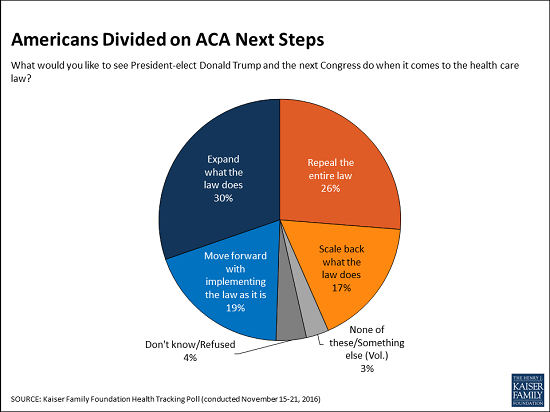
The first Kaiser Health Tracking Poll since the 2016 election finds that Americans are largely divided on the future of the Affordable Care Act even though many of the law’s major provisions remain quite popular across party lines.

The new survey finds that one fourth (26%) of Americans want to see President-elect Donald Trump and the next Congress repeal the entire law, and an additional 17 percent want them to scale back what the law does. This compares to 30 percent of the public who want to see the law expanded and 19 percent who want to see lawmakers move forward with implementing the law as it is.

The poll captures a slight uptick in the share of Americans who want lawmakers to scale back the law as well as a decrease in the share who want lawmakers to repeal the entire law.  This is largely driven by Republicans: About half (52%) of Republicans now say they want to see the Affordable Care Act repealed, down from 69 percent in October. At the same time, a quarter (24%) of Republicans now want to see the law scaled back, up from 11 percent in October.

Among the quarter (26%) of Americans that want to see the Affordable Care Act repealed, 31 percent want to see the health care law just repealed and not replaced. About two-thirds wants lawmakers to repeal the health care law and replace it with a Republican-sponsored alternative, with 42 percent wanting lawmakers to wait to repeal it until the details of a replacement plan have been figured out and 21 percent wanting lawmakers to repeal it immediately and figure out a replacement plan later.

Among those who want the law repealed, 38 percent (or 10% of the public overall) change their opinion after hearing the argument that repealing the ACA would mean that insurance companies could deny coverage to people with pre-existing conditions. A slightly smaller share change their opinion after hearing that more than 20 million Americans could lose their coverage.

Presidential candidates in fantasy land over health care

https://www.publicintegrity.org/2015/09/28/18071/presidential-candidates-fantasy-land-over-health-care

Image result for pharmaceutical industry lobby

The drug companies always win, which is why Americans pay far more than citizens of any other country for prescription medications. We pay exactly 100 percent more per capita for pharmaceuticals than the average paid by citizens of the 33 other developed countries that comprise the Organization for Economic Cooperation and Development (OECD).

Obama also once supported drug re-importation, as did Sen. John McCain, the Arizona Republican who lost to Obama in the 2008 presidential election. In 2012, two years after the passage of the Affordable Care Act, McCain teamed up with Sen. Sherrod Brown, (D-Ohio) in another attempt to get Congress to pass a drug re-importation bill.

When it became clear that his bill would not pass, McCain took to the floor to denounce the ability of well-financed special interests to control the federal government.

“What you’re about to see is the reason for the cynicism that the American people have about the way we do business in Washington. (The pharmaceutical industry)… will exert its influence again at the expense of low-income Americans who will again have to choose between medication and eating.”

Don’t expect that to change anytime soon. As long as interest groups can spend unlimited amounts of money to influence elections and can hire hundreds of lobbyists to do their bidding, millions of Americans will have to decide between health care and eating, while executives and shareholders get richer and richer.