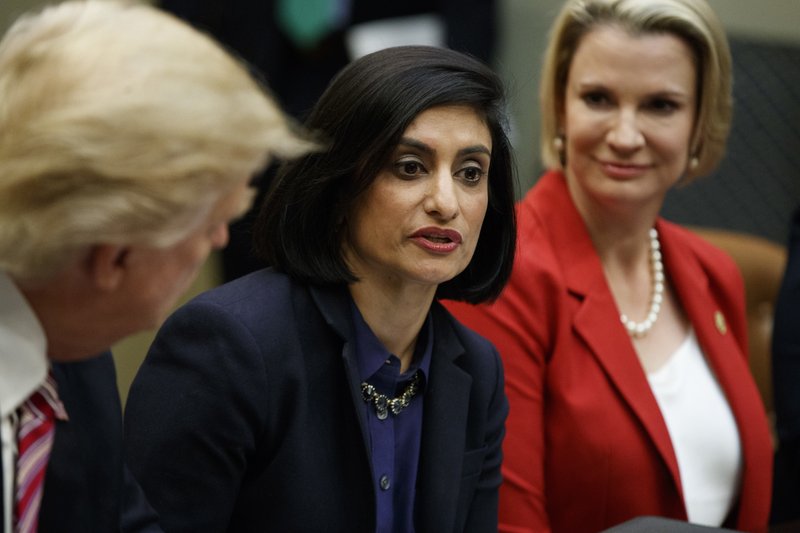
CMS Adminstrator dismisses Affordable Care Act

CMS Adminstrator dismisses Affordable Care Act

Image result for 2018 midterm elections


About 1.4 million Californians buy coverage through the state’s Obamacare exchange, Covered California, and nearly 4 million have joined Medicaid as a result of the program’s expansion under the law.

Stepping into the land of the Trump resistance, Seema Verma flatly rejected California’s pursuit of single-payer health care as unworkable and dismissed the Affordable Care Act as too flawed to ever succeed.

Speaking Wednesday at the Commonwealth Club here, the administrator of the Centers for Medicare & Medicaid Services said she supports granting states flexibility on health care but indicated she would not give California the leeway it would need to spend federal money on a single-payer system.

“I think a lot of the analysis has shown it’s unaffordable,” Verma said during a question-and-answer session following her speech. “It doesn’t make sense for us to waste time on something that’s not going to work.”

During her speech, Verma issued a broader warning to advocates pushing for a Medicare-for-all program nationally. She said that “socialized” approach to medicine would endanger the program and the health care it provides for millions of older Americans.

“We don’t want to divert the purpose and focus away from our seniors,” Verma said in the address before more than 200 people. “In essence, Medicare for all would become Medicare for none.”

Single-payer has emerged as a key issue in the California governor’s race this year. The current front-runner for governor, Gavin Newsom, a Democrat and the current lieutenant governor, has vowed to pursue a state-run, single-payer system for all Californians if elected in November. Many California lawmakers have endorsed that idea as the next step toward achieving universal coverage and to tackling rising costs.

California has enthusiastically embraced the Affordable Care Act, and state leaders have struggled with — and even bucked — the Trump administration on a variety of health-policy fronts. The state stands to lose more than any other if the Trump administration is successful in further dismantling the ACA.

About 1.4 million Californians buy coverage through the state’s Obamacare exchange, Covered California, and nearly 4 million have joined Medicaid as a result of the program’s expansion under the law.

Verma wields enormous power as head of CMS, overseeing a $1 trillion budget. The agency sets policy for Medicare, Medicaid and the federal insurance exchanges under the ACA.

The landmark health law, she said, was so flawed it could not work without further action from Congress.

“It wasn’t working when we came into office and it continues not to work,” Verma said, responding to a question from moderator Mark Zitter, founder of the Zetema Project, a nonprofit organization that promotes debate on health care across partisan lines. “The program is not designed to be successful.”
Zitter billed the event as a rare chance for Californians to hear directly from a top Trump administration official, although Verma’s remarks broke little new ground, he said.

Trump health care policies figure into many of California’s congressional races this fall in which incumbent Republicans are fending off Democratic challengers. And in court, California Attorney General Xavier Becerra is leading a coalition of attorneys general who are defending the constitutionality of the ACA in a Texas case with national implications.

The Trump administration has sided with the officials waging the lawsuit, choosing not to defend the health law’s protections for people with preexisting conditions. Separately, the administration has backed work requirements for many people on Medicaid.

Short
California’s state Senate passed a law in May banning such requirements as a condition for eligibility in Medi-Cal, the state’s Medicaid program. The bill is pending in the state Assembly.

“Making health insurance coverage contingent on work requirements goes against all we’ve worked for here in California,” state Sen. Ed Hernandez (D-West Covina), author of SB 1108, said in May.

State lawmakers also are considering bills that would limit the GOP-backed sale of short-term health policies and prevent people from joining association health plans that don’t have robust consumer protections.

In an interview after the speech, Verma criticized those legislative efforts in California because they would limit consumer choice.
“Any efforts to thwart choice and competition and letting Americans make decisions about their health care is bad health policy,” she said.

Peter Lee, executive director of Covered California, the state’s ACA marketplace, has criticized the Trump administration for promoting those cheaper, skimpier policies as an alternative to ACA-compliant plans. He said he fears consumers will be harmed by “bait-and-switch products” that don’t provide comprehensive benefits.

“There have been a series of policies from Washington that have the effect of raising costs, particularly for middle-class Americans, and pricing them out of coverage,” Lee said in an interview last week. “This is not a failure of the ACA. This is entirely happening since the new administration.”

Most of Verma’s speech in San Francisco focused on Medicare. She outlined a number of initiatives designed to strengthen the program and protect taxpayers from ballooning costs. After the speech, CMS announced proposed changes to Medicare payment policies for outpatient care that could yield savings for the government and patients.

In her remarks, Verma reiterated the Trump administration’s efforts to reduce prescription drug prices, improve patients’ access to their own medical records and eliminate burdensome regulations on doctors and other medical providers.

Verma received a polite round of applause at the beginning and end of her appearance.


CMS’ proposed outpatient payment rule for 2019: 10 things to know

https://www.beckershospitalreview.com/finance/cms-proposed-outpatient-payment-rule-for-2019-10-things-to-know.html

Related image


CMS released its 2019 Medicare Outpatient Prospective Payment System proposed rule July 25, which calls for site-neutral payments and would make changes to the 340B program.

Here are 10 things to know about the 2019 proposed rule:

Payment update

1. CMS proposed increasing the OPPS rates by 1.25 percent in 2019. The agency arrived at its proposed rate increase through the following updates: a positive 2.8 percent market basket update, a negative 0.8 percentage point update for a productivity adjustment and a negative 0.75 percentage point adjustment for cuts under the ACA.

Site-neutral payment proposal

2. Under the proposed rule, CMS would make payments for clinic visits site-neutral by reducing the payment rate for hospital outpatient clinic visits provided at off-campus provider-based departments to 40 percent of the OPPS rate. The clinic visit is the most common service billed under the OPPS, and CMS estimates the payment proposal would save the Medicare program and Medicare recipients a combined $760 million in 2019.

3. This change is projected to reduce OPPS payments by 1.2 percent, which would largely offset the 1.25 percent payment rate increase under the proposed rule.

Proposed 340B program changes

4. CMS scaled back the 340B drug discount program in 2018, and the agency proposed additional cuts for next year.

5. On Jan. 1, 2018, CMS began paying hospitals 22.5 percent less than the average sales price for drugs purchased through the 340B program. That’s compared to the previous payment rate of average sales price plus 6 percent.

6. Under the proposed rule, CMS would extend the average sales price minus 22.5 percent payment rate to 340B drugs provided at nonexcepted off-campus provider-based departments.

7. CMS also proposed to pay for separately payable biosimilars acquired under the 340B program at the average sales price minus 22.5 percent of the biosimilar’s own ASP, rather than ASP minus 22.5 percent of the reference product’s ASP.

Hospital Outpatient Quality Reporting Program changes

8. For 2019, CMS proposed removing one measure from the Hospital Quality Reporting Program beginning with the 2020 payment determination and removing nine other measures beginning with the 2021 payment determination.

9. “The proposals to remove these measures are consistent with the CMS’ commitment to using a smaller set of more meaningful measures and focusing on patient-centered outcomes measures, while taking into account opportunities to reduce paperwork and reporting burden on providers,” CMS said in the fact sheet for the proposed rule.

Comment period

10. CMS will accept comments on the proposed rule until 5 p.m. EST Sept. 24.


House passes bills to expand HSAs, delay health insurance tax

https://www.fiercehealthcare.com/payer/house-passes-bills-to-expand-hsas-delay-health-insurance-tax?mkt_tok=eyJpIjoiTldSak16YzRNMk16WkRReiIsInQiOiJxSDc3cTV3bUNJbkxxOW5yVlBob2FOcEhOUFlnZkxoRHVaSFgyZ1RHZWs5K0V1S2hWYVZtRFJqSnBXcURCeDhKVWU1OEYxTHZUQ2d4ajdUQU9pRlZmYzNmNmJmUzFPMGVtb21jT1wvbnl0clNHRERaTUh4U0dTNTVzQTY4SXJ3c2QifQ%3D%3D&mrkid=959610

congress

The House of Representatives passed a pair of bills on Wednesday that would loosen regulations around health savings accounts and delay the health insurance tax for two years.

The Restoring Access to Medication and Modernizing Health Savings Accounts Act (H.R. 6199) passed 277-142. The legislation would give plans additional flexibility to cover services before a deductible is met. It would also permit spouses to contribute to an HSA and allow members to purchase over-the-counter drugs.

The Increasing Access to Lower Premium Plans and Expanding Health Savings Accounts Act of 2018 (H.R. 6311), which passed 242-176, would increase the amount beneficiaries can contribute to an HSA. But it also includes provisions to add catastrophic or “copper” plans to the ACA exchanges.

Additional solutions to strengthen Health Savings Accounts will provide Americans with more choices, more control and better flexibility to invest their healthcare dollars in ways that best fit their personal needs,” AHIP president and CEO Matt Eyles said in a statement.

H.R. 6311 also includes a two-year delay on the health insurance tax, something insurers have pushed against for some time. In an earnings call last week, UnitedHealth Group CEO David Wichmann said the insurer was advocating for a “delay or outright repeal of the insurance tax” which he claimed would drive up premiums.

In 2015, the most recent year the tax was in effect, insurers lost about $11 billion.

“Providing another temporary reprieve, as work continues to fully repeal this harmful tax, will help reduce premiums for families, small business owners, seniors and states,” Eyles said.

HSAs have been largely supported by Republicans, although some bipartisan bills have sought to use high-deductible plans and HSAs to improve chronic disease treatment. HSAs combined with high-deductible plans have seen steady growth over the last several years, increasing more than 400% since 2007, according to AHIP.

Critics have pointed out that HSAs don’t work well for low-income individuals who don’t have the money to put into an HSA.
On Thursday, following a speech at the Heritage Foundation, Department of Health and Human Services Secretary Alex Azar lauded the use of HSAs as a way to involve consumers in their care.

“We are very supportive of efforts to strengthen HSAs to allow more money to be put in there, to enable the HSA money to be used for more preventive services, and to expand the reach of those,” he said. “I think it’s a critical counterpart to high-deductible plans and a critical element to how we bring that kind of consumerism to a third-party payer system.”


Poll reveals partisan divide among consumers on healthcare policy priorities

https://www.fiercehealthcare.com/regulatory/bipartisan-policy-center-health-reform-insurance-coverage-single-payer-markets?mkt_tok=eyJpIjoiTldSak16YzRNMk16WkRReiIsInQiOiJxSDc3cTV3bUNJbkxxOW5yVlBob2FOcEhOUFlnZkxoRHVaSFgyZ1RHZWs5K0V1S2hWYVZtRFJqSnBXcURCeDhKVWU1OEYxTHZUQ2d4ajdUQU9pRlZmYzNmNmJmUzFPMGVtb21jT1wvbnl0clNHRERaTUh4U0dTNTVzQTY4SXJ3c2QifQ%3D%3D&mrkid=959610

congress

Many healthcare consumers want the federal government to control costs.
But they also have serious reservations about the typical levers policymakers would need to pull to do so.

Morning Consult polled (PDF) more than 2,200 adults on behalf of the Bipartisan Policy Center (BPC) and found that 37% want the government to play a greater role in regulating the price of healthcare goods and services, while 21% believe the government should have more power to set healthcare prices.

However, just 13% were in favor of increased Medicare taxes, raising the Medicare eligibility age from 65 to 67 or reducing benefits required in Affordable Care Act plans—all key ways the government can achieve lower costs in that program.

The Bipartisan Policy Center’s Expert Panel on the Future of Health Care crafted a set of guiding principles for lawmakers to use in building future healthcare policy, including:

Everyone should have useful and affordable health insurance, whether through a public payer or a private insurer.
Reforms should be built so as to avoid major disruptions to consumer access.

Stable insurance markets are crucial. Policies must target “excessive and unnecessary” cost growth.
Reforms must have long-term stability, both politically and financially.

The split, experts said, reflects consumer frustration and misunderstanding of a complex, expensive and fragmented healthcare system, said Sheila Burke, a BPC fellow and strategic adviser at the law firm Baker, Donelson, Bearman, Caldwell & Berkowitz.

“I think what we see in the mix of systems reflects that confusion,” Burke said at an
event hosted by the center on Wednesday.

Burke was one of 10 people recruited by BCP for its Expert Panel on the Future of Health Care, which aims to build a bipartisan framework that legislators can use to build future healthcare policy. Other members include former Centers for Medicare & Medicaid Services Acting Administrator Andy Slavitt and former Senate majority leaders Tom Daschle and Bill Frist.

The poll results are another element the panel members said legislators can use when taking aim at healthcare reform.

The respondents were also divided by political party, and the survey found a notable split in what people on each side of the aisle view as healthcare reform priorities. Close to half (43%) of Democrats said that ensuring everyone has access to insurance is a main priority, compared to 14% of Republicans.

Meanwhile, 25% of Republicans said Congress should focus on lowering premiums, and 24% said it should look at ways to reduce the role of government in healthcare. Just 13% and 5% of Democrats, respectively, said the same.

Daschle said at the event that while the panel’s focus was on federal reform, the real energy to address healthcare reform may be at the state level. As the federal government flounders on healthcare, states are likely to step in and innovate, he said.
“The more dysfunctional Washington is, the more states pick up the slack,” he said.
The federal government should set guardrails and guidelines for that state innovation, though, Daschle said.


Trump’s top Medicare official slams ‘Medicare for All’

https://apnews.com/a69f5ada0db24ada9bc5bd8a44604f3b

The Trump administration’s Medicare chief on Wednesday slammed Sen. Bernie Sanders’ call for a national health plan, saying “Medicare for All” would undermine care for seniors and become “Medicare for None.”

The broadside from Medicare and Medicaid administrator Seema Verma came in a San Francisco speech that coincides with a focus on health care in contentious midterm congressional elections.

Sanders, a Vermont independent, fired back at Trump’s Medicare chief in a statement that chastised her for trying to “throw” millions of people off their health insurance during the administration’s failed effort to repeal the Affordable Care Act.

Verma’s made her comments toward the end of a lengthy speech before the Commonwealth Club of California, during which she delved into arcane details of Medicare payment policies.

Denouncing what she called the “drumbeat” for “government-run socialized health care,” Verma said “Medicare for All” would “only serve to hurt and divert focus from seniors.”

“You are giving the government complete control over decisions pertaining to your care, or whether you receive care at all,” she added.

“In essence, Medicare for All would become Medicare for None,” she said. Verma also said she disapproved of efforts in California to set up a state-run health care system, which would require her agency’s blessing.

In his response, Sanders said that “Medicare is, by far, the most cost-effective, efficient and popular health care program in America.

He added: “Medicare has worked extremely well for our nation’s seniors and will work equally well for all Americans.”

The Sanders proposal would add benefits for Medicare beneficiaries, coverage for eyeglasses, most dental care, and hearing aids. It would also eliminate deductibles and copayments that Medicare and private insurance plans currently require.

Independent analyses of the Sanders plan have focused on the enormous tax increases that would be needed to finance it, not on concern about any potential harm to seniors currently enrolled in Medicare.

But so-called “Mediscare” tactics have been an effective political tool for both parties in recent years, dating back to Republican Sarah Palin’s widely debunked “death panels” to fan opposition to President Barack Obama’s health care overhaul. Democrats returned the favor after Republicans won control of the House in 2010 and tried to promote a Medicare privatization plan.

Democrats clearly believe supporting “Medicare for All” will give them an edge in this year’s midterm elections.

More than 60 House Democrats recently launched a “Medicare for All” caucus, trying to tap activists’ fervor for universal health care that helped propel Sanders’ unexpectedly strong challenge to Hillary Clinton for the 2016 Democratic presidential nomination. Just a few years ago, Sanders could not find co-sponsors for his legislation.

A survey earlier this year by the Kaiser Family Foundation and The Washington Post found that 51 percent of Americans would support a national health plan, while 43 percent opposed it. Nearly 3 out of 4 Democrats backed the idea, as did 54 percent of independents. But only 16 percent of Republicans supported the Sanders approach.

Early in his career as a political figure, President Donald Trump spoke approvingly of Canada’s single-payer health care system, roughly analogous to Sanders’ approach. But by the 2016 presidential campaign Trump had long abandoned that view.


CMS ends risk-adjustment freeze, releasing $10.4B to insurers

https://www.fiercehealthcare.com/payer/cms-risk-adjustment-final-rule-methodology-aca?mkt_tok=eyJpIjoiTXpNek1HSm1NRGRqWVRKayIsInQiOiI3bHlhXC8rXC9uTkhJWkNGN1lvZTRHWjZYbVZ2SXRibEo5b0o3NUd5NUZrSkpwN0VwRlZmdW5vUXB6clI3cHQwVW1uZVg2dkZtRHExM3B6SytHOWJuSmk2T2lVQlNGQ0lLaTJMZWJuTEpxYzFDcENYdXVjQnNGRk1JU1o0UG9LTUZsIn0%3D&mrkid=959610

Image result for cms risk adjustment freeze


The Trump administration will release billions in risk-adjustment payments to insurers this fall, ending a relatively short-lived freeze that generated pushback from payers and providers alike.

“This rule will restore operation of the risk-adjustment program and mitigate some of the uncertainty caused by the New Mexico litigation,” CMS Administrator Seema Verma said in a statement. “Issuers that had expressed concerns about having to withdraw from markets or becoming insolvent should be assured by our actions today. Alleviating concerns in the market helps to protect consumer choices.”

The final rule (PDF), released by the Centers for Medicare & Medicaid Services (CMS) on Tuesday evening, maintains the same methodology for risk-adjustment transfers previously outlined by the agency, using statewide average premiums as part of the formula. CMS included an additional explanation in the rule on the formula.

For the 2018 and 2019 benefit years, CMS will adjust statewide average premiums by 14% to account for an estimated proportion of administrative costs that do not vary with claims. The agency will not apply an adjustment to the 2017 plan payments “to protect the settled expectations of insurers” that have already calculated pricing and offering decisions based on the 2017 formula.

“Absent this administrative action, HHS would be unable in the coming months to collect charges or make payments to issuers for the 2017 benefit year,” the rule states. “These amounts total billions of dollars, and failure to make the payments in a timely manner threatens to undermine the stability of the insurance markets.”

CMS suspended the $10.4 billion in risk-adjustment payments earlier this month, citing a New Mexico court decision in February that vacated the use of statewide average premiums to calculate risk-adjustment payments. The agency asked the district court judge to reconsider his ruling, but that decision isn’t expected until the end of August.

Most policy experts expected CMS to unfreeze the payments, and late last week the agency sent an interim rule to the Office of Management and Budget (OMB) for review.

Several insurers were quick to denounce the freeze. Physician and hospital groups like the American Hospital Association and the American Medical Association had also urged CMS to reinstate the payments in recent weeks.


House votes to repeal medical device tax

https://www.washingtonpost.com/politics/house-votes-to-repeal-medical-device-tax/2018/07/24/d786fa0e-8f9c-11e8-b769-e3fff17f0689_story.html?utm_term=.189b15308a2f

The House voted Tuesday to repeal the excise tax on medical devices, with nearly five-dozen Democrats joining all but one Republican in backing the bill.

The measure was approved on a 283-132 vote that comes before lawmakers leave Washington for their summer recess at the end of the week.

The 2.3 percent tax on some devices sold by medical manufacturers was created under the Affordable Care Act. It is not set to take effect until 2020, following a move by lawmakers to include its postponement as part of the deal that ended a government shutdown in January. But lawmakers of both parties have long sought to repeal the tax, arguing that its enactment could lead to higher prices for consumers as well as the loss of tens of thousands of manufacturing jobs.

Fifty-seven Democrats joined 226 Republicans in approving the measure Tuesday night. The path forward in the Senate remains uncertain.


Some Drugmakers Are Canceling Price Hikes – but Not Because of Trump

http://www.thefiscaltimes.com/2018/07/11/Some-Drugmakers-Are-Canceling-Price-Hikes-Not-Because-Trump

Pfizer may have decided to roll back drug price hikes after being criticized by President Trump, but Bloomberg reports that several other large drugmakers are canceling or reducing planned price increases, perhaps in part because of a new California drug pricing transparency law that requires them to provide at least 60 days’ notice of price increases greater than 16 percent during a two-year period.

“In the past three weeks, Novartis AG, Gilead Sciences Inc., Roche Holding AG and Novo Nordisk A/S sent notices to California health plans rescinding or reducing previously announced price hikes on at least 10 drugs,” Bloomberg’s Ben Elgin, Cynthia Koons and Robert Langreth write.

The law is being challenged in court by the industry, but manufacturers have been complying while the case plays out.

Still, one industry analyst tells Bloomberg that the California law won’t actually slow the rate of price hikes. “If what you are trying to do is limit price inflation, this is not the way to go about it,” said Richard Evans, an analyst at investment research firm SSR. “This is not going to change mainstream list price behavior at all.”

Evans says that the drugmakers involved are probably just “throwing up a smokescreen” to hide the details of their price increases from competitors and patients.

Why it matters: These early results from California’s law might look encouraging, but it’s still a far cry from structural reforms that will keep prices in check.


Association Health Care Plans Not Gaining Traction

http://www.thefiscaltimes.com/2018/07/19/Association-Health-Care-Plans-Not-Gaining-Traction

The influential National Federation of Independent Business long supported the expansion of association health care plans, which allow small businesses and trade groups to join together to offer health insurance. At NFIB’s 75th anniversary party in June, President Trump announced new rules that make it easier to offer such plans, promising a new option for “low-cost, great health care” for business owners and employees around the country. But it looks like few groups are taking advantage of the new system, Politico reports, and even the NFIB has abandoned long-held intentions to offer a plan for its hundreds of thousands of members.

Although association plans can’t be sold until September 1 — despite Trump’s recent claim that millions of people are already signing up — several nationwide trade groups told Politico that it’s not clear how the new system will work, if it will work at all. For example, the National Association of Realtors, which had long favored the expansion of association health plans, said it was still working on understanding the new rules and has no plans to offer insurance anytime soon.

While the Trump administration’s new rules removed some restrictions on the operation of association health care plans, such as the ability to cross states lines, other limits remain. Groups can join together only if they are in the same industry; if not, small businesses still must be in the same state in order to join together. The remaining restrictions may inhibit the widespread adoption of the plans, Politico says, although NFIB is looking into workarounds such as offering insurance to small businesses at the state level.


Trump Administration Seeks a Big Change in How Medicare Pays Doctors

http://www.thefiscaltimes.com/2018/07/23/Trump-Administration-Seeks-Big-Change-How-Medicare-Pays-Doctors

The Trump administration wants to change the way Medicare pays doctors for office visits by creating a flat payment of about $135 for all appointments. The change is intended to reduce paperwork significantly but is meeting resistance from specialists who say they will be underpaid for their services, which could result in more doctors refusing to see Medicare patients.

Currently, there are five levels of Medicare office visits, each with its own payment amount, ranging from a short visit with a nurse (level 1) to an in-depth evaluation from a specialist (level 5). Visits with doctors typically start at level 2, with a current billing rate for new patients of $76, and move up in complexity to level 5, with a billing rate of $211.

Not all doctors would lose out, since less complex visits would be billed at a higher rate under the proposal, but the specialists currently billing at the top level would see a reduction in fees. “This proposal is likely to penalize physicians who treat sicker patients, even though they spend more time and effort and more resources managing those patients,” Deborah J. Grider, an expert on the subject, told The New York Times.

On the other hand, the proposal would reduce the time-intensive requirement to document the different levels of services, particularly at the upper end. “The differences between Levels 2 to 5 are often really difficult to discern and time-consuming to document,” Dr. Kate Goodrich, Medicare’s chief medical officer, toldthe Times.

One thing the proposed billing system won’t change is the overall cost of spending on physician services under Medicare. While the proposal would redirect some of the fees from one set of doctors to another, spending would remain at roughly $70 billion a year.