Here’s What’s Really Driving Healthcare Costs

https://www.medpagetoday.com/publichealthpolicy/healthpolicy/69102?pop=0&ba=1&xid=fb-md-pcp

Image result for Here's What's Really Driving Healthcare Costs


The market economy fails when applied to healthcare.

That healthcare expenditures in the US are high and rising rapidly is nothing new, but this study appearing in the Journal of the American Medical Association identifies the exact components of healthcare that are driving those soaring costs. As F. Perry Wilson, MD points out in this 150 Second Analysis, the data suggest traditional economic forces break down in the US healthcare market.

Transcript:

It’s no secret that healthcare costs in the United States are exceedingly high, and rising.

The US spends the most of any country in the world on healthcare in terms of percent of GDP, sitting around 18% as of the most recent data.

But to address the issue, we need to understand what is driving this increase, and a new study appearing in the Journal of the American Medical Association does the best job yet in decomposing the factors behind the rising costs.

The researchers used data from the US Disease Expenditure Project, which utilizes 183 data sources and 2.9 billion patient records to quantify where each healthcare dollar is being spent in this country.

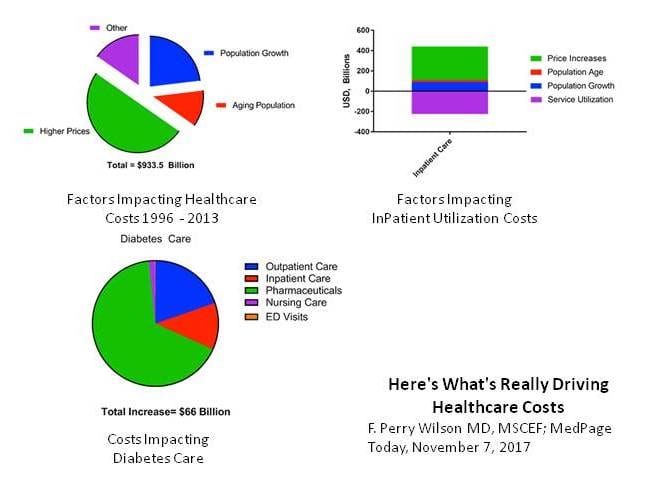
Here’s the top level overview. After accounting for inflation, healthcare expenditures increased by $933.5 billion between 1996 and 2013. To put that into perspective, that’s enough money to create 9 additional interstate highway systems. We could fully fund 3 NASAs every year.

Or we could provide 400 malaria nets to every man, woman, and child in Africa. We could even do something crazy like pay down the debt.

But to save money in the future, we have to know why we keep spending more. Here’s the breakdown.

Some of the increase in spending comes from the aging of the US population and population growth. Not much we can do about that. But 50% of the increase was simply due to higher prices.

This is distinct from healthcare utilization. In fact, healthcare utilization was decreased a bit over this time period. This is shown most dramatically in the data for inpatient care. Take a look at this bar chart.

Use of inpatient care (that’s service utilization – in purple) went down substantially from 1996 – 2013 as we moved to more outpatient treatment. But this may have been a Faustian bargain. The price of the inpatient care that remained went up much more – increasing overall inpatient spending by around 250 billion dollars.

Let’s take a moment to realize how weird this is, economically. Demand for healthcare decreased over time. Prices increased. That is not an efficient market.

Different chronic diseases had different patterns of price increases. The biggest increase was seen in diabetes care, as you can see here, driven largely by rising costs of pharmaceuticals.

Regardless of the disease, though, it is clear that it is the price of what we’re buying – whether a drug, an ED visit, or a hospital stay – not the amount of what we’re buying that is the major driver of cost increases. Efforts to reduce the consumption of healthcare, therefore, may not bend the cost curve as much as efforts to reduce its price. That’s just my 2 cents.

Professor Speaks episode, “ACA Individual Mandate”

https://zc1.campaign-view.com/ua/viewinbrowser?od=11287eca81286e&rd=13f3dcd2f1327e7b&sd=13f3dcd2f1324a7b&n=11699e4c13d805f&mrd=13f3dcd2f1324a6d&m=1

http://www.propharmaconsultants.com/speak.html

Professor Speaks

The November 15th, 2017 Professor Speaks episode, “ACA Individual Mandate”, is now available on YouTube and the Pro Pharma Website.

This episode addresses questions like:

  • What is the Individual Mandate?
  • Why do some want to repeal it?
  • What would be the effect of repealing it?

GOP may have no choice but to try health care again after taxes

https://www.axios.com/gop-may-have-no-choice-but-to-try-health-care-again-after-taxes-2513940879.html

Image result for market instability and uncertainty


Republicans have been asking themselves what they’ll turn to next, after their tax overhaul wraps up. If they repeal the Affordable Care Act’s individual mandate, there’s a good chance the answer will be health care — whether they like it or not.

What they’re saying: President Trump has said several times that he wants to take another crack at repeal-and-replace after the tax bill. GOP leaders in the House and Senate have not echoed that plan. But if Republicans do end up repealing the individual mandate, Insurance markets will begin to feel the effects quickly, leading to almost immediate nationwide upheaval that will be impossible to ignore — especially in an election year.

  • This year saw a lot of chaos — insurers pulling out of markets, coming back in, changing their premiums at the last minute — due in large part to changes that would pale in comparison to something on the scale of repealing the individual mandate.
  • “I think next year will be even crazier” if the coverage requirement goes away, the Kaiser Family Foundation’s Larry Levitt says.

The timing: The disruption caused by repealing the individual mandate would start early next year and intensify again just before next year’s midterm elections.

  • The Senate’s tax bill would eliminate the ACA’s penalty for being uninsured, starting on Jan. 1, 2019. That might seem like a long way away, but it’s not.
  • Insurers will start deciding this coming spring whether they want to participate in the exchanges in 2019 — and if so, where. Without the mandate, insurers would likely begin to pull back from state marketplaces early next year, likely leaving many parts of the country with no insurance plans to choose from.
  • Insurers will then have to finalize their 2019 premiums next fall. Those rates would likely be substantially higher (10% higher, on average, according to the Congressional Budget Office) without the mandate in place — and that news would hit just before next year’s midterms.

The bottom line: All this fallout would be impossible to ignore, putting more pressure on Congress to return to health policy whether it wants to or not — and reopening all the same internal divisions that have stymied every other health care bill.

Flashback: “You can make an argument that Obamacare is falling of its own weight — until we repeal the individual mandate,” Sen. Lindsey Graham said two weeks ago. “Then there is absolutely no excuse for us not to replace Obamacare because we changed a fundamental principle of Obamacare. So I hope every Republican knows that when you pass repeal of the individual mandate, it’s no longer their problem, it becomes your problem.”

What we learned from Azar’s first hearing

https://www.axios.com/hhs-nominee-drug-prices-are-too-high-2513516063.html

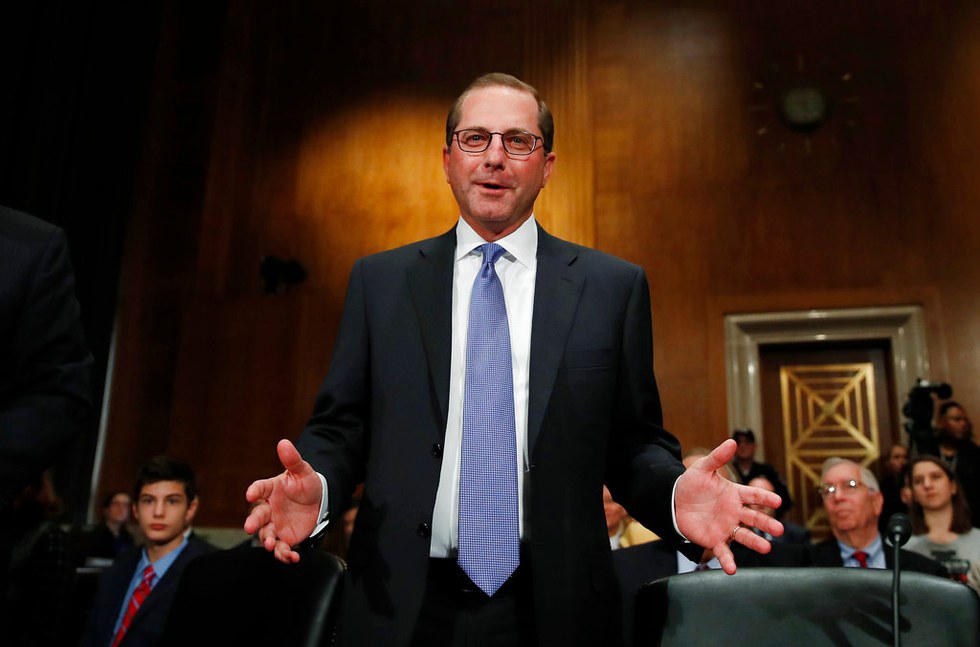
Alex Azar is in line to be the next HHS secretary. Photo: Carolyn Kaster / AP

The biggest cloud hanging over Alex Azar during his Senate confirmation hearing Wednesday was his pharmaceutical industry background. Republicans praised the experience as an advantage to tackle high drug costs, while Democrats said it raises conflicts of interest and encourages a revolving door mentality.

Azar’s response: He will not “implement pharma’s policy agenda. I don’t know what their list of agenda items is.”

Between the lines: Private industry experience doesn’t preclude someone from a public job. But, as my colleague Bob Herman notes, many of Azar’s responses matched up with the pharmaceutical lobby’s playbook:

  • discussing the holes in health insurance plans and high deductibles
  • targeting pharmacy benefit managers and others in the “entire channel”
  • focusing on lowering what people pay at the pharmacy counter instead of systemic issues like the rising list prices that drugmakers set

Yes, but: Azar did mention wanting to reform the drug patent system, which the drug industry almost certainly would oppose.


​Mandate repeal gets more complicated

Related image

Senate Republicans are still moving ahead with their tax overhaul, but the bill’s health care components —namely, repealing the individual mandate — got thornier yesterday.

On the Senate side: GOP leaders told Sen. Susan Collins they would agree to pass two health care measures to offset the damage from repealing the mandate: the ACA stabilization bill from Sens. Lamar Alexander and Patty Murray, and Collins’ proposal to establish a new reinsurance program with about $5 billion in federal money.

  • Alexander-Murray would not have much effect at all, the Congressional Budget Office said yesterday. CBO still expects repealing the mandate to produce about 13 million newly uninsured Americans and premium hikes of about 10%, on average.
  • As it did in its initial score of the Alexander-Murray legislation, CBO assumed the ACA’s cost-sharing payments were still being made, even though they are not. This is weird, and it does produce more conservative estimates of the bill’s impacts. But it’s not new, and GOP leaders on the Senate Budget Committee have some input into CBO’s assumptions on this front.
  • As for reinsurance, Majority Leader Mitch McConnell has told Collins he’s on board.

The other side: The House is not on board. Rep. Mark Meadows, the influential chairman of the House Freedom Caucus, said yesterday that he opposes new reinsurance funding, according to The Hill. It’s not entirely clear whether Alexander-Murray could pass the House outside of a larger package, either.

Don’t forget about entitlements. Sen. Bob Corker’s colleagues are not wild about his idea for a “trigger” that would automatically raise taxes if these tax cuts don’t end up paying for themselves. Some are talking instead about a “trigger” that would cut spending — including spending on Medicare and Medicaid.

  • A similar trigger already exists: As it stands, the tax bill would already prompt some $25 billion in Medicare cuts, thanks to existing rules that call for automatic spending cuts to counteract new laws that add to the deficit — which the tax bill would. An ACA payment program for insurers would also be cut substantially under those automatic reductions.
  • The New York Times has a good visualization of these automatic spending cuts.

Image result for axios vitals

Healthcare Triage News: Lots of Children Are About to Lose Their Health Coverage

Healthcare Triage News: Lots of Children Are About to Lose Their Health Coverage

Image result for Health Triage: Lots of Children Are About to Lose Their Health Coverage

Budget authorization for the Children’s Health Insurance Program in the US ran out a couple of months ago, and there’s no reauthorization in sight. A LOT of kids are insured through this program.

Freedom Caucus chair opposes ObamaCare funding pushed by GOP senator

Freedom Caucus chair opposes ObamaCare funding pushed by GOP senator

Image result for band aid on a gunshot wound


House Freedom Caucus Chairman Mark Meadows (R-N.C.) said Wednesday that he opposes ObamaCare funding known as “reinsurance” that was part of a commitment given to Sen. Susan Collins(R-Maine) to help gain her vote for tax reform.

“That’s a totally different thing because that actually puts more money into a failing system where the money will not actually lower premiums and reduce costs in a substantial way,” Meadows told The Hill. “I think that’s a bigger problem.”

Meadows’s objections, and those among House Republicans more broadly, could be an obstacle to the deal that Collins worked out on Tuesday.

Collins said that President Trump had agreed to support the reinsurance funding, as well as another bill from Sens. Lamar Alexander (R-Tenn.) and Patty Murray (D-Wash.), to help assuage her concerns about repealing ObamaCare’s individual mandate in the tax bill.

Senators said those two ObamaCare bills could be added to a must-pass government funding bill after the tax bill passes the Senate. But Meadows’s objections are an obstacle in that situation.

Reinsurance is government funding that helps pay for the cost of sick enrollees, with the intention of bringing down premiums. But conservatives oppose it as simply throwing more money at the health-care law.

Meadows was more open to the Alexander-Murray bill, but said that he wanted certain concessions for Republicans on that before adding it to a short-term government funding bill, known as a continuing resolution (CR).

“The Alexander-Murray bill, the problem with it is that it was more give on Sen. Alexander’s part than Sen. Murray’s part, so suggesting that Sen. Murray would perhaps be a little bit more engaging in the negotiation, I would certainly be willing to [work with them],” Meadows said.

The Alexander-Murray bill funds key payments to insurers for two years in exchange for more flexibility for states. But conservatives say the flexibility in the bill currently is not substantial.

Meadows said Wednesday he is willing to work on the issue.

“I think with the CR really at this point, I’ve been one that’s been willing to work with our Senate colleagues on a CR,” he said.

Stat: In A Shift, Debate Over Drug Prices Overshadows Obamacare

Obamacare? That’s so last month. On Capitol Hill, drug prices are now the hot topic

Image result for high drug prices


Obamacare? That’s so last month. On Capitol Hill, drug prices are now the hot topic.

Drug prices finally have lawmakers’ attention.

After years in which the debate over Obamacare has dominated all health policymaking discussion on Capitol Hill, U.S. lawmakers are increasingly turning their attention to the prices that everyday Americans pay for their prescription drugs.

Less than one year ago, when the Senate health committee spent four hours grilling Tom Price, President Trump’s nominee as secretary of health and human services, Democrats focused their most aggressive attention on his support for repealing Obamacare and for making major changes to the Medicare and Medicaid programs, as well as his investments in an Australian biotech company.

After years in which the debate over Obamacare has dominated all health policymaking discussion on Capitol Hill, U.S. lawmakers are increasingly turning their attention to the prices that everyday Americans pay for their prescription drugs.

Less than one year ago, when the Senate health committee spent four hours grilling Tom Price, President Trump’s nominee as secretary of health and human services, Democrats focused their most aggressive attention on his support for repealing Obamacare and for making major changes to the Medicare and Medicaid programs, as well as his investments in an Australian biotech company.

On Wednesday, the same panel heard from Alex Azar, who has been nominated as the next official to take over the helm of HHS. This time the grilling was bipartisan: All but four of the 18 lawmakers, on both sides of the aisle, used their opening remarks and questions to press Azar about different drug pricing and pharmaceutical issues.

Chairman Lamar Alexander of Tennessee and the panel’s top Democrat, Sen. Patty Murray of Washington, made drug prices the subject of their very first questions. Sen. Johnny Isakson (R-Ga.) pressed Azar to draft a list of proposals to “end the gaming of the system” by drug makers and other companies before next July. And Sen. Rand Paul (R-Ky.) suggested he could even oppose Azar’s confirmation unless he receives clearer answers on the safety risks of drug importation.

Most of the Obamacare questions, if they came at all, came as the hearing wound down. Other issues, like Medicare payment initiatives, got almost no attention. It was a stark contrast to the same panel’s focus even just in June, when Democrats derailed a hearing on drug pricing to focus on Republican efforts to repeal Obamacare.

Even Alexander noticed something different was taking place on Wednesday.

“For the last, oh, seems like forever, we have focused on health insurance,” he said in his closing remarks. “There’s so much other important [work] we should we working on when we talk about health, health care and the agencies that you work on. Drug pricing is one this committee has a great interest in.”

The debate over Obamacare is hardly over; a tax reform bill approved by the House and a similar version up for consideration in the Senate this week, for instance, would repeal the law’s individual mandate, a provision that has prompted outcry among Democrats.

It’s also true that congressional interest in drug prices isn’t entirely new. Lawmakers turned their attention to drug pricing in the wake of state-budget-busting drugs like the hepatitis C treatment Sovaldi, headline-grabbing increases like Martin Shkreli’s 5,500 percent price spike for the HIV medication Daraprim, and widespread public outcry. Trump made the issue a central tenet of his campaign for president, and lawmakers on both sides of the aisle have introduced legislation aimed at tackling aspects of the issue.

For the most part, however, lawmakers’ interest has yielded few concrete results. They have largely avoided any policymaking on the issue, even as they delivered major priorities for the industry, like a package of so-called user fees and the 21st Century Cures Act to spur medical innovation.

Azar, a former pharmaceutical executive at Eli Lilly, was sensitive to the shift in tone over drug prices on Wednesday, and gave far longer and more detailed answers to related questions than to queries about issues like access to contraception. He took an early stand on the topic himself, saying the issue would be his top priority for his time at the agency and declaring emphatically, in his opening remarks, that prices are “too high.”

For the most part, the policy solutions he offered are more in line with other conservative thinkers than with Trump, who broke with some Republicans to support more liberal policies like drug importation and Medicare price negotiations on the campaign trail. Azar pushed back on importation in his testimony and dodged questions about negotiation, highlighting instead efforts to increase generic competition and deter abuses of the patent system.

He, like other Republicans and pharmaceutical executives, also shifted some blame from drugmakers and highlighted the role other industry players play in the pricing debate.

“Everybody in the system owns a piece of this,” he said, as Sen. Tammy Baldwin (D-Wis.) pushed him to admit that drug makers, too, had a role. “The system has to get fixed. That’s the problem. … What we need to do is work to fix the system so that [consumers] have insurance that covers that insulin, so they have low out-of-pockets. We’ve got to get the list prices down, also.”

If not for Azar’s tenure at Lilly, drug pricing might be considered an unusual focus for a hearing ostensibly aimed at vetting Azar as health secretary. Few of Azar’s day-to-day responsibilities — or even his authority — would center on drug pricing if he is confirmed. Most of the concerns senators raised would need to be addressed with congressional action, not regulatory changes at the Health and Human Services Department.

Sen. Maggie Hassan of New Hampshire, for example, pressed Azar to opine on the drug company Allergan’s efforts to avoid patent challenges by selling its intellectual property to a Native American tribe. Azar said he shared her concerns — but even he noted he wouldn’t have jurisdiction on the issue. Indeed, any of the major patent system changes he suggested Wednesday would fall to the Patent and Trademark Office Director or, more likely, to Congress.

Major changes to spur generic competitors to existing prescription drugs — the subject of questions from Sen. Susan Collins (R-Maine) — would likely require congressional action. Lawmakers, too, would have to make changes about who is held liable in cases like a Lilly lawsuit, focused on its marketing for the drug Zyprexa, that Sen. Elizabeth Warren (D-Mass.) made the centerpiece of her questions. The same goes for efforts to speed changes to over-the-counter drug marketing, as Sen. Lisa Murkowski (R-Alaska) raised.

In the handful of areas in which Azar could, if confirmed, actually affect pricing policy, his attitude was mixed.

Though he would legally have the authority to encourage the importation of drugs from other countries, he expressed great skepticism of that idea when pressed by Paul and other senators. That skepticism is in line with his earlier comments on the issue, though notably differs from Trump’s.

Interestingly, Azar suggested he would like to explore changes to the way Medicare pays for drugs administered by doctors — an area over which he would have jurisdiction alongside the administrator of the Centers for Medicare and Medicaid Services, Seema Verma. His remarks were notably vague, but offered insight into policies he may try to pursue if confirmed.

“How could we think about the ways to take the learnings from Part D and actually bring lower costs to the system, but also lower costs to the patient because they pay a share of whatever Medicare reimburses in part B?” he asked. “That’s a double win. Lower for the system and lower for the patient on their out-of-pocket costs. That’s the kind of thing I would have energy to see, where we could really save money and actually improve things for our patients.”

Many senators used their second round of questioning to press harder on Obamacare — and lawmakers on the Senate Finance Committee, which has jurisdiction over Medicare policy, will have another chance to question him on those and other issues when that panel takes up Azar’s nomination officially.

That hearing has not yet been scheduled. But Alexander used his remarks Wednesday to announce a few future hearings for his panel, including a Dec. 12 meeting — on drug prices.

Patients With Rare Diseases And Congress Square Off Over Orphan Drug Tax Credits

Patients With Rare Diseases And Congress Square Off Over Orphan Drug Tax Credits

As President Donald Trump talked tax reform on Capitol Hill Tuesday, Arkansas patient advocate Andrea Taylor was also meeting with lawmakers and asking them to save a corporate tax credit for rare-disease drug companies.

Taking the credit away, Taylor said, “eliminates the possibility for my child to have a bright and happy future.”

Taylor, whose 9-year-old son, Aiden, has a rare connective tissue disorder, spoke as part of a small rally thrown together this week by the National Organization for Rare Disorders (NORD) — the nation’s largest advocacy group for patients with rare diseases.

NORD advocate Andrea Taylor holds a picture of her sons, Aiden, 9, and Aaron, 11. Aiden has the rare connective-tissue disorder arterial tortuosity syndrome, which causes symptoms such as aneurysms and congestive heart failure. The syndrome has no treatment. Taylor says Congress is sending a message “that my child’s life does not matter” if the orphan drug tax credit is eliminated or reduced. (Sarah Jane Tribble/KHN)

Earlier this month, House Republicans proposed eliminating the orphan drug tax credits, which Congress passed as part of a basket of financial incentives for drugmakers in the 1983 Orphan Drug Act. The law, intended to spur development of medicines for rare diseases, also gives seven years of market exclusivity for drugs that treat a specific condition that affects fewer than 200,000 people.

The Senate Finance Committee, led by Sen. Orrin Hatch (R-Utah), put the tax credit back into the tax legislation. After some negotiations, the committee settled on reducing the credit to 27.5 percent of the costs of preapproved clinical research, compared with the current 50 percent. The committee also restored a provision that would have eliminated any credits for drugmakers who repurpose a mass-market drug as an orphan.

“As with any major reform, tough choices have to be made,” a Hatch spokesperson wrote in an emailed statement, adding that the senator will continue to work “to make the appropriate policy decisions” to deliver a comprehensive tax overhaul.

Hatch, a member of a rare-disease congressional caucus, received $102,600 in campaign contributions from pharmaceutical and related trade group political action committees in the first half of 2017, making him the top recipient of pharmaceutical cash in the Senate.

If the Senate provision remains untouched, reducing the tax credit would save the federal government nearly $30 billion over a decade, according to a markup of the bill released late last week.

Orphan drug development has become big business in recent years and advocates as well as critics of the industry say tax credits have been an important motivation for companies. Orphan drugs accounted for 7.9 percent of total U.S. drug sales last year, according to a report released by QuintilesIMS and NORD.

Because patient populations for rare-disease drugs are relatively small, companies often charge premium prices for the medicines. EvaluatePharma, a company that analyzes the drug industry, estimates that among the top 100 drugs in the U.S. the average annual cost per patient for an orphan drug last year was $140,443. Giant pharmaceutical companies such as Celgene, Roche, Novartis, AbbVie and Johnson & Johnson have led worldwide sales in the orphan market, according to EvaluatePharma’s 2017 Orphan Drug Report.

Jonathan Gardner, the U.S. news editor for EvaluatePharma, said the orphan drug tax credit is “probably the most important incentive for developing an orphan drug.” Cutting the credit will force even the large companies to question development of drugs for rare diseases, Gardner said.

Dr. Aaron Kesselheim, an associate professor of medicine at Harvard Medical School, has been critical of the Orphan Drug Act’s incentives and of companies taking advantage of the law’s financial incentives for profit. But he warned against rushing to eliminate the tax credit.

“We need to think about ways we can improve the Orphan Drug Act and stop people from gaming the system and exploiting it,” Kesselheim said. But there “are a lot of rare diseases that don’t have treatments. So, we need to be careful in making changes.”

The battle over the tax credit is the latest controversy for the Food and Drug Administration’s orphan drug program. FDA Commissioner Scott Gottlieb announced a “modernization” plan for the agency this summer, closing a pediatric testing loophole and eliminating a backlog of corporate applications for orphan drug status. And, this week, the agency confirmed that Dr. Gayatri Rao, director for the Office of Orphan Products Development, is leaving.

Meanwhile, the Government Accountability Office confirmed this month that it recently launched an investigation of the orphan drug program. The GAO’s review was sparked by a letter from top Republican Sens. Hatch, Chuck Grassley (R-Iowa) and Tom Cotton (R-Ark.), asking the agency to investigate whether drugmakers “might be taking advantage” of the drug approval process.

When the 1983 Orphan Drug Act was passed, the law described an orphan drug as one that affects so few people that drugmakers might lose money after covering the cost of developing a drug. Congress added the 200,000-patient limit in 1984.

Today, many orphan medicines treat more than one condition and often come with astronomical prices. Many of the medicines aren’t entirely new, either. A Kaiser Health News investigation, which was also aired and published by NPR, found that more than 70 of the roughly 450 individual drugs given orphan status were first approved for mass-market use, including cholesterol blockbuster Crestor, Abilify for psychiatric conditions, cancer drug Herceptin and rheumatoid arthritis drug Humira, which for years was the best-selling medicine in the world.

More than 80 other orphans won FDA approval for more than one rare disease and, in some cases, multiple rare diseases, the KHN investigation showed.

The pharmaceutical industry has had a muted response to the tax bill, which includes a corporate tax cut. The powerful industry lobbying group PhRMA said it is pleased Congress is looking at overhauling the tax code but “encourages policymakers to maintain incentives” for rare diseases. BIO, the Biotechnology Innovation Organization that represents biomedical companies, said it was “gratified” the Senate committee chose to partially retain the credit but would prefer to keep the existing incentive.

The group that rallied Tuesday — wearing bright-orange shirts that read “Save the Orphan Drug Tax Credit” — planned to meet with a couple of dozen lawmakers, including Grassley, who is a member of the Senate Finance Committee.

NORD, like many patient advocacy groups, receives funding from pharmaceutical companies, but the organization’s leaders say the industry does not have members on the board and does not dictate how general donations are spent.

On Tuesday, NORD leaders said they are open to discussions about the tax credit and whether the overall law is working as intended.

“We’re here to have that conversation, we’re ready to have that conversation,” said Paul Melmeyer, director of federal policy for NORD. “Sadly, that’s not the conversation we are having today.”

Abbey Meyers, a founder of NORD and the leading advocate behind passing the initial 1983 law, said she fears the high cost of the drugs will make it impossible to sustain the orphan drug program. Now retired, Meyers said she has followed the law’s success over the years and believes the tax credit should not be changed.

“There are other things that have happened since the law was passed where there wasn’t any logic to what they did,” Meyers said, adding “because somebody went to a senator and they put into the law.”


Stabilization Bill Couldn’t Fix the Damage of Repealing Obamacare’s Mandate

https://www.bloomberg.com/news/articles/2017-11-29/obamacare-stabilization-bill-can-t-fix-harms-of-mandate-repeal

Image result for Healthcare and Tax Cuts


  • CBO has estimated 4 million would lose coverage in 2019
  • Stabilization bill would have no impact on predictions: CBO

Passing a bipartisan Obamacare stabilization bill wouldn’t do much to cushion the blow from repealing the health law’s requirement that all individuals buy health insurance, the Congressional Budget Office said.

 The CBO has estimated that scrapping the mandate would result in 4 million people losing health coverage in 2019 and premiums in the individual market to increase by 10 percent. On Wednesday, the nonpartisan Congressional agency said a stabilization proposal backed by some Republican Senators would have no impact on its calculations.
The CBO’s conclusion could have an impact on the fate of the Senate tax overhaul bill that is expected to get a vote this week. Senate Republicans included the repeal of the Affordable Care Act’s individual mandate in their tax proposal. And several Senators concerned about their states’ health insurance markets, including Susan Collins of Maine and Lisa Murkowski of Alaska, had pushed forward the stabilization bill as a way to mitigate the blow.
President Donald Trump endorsed the proposal, known as the Bipartisan Health Care Stabilization Act, on Tuesday.

“The effects on premiums and the number of people with health insurance coverage would be similar to those referenced above,” the CBO said Wednesday.

The CBO projection comes with caveats. It compares the effect of the stabilization bill to a baseline in which Obamacare’s cost-sharing reduction subsidies are paid. The Trump administration has halted the payments, which lower deductibles and out-of-pocket costs for low-income people, and the funds are the subject of a legal dispute.

“I find it baffling,” Collins said Wednesday. She and Murkowski voted against earlier Republican efforts to repeal the ACA, blocking them.

The CBO report also doesn’t evaluate the effect of giving insurers additional funding, an approach that’s also under discussion. Collins introduced a bill with Senator Bill Nelson of Florida to give states seed money for high-risk pools “which would ensure that people with pre-existing conditions are protected and also to lower premiums,” she said on Tuesday. Alexander specified that Collins’s bill would provide $3 billion to $5 billion to states to set up the high-risk pools. Collins said on Tuesday that Trump also supporters her proposal.