

Hospital prices … increased substantially in California during a period of low overall price inflation, low economic growth, and declining demand.— Melnick and Fonkych, USC
Tag Archives: High Deductible Health Plans
As Hospital Chains Grow, So Do Their Prices For Care

As health care consolidation accelerates nationwide, a new study shows that hospital prices in two of California’s largest health systems were 25 percent higher than at other hospitals around the state.
Payment Methods and Benefit Designs:How They Work and How They Work Together to Improve Health Care
http://www.urban.org/research/publication/benefit-designs-how-they-work/view/full_report

AB O U T T H E U R BA N I N S T I T U TE: The nonprofit Urban Institute is dedicated to elevating the debate on social and economic policy. For nearly five decades, Urban scholars have conducted research and offered evidence-based solutions that improve lives and strengthen communities across a rapidly urbanizing world. Their objective research helps expand opportunities for all, reduce hardship among the most vulnerable, and strengthen the effectiveness of the public sector.
ST A T E M E N T O F IN D E P E N D E N C E: The Urban Institute strives to meet the highest standards of integrity and quality in its research and analyses and in the evidence-based policy recommendations offered by its researchers and experts. We believe that operating consistent with the values of independence, rigor, and transparency is essential to maintaining those standards. As an organization, the Urban Institute does not take positions on issues, but it does empower and support its experts in sharing their own evidence-based views and policy recommendations that have been shaped by scholarship. Funders do not determine our research findings or the insights and recommendations of our experts. Urban scholars and experts are expected to be objective and follow the evidence wherever it may lead.
This Obamacare Repeal Plan Cripples State Budgets—and Economies
http://www.thefiscaltimes.com/2016/06/14/Obamacare-Repeal-Plan-Cripples-State-Budgets-and-Economies

If Republicans finally make good on their vow to repeal the Affordable Care Act — but without adopting a suitable replacement — 24 million Americans would be removed from the health care insurance rolls in 2021. And federal spending on health care would decline by $927 billion over the next decade, according to a provocative new study by the Urban Institute and the Robert Wood Johnson Foundation.
Are Freestanding Emergency Rooms Driving Up Costs?
http://healthcare.dmagazine.com/2016/05/18/are-freestanding-emergency-rooms-driving-up-costs/

In most affluent corners of North Texas, these centers have become as ubiquitous as Starbucks. They’ve sprouted near households whose families are insured through private insurance plans and sold as a boon to a community in need of emergency services. (A Texas Tribune study found that these neighborhoods have incomes 49 percent higher than the state’s average). In 2010, there were about 20 freestanding ERs in Texas. Now, just six years later, there are north of 215, galvanized by a 2009 state law that allowed them to become licensed emergency rooms.
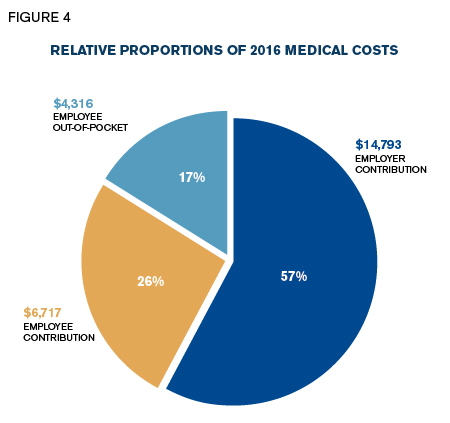
Health Care Costs for Average American Family Now Exceed $25,000 a Year

How Health Care Factors Into the Presidential Campaign
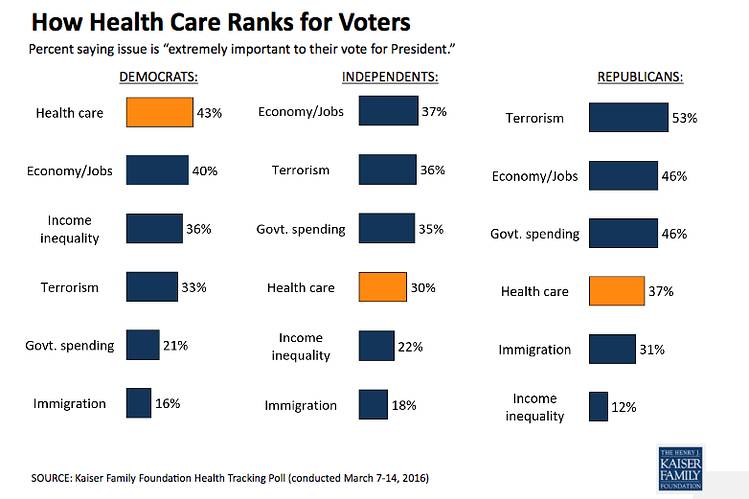
Health care has faded into the background of the election campaign as Donald Trump himself has become the issue on the Republican side and the debate between Hillary Clinton and Bernie Sanders over health care has shifted to other topics. This doesn’t mean that health will be the No. 1 or No. 4 factor when Democrats and Republicans vote in November. As the chart also shows, issue priorities are closely bunched, and my experience has been that voters cast ballots in presidential elections on the basis of their overall views of the candidates rather than candidates’ specific positions on issues.
When people say health care is an extremely important voting issue, they aren’t always thinking of the ACA. Among Republicans who say health is “extremely important” to their vote, about equal shares are thinking about the ACA as are thinking about issues such as access to care and health-care costs. Nor are Democrats always intending to support the ACA when they cite health as a voting issue. They are more likely to cite improving access or addressing costs generally as their reason for naming health a top voting issue.
Health insurers not responsible for rising premiums, exec says
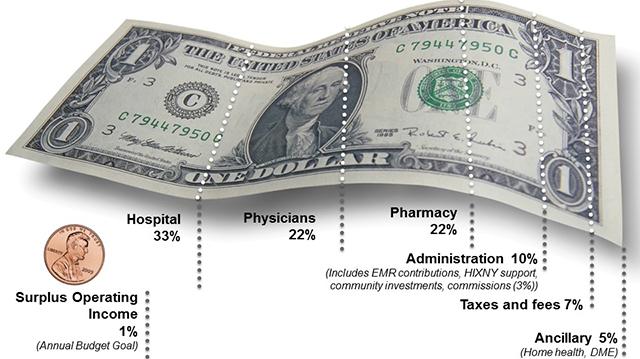
Here’s Why Your Health Insurance Premiums Are Going Up Again
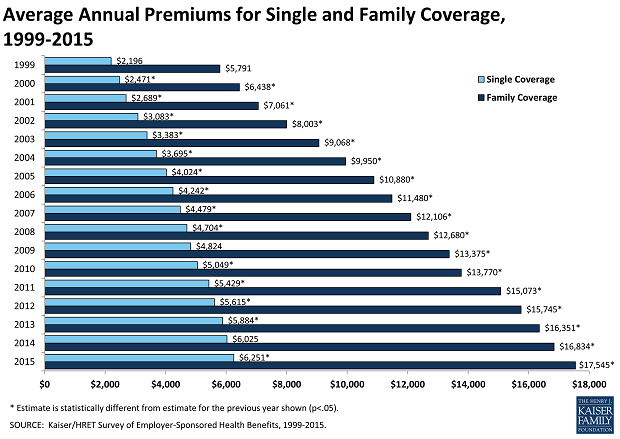
A new report from the American Academy of Actuaries outlines the trends that will impact health insurance premiums next year. “There are both upward and downward pressures on premiums for 2017, but for the individual and small group markets as a whole, the factors driving premium increases up dominate,” senior academy health fellow Cori Uccello said in a statement.
Are High Out-Of-Pocket Costs Forcing Patients To Settle For Substandard Care?

Rosemary Myers and her husband came to the oncology clinic with no major treatment decisions to make. Her breast cancer had metastasized to her brain many months ago, but after the metastasis was removed surgically, it had not shown signs of recurrence in any follow-up tests. So today’s visit wasn’t going to involve talking about chemotherapy or radiation; it wasn’t going to center upon end-of-life decision-making. Myers (a pseudonym) was here to see if her doctor could improve her quality of life. Eventually, that quality-of-life discussion would focus on the cost of Myers’ care.
 HENRY KOTULA