The different ways your health care costs are going up

https://www.axios.com/the-different-ways-your-health-care-costs-are-going-up-2471186113.html

Image result for The different ways your health care costs are going up


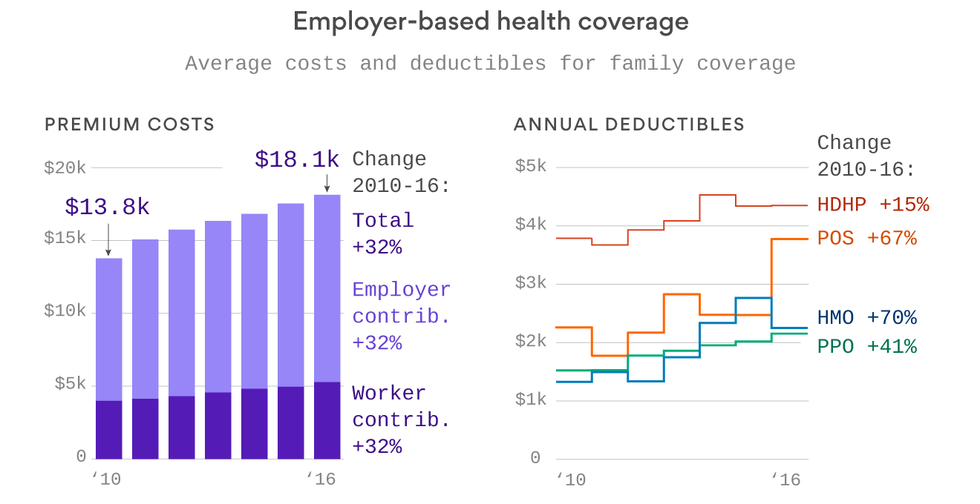
We’ve spent so much time talking about Affordable Care Act costs this year that it’s easy to forget what most people are actually paying for health care — the 156 million Americans who get their health coverage through the workplace. Turns out, most of us aren’t seeing sky-high premium increases. But it’s also worth remembering that deductibles matter too — because that’s what we pay out of pocket before insurance kicks in.

Take a look at these two graphics from Axios datavisuals genius Chris Canipe. The premium increases between 2010 and 2016 weren’t that bad — they’re single digits each year, and just add up over time. But you can see some big increases in deductibles, especially in point-of-service plans and HMOs.

Why it matters: That’s a big reason why people feel their health care costs going up, because it means they’re paying more out of pocket. And when prescription drug prices rise, they’re more likely to feel it directly.

Why Are Prescription Drug Prices So High?

http://www.commonwealthfund.org/publications/issue-briefs/2017/jul/getting-to-root-high-prescription-drug-prices?omnicid=EALERT1240145&mid=henrykotula@yahoo.com

Increased prescription drug prices and spending are among the main drivers of health care costs in the U.S. About one-third of the rise in prescription spending from 2010 to 2014 was a result of either price increases for drugs or a shift toward prescribing higher-price products, with patients caught in the middle.

A new issue brief by former Rep. Henry Waxman and his colleagues at Waxman Strategies summarizes major problems behind high U.S. prescription drug prices, while also offering feasible policy actions. For instance, the authors identify the use of patent protection and market exclusivity laws by brand-name drug manufacturers as one driver of high prices.

Among other potential solutions, the authors suggest introducing price competition sooner for such drugs and making government-purchasing arrangements for medications that protect public health

GOP promises lower health premiums but ignores all that’s driving them

http://www.politico.com/story/2017/07/06/health-care-premiums-republicans-obamacare-240242

Image result for underinsured

Republicans promise to bring down the cost of health insurance for millions of Americans by repealing Obamacare.

But in the race to make insurance premiums cheaper, they ignore a more ominous number — the $3.2 trillion-plus the U.S. spends annually on health care overall.

Republicans are betting it’s smart politics to zoom in on the pocketbook issues affecting individual consumers and families. But by ignoring the mounting expenses of prescription drugs, doctor visits and hospital stays, they allow the health care system to continue on its dangerous upward trajectory.

That means that even if they fulfill their seven-year vow to repeal Obamacare and rein in premiums for some people,the nation’s mounting costs are almost sure to pop out in other places — includingfresh efforts by insurers and employers to push more expenses onto consumers through bigger out-of-pocket costs and narrower benefits.

As a presidential candidate, Donald Trump didn’t talk much about health care in 2016 — not compared to the border wall, jobs, or Hillary Clinton’s emails. But the final days of the campaign coincided with the start of the Obamacare sign-up season — and Trump leapt to attack what he called “60, 70, 80, 90 percent” premium increases. Big spikes did occur in some places, but they weren’t the rule, and most Obamacare customers got subsidies to defray the cost.

But the skyrocketing premium made a good closing message for Trump — and Republicans have stuck with it.

“The Republicans decoded: What is the single, 10-second thing that says why you are running against the Affordable Care Act?” said Bob Blendon, an expert on health politics at the Harvard T.H. Chan School of Public Health. “Premiums became the face of what’s wrong.”

The GOP approach differs from the tack Democrats took when they pushed for the Affordable Care Act back in 2009-10. That debate was about covering more Americans — and about “bending the curve” of national health care spending, which eats up an unhealthy portion of the economy.

Conservatives like Sen. Ted Cruz of Texas argue that Obamacare failed to achieve its promise to bring down costs.

“The biggest reason that millions of people are unhappy with Obamacare is it’s made premiums skyrocket,” said Cruz, who is leading a small band of conservatives trying to pull the Senate repeal bill to the right as leaders seek to cobble together 50 votes. “We’ve got to fix that problem that was created by the failing policies of Obamacare.”

The answer, he says, is getting government out of the way. Conservatives want to free insurers from many of the coverage requirements and consumer protections in Obamacare. That means they could sell plans that wouldn’t cover as comprehensive a set of benefits — but they’d be cheaper.

Even some prominent critics of the Affordable Care Act think that’s not getting at the heart of the U.S. health care problem, even if it sounds good to voters.

“Too many in the GOP confuse adjustments in how insurance premiums are regulated with bringing competitive pressures to bear on the costs of medical services,” the American Enterprise Institute’s James Capretta wrote in a recent commentary for Real Clear Health. “They say they want lower premiums for consumers, but their supposed solution would simply shift premium payments from one set of consumers to another.”

The Congressional Budget Office has not yet evaluated how the House repeal bill, which narrowly passed, or the Senate companion legislation, which is still being negotiated, would affect overall health spending in coming years. It is already a sixth of the U.S. economy — more than 17 cents out of every dollar — and spending is still growing, partly because of an aging population.

The nonpartisan budget office projected the federal government would spend about $800 billion less on Medicaid over a decade, as the GOP legislation upends how Washington traditionally paid its share. But CBO hasn’t yet reported on how that would affect the health sector overall.

Many Republicans predict that limiting federal payments to states would force Medicaid to be more efficient. Democrats says the GOP bill would basically thrust those costs onto the states and onto Medicaid beneficiaries themselves, who are too poor, by definition, to get their care — often including nursing homes — without government assistance.

The CBO gave a mixed assessment of what would happen to premiums under the GOP proposals. They’d rise before they’d fall — and they wouldn’t fall for everyone. Older and sicker people could well end up paying more, and government subsidies would be smaller, meaning that even if the sticker price of insurance comes down, many people at the lower end of the income scale wouldn’t be able to afford it.

“Despite being eligible for premium tax credits, few low-income people would purchase any plan,” the CBO said.

Shrinking insurance benefits may work out fine for someone who never gets injured or sick. But there are no guarantees of perpetual good health; that’s why insurance exists. If someone needs medical treatment not covered in their slimmed-down health plan, the costs could be astronomical and the treatment unobtainable.

Couple that with skimpier benefits, bigger deductibles, smaller subsidies and weaker patient protections, and “Trumpcare” — or whatever an Obamacare successor ends up being called — could spell voter backlash in the not-too-distant future, particularly as poll after poll shows the legislation is already deeply unpopular.

“Premiums are one of the important ways in which consumers experience cost. But it’s not the only way,” said David Blumenthal, president of the Commonwealth Fund, a liberal-leaning think tank, and a former Obama administration official. But deductibles running into the thousands of dollars and steep out-of-pocket costs, he added, “are a source of discontent for Trump and non-Trump voters alike.”

Even the 2009 health debate early in the Obama presidency, which looked at staggering national health spending and what it meant for the U.S. economy, didn’t translate into a bottom line for many American families, said Drew Altman, president and CEO of the Kaiser Family Foundation, which has extensively polled public attitudes on health care.

And the bottom line — the cost of care — is what ordinary people focus on, Kaiser has found. Not just on premiums, but on what it costs to see a doctor, to fill a prescription, or to get treated for a serious disease.

“That’s what all of our polling shows,” Altman said. “The big concern is health care costs.”

Democrats have a long list of things they detest about the Republican repeal-and-replace legislation — and the lack of attention to overall health spending for the country and for individuals and families is right up there.

Sen. Ron Wyden (D-Ore.), the top Democrat on the Finance Committee, would like a bill that tackles cost — starting with rising drug prices. But this bill, he said, does nothing about health care costs.

“This really isn’t a health bill. This is a tax-cut bill,” he said. The repeal bills would kill hundreds of billions of dollars of taxes — many on the health care industry or wealthy people — that were included in Obamacare to finance coverage expansion, though the Senate is now considering keeping some of them to provide more generous subsidies.

Conservative policy experts acknowledge that premiums aren’t the whole story.

The overall cost and spending trajectory “is something we have to get to,” said Stanford University’s Lanhee Chen, who has advised Mitt Romney and other top Republicans. But for now, he said, premiums are a good first step.

Wall Street Investor Call Unveils the Secret of High Drug Prices

http://www.businessinsider.com/mallinckrodt-acthar-express-scripts-call-by-wells-fargo-2017-6

Image result for Wall Street Investor Call Unveils the Secret of High Drug Prices

  • Mallinckrodt Pharmaceuticals is facing scrutiny over the price of its blockbuster drug Acthar, some say it wouldn’t be viable without an opaque distribution system.
  • The company depends on pharmacy-benefit manager (PBM) Express Scripts to distribute the drug, manage co-pays, and provide patients with assistance paying for it.
  • The role of PBMs is under scrutiny from Congress, they fear PBMs pushes prices up, and that could threaten Mallinckrodt’s Achtar franchise.

Earlier this month, Wells Fargo pharma analyst David Maris called a Wall Street huddle.

He held a call for embattled pharmaceutical firm Mallinckrodt, giving its CEO Mark Trudeau an opportunity to explain the uproar surrounding his company’s $36,382 blockbuster drug, Acthar.

You see, a very Wall Street thing has just happened to Acthar. Short sellers are circling, and people are now asking questions about what was once considered business as usual. For months, some in the market, like Citron Research’s Andrew Left, have been daring Mallinckrodt to test Acthar’s efficacy as a treatment for multiple sclerosis. They say it doesn’t work.

Worse yet, other short sellers say they think they know how Acthar gets away with not working. At a Las Vegas hedge fund conference in May, Jim Chanos accused the company of having a “murky alliance” with pharmacy benefits manager Express Scripts.

“This alliance may lead to performance-enhancing drug prices,” Chanos said, “but it could give investors the blues.”

Why? Because lawmakers are starting to realize that drug pricing and distribution is a black box. What happens to the price of a drug from the time it is made to the time it gets to a patient — who gets paid and how much — is something of a mystery. It’s something, it seems, the pharmaceutical industry would rather not share.

Maris’ Wall Street huddle call opened that black box just a crack, and what it revealed is just the tip of everything Washington is worried about.

Turning to the States to Solve the National Problem of Drug Pricing

http://www.realclearhealth.com/articles/2017/06/20/turning_to_the_states_to_solve_the_national_problem_of_drug_pricing_110639.html?utm_source=morning-scan&utm_medium=email&utm_campaign=mailchimp-newsletter&utm_source=RC+Health+Morning+Scan&utm_campaign=d975383149-MAILCHIMP_RSS_EMAIL_CAMPAIGN&utm_medium=email&utm_term=0_b4baf6b587-d975383149-84752421

Image result for Turning to the States to Solve the National Problem of Drug Pricing

Drug pricing is a national problem. So a nonprofit wants to help hand off some of that burden to the states.

The National Academy for State Health Policy just launched a new center, called the Center for State Rx Drug Pricing, to help state governments navigate the treacherous waters of drug pricing. It just received about a million dollars in funding from the Laura and John Arnold Foundation to help states get drug pricing initiatives underway.

“We believe that pricing is such a difficult, complicated issue at the federal level that states can serve as laboratories of innovation,” said Trish Riley, executive director of NASHP. “It’s an opportunity for states to try all kinds of different approaches to lower drug prices.”

It’s an opportunity, too, to allow states to learn from one another — seeing what works and what does not in lowering pricing, and using the new NASHP center as a conduit of information.

“States are desperate for meaningful efforts to address the ever-increasing burden of drug prices on our budget,” said Dr. Rebekah Gee, secretary of the Louisiana Department of Health. There was initial optimism that President Trump might enforce a new drug price negotiating process — “but that interest seems to have dwindled, so it’s up to states to drive the conversation,” she said.

NASHP, a nonprofit, has long served as a coalition of state health policy wonks. Last year it assembled 11 points of possible policy options for states to lower prices — suggesting reforms in rate regulation, importation, bulk drug ordering, and more.

Some states already have drug cost-containment initiatives underway. Maryland, for instance, now has a law in place that punishes price gouging on generic drugs. And Nevada just passed a strict pricing transparency law that focuses primarily on diabetes drugs.

“Over the last year, 79 bills on transparency, PBMs, and the like have been introduced,” Riley said. “It’s now a very active field.”

But some think that such state-driven measures to lower prices just aren’t enough. The federal government has to be involved.

“Generally it’s difficult for programs such as these to effect real industry-level change without policy-setting power at the national level,” said Scott Hinds, an analyst at Sector & Sovereign Research. Public pressures on pricing have prompted drug makers to voluntarily decrease their inflation rates, he pointed out. And payers are now limiting formularies — lists of medicines with favored insurance coverage — which forces price competition, and could therefore lower rates, he said.

“Absent policy changes that would allow Medicare to negotiate Part D prices, I’m skeptical that there’s much that would have as much of an impact at the aggregate level as these self- or market imposed- changes,” Hinds said.

Rachel Sachs, an associate professor of law at Washington University of St. Louis, agrees that it’s likely not feasible for states to go it alone. While states could embark on a number of initiatives to promote transparency in drug pricing decisions, or tinker with spending, “most of the ambitious proposals states have advanced so far would require the federal government’s cooperation.”

She said that states could, indeed, use their existing Medicaid formularies more aggressively to also force that competition, as evidenced by the work states did around Hepatitis C drugs. However, Sachs said that price cap provisions simply won’t work on their own.

The new drug pricing center will also dole out small grants — taken from the larger Arnold Foundation gift — to a handful of states in order to help fuel their proposals for lowering drug pricing.

“We’re on a fast track to get that money out,” Riley said.

The Arnold Foundation has had a sustained interest in lowering drug pricing. Last year, for instance, it gave Memorial Sloan Kettering Cancer Center a $4.7 million grant to support the Evidence Driven Drug Pricing Project — a three-year study that examines the payment structures of specialty drugs. It also granted $5.2 million to a Boston nonprofit, the Institute for Clinical and Economic Review, to analyze whether new drugs are worth what they cost.

With Spotlight on Obamacare, Public’s Opinion of Drugmakers Softens

https://morningconsult.com/2017/06/05/spotlight-obamacare-publics-opinion-drugmakers-softens/

Consumer perceptions of several major pharmaceutical companies have softened in recent months amid an industry push to counter public uproar over high drug prices, Morning Consult Brand Intelligence data show.

Large drugmakers this spring have seen a decline in the the percentage of Americans who view them unfavorably, according to weekly national surveys of thousands of U.S. adults.

The Pharmaceutical Research and Manufacturers of America, the industry’s largest trade group, took action in January to revamp its public image by rolling out a multiyear ad campaign that promotes breakthrough medicines. The drug lobby, which consistently outspends other industries in an effort to exert influence on Capitol Hill, spent $245 million last year, an increase of more than $18 million since 2013, according to the Center for Responsive Politics.

The shift in public opinion has occurred amid GOP efforts to overhaul the nation’s health insurance system and the high-profile battle over the Affordable Care Act. The White House has prioritized replacing the 2010 ACA over lowering drug prices, though newly installed Food and Drug Administration Commissioner Scott Gottlieb announced last month that his agency is looking for ways to reduce some costs to consumers.

Since the House GOP health care legislative effort began in earnest in March, some of the most unpopular drugmakers have seen declines in the percentage of Americans who view them unfavorably. Still, favorability rankings for drugmakers have not improved significantly.

Some of the most-liked drugmakers include Johnson & Johnson and Bayer — the most well-known drug manufacturers among U.S. consumers.

Results are based on online surveys, with a nationally representative sample of adults, that ask participants if they have a favorable or unfavorable impression of certain companies.

Pfizer, which last year killed a proposed $160 billion merger with Allergan after the Obama administration announced new rules on tax inversions, had the highest unfavorability percentage among drugmakers tracked in March, at 29 percent. As of June 5, that figure had fallen to 12 percent.

Another drugmaker – Bristol-Myers Squibb – saw its unfavorability decline 13 percentage points during the same time period, from 23 percent in March to 10 percent in June. Merck had its unfavorable views peak at 25 percent in March before falling to 12 percent in June.

Pharmaceutical Product Hopping: A Proposed Framework For Antitrust Analysis

http://healthaffairs.org/blog/2017/06/01/pharmaceutical-product-hopping-a-proposed-framework-for-antitrust-analysis/

Skyrocketing drug prices are in the news. Overnight price increases have riveted the attention of the public, media, and politicians of all stripes. But one reason for high prices has flown under the radar. When drug companies reformulate their product, switching from one version of a drug to another, the price doesn’t dramatically increase. Instead, it stays at a high level for longer than it otherwise would have without the switch. Although more difficult to discern than a price spike, this practice, when undertaken to prevent generic market entry, can result in the unjustified continuation of monopoly pricing, burdening patients, the government, and the health care system as a whole.

Not all reformulations pose competitive concerns. Empirical studies have shown that more than 80 percent can be explained by improvements that are not temporally connected to impending generic entry. But a dangerous subset of such reformulations is undertaken for one, and only one, reason: to delay generic entry. In such cases, reformulation is called “product hopping.”

When generics enter the market, the price can fall dramatically overnight, by as much as 85 percent. For that reason, brand firms have every incentive to delay this moment of reckoning as long as possible. Sure enough, making trivial changes to their drugs has that effect. Every state has a substitution law that requires or allows pharmacists to offer a generic drug when the patient presents a prescription for a brand drug. But such substitution is thwarted if the drug is not the same—in particular, if it is not bioequivalent (able to be absorbed into the body at the same rate) and therapeutically equivalent (having the same active ingredient, form, dosage, strength, and safety and efficacy profile). A minor change to a drug’s formulation can prevent the pharmacist from substituting the generic.

Product hopping raises nuanced issues arising at the intersection of patent law, antitrust law, the federal Hatch-Waxman Act, and state drug product substitution laws. It is even more complex given the uniquely complicated pharmaceutical market, in which the buyer (patient, insurance company) is different from the decision maker (doctor).

Courts applying US antitrust law have struggled to create a robust and defensible legal framework for separating anticompetitive product hops from competitively benign, legitimate product development. In this post, we propose a framework that would help courts defer to legitimate reformulations while targeting anticompetitive switches.

Drug Rebates Reward Industry Players — And Often Hurt Patients

http://khn.org/news/drug-rebates-reward-industry-players-and-often-hurt-patients/

Medicare and its beneficiaries aren’t the winners in the behind-the-scenes rebate game played by drugmakers, health insurers and pharmacy benefit managers, according to a paper published Tuesday in JAMA Internal Medicine.

The paper, which dives into the complex and opaque world of Medicare drug price negotiations, finds that rebates may actually drive up the amount Medicare and its beneficiaries pay for drugs — especially for increasingly common high-priced drugs — and it offers some systemic solutions.

“How these rebates and price concessions happen between the manufacturer of the drug and the PBMs [pharmacy benefit managers] and health plans can directly impact patient cost in a big way,” said the paper’s lead author, Stacie Dusetzina of the University of North Carolina-Chapel Hill’s pharmacy school.

The paper’s findings and proposed solutions come as President Donald Trump’s administration, Congress and state lawmakers grapple with ways to control drug prices and overall health spending. Trump’s administration has said it wants to lower drug prices and hinted at mandating rebates in Medicare. Leaders on Capitol Hill have called for Medicare price negotiations.

In the JAMA paper, Dusetzina cites the EpiPen as one example. Last year, executives at Mylan, the maker of the EpiPen, said the list price of the drug for life-threatening allergic reactions was $600, but the company earned $274 after rebates and other fees.

That savings, though, isn’t necessarily passed on to patients in Medicare’s system. Instead, the money tends to be swallowed up by health insurers and middlemen like pharmacy benefit managers.

And, even though patients don’t pay list prices for their drugs, those high prices (like $600 for the EpiPen) are used to calculate how much Medicare covers for any individual patient — and sometimes what patients pay out-of-pocket, Dusetzina said.

“We’ve heard over the years that the list price doesn’t really matter, that it’s not the real price,” Dusetzina said. “It matters.”

The way it matters is not easily apparent. Here’s what happens: When a Medicare patient picks up a prescription, what they pay toward it is generally based on that higher list price and not the price after rebates, so the amount the beneficiary pays is scaled upward as a result.

And Medicare uses that high-end list price to calculate how rapidly beneficiaries reach the dreaded doughnut hole, where patients pay a bigger share of the price of the drug after their spending hits $3,700, the 2017 benchmark. Once through the doughnut hole, Medicare picks up the bulk of the drug’s cost.

High list prices drive patients into and out of the doughnut hole faster, raising their out-of-pocket costs and Medicare expenditures.

Dusetzina and co-authors Rena Conti, assistant professor of health policy and economics at the University of Chicago, and Dr. Peter Bach, director of Memorial Sloan Kettering Cancer Center’s Center for Health Policy and Outcomes, propose solutions to this problem.

Bach called the current Medicare system “absolutely devastating for people on high-cost specialty drugs.”

Bach’s drug pricing lab at Memorial Sloan Kettering offers an interactive tool for comparing how dollars shift when using the list price and post-rebate price.

The authors recommend that patients should be charged flat-dollar copays rather than coinsurance charges, which are based on a percentage of the drug’s price. The copays could be tiered, depending on the cost of the drug, the paper suggested.

This solution comes, in part, because the number of Medicare enrollees paying coinsurance for their drug, rather than a flat fee, has increased to 58 percent last year from 35 percent in 2014, the paper notes.

Another tactic would be to address the underlying disconnect between rebate negotiations and savings for Medicare and beneficiaries. The authors suggest that incentives for health insurers need to change to require health plans to pay more of the drugs’ costs after beneficiaries pass through the doughnut hole.

In addition, Dusetzina said, using the post-rebate amount in Medicare’s calculations would allow Medicare beneficiaries to move through the doughnut hole more slowly. That would save both patients and Medicare money.

“It really just stops us from accelerating people through the benefit,” Dusetzina said.

Last month, the Pharmaceutical Research and Manufacturers of America, which represents the pharmaceutical and biotechnology industry, launched a “Share the Savings” advertising campaign calling for public education about how the savings from rebates don’t actually get passed on to commercial insurance patients.

In an email, PhRMA’s Holly Campbell said the group’s commissioned research has found that rebates and discounts have nearly doubled from 2013 to 2015. Campbell said PhRMA believes “insurance companies should share more of the rebates and discounts they receive with patients.”

America’s Health Insurance Plans, which represents the insurance industry, calls the assertion that rebates and other discounts aren’t passed along “absolutely inaccurate” and noted the “true issue” is that drug prices continue to skyrocket “with no clear explanation as to how prices are set.” Insurers pass the savings from rebates on in different ways, including lower monthly premiums and co-pays, said AHIP’s Cathryn Donaldson.

Dusetzina said there is one caveat to the Medicare study: It is unclear how many drugs get a rebate and for how much because there is lack of transparency when it comes to rebates.

The paper’s final suggestion is about transparency. It says that federal regulators should require rebate data to be reported for individual drugs and then use that information to change Medicare’s benefit design in a way that “would lead to savings” for Medicare and its enrollees.

Healthcare Triage News: The Advantages of Medicare Advantage

Healthcare Triage News: The Advantages of Medicare Advantage

Image result for Healthcare Triage News: The Advantages of Medicare Advantage

Many studies have demonstrated what economics theory tells us must be true: When consumers have to pay more for their prescriptions, they take fewer drugs. That can be a big problem. This is Healthcare Triage News.


Rising Insulin Prices Have Diabetics Crying Foul

http://www.cbsnews.com/news/insulin-prices-rise-yet-again-causing-diabetics-to-cry-foul/

Image result for Rising Insulin Prices Have Diabetics Crying Foul

Insulin prices are only getting more painful.

Drugmakers Eli Lilly (LLY) and Novo Nordisk recently boosted their insulin list prices by almost 8 percent each, adding to concerns that treating diabetes is unaffordable for some patients. The average price of insulin almost tripled between 2002 and 2013, according to the American Diabetes Association (ADA). Even before the most recent price hike, some diabetics were cutting back or even going without the drug because of its expense.

The price hikes come at a sensitive time for the drugmakers as Eli Lilly, Novo Nordisk and rival Sanofi-Aventis are facing a class-action lawsuit alleging they conspired to raise their prices in lockstep. Almost one in 10 Americans has diabetes, a group of conditions where the body fails to properly regulate blood sugar. People with Type 1 diabetes, often referred to as juvenile diabetes, need to take insulin daily to stay alive.

“We were really disappointed in this announcement,” said Dr. William Cefalu, the chief scientific, medical and mission officer for the ADA, who noted that his organization has partnerships for research with the drugmakers. “This is really going in the wrong direction.”