Tax Bill Is Likely to Undo Health Insurance Mandate, Republicans Say

Image result for Tax Bill Is Likely to Undo Health Insurance Mandate, Republicans Say

House and Senate negotiators thrashing out differences over a major tax bill are likely to eliminate the insurance coverage mandate at the heart of the Affordable Care Act, lawmakers say.

But a deal struck by Senate Republican leaders and Senator Susan Collins of Maine to mitigate the effect of the repeal has been all but rejected by House Republicans, potentially jeopardizing Ms. Collins’s final yes vote.

“I don’t think the American people voted for bailing out big insurance,” said Representative Dave Brat, Republican of Virginia, who opposes a separate measure to lower insurance premiums that Ms. Collins thought she had secured.

The sweeping tax overhaul approved Saturday by the Senate would eliminate penalties for people who go without insurance, a change not in the tax bill passed last month by the House. But the House has voted many times to roll back the mandate, most recently in a bill to dismantle the Affordable Care Act, and House members were enthusiastic about going along.

“Mandating people to buy a product was a bad idea to begin with,” said Representative Rob Woodall, Republican of Georgia. “We made people do something that was supposed to be good for them. But they are telling us by the millions how much they dislike the mandate.”

The individual mandate was originally considered indispensable to the Affordable Care Act, a way to induce healthy people to buy insurance and thus to hold down insurance premiums for sicker customers. The Obama administration successfully defended the mandate in the Supreme Court. But recent economic research suggests that the effect of the mandate on coverage is somewhat smaller than previously thought.

With little more than a week remaining until the annual open enrollment period ends, 3.6 million people have selected health plans for 2018 in the 39 states that use the federal marketplace, the Trump administration reported Wednesday. That is 22 percent higher than at this point last year, despite uncertainty about the mandate’s future and efforts by Republicans and the administration to undermine the law.

But because the sign-up period is only half as long, it appears likely that enrollment will end up lower than in the last period.

Without a mandate, some healthy people are likely to go without coverage, leaving sicker people in the market, and prices are likely to rise more than they otherwise would. The Congressional Budget Office said last month that repealing the individual mandate would increase average premiums on the individual market about 10 percent, and it estimated that the number of people without health insurance would rise by 13 million.

Regardless, the requirement has proved to be one of the most unpopular parts of the 2010 law, and House Republicans were happy to see it go. Representative Richard Hudson, Republican of North Carolina, called the Senate provision “a great move.”

The repeal also frees up money that Congress can use to reduce tax rates. The budget office said it would save the federal government more than $300 billion over 10 years — mainly because fewer people would have Medicaid or subsidized private insurance.

The mandate repeal’s effect on health insurance markets did concern Ms. Collins, and to win her vote for the Senate tax bill, the Senate majority leader, Mitch McConnell of Kentucky, offered her a deal, in writing: He would support two bipartisan bills to stabilize markets and hold down premiums, in the absence of the individual mandate.

One bill would provide money to continue paying subsidies to insurance companies in 2018 and 2019 to compensate them for reducing out-of-pocket costs for low-income people. President Trump cut off the “cost sharing” subsidies in October, more than a year after a federal judge ruled that the payments were unconstitutional because Congress had never explicitly provided money for them. The payments would resume under this measure, drafted by Senators Lamar Alexander, Republican of Tennessee, and Patty Murray, Democrat of Washington State.

The second bill would provide $5 billion a year for grants to states in 2018 and 2019. States could use the money to help pay the largest health claims, through a backstop known as reinsurance, or to establish high-risk pools to help cover sick people.

Ms. Collins has released a copy of her agreement with Mr. McConnell in which he pledged to support passage of the two measures before the end of the year. His signature was displayed prominently at the top of the first page. But the deal has landed with a thud in the House, where Republicans appear loath to support legislation that they view as propping up a health law that they have pledged to repeal.

“Our members wince at voting to sustain a system that none of them supported,” said Representative Tom Cole, Republican of Oklahoma.

The Senate could attach the Alexander-Murray legislation to a government funding measure, hoping that Republicans in the House would be willing to swallow it as part of a measure to avoid a government shutdown. But Mr. Cole said House Republicans would be “very offended” at such an approach.

“I don’t think we’re in the mood to be blackmailed by anybody,” he said.

Mr. Brat, a member of the conservative Freedom Caucus, assailed the deal with Ms. Collins as an example of horse trading that is characteristic of the Washington swamp that he said voters had repudiated.

Likewise, Representative Mark Walker of North Carolina, the chairman of the conservative Republican Study Committee, said of the Alexander-Murray bill, “There’s no appetite for that over here.”

Ms. Collins said on Wednesday that she believed the House would “take a serious look” at the two bills intended to hold down insurance premiums and that Mr. Trump, in several recent meetings, had assured her that he also supported those bills.

“I don’t think this effort is over by any means,” Ms. Collins said.

For Democrats, eliminating the insurance mandate penalties provides yet another reason to oppose the tax bill.

“The individual mandate is at the heart of the Affordable Care Act,” said Representative James E. Clyburn, Democrat of South Carolina. “Repealing it, as the G.O.P. tax scam does, is a deliberate attempt to undercut the law, create chaos in the health insurance marketplaces, increase premiums and decrease choice and coverage.”

Ms. Murray indicated that even if Ms. Collins secures her deal, Democrats would remain steadfast.

“Our bill, the Alexander-Murray bill, was designed to shore up the existing health care system,” not to “solve the new problems in this awful Republican tax bill,” she said.

Meanwhile, the damage to the Affordable Care Act may already have been done. Daniel Bouton, an enrollment counselor in Dallas, said he worried that the Trump administration’s decision to cut advertising for open enrollment had prevented millions of people from learning about the shortened sign-up period. He also said that the Senate’s recent vote to undo the individual mandate as part of its tax bill would discourage people from signing up.

“You’re going to have people who say, ‘Well, perfect, I don’t have to buy insurance anymore,’” Mr. Bouton said.


With House conservatives’ resistance, ACA stabilization bills’ prospects get dimmer

https://www.fiercehealthcare.com/aca/house-gop-alexander-murray-collins-nelson-bills?mkt_tok=eyJpIjoiT0RnMFkySXdPV0psWldSaCIsInQiOiJQSllQNlpcL2RhTzBDZFwvZXh5M1ZUSDJyUU5JTGw3dnh1QTVac01rZUFcL2pNUUhhMXBaQjBxK29ScHRrOHhsT3d6aE5pcFRJUWd4Sm0rYXA4S0RYVGE2N0czN2hhc2hsXC9EZk9mSGVLR0V1UFlwVDZpQmdkcll0eTBMNDUzTHlIZDIifQ%3D%3D&mrkid=959610&utm_medium=nl&utm_source=internal

Image result for free rider problem

Senate GOP leaders won a key swing vote for their tax bill by pledging to pass bipartisan legislation to shore up the Affordable Care Act. But now it looks like those measures’ chances of becoming law are getting dimmer.

Sen. Susan Collins, R-Maine, wants two bills to pass that she hopes will mitigate the effects of a provision in the tax bill that repeals the individual mandate: the Alexander-Murray bill, which would fund cost-sharing reduction payments for two years, and a bill she co-authored with Democrat Bill Nelson, which provides funding for states to establish invisible high-risk pool or reinsurance programs.

Collins voted for the Senate’s version of the tax bill—a critical win for GOP leaders, as they could only lose two votes and it failed to gain her support for previous ACA repeal bills. But she only did so after Senate Majority Leader Mitch McConnell assured her the two ACA stabilization measures would pass.

Yet while some lawmakers previously said those measures could be tacked on to the short-term spending bill Congress aims to pass this week, congressional aides now say it isn’t likely to be included, according to The Wall Street Journal. Further, while House conservatives have indicated strong support for repealing the individual mandate in the final version of the GOP tax bill, they are far from on board with the two ACA stabilization bills.

For example, Ohio Rep. Warren Davidson said he’s a “hard, hard, very hard no,” on the Alexander-Murray bill, per the WSJ article.

House Speaker Paul Ryan could also be a barrier to passing the two bills. His office told a meeting of congressional leadership offices on Monday that he wasn’t part of any deal between Collins and McConnell, The Hill reported. But his office didn’t say outright that it opposed the bills.

For her part, Collins said it will be “very problematic” if the ACA stabilization bills don’t pass, according to the WSJ. She also won’t commit to voting for the final version of the tax bill until she sees what comes out of a conference committee between the House and Senate.

Even if those measures do pass, there have been questions about whether they would do enough to soften the blow of repealing the individual mandate. The Congressional Budget Office has advised that the Alexander-Murray bill would do little to change its prediction that repealing the mandate would increase the uninsured rate and raise premiums.

A new analysis from Avalere found that Collins’ bill could help stabilize the individual market by increasing enrollment and reducing premiums in 2019, but the consulting firm’s experts cautioned that those effects could be overshadowed by repealing the individual mandate.


ACA mandate repeal may be less popular than GOP thinks

https://www.axios.com/individual-mandate-repeal-may-be-less-popular-than-republicans-think-2514871844.html

The tax bill that just passed the Senate eliminates the Affordable Care Act’s individual mandate, and the House is likely to go along when Congress writes the final version. With the tax legislation moving so quickly and the mandate lost in the maze of so many other consequential provisions, we are not likely to have much public debate about this big change in health policy.

Why it matters: If we did, even though the mandate has never been popular, our polling shows that the public does not necessarily want to eliminate it as part of tax reform legislation, once they understand how it works and what the consequences of eliminating it might be.

The back story: Republicans have targeted the ACA mandate because they want the $318 billion in savings the Congressional Budget Office says they would get to help them pay for their tax cuts. (The change would save money because fewer people would get federal subsidies on the ACA marketplaces or apply for Medicaid coverage.)

They have also targeted the mandate because they think it’s so unpopular. Our polls have consistently shown that the mandate is the least popular element of the ACA and in the abstract, more Americans (55%) would eliminate the mandate than keep it (42%).

Yes, but: When people know how the mandate actually works, and are told what experts believe is likely to happen if it’s eliminated, most Americans oppose repealing it in the tax plan.

  • When people learn that they will not be affected by the mandate if they already get insurance from their employer or from Medicare or Medicaid, 62% oppose eliminating it.
  • When people are told that eliminating the mandate would increase premiums for people who buy their own coverage, as the CBO says it will, they also flip, with 60% opposing eliminating the mandate.
  • And when they’re told that 13 million fewer people will have health coverage – another CBO projection – 59% oppose eliminating the mandate.

The bottom line: Many people change their minds when they learn more about facts and consequences, which happens as the lights shine brighter on them in legislative debates. This happened to the “skinny repeal” proposal, and it would happen to single payer.

But as the tax legislation rushes through Congress and heads to the final negotiations, there is almost no chance for the public to grasp the tradeoffs that would come from eliminating the mandate and who is affected and who is not. If they did, the polling suggests, eliminating the mandate might prove far less popular than Republicans seem to think it is.

​Let’s see what the ACA’s subsidies can do

It sure looks like Congress is about to repeal the Affordable Care Act’s individual mandate, which will put a lot of pressure on the law’s premium subsidies. What was once a “three-legged stool” — consumer protections, the mandate and premium subsidies — is down to two legs, and subsidies are the only remaining tool to try to attract the people who weren’t already inclined to seek health insurance.

What’s happening: When President Trump cut off federal payments for the ACA’s cost-sharing subsidies, insurers responded by increasing their premiums in a way that also bumped up the law’s premium subsidies — a bit of gamesmanship that few experts had fully anticipated, and which leveraged the structure of the premium subsidies to make up for the effects of political chaos.

The big question: Would something like that work again? Can subsidies make up the difference if the mandate goes away?

The answer: Probably not, policy analysts told my colleague Caitlin Owens and me.

  • “Mandate repeal could quite likely be the last straw for some insurers, and we are likely to see more bare counties for 2019, possibly bare states, as well as higher premiums as remaining insurers take advantage of their market power to raise premiums,” says Washington & Lee University professor Tim Jost, a vocal ACA supporter.

The bottom line: As premiums go up, subsidies go up. So subsidies would help shield the lowest-income consumers from the cost increases caused by the loss of the individual mandate.

Yes, but: The people who don’t receive subsidies will just have to bear the brunt of those costs. And it won’t be easy to concentrate premium hikes onto a specific set of plans, with the goal of increasing subsidies as much as possible, the way insurers did when Trump cut off cost-sharing payments.

  • “I don’t think there’s the same opportunity to play arithmetic games. Insurers will have to raise premiums across the board,” Kaiser Family Foundation’s Larry Levitt says.

Image result for axios

GOP may have no choice but to try health care again after taxes

https://www.axios.com/gop-may-have-no-choice-but-to-try-health-care-again-after-taxes-2513940879.html

Image result for market instability and uncertainty


Republicans have been asking themselves what they’ll turn to next, after their tax overhaul wraps up. If they repeal the Affordable Care Act’s individual mandate, there’s a good chance the answer will be health care — whether they like it or not.

What they’re saying: President Trump has said several times that he wants to take another crack at repeal-and-replace after the tax bill. GOP leaders in the House and Senate have not echoed that plan. But if Republicans do end up repealing the individual mandate, Insurance markets will begin to feel the effects quickly, leading to almost immediate nationwide upheaval that will be impossible to ignore — especially in an election year.

  • This year saw a lot of chaos — insurers pulling out of markets, coming back in, changing their premiums at the last minute — due in large part to changes that would pale in comparison to something on the scale of repealing the individual mandate.
  • “I think next year will be even crazier” if the coverage requirement goes away, the Kaiser Family Foundation’s Larry Levitt says.

The timing: The disruption caused by repealing the individual mandate would start early next year and intensify again just before next year’s midterm elections.

  • The Senate’s tax bill would eliminate the ACA’s penalty for being uninsured, starting on Jan. 1, 2019. That might seem like a long way away, but it’s not.
  • Insurers will start deciding this coming spring whether they want to participate in the exchanges in 2019 — and if so, where. Without the mandate, insurers would likely begin to pull back from state marketplaces early next year, likely leaving many parts of the country with no insurance plans to choose from.
  • Insurers will then have to finalize their 2019 premiums next fall. Those rates would likely be substantially higher (10% higher, on average, according to the Congressional Budget Office) without the mandate in place — and that news would hit just before next year’s midterms.

The bottom line: All this fallout would be impossible to ignore, putting more pressure on Congress to return to health policy whether it wants to or not — and reopening all the same internal divisions that have stymied every other health care bill.

Flashback: “You can make an argument that Obamacare is falling of its own weight — until we repeal the individual mandate,” Sen. Lindsey Graham said two weeks ago. “Then there is absolutely no excuse for us not to replace Obamacare because we changed a fundamental principle of Obamacare. So I hope every Republican knows that when you pass repeal of the individual mandate, it’s no longer their problem, it becomes your problem.”

Stabilization Bill Couldn’t Fix the Damage of Repealing Obamacare’s Mandate

https://www.bloomberg.com/news/articles/2017-11-29/obamacare-stabilization-bill-can-t-fix-harms-of-mandate-repeal

Image result for Healthcare and Tax Cuts


  • CBO has estimated 4 million would lose coverage in 2019
  • Stabilization bill would have no impact on predictions: CBO

Passing a bipartisan Obamacare stabilization bill wouldn’t do much to cushion the blow from repealing the health law’s requirement that all individuals buy health insurance, the Congressional Budget Office said.

 The CBO has estimated that scrapping the mandate would result in 4 million people losing health coverage in 2019 and premiums in the individual market to increase by 10 percent. On Wednesday, the nonpartisan Congressional agency said a stabilization proposal backed by some Republican Senators would have no impact on its calculations.
The CBO’s conclusion could have an impact on the fate of the Senate tax overhaul bill that is expected to get a vote this week. Senate Republicans included the repeal of the Affordable Care Act’s individual mandate in their tax proposal. And several Senators concerned about their states’ health insurance markets, including Susan Collins of Maine and Lisa Murkowski of Alaska, had pushed forward the stabilization bill as a way to mitigate the blow.
President Donald Trump endorsed the proposal, known as the Bipartisan Health Care Stabilization Act, on Tuesday.

“The effects on premiums and the number of people with health insurance coverage would be similar to those referenced above,” the CBO said Wednesday.

The CBO projection comes with caveats. It compares the effect of the stabilization bill to a baseline in which Obamacare’s cost-sharing reduction subsidies are paid. The Trump administration has halted the payments, which lower deductibles and out-of-pocket costs for low-income people, and the funds are the subject of a legal dispute.

“I find it baffling,” Collins said Wednesday. She and Murkowski voted against earlier Republican efforts to repeal the ACA, blocking them.

The CBO report also doesn’t evaluate the effect of giving insurers additional funding, an approach that’s also under discussion. Collins introduced a bill with Senator Bill Nelson of Florida to give states seed money for high-risk pools “which would ensure that people with pre-existing conditions are protected and also to lower premiums,” she said on Tuesday. Alexander specified that Collins’s bill would provide $3 billion to $5 billion to states to set up the high-risk pools. Collins said on Tuesday that Trump also supporters her proposal.

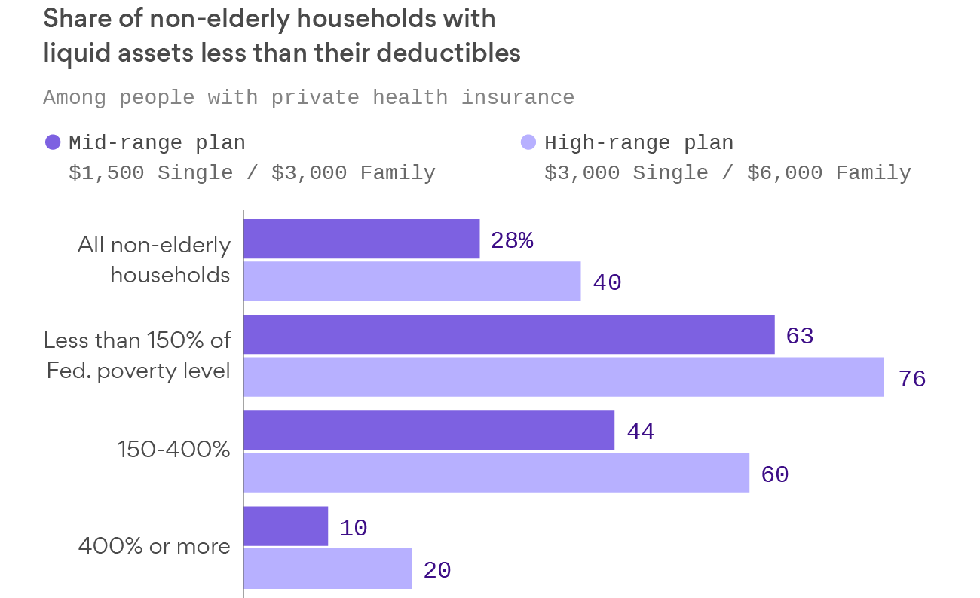
​Many families can’t afford even moderate deductibles

Reproduced from Kaiser Family Foundation analysis of the 2016 Survey of Consumer Finance; Note: Liquid assets include the sum of checking and saving accounts, money market accounts, certificates of deposit, savings bonds, non-retirement mutual funds, stocks and bonds; Chart: Axios Visuals

A lot of low-income families can’t afford even a moderate deductible, yet deductibles continue to rise in almost all forms of insurance, Kaiser Family Foundation president Drew Altman writes in his latest Axios column.

  • Roughly 40% of all non-elderly households don’t have enough liquid assets to cover a high deductible ($3,000 for an individual or $6,000 for a family).
  • Among families whose income makes them eligible for the ACA’s premium subsidies, 60% don’t have enough liquid assets to cover a high deductible and 44% couldn’t cover the deductible for a mid-range plan ($1,500 for an individual or $3,000 for a family).

Why it matters: High deductibles are everywhere, and they’re only getting higher. Many ACA plans have relatively big deductibles and Republicans’ alternatives would push them higher. They’ve been getting bigger and bigger in employer plans, too.

  • “For many families, even if they have insurance, any significant illness could wipe out all their savings, making impossible to fix a broken car to get to work, or pay for school, or make a rent or mortgage payment,” Altman says.

The GOP’s Strategy for Killing Obamacare Now Looks Like This

https://www.bloomberg.com/news/articles/2017-11-22/the-gop-s-strategy-for-killing-obamacare-now-looks-like-this

The mandate to buy health insurance is the broccoli of Obamacare—the part you have to accept if you want the goodies, like affordable coverage of people with costly pre-existing conditions. Now Senate Republicans are saying you don’t have to eat your broccoli anymore. They eliminate the penalty for lack of coverage in their version of the $1.5 trillion tax cut bill, which they aim to vote on after Thanksgiving.

Could removing the penalty, which effectively kills the individual mandate, possibly make sense? Health-care economists describe the mandate as a necessary evil. Without it, they say, healthy people will roll the dice and choose to go uncovered, leaving insurance pools made up of sicker, older people who are costlier to cover. But the impact of the requirement is regressive. Well-off families generally get health insurance through their employers, so those who pay the tax for noncoverage tend to be poorer, some working two or three jobs to make ends meet.

For Senate Republicans, killing the individual mandate is a beautiful twofer. First, it’s a way to limit the red ink from their tax package. The Joint Committee on Taxation estimates ending the mandate would save $318 billion over 10 years, because the people who dropped coverage wouldn’t get subsidies. Savings would continue after 2027. That’s crucial because under the Byrd rule, a measure can pass the Senate with a simple majority only if it doesn’t add to deficits beyond 10 years. Second, gutting the mandate would partially fulfill Republicans’ long-standing objective of getting rid of Obamacare entirely.

The downside for Republicans is that the repeal gambit has breathed new life into the pro-Obamacare coalition, which argues that Republicans are financing tax cuts for the rich by reducing the number of people with health insurance. “Adding ACA repeal to the corporate tax giveaway has fanned the flames of resistance into a roaring inferno,” says Ben Wikler, the Washington director of MoveOn.org, a liberal activist group. The Congressional Budget Office said on Nov. 8 that repealing the mandate would increase the number of uninsured Americans by 13 million and raise premiums by 10 percent “in most years” of the next decade.

Within hours of Senate Republicans’ announcing their intentions to kill the mandate, a coalition of trade groups for doctors, hospitals, and insurers urged them not to, warning that doing so would raise premiums. In Virginia, a CNN exit poll showed health care was voters’ top issue by more than 2 to 1. Democrat Ralph Northam won voters most concerned about health care 77 percent to 23 percent en route to his decisive election as their next governor.

This leaves Republicans in an awkward spot. While they crave the savings that come from repealing the mandate, they don’t love the reason why—namely, millions fewer people would be insured. That’s something they’ve always insisted wouldn’t happen. As recently as July, two White House officials wrote a Washington Post op-ed ridiculing the notion that millions of people “value their insurance so little that they will simply drop coverage next year following the repeal of the individual and employer mandates.”

Republicans are trying to have it both ways. Utah Senator Orrin Hatch, chairman of the Senate Finance Committee, said that dropping the mandate wouldn’t cut Medicaid. The CBO predicts that of the 13 million people who drop coverage, 5 million will be current Medicaid recipients. Senator Claire McCaskill, a Missouri Democrat, balked. “Where do you think the $300 billion is coming from?” she asked Hatch. “Is there a fairy that’s dropping it on the Senate?”

It’s not just the Republicans who have a complicated relationship with the mandate. Democrats need it to make Obamacare hang together, yet they know it’s unpopular and regressive. Seventy-nine percent of the 6.7 million households that paid the mandate tax for 2015 had incomes under $50,000, and 37 percent made below $25,000, according to Internal Revenue Service data. Republicans tweak Obamacare’s defenders by arguing that if financially hard-pressed families want to drop their policies—and lose the government subsidies that go with them—that’s their right.

Democrats say the mandate gets people to do something that’s in their best interest and keeps emergency rooms from being swamped by uninsured sick people. (Republicans used to make this argument.) But the mandate is also a way to get healthy families to subsidize less-healthy ones, rather than just cover their own risks. That’s what makes it unpopular. “That’s sort of the trap,” says Christopher Pope, a senior fellow at the conservative Manhattan Institute.

Also, the mandate probably isn’t as effective as Democrats have argued. In its Nov. 8 report, the CBO said that for its next estimate, it’s changing its model for how people behave. While results won’t be ready until after Congress wants to finish the tax bill, it said, the effects “would probably be smaller than the numbers reported in this document.” In other words, it won’t reduce coverage as much—or save as much money. It could be that Obamacare needs to rely less on the stick (mandates) and more on the carrot (subsidies that hold down the cost of premiums).

A new CBO estimate that played down the impact of mandate repeal could work out quite nicely for the Republicans. They could point to the Joint Committee on Taxation’s current high estimate for savings to pay for the tax cut, and then next year’s lower estimate of coverage losses from the CBO to claim that eliminating the mandate wasn’t so harmful after all. “Politics is a funny business,” says Pope. “You use whatever weapon you can grab hold of.”

BOTTOM LINE – By dropping Obamacare’s individual mandate, Senate Republicans can raise billions to pay for their tax cuts—and undercut a key part of the health-care law.


Repealing the individual mandate would do substantial harm

https://www.brookings.edu/blog/up-front/2017/11/21/repealing-the-individual-mandate-would-do-substantial-harm/?utm_campaign=Brookings%20Brief&utm_source=hs_email&utm_medium=email&utm_content=58686618

Related image

he tax legislation reported by the Senate Finance Committee last week included repeal of the individual mandate, which was created by the Affordable Care Act (ACA) and requires individuals to obtain health insurance coverage or pay a penalty. The Congressional Budget Office (CBO) has estimated that this proposal would cause large reductions in insurance coverage, reaching 13 million people in the long run.

Supporters of repealing the individual mandate have argued that the resulting reductions in insurance coverage are not a cause for concern because they would be voluntary. Rigorous versions of this argument acknowledge that individuals who drop coverage would lose protection against high medical costs, find it harder to access care, and likely experience worse health outcomes, but assert that the very fact that these individuals would choose to drop insurance coverage shows that they will be better off on net. On that basis, advocates of repealing the mandate claim that its repeal would do no harm. However, this argument suffers from two serious flaws.

The first flaw in this argument is that it assumes individuals bear the full cost of their decisions about whether to obtain insurance coverage; in fact, one person’s decision to go without health insurance coverage shifts costs onto other people. Notably, CBO has estimated that the departure of healthy enrollees from the individual market spurred by repeal of the individual mandate will increase individual market premiums by 10 percent, causing some in that market to involuntarily lose coverage and causing those who remain to bear higher costs. In addition, many of those who become uninsured will end up needing health care but not be able to pay for it, imposing costs on other participants in the health care system. Because individuals who choose to become uninsured do not bear the full cost of that decision, they may choose to do so even in circumstances where the benefits of coverage—accounting for its effects on both the covered individual and the rest of society—exceed its costs.

The second flaw in this argument is that it assumes individual decisions about whether to purchase health insurance coverage reflect a fully informed, fully rational weighing of the cost and benefits. In fact, there is strong reason to believe that many individuals, particularly the healthier individuals most affected by the mandate, are likely to undervalue insurance coverage. This likely reflects a variety of well-documented psychological biases, including a tendency to place too much weight on upfront costs of obtaining coverage (including the “hassle costs” of enrolling) relative to the benefits insurance coverage would provide if the individual got sick and needed care at some point in the future. It is therefore likely that many people who would drop insurance coverage due to repeal of the individual mandate would end up worse off, even solely considering the costs and benefits to the individuals themselves.

The considerations described above mean that, in the absence of subsidies, an individual mandate, or some combination of the two, many people will decline to obtain insurance coverage despite that coverage being well worth society’s cost of providing it. Furthermore, unless the current subsidies and individual mandate penalty provide too strong an incentive to obtain coverage that results in too many people being insured—a view that appears inconsistent with the available evidence—then reductions in insurance coverage due to repealing the individual mandate would do substantial harm.

The remainder of this analysis takes a closer look at the two flaws in the argument that reductions in insurance coverage caused by repeal of the individual mandate would do no harm. The analysis then discusses why these considerations create a strong case for maintaining an individual mandate.

INDIVIDUAL DECISIONS TO DROP INSURANCE COVERAGE IMPOSE SUBSTANTIAL COSTS ON OTHER PEOPLE

As noted above, supporters of repealing the individual mandate have often argued that the resulting reductions in insurance coverage would do no harm because they are the outcome of voluntary choices. One major flaw in this argument is that one person’s decision to drop insurance coverage imposes costs on other people through a pair of mechanisms: increases in individual market premiums and increases in uncompensated care. I discuss each of these mechanisms in greater detail below.

Increases in individual market premium reduce coverage and increase others’ costs

Repealing the individual mandate would reduce the cost of being uninsured and, equivalently, increase the effective cost of purchasing insurance coverage. That increase in the effective cost of insurance coverage would, in turn, cause many people to drop coverage. Because individuals with the most significant health care needs are likely to place the highest value on maintaining insurance coverage, the people dropping insurance coverage would likely be relatively healthy, on average. In the individual market, those enrollees’ departure would raise average claims costs, requiring insurers to charge higher premiums to the people remaining in the individual market.[1]

CBO estimates that, because of this dynamic, repealing the individual mandate would increase individual market premiums by around 10 percent. Those higher premiums would push some enrollees who are not eligible for subsidies out of the individual market. Higher premiums would impose large costs on unsubsidized enrollees who remained in the ACA-compliant individual market—around 6 million people—while increasing federal costs for subsidized enrollees who remain insured.[2]

CBO’s estimates are at least qualitatively consistent with empirical evidence on the effects of the individual mandate. Perhaps the best evidence on this point comes from Massachusetts health reform. Research examining the unsubsidized portion of Massachusetts’ individual market estimated that Massachusetts’ individual mandate increased enrollment in the unsubsidized portion of its individual market by 38 percent, reducing average claims costs by 8 percent and premiums by 21 percent. Similarly, research focused on the subsidized portion of Massachusetts’ market found that the mandate appears to have been an important motivator of enrollment, particularly among healthier enrollees.

Direct evidence on the effects of the ACA’s mandate is relatively scant because it is challenging to disentangle the effect of the mandate from the effect of other policy changes implemented by the ACA. However, it is notable that the uninsured rate among people with incomes above 400 percent of the federal poverty level fell by almost one-third from 2013 to 2015. This trend is consistent with the view that the ACA’s individual mandate has increased insurance coverage since these individuals are not eligible for the ACA’s subsidies, and implementation of the ACA’s bar on varying premiums or denying coverage based on health status, taken on its own, would have been expected to actually reduce insurance coverage in this group. Because this estimate applies to only a relatively small slice of the population, it cannot easily be used to determine the total effect of the individual mandate on insurance coverage, but it does suggest that the mandate has had meaningful effects.

Repealing the individual mandate could also cause broader disruptions in the individual market for some period of time. Insurers would find it challenging to predict exactly what the individual market risk pool would look like after repeal of the mandate. Some insurers might elect to limit their individual market exposure until that uncertainty is resolved, particularly since the Trump Administration has signaled an intent to pursue other significant policy changes affecting the individual market. That uncertainty could cause some insurers to withdraw from the market, potentially leaving some enrollees without any coverage options. Alternatively, insurers could elect to raise premiums by even more than they expect to be necessary (e.g., by more than the CBO 10 percent estimate cited above) to ensure that they are protected in all scenarios, with significant costs to both individuals and the federal government. It is uncertain how widespread these types of broader disruptions would be in practice, but they are possible.

It is important to note that one person’s decision about whether to purchase individual market coverage affects the premiums faced by others because of a conscious policy choice: the decision to bar insurers from varying premiums or denying coverage based on health status. Without those regulations, individual coverage decisions would have little or no effect on the premiums charged to others. But policymakers and the public have, appropriately in my view, concluded that these regulations perform a valuable social function by ensuring that health care cost burdens are shared equitably between the healthy and the sick. Having made that decision, other aspects of public policy must take account of the fact that one person’s decision to go uninsured has consequences for the market as a whole.

Some newly uninsured individuals would need care, but be unable to pay for it

Dropping insurance coverage also allows individuals to shift a portion of the cost of the care they receive onto others in the form of uncompensated care. Even in the group of comparatively healthy individuals who elect to drop their coverage, some will get sick and need health care. Some of these individuals might be able to pay for that care out of pocket, but others—particularly those who get seriously ill—would likely be unable to pay for it. In some cases, that would cause these individuals to forgo needed care, but in other cases they would receive care without paying for it, either due to the legal requirement that hospitals provide care in emergency situations or through various other formal and informal mechanisms. (Although individuals would often still be able to access care without paying for it, they would frequently still be billed for that care, with potential downstream consequences for their ability to access credit.)

Uninsured individuals receive large quantities of uncompensated care in practice. Estimates based on the Medical Expenditure Panel Survey indicate that a non-elderly individual uninsured for the entire year received $1,700 in uncompensated care, on average, during 2013. Consistent with that fact, increases in the number of uninsured individuals increase the amount of uncompensated care. In the context of the Oregon Health Insurance Experiment, a randomized controlled trial of the effects of expanded Medicaid coverage, having Medicaid coverage was estimated to reduce the amount of uncompensated care an individual receives by almost $2,200 per year, on average. Quasi-experimental research has similarly found that increases in the number of uninsured individuals in a hospital’s local area increase the amount of uncompensated care a hospital delivers and that the expansion in insurance coverage achieved by the ACA substantially reduced hospitals’ uncompensated care burdens.

Precisely who bears the cost of uncompensated care, particularly in the long run, is not entirely clear. A portion of uncompensated care costs are borne by federal, state, and local government programs and, therefore, are ultimately borne by taxpayers. In 2013, around three-fifths of uncompensated care was financed by federal, state, and local government programs explicitly or implicitly aimed at this purpose. Increases in uncompensated care burdens are likely to lead to increases in spending on these programs. In some cases, those increases will happen automatically. For example, CBO finds that repealing the individual mandate will increase federal spending on the Medicare Disproportionate Share Hospital (DSH) program, which is intended to defray uncompensated care costs, by $44 billion over the next ten years because the formula for determining DSH payments depends on the uninsured rate. In other cases, changes may occur more indirectly, perhaps because higher uncompensated care burdens create political pressure to expand these programs (or make it harder to cut them).

The impact of uncompensated care therefore depends to a significant degree on how non-profit hospitals cope with reduced operating margins. Evidence on this point is relatively limited. However, in instances where increases in uncompensated care burdens cause providers to incur outright losses, they are likely to ultimately force facilities to close, which could reduce access to care or increase prices charged to those enrolled in private insurance by reducing competition. In instances where increases in uncompensated care burdens merely trim positive operating margins, lower margins presumably force hospitals to reduce capital investments or to reduce cross-subsidies to other activities such as medical education or research.Recent research focused on the hospital sector, which accounts around three-fifths of all uncompensated care, suggests that providers also bear a significant portion of uncompensated care costs in the form of lower operating margins. However, this does not imply that uncompensated care costs are ultimately borne by hospitals’ owners. Indeed, this research finds that reductions in operating margins in response to increases in uncompensated care occur almost exclusively among non-profit hospitals, plausibly because for-profit hospitals are adept at locating in geographic areas where the demand for uncompensated care is relatively low. (Greater distortions where providers choose to locate and what services they choose to offer may be an important cost of increased uncompensated care.)

INDIVIDUAL DECISIONS TO DROP INSURANCE COVERAGE MAY HARM THE INDIVIDUALS THEMSELVES

The argument that reductions in insurance coverage due to repeal of the individual mandate do no harm because they are voluntary has a second important flaw; specifically, this argument assumes that individual decisions about whether to obtain health insurance coverage reflect a fully informed, fully rational weighing of the costs and benefits. There is strong reason to doubt that assumption.

Economists commonly note that many people decline to take-up health even in settings where that coverage is free or nearly so. For example, analysts at the Kaiser Family Foundation (KFF) have estimated that, in 2016, there were 6.8 million people who were eligible for Medicaid or the Children’s Health Insurance Program, but not enrolled in those programs, despite the fact that these programs had negligible premiums. Similarly, for this year’s Marketplace open enrollment period, analysts at KFF estimated that among uninsured individuals eligible to purchase Marketplace coverage, around two-fifths could obtain a bronze plan for a premium of zero, but few expect all of these individuals to enroll.

This type of behavior is very challenging to explain as the outcome of a fully informed, fully rational decision-making process. The fact that individuals who do not purchase insurance coverage can shift significant costs to others, as discussed above, can help explain why some individuals value insurance at less than the cost of providing it. But these factors cannot explain why enrollees would decline to obtain coverage that is literally free to them. In principle, “hassle costs” of enrolling in coverage could explain decisions to forgo coverage in these instances, but those hassle costs would need to be implausibly large to explain a decision to forgo an offer of free insurance coverage.

Precisely why individuals decline to take up insurance coverage even in settings where it seems clearly in their interest to do so is not fully understood. This review article catalogues a wide variety of psychological biases that may play a role, but three seem particularly important in this context:

  • Present bias: Economists have documented that individuals generally exhibit “present bias,” meaning that they place a large weight on current costs and benefits relative to similar costs and benefits in the future. In the context of insurance coverage, this type of bias is likely to cause individuals, particularly those who are currently healthy, to place too much weight on the upfront premium and hassle costs required to enroll in health insurance relative to the benefit of having insurance coverage if they get sick at some point in the future. This may cause individuals to decline to obtain insurance coverage even when it is in their economic interest, including in instances where the premium required to enroll is literally zero.

Overweighting of small up front hassle costs appears to lead suboptimal decisions in many economic settings, but the retirement saving literature provides a particularly striking example. Simply being required to return a form to enroll in an employer’s retirement plan has been documented to sharply reduce take-up of that plan, even in circumstances where employees forgo hundreds or thousands of dollars per year in employer matching contributions by declining to participate.

  • Overoptimistic perceptions of risk: One core function of health insurance is to provide protection against relatively rare, but very costly, illnesses. Indeed, a large fraction of the total value of a health insurance contract is delivered in those states of the world. In 2014, around 5 percent of the population accounted for around half of total health care spending.[3] But because these events are comparatively rare, many individuals, particularly healthier individuals, may have difficulty forming accurate perceptions of the risks they face. Research on Medicare Part D has found that individuals tend to place too much weight on premiums relative to expected out-of-pocket costs when choosing plans, providing some evidence that individuals do indeed underestimate risk (although research focused on insurance products other than health insurance has concluded that individuals may sometimes overestimate risk). Like present bias, misperceptions of risk can cause hassle or premium costs to receive too much weight relative to the actual benefits of coverage.
  • Inaccurate beliefs about affordability: Enrollees could also have inaccurate information about the availability of coverage. Survey evidence has suggested that, as of early 2016, almost 40 percent of uninsured adults were unaware of the existence of the ACA’s Health Insurance Marketplaces. Additionally, approximately two-thirds of those who were aware of the Marketplaces had not investigated their coverage options, with most saying that they had not done so because they did not believe that they could afford coverage. Individuals’ beliefs about whether coverage is affordable may be accurate in some instances, but it is likely that they are not accurate in many other cases. Inaccurate beliefs may cause many individuals to fail to investigate their coverage options, including some who are eligible for free or very-low-cost coverage.

REDUCTIONS IN INSURANCE COVERAGE FROM REPEALING THE INDIVIDUAL MANDATE WOULD DO SUBSTANTIAL HARM

The factors identified above provide strong economic rationale for implementing some combination of subsidies and penalties to strengthen the financial incentive to obtain health insurance coverage. These policy tools can compensate for the fact that individual decisions to go without coverage do not account for the ways in which those decisions increase costs for others. Similarly, in many (though not all) instances, financial incentives can help counteract psychological biases that cause individuals to go without insurance coverage even when it is against their own economic interest.

This discussion does not, of course, speak directly to how large subsidies and penalties should be. At least in theory, it is possible to overcompensate for the factors catalogued in the preceding section by creating too large an incentive to obtain coverage and thereby causing too many people to become insured. This occurs if the cost of the additional health care individuals receive when they become insured plus the administrative costs of providing that coverage exceeds the health benefits of the additional health care and the improved protection against financial risk.

Estimating the optimal size of subsidies and penalties is beyond the scope of this analysis. However, it is notable that virtually no one in the current policy debate is arguing that the United States insures too many individuals. Furthermore, there is reason to doubt that this is an empirically relevant concern. For example, the research on Massachusetts health reform by Hackmann, Kolstad, and Kowalski that was discussed earlier used their estimates to calculate the “optimal” mandate penalty to apply to unsubsidized enrollees. They conclude that just offsetting adverse selection justifies a mandate penalty similar in size to the one included in the ACA; also accounting for either uncompensated care or imperfections in consumer decision making could justify a considerably larger penalty.

It therefore seems difficult to justify repealing the individual mandate on the grounds that current policies provide an excessive overall incentive to obtain insurance coverage. Of course, policymakers might believe that it would be preferable to swap the mandate for larger subsidies, perhaps because they believe that it is inappropriate to penalize individuals for not obtaining coverage. In principle, sufficiently large increases in subsidies could offset the reduction in insurance coverage that repealing the individual mandate would cause. But such an approach would require large increases in federal spending since it would keep insurance enrollment at its current level by providing larger subsidies to each enrolled individual. In any case, the Senate Finance Committee bill does not take this approach. Rather than increasing spending on insurance coverage programs to mitigate coverage losses, the bill uses the reduction in spending on coverage programs caused by repealing the mandate (which results from lower enrollment in those programs) to finance tax cuts.


Podcast: ‘What The Health?’ Tax Bill Or Health Bill?

https://khn.org/news/podcast-what-the-health-tax-bill-or-health-bill/?utm_campaign=KFF-2017-The-Latest&utm_source=hs_email&utm_medium=email&utm_content=58570997&_hsenc=p2ANqtz-90FnDooDrGIdtTTHP8VfZovw1vS_Y_js4RdDwCCIwslKGDgrqu1yZ6bbcLJ5AbWfyJaM2B3HhQ9fR9txLD5dY-TnO3HA&_hsmi=58570997

Image result for kaiser podcast what the health?


Republican efforts to alter the health law, left for dead in September, came roaring back to life this week as the Senate Finance Committee added a repeal of the “individual mandate” fines for not maintaining health insurance to their tax bill.

In this episode of “What the Health?” Julie Rovner of Kaiser Health News, Sarah Kliff of Vox.com, Joanne Kenen of Politico and Alice Ollstein of Talking Points Memo discuss the other health implications of the tax bill, as well as the current state of the Affordable Care Act.

Among the takeaways from this week’s podcast:

  • The tax bill debate proves that Republicans’ zeal to repeal the Affordable Care Act is never dead. The new congressional efforts to kill the penalties for the health law’s individual mandate could seriously wound the ACA since the mandate helps drive healthy people to buy insurance.
  • One of the most overlooked consequences of the tax debate is that it could trigger a substantial cut in federal spending on Medicare.
  • A $25,000 MRI? That’s what one family paid to go out of their plan’s network to get the hospital they wanted for the procedure for their 3-year-old. Such choices are again drawing complaints about narrow networks of doctors and hospitals available in some health plans.
  • Although they don’t likely say it in front of cameras, many Democrats are relieved at President Donald Trump’s choice to head the Department of Health and Human Services, former HHS official Alex Azar.
  • Federal officials have given 10 states and four territories extra money to keep their Children’s Health Insurance Programs running but it’s not clear what couch they found the money hidden in.
  • And in remembrance of Uwe Reinhardt, a reminder that he always stressed that a health care debate was about more than money — it was about real people.

Plus, for “extra credit,” the panelists recommend their favorite health stories of the week they think you should read, too.