New competitor poses big risk for Community Health Systems

Image result for Indiana University Health

IU Health is getting into the Fort Wayne market.

The News-Sentinel in Fort Wayne, Indiana, is reporting Indiana University Health, the dominant not-for-profit health system in the state, is expanding into the city. Brian Bauer — the former CEO of Lutheran Health Network in Fort Wayne who was fired by Lutheran’s for-profit parent, Community Health Systems — will lead the IU Health region.

Why it matters: This is not just a small regional deal in Indiana. CHS is on the brink of collapse. And now Lutheran, one of CHS’ most profitable hospital systems, faces a powerful competitor that likely will nab Lutheran’s patients as well as doctors, nurses and other employees.

Inside Fort Wayne: Two sources familiar with Lutheran told me the environment is “toxic” and “adversarial.” Lutheran already has lost employees to a separate nearby system, Parkview Health, the sources said. They also said Lutheran’s profitability has dwindled this year. IU Health did not respond to inquiries.

  • IU Health plans to build hospitals and outpatient centers in the Fort Wayne area, and that would be a giant blow to Lutheran, which many Wall Street analysts say is the “crown jewel” of CHS. One source said Lutheran’s earnings before interest, tax, depreciation and amortization last year were around $280 million.
  • That will make it even tougher for CHS to pay down its mountain of debt if profits get sucked out of its most lucrative region.
  • CHS, which is in the process of selling off hospitals, turned down a buyout offer of Lutheran last year.
What to watch: CHS will report third-quarter earnings after markets close Nov. 1, and the investor call will be the following morning.

The hospital divestiture trend is heating up, and not going away anytime soon

http://www.healthcaredive.com/news/the-hospital-divestiture-trend-is-heating-up-and-not-going-away-anytime-so/505566/

Image result for The hospital divestiture trend

Not long ago, health systems gobbled up hospitals with the overriding goal of growth, expanded footprints and market share. Some major health systems are now regretting those buys as they have become saddled with community hospitals that are losing money and struggling with large debt and capital needs.

Two major health systems facing this issue are Community Health Systems (CHS) and Tenet Healthcare, who are both looking to shed facilities.

“The strategy that CHS, Tenet and many others had was to really build around scale without really thinking about the regional economics of how these hospitals work together,” Gregory Hagood, senior managing director at SOLIC Capital Advisors, which works with hospitals on mergers and acquisitions, told Healthcare Dive.

Health systems like CHS and Tenet grew their systems with large purchases, but they’ve learned from their experiences and are now looking at divestiture options as a way to shed unprofitable hospitals and billions of debt. No longer are major systems and investors interested in buying struggling hospitals, which CHS did when it purchased the struggling Florida system Health Management Associates for $7.5 billion in 2014.

CHS and Tenet look to cut facilities, debt

CHS, a for-profit system with 137 hospitals in 21 states, is looking to divest at least 30 hospitals this year. They have already announced more than 20 hospital sales this year. CHS’ divestitures come after the health system lost $1.7 billion last year and accumulated about $15 billion in debt. Given their financial situation, Moody’s Investors Service recently downgraded CHS’ corporate family rating, probability of default rating and senior unsecured notes.

Meanwhile, Tenet Healthcare, the third largest investor-owned U.S. health system, is looking into strategic business options that may include a sale. The Wall Street Journal estimated Tenet has a market value of $1.6 billion, which is a far cry from what it owes. Fitch Ratings reported that Tenet had about $15.4 billion of debt at the end of June.

Tenet recently announced it’s selling eight U.S. hospitals and all of its nine U.K. facilities, which CEO Trevor Fetter said will yield between $900 million and $1 billion.

In addition to the sales, the company is dealing with executive and board shake-ups. Fetter recently announced his impending departure and two board members left the board because of “irreconcilable differences regarding significant matters impacting Tenet and its stakeholders.”

CHS and Tenet might be the most high-profile systems looking to shed debt and facilities, but they’re far from the only ones. A recent report by Kaufman Hall found that hospital and health systems mergers and acquisitions increased 15% in Q2. Big players are especially active. There were six transactions of health systems with nearly $1 billion or more in revenues announced in the first half of 2017. There were only four such deals in all of 2016.

Though hospital M&A activity remains high, healthcare financial experts say the days of health systems swallowing small, unprofitable hospitals as part of larger deals to solely build a system’s footprint are gone. Those days have been replaced by more strategic decisions as to what is right for the organizations, Richard Gundling, senior vice president of healthcare financial practices at the Healthcare Financial Management Association, told Healthcare Dive.

Health systems are now taking a strategic view of hospitals to see if they fit into their culture. They are also ignoring small, community hospitals with debt or buying them for much less than they may be worth.

The systems that are selling unprofitable hospitals are also faced with a market in which investors aren’t interested in paying top dollar for struggling hospitals with heavy debt. Instead, Hagood said, investors are more interested in post-acute care services like rehab and long-term care and ambulatory care initiatives. They don’t typically see hospitals as a wise investment.

“Smaller systems that have huge debt loads or pent-up capital demands have received a lukewarm reception at best,” Patrick Allen, managing director with Kaufman Hall’s mergers and acquisitions practice, told Healthcare Dive.

Why are health systems divesting?

Health systems, especially ones that have built up debt, are having trouble making up lost revenues. Hospitals could once cover a struggling type of care through a different, more profitable service. That’s no longer the case as payers and the CMS have squeezed hospital margins.

Sagging reimbursements and payer policies that move patients from hospitals to outpatient care and freestanding facilities are hurting hospital finances. There’s also a CMS proposal to allow hip and knee replacement surgeries for Medicare patients on an outpatient basis. Those kinds of surgeries are often the most profitable for hospitals, which means they may soon lose another revenue driver.

Beyond those direct payer impacts, health systems are looking to protect themselves against a changing industry in which market share isn’t as important as flexibility and efficiency.  “As all of these changes are occurring, the systems are strategically moving and gathering their assets to be able to deal with expected changes,” Gundling said.

Gundling said another issue facing large systems that may lead to divestiture is cultural mismatch. A large system may have swooped in and bought a 100- or 150-bed community hospital as part of a larger purchase. The hospital’s community may have bristled at the idea of a large out-of-state corporate entity buying a mainstay of their community. Plus, physicians may dislike a new system’s clinical protocols.

“There might be times when you say it might not be the right fit for us after all … That can lead to a divestiture decision,” Gundling said.

How are health systems handling divestitures?

Health systems are taking different avenues to deal with possible divestitures. Some systems want to completely rid themselves of certain hospitals. Others look to repurpose small hospitals for outpatient, skilled nursing facilities, labs or imaging while maintaining a large regional hospital. Still others forge partnerships, so they don’t completely sell the properties.

Allen said many health systems see their small community hospitals aren’t bringing in enough revenue and can’t be competitive in every service line and business. So, instead, they are dropping unprofitable services and sticking with what works for them.

Gundling compared health systems’ decisions about divestiture to an individual creating the right investment balance. For health systems, divestitures are not about selling properties, but strategically managing risk. “They aren’t just selling off to sell off. All have different strategies,” said Gundling.

Allen said divestitures are a balancing act for systems. They can shed debt and assets, but that comes with revenue loss. “The balance is always what is the right sale price for the exchange of cash flow when it becomes less than profitable. Balancing those two are always tough,” said Allen.

When deciding on whether to divest, merge or partner with other facilities, Allen said systems need to figure out the community’s needs, the area’s business climate, what the facility wants to be and potential partnership opportunities. Allen, whose company works mostly with nonprofit systems, said many are repurposing underutilized facilities into other uses like rehab, skilled nursing facilities, labs and imaging.

“Once you have a handle on what the market needs and what the market provides, then you can make strategies to get you there,” he said.

Another issue facing health systems is infrastructure. Many smaller hospitals don’t meet today’s care delivery system. “A lot of hospitals don’t lend themselves very efficiently to quality care based on their 30- and 40-year old design,” said Hagood. “That factor can accelerate their repurposing.”

The results and future of the divestiture trend

Allen said divestitures have resulted in systems being able to reallocate capital and move forward with less debt. However, Hagood said one major reason health systems have for divestitures — shedding debt — hasn’t completely worked. Part of the problem is that the new investors aren’t paying top dollar for a struggling community hospital with debt.

“The biggest challenge so far is that they have struggled to get value for those assets to effectively repay that debt,” he said.

Gundling said health systems that have shed debt have followed the divestitures by focusing on cost efficiencies, supply chain management and revenue cycle management.

The hospital divestiture trend has led to sales, mergers and partnerships, with repurposed or downsized facilities, but it hasn’t closed many facilities. That may be coming soon, though.

Hagood said pending mergers, including the Mountain States Health Alliance and Wellmont Health System deal in Tennessee and Virginia, will likely lead to facility closures. There aren’t enough healthcare dollars to support the number of facilities in some of the Appalachian communities involved, he said.

Most of the large divestiture action has been centered around for-profit systems, but Hagood said to watch for more nonprofit action, including Catholic Health Initiatives (CHI), which recently reported a $585.2 million operating loss for fiscal year 2017 after losing $371.4 million in 2016.

Earlier this year, Moody’s Investor Service downgraded CHI’s rating on long-term debt and variable rate demand bonds because of poor operating performance since 2012 and a relatively low level of liquid assets. Moody’s warned that further downgrades could occur unless CHI improves its operating performance.

CHI divested its KentuckyOne facilities earlier this year, a move expected to bring in $534.9 million. Given the company’s finances and healthcare environment, Hagood said there could be more divestitures.

“Nonprofits are going to move slower, but I think you’re going to see them (divest) as economics continue to shift,” he said.

Experts agree the divestiture trend is just heating up as health systems deal with the greater emphasis on outpatient care and freestanding centers. Hagood predicted 24-7 inpatient facilities with full emergency rooms and surgical facilities will continue to dwindle in the coming years as systems repurpose facilities.

“There are 5,000-plus hospitals today. I think you’re going to see that consolidate down,” he said.


The fuzzy math around Community Health Systems’ hospital sales

https://www.axios.com/the-fuzzy-math-around-community-health-systems-hospital-sales-2491001792.html

Image result for Fuzzy math on hospital sales

Community Health Systems, the struggling for-profit hospital company, recently conducted a 30-hospital fire sale to reduce its massive debt load. Top executives routinely said in earnings calls with investors they were selling “unproductive” hospitals for “outstanding prices.”

What we found: An Axios analysis finds that, for at least some of those facilities, the numbers don’t really match what executives said. CHS appears to have sold several profitable hospitals for below-average prices.

Why it matters: The discrepancy between CHS’ words and actions raises questions. If CHS sold profitable hospitals for low prices, the company could continue to struggle paying down its mountain of debt because it will have fewer facilities to generate cash. Some investors already believe CHS could default on its debt.

The background: Hospitals are often sold based on a measure of profitability called earnings before interest, tax, depreciation and amortization, or EBITDA. Prices vary based on location, profit, insurance contracts and other factors, but the average hospital today could be sold at 8.5 times its EBITDA, according to one industry estimate.

CHS CEO Wayne Smith and former CFO Larry Cash both have frequently said during earnings calls over the past 18 months the company was getting rid of low-performing and low-margin hospitals. Smith also declared CHS was getting “attractive prices” and “very good value for the facilities that we’re selling, and we’re getting about 10 times (EBITDA) in a market for single-digit (margin) hospitals.” Smith later said “the multiple from our 30-hospital divestiture plan is approximately 12 times EBITDA.”

The gritty details: Eight of the 30 hospitals in CHS’ fire sale are in two states, Pennsylvania and Washington, that have reported financial statements to the public. And the numbers don’t line up with what Smith and Cash said. Here’s the quick synopsis of our analysis, which focused on deals that had publicly announced financial terms:

  • CHS sold four hospitals in Pennsylvania to PinnacleHealth for $231 million, or 3.4 times operating earnings. That multiple would have been even lower if the Pennsylvania data excluded interest and depreciation.
  • CHS sold two hospitals in Washington to Sunnyside Community Hospital for $45 million, or 5.3 times EBITDA.
  • CHS sold two hospitals in Washington to MultiCare Health System for $424 million, or 7.2 times EBITDA.
  • None of those deals are close to the prices that CHS executives discussed publicly.

CHS had a few gripes with the analysis:

  • The Pennsylvania data is based on a July 1 to June 30 fiscal year instead of the typical calendar year that CHS reports.
  • Neither state includes the financial impact of physician practices and other ancillary services.
  • Smith said the multiple from the entire 30-hospital divestiture plan, including working capital, was 12 times EBITDA. That means “some of the transactions were above 12 times, and some were below.”
“The Community Health Systems management team has made accurate and appropriate disclosures about our divestitures,” spokeswoman Tomi Galin said several times during a three-week email exchange. CHS declined to provide the audited data it used for the hospital transactions, and executives were not made available for interviews.
Yes, but: The analysis was shared with a few industry experts who have experience with hospital transactions and spoke on background. They didn’t believe CHS’ points made a material difference. “You’re not going to get a 12-times multiple for something that’s debt-laden,” one hospital finance expert said.
Another industry source said it’s “a little fuzzy sometimes to figure out exactly what the EBITDA is and what the multiples are.” But the numbers CHS executives were citing “just aren’t seen often,” the source said. Getting anything above 12 times EBITDA is almost unheard of for most hospitals right now and highly unlikely in these cases, the experts said.

Underlying concern: Although CHS defended the statements and numbers from earnings calls, some people who follow the company believe the discrepenacies are representative of a long pattern. “There’s a history of deceptive communication practices,” said one CHS investor, who asked not to be named given the sensitivity of the issue.

What to watch for: How much debt CHS still has at the end of the third quarter, and what executives tell investors about the status of the company.

The collapse of Community Health Systems

https://www.axios.com/the-collapse-of-community-health-systems-2471839258.html

Image result for The collapse of Community Health Systems


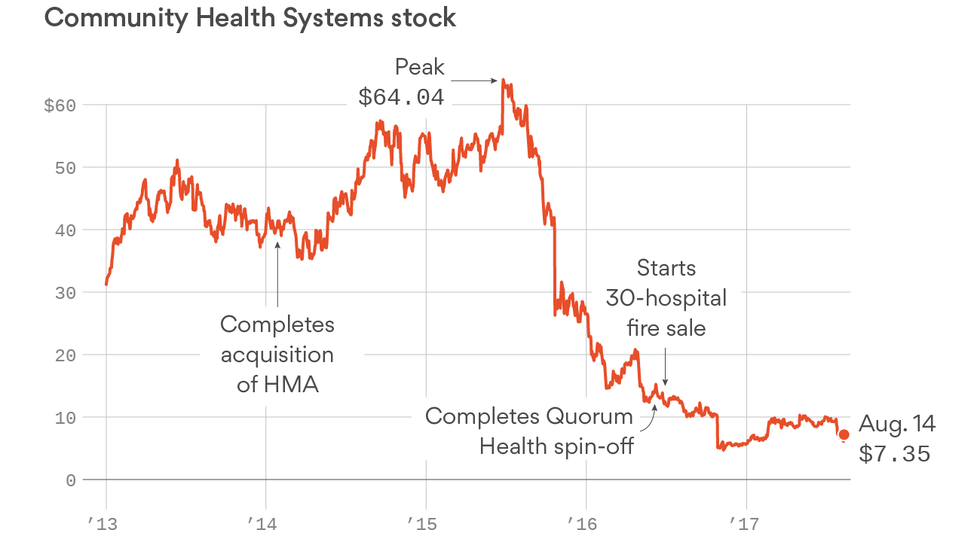
Just three years ago, Community Health Systems was the largest for-profit operator of hospitals with more than 200 facilities scattered in rural and suburban areas with growing populations. Now, the company is hemorrhaging money, sitting atop a mountain of debt and teetering on the edge of bankruptcy — all major reasons why CHS has lost almost 90% of its market value.

“I think the company has a nontrivial chance of defaulting,” said one CHS investor who asked to be unnamed because of the sensitivity of the issue. Tomi Galin, a CHS spokeswoman, did not make any company officials available for an interview, but said the company is confident it will have “a stronger core group of hospitals that are better positioned for long-term growth.”

Why it matters: CHS sits in a massive hole after a string of missteps, according to industry insiders. And it’s not likely to get better for CHS, or the local communities that rely on a CHS facility, as more people get treated in lower-cost outpatient centers instead of the hospital.

The collapse: It began in 2013 and continued into January 2014. That’s when CHS completed its acquisition of Health Management Associates, a for-profit hospital chain that had a slew of financial and legal problems. The deal was worth $7.6 billion, including debt, and made CHS the largest for-profit hospital company by number of facilities.

“That was the death knell,” a health care investment banker said. “HMA was a troubled company, and (CHS) thought bigger would be better.”

Here’s what has happened at CHS since then:

  • A market cap that crumbled from roughly $7.5 billion in 2015 to less than $800 million today.
  • Net losses of almost $1.9 billion from the start of 2016 through the second quarter of this year.
  • A ballooning debt load totaling $14.7 billion as of June 30.
  • Larry Robbins, a prominent hedge fund manager, dumped his entire portfolio of CHS stock. Paul Singer of Elliott Management did the same earlier this year.
  • A fire sale of 30 hospitals to get cash to pay down debt.
  • Some of those sold hospitals were HMA remnants, while others were considered CHS’ better, more profitable hospitals. “It’s almost like they’re burning the furniture,” the banker said. An investor said CHS was “selling off the fine china” to meet debt payments.
  • A completed spin-off of Quorum Health that, in essence, threw many struggling rural hospitals off CHS’ books. Quorum isn’t faring well either.
  • High amounts of uncompensated care. CHS owns many hospitals in the South, and most of those states did not expand Medicaid under the Affordable Care Act. That means CHS has absorbed more uncompensated care than hospitals in Medicaid expansion states.

Looking ahead: CHS plans on divesting even more hospitals, executives said during their latest earnings call. They likely will be profitable hospitals, as buyers won’t touch money-losing inpatient facilities with dwindling admissions.

But large debt payments are due in 2019 through 2022. Short-term cash from transactions appears to be a bandage, and a subsequently smaller profit base won’t solve the big debt picture, making bankruptcy a real possibility, an investor said.

Galin, the CHS spokeswoman, said the money from the hospital sales “are being used to reduce our debt” and that “cash flow generation remains strong.”

Leadership questions: Many CHS executives have retired or left in the past two years, including longtime CFO Larry Cash. Wayne Smith, the CEO of the hospital chain since 1997, remains in his position. Smith is one of the highest earners among hospital executives and reaped more than $1 million in bonuses alone the past two years even though CHS’ stock price tanked.

Numerous sources would not go on the record to talk about CHS. One hospital industry analyst said this when asked how Smith still had his job despite the company’s problems: “Your question is very valid.”

CHS announces hospital sales worth $1.5B in revenue amidst ‘disappointing’ 2nd quarter losses

http://www.healthcarefinancenews.com/news/chs-announces-more-hospital-sales-amidst-disappointing-2nd-quarter-losses?mkt_tok=eyJpIjoiTXpOa01qUXhaVGd5TnpkaiIsInQiOiJudFozOHVLS1VVNXZZRE42Y0RmTWdIZHpkOU0yNERUSmlXU0VCMlJDMEFyMmVTUUc4aVwvcXRVc0gzXC9ndUdJVjhHT1drZkkzdDhBVFhHZ3BHVjI1NmhIVHY1RmNXSENVdWtwb3RVVnVtaFNWbXNFdnBzb0JVenRcL1ZuR1p0MW0zRyJ9

System is already knee deep in the planned divestitures of 30 hospitals; additional sales are part of shift to “smaller stronger” portfolio.

In addition to the planned divestitures of 30 hospitals,  struggling Franklin, Tennessee-based Community Health Systems announced during an earnings call Wednesday that they are looking at the additional sale of a group of hospitals that carries a combined $1.5 billion in annual net operating revenue.

CHS has already completed 20 of the 30 other planned sales, with 11 being sold in May and another nine deals having closed as of July 1st. The remaining 10 hospital sales are expected to close by September 30th, CHS said.

CHS’ financial health continued its downward slope, with a net loss of $137 million or $1.22 per diluted share in the second quarter of 2017. Their net operating revenue was down 9.7 percent to $4.1 billion. The company’s operating results for the second quarter reflected a 10.8 percent decrease in total admissions. On a same-store basis, both admission and adjusted admission dropped 2.5 percent year over year from 2016, financial documents showed.

Wayne T. Smith, chairman and chief executive officer of Community Health Systems said their focus is now on shifting to a “smaller, stronger portfolio of assets.”

“Obviously, we are disappointed with our performance during the second quarter. Our financial results reflect weaker than expected volumes, which negatively affected our net revenue and Adjusted EBITDA performance. We are seeing better results in certain areas, and we continue to work on a number of initiatives to drive operational and financial improvements.”

CHS expects $137M net loss in Q2, says divestitures will continue

http://www.beckershospitalreview.com/finance/chs-expects-137m-net-loss-in-q2-says-divestitures-will-continue.html

Image result for all that glitters is not gold

Franklin, Tenn.-based Community Health Systems ended the second quarter of 2017 with a net loss of $137 million, marking the fifth consecutive quarter the company has posted a loss, according to a preliminary earnings statement released Wednesday.

CHS recorded revenues of $4.14 billion in the second quarter of this year, down 9.7 percent from revenues of $4.59 billion in the same period of 2016. The drop was attributable, in part, to lower patient volumes. Total admissions were down 10.8 percent in the second quarter of 2017 compared to the same quarter of last year. On a same-facility basis, admissions were down 2.5 percent year over year.

In addition to a drop in patient volume, CHS said the lower than anticipated results in the second quarter were attributable to higher expenses related to purchased services, medical specialist fees and information systems. The company’s financial results also included one-time expenses related to its hospital divestitures.

The company ended the period with an operating loss of $131 million. That’s compared to the $1.43 billion operating loss CHS reported in the second quarter of 2016, when it recorded a noncash impairment charge of $1.4 billion.

To improve its finances and reduce its nearly $15 billion debt load, CHS put a turnaround plan into place last year. As part of the plan, the company announced earlier this year that it intended to sell off 30 hospitals.

CHS completed the sale of nine hospitals on June 30 and July 1, bringing its total completed divestitures to 20 out of the 30 it intends to sell off. The company said it expects to complete the divestiture of the remaining 10 hospitals by Sept. 30.

In its preliminary earnings release, CHS said it plans to continue to unload more hospitals.

“In addition to the previously announced divestiture of 30 hospitals, the company continues to receive interest from acquirers for certain of its hospitals. The company is pursuing this interest for sale transactions involving hospitals with a combined total of at least $1.5 billion in annual net revenue and combined mid-single digit adjusted EBITDA margins,” CHS said.

CHS will release its formal numbers for the second quarter and the first half of 2017 on Aug. 1.

CHS to sell 25 more hospitals after $1.7B loss in 2016

http://www.healthcaredive.com/news/chs-to-sell-25-more-hospitals-after-17b-loss-in-2016/436555/

Dive Brief:

Dive Insight:

The downfall of CHS continued into the fourth quarter of 2016, although it could have been worse. On a per share basis, earnings came in at 46 cents per share while financial analysts had predicted earnings of 12 cents per share, according to an Associated Press report.

How CHS will proceed from here remains unclear. The hospital operator divested from dozens of hospitals last year and deals to sell additional hospitals are in the works. Reports surfaced last year that CHS was considering a sale, but it may be difficult to find a buyer willing to take on debt accumulated by CHS.

In 2016, CHS’ net losses were “primarily related to impairment charges totaling approximately $315 million to reduce the value of long-lived assets,” the earnings report states. “These impairment charges were partially offset by the gain of $91 million on the sale of a majority ownership interest in the company’s home care division, which closed on Dec. 31, 2016.”

CHS has made some progress paying off its debt, but there is still a long way to go. Long-term debt totaled $16.5 billion at the end of 2015 and dipped to $14.8 billion at the end of 2016. The hospital operator has entered into agreements and letters of intent, “consisting of ten separate contemplated transactions,” to divest the additional 25 hospitals, which represent about $3.0 billion of 2016 net revenue.